
ISO 14001 does not prescribe a named course, a number of training hours or a certificate for your staff. It requires you to show that the people whose work affects the environment are competent (clause 7.2) and aware (clause 7.3), and to keep evidence that proves it. Everything else, including which courses, for whom and how often, is your decision, and an auditor will test whether that decision was sensible. This guide sets out what each clause asks, who it covers, how to plan role-based training and what an auditor will want to see.
TL;DR
- ISO 14001 requires competence and awareness, not a specific qualification. Clause 7.2 covers competence, clause 7.3 covers awareness.
- Awareness training applies to everyone working under your control, including contractors and temporary workers, and it must be about the significant environmental aspects of their own work.
- Training alone is not proof. Keep a needs analysis, training records and a check that the training worked.
- ISO 14001:2026 was published in April 2026 and 2015 certificates must convert before the transition closes in 2029, so build training plans around the new edition.
- Tiered, role-specific programmes (all staff, supervisors, EMS specialists, top management) are easier to audit than one generic presentation.
Table of Contents
- What ISO 14001 actually requires
- What changed in the 2026 edition
- Who must be trained
- Awareness: make it specific to the job
- Competence: a five-step method
- A tiered model for training content
- What auditors look for
- Common gaps and how to close them
- How we approach it
- Training built around your roles
- FAQ
- Sources
What ISO 14001 actually requires
The training requirements sit in two short clauses of the support section of the standard.
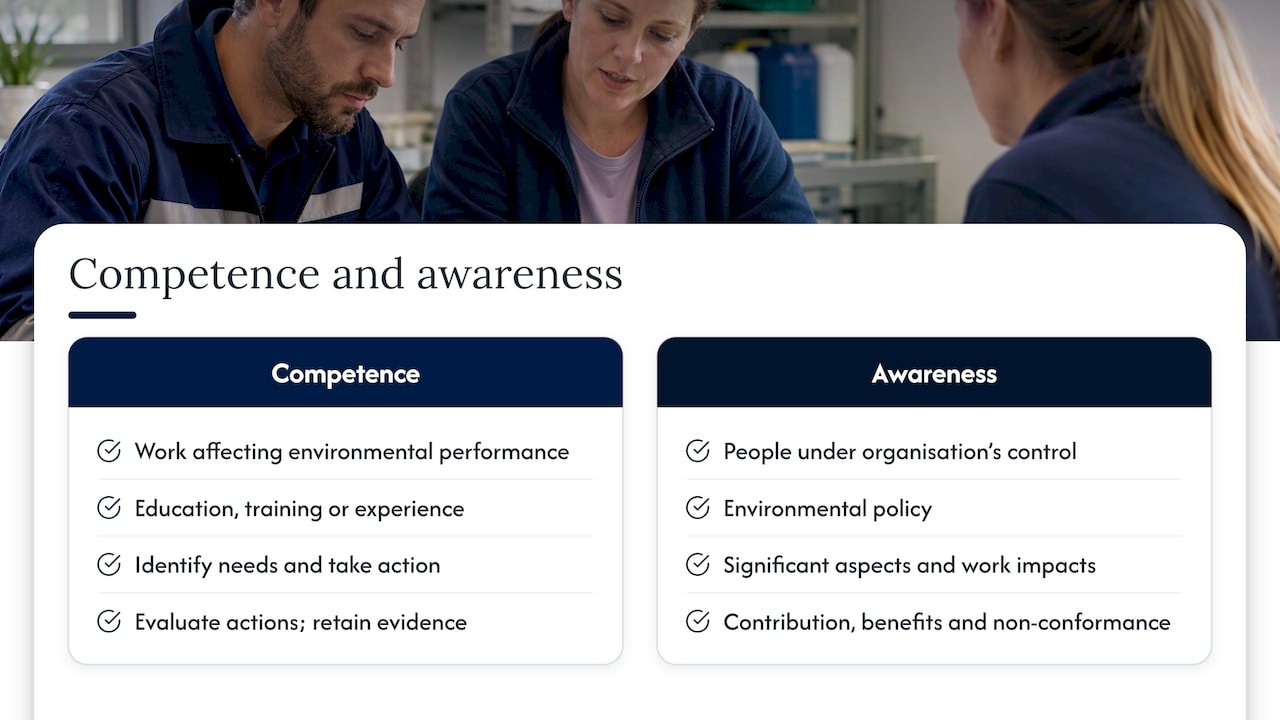
Clause 7.2, competence. According to a webinar run by North Carolina’s environmental agency, the organisation must determine the competence needed for people whose work affects its environmental performance, ensure they are competent on the basis of education, training or experience, identify training needs linked to its environmental aspects and management system, take action to gain the competence needed, evaluate whether those actions worked, and retain documented information as evidence.
Two points matter in practice. First, training is only one of three routes: education, training or experience. A senior site engineer with twenty years of spill-response experience can be competent without a course. Second, the clause asks you to evaluate effectiveness. Completing a course is an activity; being competent is the result.
Clause 7.3, awareness. The same source sets out that people working under the organisation’s control must be aware of four things: the environmental policy; the significant environmental aspects (the parts of your activities that interact with the environment most strongly) and related impacts of their own work; how they contribute to the effectiveness of the system, including the benefits of better environmental performance; and what follows from not conforming with the system, including failing to meet compliance obligations.
This is where most searches for “ISO 14001 awareness training” end up. Awareness is not a qualification. It is a baseline understanding that every relevant person must have, and you decide how to deliver it.
What changed in the 2026 edition
The fourth edition of the standard, ISO 14001:2026, was published on 15 April 2026 with a three-year transition. Certificates to the 2015 edition stay valid but must be converted before the transition closes in 2029. The same report says the biggest change is that climate risk assessment becomes a central part of the system, and that certification bodies are expected to complete accreditation to audit the new edition across 2027 into 2028. Confirm your certification body’s date before booking a transition audit.
For training, the change is small but real. A briefing note for auditors from the CQI and IRCA, based on the final draft, said the documented-information wording in clause 7.2 moves from “retain” to “available”, and clause 7.3 on awareness is unchanged. The same note says auditors themselves need professional development to audit against the new edition. In practice, keep your competence evidence current, easy to produce and organised by role. If climate risk becomes part of your significant aspects and risk assessment, the people who work with those risks need training that reflects it.
Who must be trained
The standard speaks of “persons doing work under the organisation’s control”. That is wider than your employee list. A sensible reading covers:
- employees whose work falls inside the scope of your environmental management system;
- contractors and subcontractors working on your sites or on your behalf;
- agency and temporary workers whose tasks involve significant environmental aspects;
- visitors who enter areas with significant aspects, who need a short briefing on key hazards and emergency procedures.
The competence requirement in 7.2 is narrower: it targets people whose work can affect environmental performance or your ability to meet compliance obligations. The North Carolina webinar notes that the competence record should name who must be competent by job title, and that this includes contractors.
For contractors, the practical point is timing. Obtain evidence of their competence, such as licences or their own training records, before they start work, and give them a site induction that covers your significant aspects.
Awareness: make it specific to the job
The most common weakness in awareness training is the generic slide deck. “We care about the environment” satisfies nobody. The clause asks for awareness of the significant aspects of the person’s own work. In concrete terms:
| Role | What they need to understand |
|---|---|
| Waste operative | Waste generation is a significant aspect, and wrong segregation or disposal adds to landfill and pollution |
| Chemical handler | A spill could reach drains and harm water ecology, and what to do first |
| Delivery driver | Idling raises greenhouse gas emissions |
| Maintenance engineer | Improper oil disposal contaminates land |
| Office staff | The policy, energy and paper use, and how to report an incident |
These examples are drawn from explanations of clause 7.3 that illustrate the principle, and you should replace them with the significant aspects from your own register. If your aspects register is out of date, your awareness content will be too.
Delivery methods that work
There is no mandated format. The usual choices are:
- Induction before a person starts work, covering the policy, site-specific aspects, spill response, waste segregation and how to report incidents.
- Short toolbox talks, typically 10 to 15 minutes on one topic, such as dust control or spill response, with a frequency based on risk.
- Visual reminders, such as posters, signage and drain markings at the point of work.
- Engagement, such as environmental champions and suggestion schemes.
- E-learning, where completion evidence is kept.
Repeat awareness activity when the policy, significant aspects or compliance obligations change. Industry guidance from the European Industrial Gases Association, written for that sector, suggests a default refresh frequency of one year, updated sooner after substantial changes. Use that as a starting point, not a rule.
Competence: a five-step method
The route from “we need competent people” to an audit-ready record is straightforward.
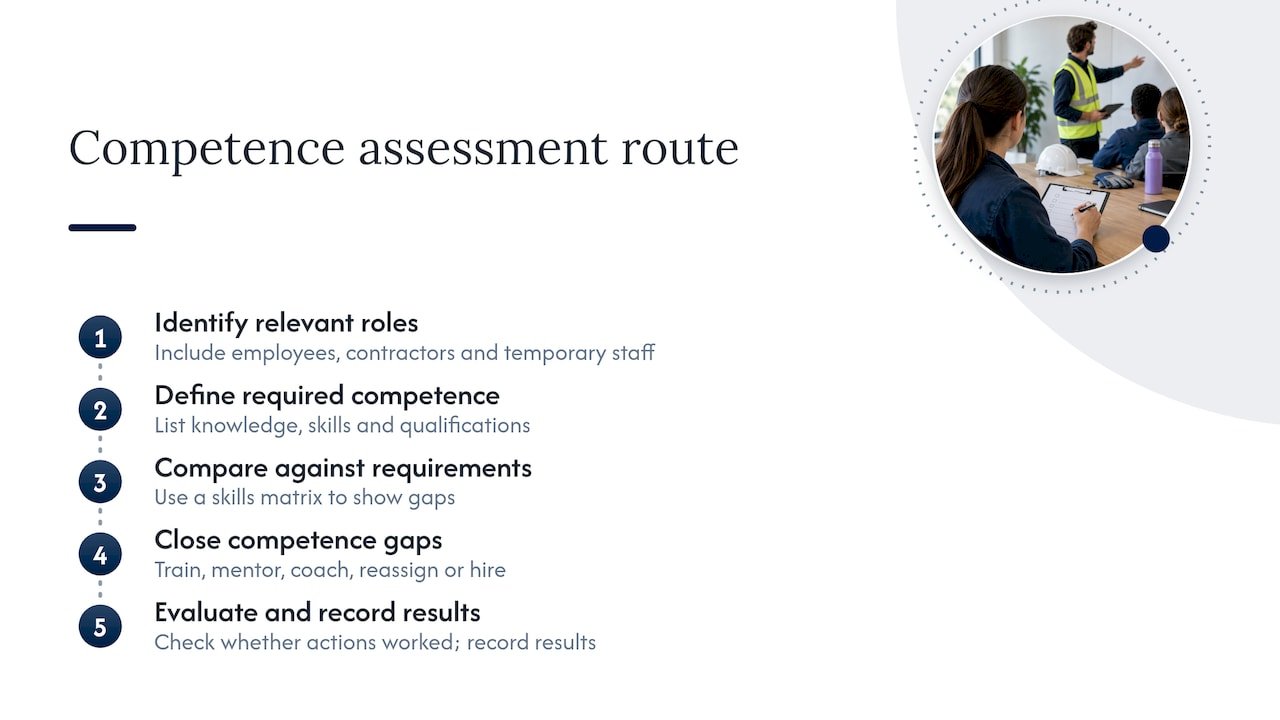
Step 1: List the roles that matter. Start with the roles and responsibilities you have assigned in the system, and the activities linked to your significant aspects. Include job titles, contractors and temporary staff.
Step 2: Define the competence each role needs. Write down the knowledge, skills and qualifications required. For a hazardous-waste handler, that might be waste classification, storage rules and transfer paperwork. For a person who operates abatement equipment, it is operation and reading monitoring data. The North Carolina webinar lists the kinds of indicators you can use: education, certification, experience, training, workshops, on-the-job training, supervisor approval, written or oral quizzes and observation of related work.
Step 3: Compare people against the requirement. A skills matrix, with roles down one side and competences across the top, shows gaps at a glance. Gaps also surface through appraisals, incidents, audit findings, process changes and new compliance obligations, so review the matrix when any of these happen.
Step 4: Close the gaps. Training is one option. Mentoring, on-the-job coaching, reassigning duties or hiring are others. The standard says “take actions”, not “book a course”.
Step 5: Evaluate whether it worked. This is the step most often skipped. Observe a spill drill, review the waste transfer notes someone completed after training, check the first audit report from a newly trained internal auditor, or give a short test. Record the result.
A practical guide on building a competency assessment system can help you structure the evaluation criteria for each role.
A tiered model for training content
One way to avoid both over-training and under-training is to tier content by responsibility:
| Tier | Who | Content |
|---|---|---|
| 1 | All people under your control | Policy, significant aspects of their work, their contribution, consequences of non-conformance |
| 2 | Supervisors and team leads | Tier 1 plus operational controls, monitoring, incident reporting, emergency response |
| 3 | EMS specialists and internal auditors | Tier 2 plus aspect evaluation, compliance evaluation, internal auditing, corrective action |
| 4 | Top management | Leadership, integration with strategy, management review, resources |
The tiers are a design choice, not a requirement of the standard, but they map neatly to what auditors ask. Top management in particular carries leadership duties under the standard, so a short, strategic briefing for directors is time well spent.
For specialist roles, you may want formal external qualifications. Internal auditors and lead auditors commonly train on recognised auditor courses, and organisations that certify their systems often require this of the people who audit them. Industry-specific programmes matter too: facilities teams, agricultural operations and carbon-focused roles each face different aspects, and training should reflect that. Our pages on environmental sustainability for facilities managers, environmental management systems for agriculture and carbon management for facilities professionals show the kind of role-specific content we build.
What auditors look for
Auditors test two things: that you planned training properly, and that it worked. Expect to produce:
- a training needs analysis showing who needs what;
- a competence matrix or job descriptions listing required competences;
- training records with dates, content and attendees;
- certificates, licences and CVs where qualifications are claimed;
- induction records, including contractors and agency workers;
- toolbox talk records with date, topic, attendees and who delivered it;
- evidence that effectiveness was evaluated and any follow-up taken.
Clause 7.3 does not itself demand documented information, but evidence of awareness activity is expected. The strongest evidence is not paper. Auditors typically interview a handful of people at different levels and ask the same core questions: what is the policy for, which aspects relate to your work, what would you do in a spill. If records show an induction took place but staff cannot answer, awareness has not been achieved.
Audit procedures follow the same logic. The US EPA’s Region 7 internal audit procedure, written against the 2004 edition of the standard, checks training by reviewing needs analyses, training records and awareness materials, then interviewing staff to verify that the training succeeded. The method has not changed in substance.
A practical test before your audit: pick five people at random, including a contractor, and ask them the three questions above. If they struggle, fix the content, not the paperwork.
Common gaps and how to close them
- Generic content. Replace one-size-fits-all slides with role-linked aspects.
- Contractors left out. Add contractor induction and competence evidence to your procurement and site-access process.
- No effectiveness check. Add a test, observation or sign-off to every training action.
- Stale records. Set an annual review of training needs and keep a training register up to date.
- Training that ignores change. When you add a process, chemical or compliance obligation, trigger a training review.
For teams that also run health and safety management, our guide to ISO 45001 training requirements shows how the same needs-analysis logic carries across, and what HR must require from auditable environmental training sets out what to specify when buying it.
How we approach it
Most organisations we talk to do not lack training. They lack a link between the training and the job. A course on environmental management is only useful to a depot supervisor if it is about the aspects of that depot.
That is why we build customisable programmes around the organisation’s own risks and roles, and deliver them on site, online or blended, whichever fits the team. Our courses are globally accredited and led by expert trainers who work through real-world problems rather than slides.
If you are preparing for ISO 14001:2026, start with your aspects register and your role list. Training designed from those two documents is far easier to defend at audit than anything bought off the shelf.
Sam
Training built around your roles
If you manage compliance and safety training for a team, we can build programmes around your significant aspects and job roles, in the format that suits your people: on-site, online or blended. Our courses are globally accredited and led by industry experts, and the content can be customised to your organisation.
Browse the full course catalogue or start from our homepage to discuss a programme for your team.
FAQ
Is a certificate required to meet ISO 14001 training requirements?
No. Clause 7.2 accepts education, training or experience as the basis for competence. A certificate is one good form of evidence, but you must still show that the person is competent for the role and keep records of how you decided that.
Who needs ISO 14001 awareness training?
Everyone doing work under your organisation’s control that falls within the scope of your system. That includes employees, contractors, agency and temporary workers, and briefly, visitors to areas with significant environmental aspects. The content should match the aspects of their own work.
How often should ISO 14001 training be repeated?
The standard sets no interval. Repeat awareness activity when the policy, significant aspects or compliance obligations change, and review training needs at least annually. One industry guideline suggests a default of one year, which is a sensible starting point.
Does ISO 14001:2026 change the training requirements?
Only slightly. Awareness in clause 7.3 is unchanged, and the competence evidence wording in 7.2 moves from “retain” to “available” according to the CQI and IRCA briefing. The larger shift is the new emphasis on climate risk, which may add topics to your training.
Sources
- Environmental Management Systems and ISO 14001, NC DEQ webinar
- ISO 14001:2026 Briefing Note for Auditors, CQI and IRCA
- This Week in Brief, week ending 3 August 2026
- Guidelines on Environmental Management Systems, EIGA
- EPA Region 7 Environmental Management System Procedure for conformance audits
- Cómo desarrollar un sistema de evaluación por competencias