
HIPAA requires every member of a covered entity’s or business associate’s workforce to be trained on the organisation’s own policies for protected health information (PHI), in a way that fits their job, and the organisation must be able to prove it did so. There is no mandatory syllabus, no fixed number of hours and no official certificate. What the law asks for is training that is relevant, timely and documented. That is a design task for HR and compliance leads, and it is where most programmes succeed or fail.
This guide is for HR managers, compliance leads and team heads who need to understand what HIPAA (the US Health Insurance Portability and Accountability Act) expects, including UK and international organisations that handle US patient data as a supplier or partner.
TL;DR
- Everyone in the workforce needs training, including volunteers, trainees and managers, whether or not they are paid and whether or not they routinely see PHI.
- The Privacy Rule requires training on your PHI policies, as necessary and appropriate for each person’s functions. The Security Rule requires a security awareness and training programme for all staff.
- Train existing staff on rollout, new staff within a reasonable period of joining, and affected staff within a reasonable period after a material policy change. Keep the records for six years.
- No federal body certifies HIPAA courses. Judge a course by whether it fits your policies and your roles, not by a badge.
- Business associates are directly liable under HITECH, so suppliers need the same discipline as providers.
Table of Contents
- Who must be trained under HIPAA
- What the rules actually require
- Scaling the programme to your size
- How often, and what to record
- Is there a HIPAA certificate you need?
- Role-based training in practice
- HIPAA and HITECH: what the second law adds
- HIPAA or GDPR: which applies, and how training differs
- What may change: the proposed Security Rule update
- Building your programme: a six-step routine
- Training support from Oxford Centre
- Our view on HIPAA training
- FAQ
- Sources
Who must be trained under HIPAA
HIPAA applies to two groups. Covered entities are health plans, healthcare clearinghouses and healthcare providers that bill electronically. Business associates are outside persons or organisations that handle PHI on a covered entity’s behalf, for example a health information organisation, an e-prescribing gateway or a personal health record vendor, as the US government’s guide to the HIPAA Rule sets out.
The training duty attaches to the workforce of each. The same guide defines workforce members as employees, volunteers, trainees and other people whose conduct, in work for the entity, is under its direct control, whether or not they are paid. That has practical consequences:
- Clinical staff handle PHI daily and need the fullest training.
- Administrative, billing and reception staff see PHI in different forms and need training that matches those forms.
- IT and security teams need training on the technical safeguards in the Security Rule.
- Managers and executives are included in the security awareness requirement, so leadership cannot be exempted.
- Volunteers, students on placement and temporary staff count as workforce when they work under your direct control.
- Contractors who are not under your direct control are normally handled through business associate arrangements, which is a contractual and compliance question for your legal adviser.
A common misreading is that people who never touch records need no training. The rule is framed around the functions of each person, so staff with little PHI contact need less training, but not none. A porter, a receptionist or a facilities worker can still overhear, see or pick up PHI, and your policies cover that.
What the rules actually require
Two parts of the regulations carry the training duty.
The Privacy Rule: policy training for each role
Under 45 CFR 164.530, a covered entity must train all workforce members on its policies and procedures for PHI, as necessary and appropriate for each member to carry out their functions. In other words, the content is your own policies. A generic course that never mentions how your organisation requests records, releases information or handles complaints does not, on its own, meet that standard.
The Security Rule: awareness for everyone
Under 45 CFR 164.308, a covered entity or business associate must implement a security awareness and training programme for all workforce members, management included. The regulation lists four implementation specifications: security reminders, protection from malicious software, log-in monitoring and password management. The Security Standards Matrix marks all four as addressable.
“Addressable” does not mean optional. It means you assess whether the measure is reasonable for your organisation and either implement it or document why an equivalent alternative is used. In practice, most organisations cover all four because staff behaviour is where most incidents start.
| Topic | Source rule | What your training should cover |
|---|---|---|
| PHI policies and procedures | Privacy Rule, 164.530(b) | How your organisation uses, discloses and protects PHI, by role |
| Security reminders | Security Rule, 164.308(a)(5) | Regular prompts that keep safe habits current |
| Malicious software | Security Rule, 164.308(a)(5) | Phishing, attachments, unsafe downloads, reporting |
| Log-in monitoring | Security Rule, 164.308(a)(5) | Why access is logged and what odd activity looks like |
| Password management | Security Rule, 164.308(a)(5) | Creating, protecting and not sharing credentials |
Training should also cover how to recognise and report a suspected breach, how sanctions work for violations, and what to do when a patient asks to see or correct their information. Those topics follow directly from your policies.
Scaling the programme to your size
HHS states that the Rules are flexible and scalable, and that no single standardised programme could appropriately train the employees of every entity, in its training materials guidance. Its Privacy Rule FAQ gives the contrast: a small physician practice might satisfy the requirement by giving each new workforce member a copy of its privacy policies and documenting that they reviewed them, while a large health plan might use live instruction, video or interactive software.
For most organisations with a team larger than a handful of people, a blended approach works best:
- A core module for everyone on privacy, security and incident reporting.
- Role modules for clinical, administrative, finance, IT and management staff.
- Short refreshers and reminders through the year, which also serve the security reminders specification.
- A short assessment or sign-off so you can show that the material was understood and not just opened.
The last point is good practice, not a legal requirement. The final regulation removed the old idea of post-training signatures and triennial re-certification, as this legal summary of the training rule explains, but an attendance and completion record is still your evidence.
How often, and what to record
The regulation sets timing by event, not by a fixed calendar. Under 164.530, training is due:
- by the compliance date for staff already in post;
- within a reasonable period after a person joins the workforce;
- within a reasonable period after a material change to your policies or procedures, for the staff whose functions are affected.
The covered entity must document that training was provided and keep the documentation for six years from when it was created or last in effect, whichever is later, according to the same regulation.
The law does not say “annually”, but many organisations choose an annual cycle because it is simple to run and audit. Some US state agencies require it for their own staff. North Carolina’s health department, for example, sets annual privacy and security training in its 2026 policy manual, and keeps records for at least six years after the person’s last active participation. Treat an annual cycle as a sensible default, and write it into your own policy so you can follow it.
A practical record for each person should show:
- name, role and start date;
- which modules they took and when;
- the version of the policies the training was based on;
- the result of any assessment;
- the trainer or provider.
Store these where HR and compliance can both retrieve them, and set the six-year retention in your records schedule so nothing is deleted early.
Is there a HIPAA certificate you need?
No. The requirement is to train and to document that you did. HHS has said that no single standard programme could suit every entity, and the regulation refers to training on your own policies, not to any approved syllabus. A certificate of completion is useful as a record, and a course that is well designed and delivered by experienced trainers helps a lot, but a certificate does not by itself show compliance. What an auditor or regulator looks for is that your training matches your policies and that you have the records.
That has a direct consequence for buying: choose training for fit, and make sure the provider can adapt content to your policies and your roles. Ask whether it can be delivered in the form your teams can attend, on-site, online or blended, and whether the material can be updated when your policies change.
Role-based training in practice
Here is how the Privacy Rule’s “necessary and appropriate for each function” test looks in a real organisation.
| Role | Focus of training |
|---|---|
| Front desk and reception | Verifying identity, what can be said on the phone, screen privacy, visitor handling |
| Clinicians | Minimum necessary use, sharing with other providers, patient rights, mobile and messaging use |
| Billing and finance | Disclosures to payers, secure transfer of records, vendor handling |
| IT and security | Access controls, logging, malware defence, incident response |
| Managers | Sanctions, incident escalation, ensuring staff complete training |
| Technology and data teams | Handling PHI in new tools, including AI systems, and keeping PHI inside controlled environments |
For teams that are introducing AI tools around patient data, the HIPAA AI compliance steps for privacy officers walk through procurement to deployment, and the material gives you a starting point for the technology-team row above.
HHS also notes in its health IT guidance that staff whose functions involve electronic exchange of PHI with a health information organisation should be trained on new or changed privacy policies, and that sanction policies may need to address electronic noncompliance, such as suspending or revoking access. Build that into your technology and exchange roles.
HIPAA and HITECH: what the second law adds
The HITECH Act of 2009 modified HIPAA’s privacy and security standards. According to a Congressional Research Service report, it created a notification requirement for breaches of unsecured PHI, increased civil monetary penalties, expanded the enforcement role of the HHS Office for Civil Rights and made business associates directly liable for violations. It also set four tiers of penalties and limited the use of PHI for marketing and fundraising.
For training, three consequences matter:
- Breach notification. A 2026 legal guide to privacy and data security states that affected individuals must be told of a breach of unsecured PHI without unreasonable delay and no later than 60 days after discovery. Breaches affecting more than 500 people also require notice to HHS and the media within 60 days, and smaller ones are reported to HHS annually. Staff must know to escalate suspected breaches at once, because the clock starts on discovery.
- Business associates. The same guide explains that before HITECH, business associates were liable only through their contracts, whereas now they must comply with the whole Security Rule and many parts of the Privacy Rule and face direct enforcement. If your organisation is a supplier to US healthcare, your staff need the same training as the provider’s.
- Enforcement. State attorneys general also gained authority to enforce HIPAA, so the exposure is broader than a single regulator.
In short, HIPAA sets the baseline and HITECH raises the stakes. You do not run two training programmes: you teach one set of policies that reflects both.
HIPAA or GDPR: which applies, and how training differs
HIPAA is a US law that applies to specific healthcare entities and their business associates. The GDPR (and the UK’s version of it) applies to personal data of people in Europe or the UK, in any sector, and treats health data as a special, more protected category. Many international organisations are subject to both, for example a UK software supplier to a US hospital group that also processes UK patient records.
| HIPAA | GDPR / UK GDPR | |
|---|---|---|
| Who is covered | Covered entities and their business associates | Any organisation processing personal data of people in the EU or UK |
| Data protected | PHI held by those entities | All personal data, with health data as a special category |
| Training | Explicit duty to train all workforce members and keep records for six years | Awareness and competence expected as part of your safeguards; no prescribed course |
| Origin | US federal law | EU regulation, with a UK equivalent |
On training, GDPR is less prescriptive in wording. Recital 39 of the regulation says people should be made aware of the risks, rules, safeguards and rights relating to the processing of their personal data, and that supports an expectation of staff awareness. In practice, a combined programme works well: a shared core on confidentiality, access, incident reporting and rights, with a HIPAA module for US PHI and a data protection module for UK and EU personal data. Our Data Protection and GDPR Compliance course covers the data protection half of that design for UK teams.
What may change: the proposed Security Rule update
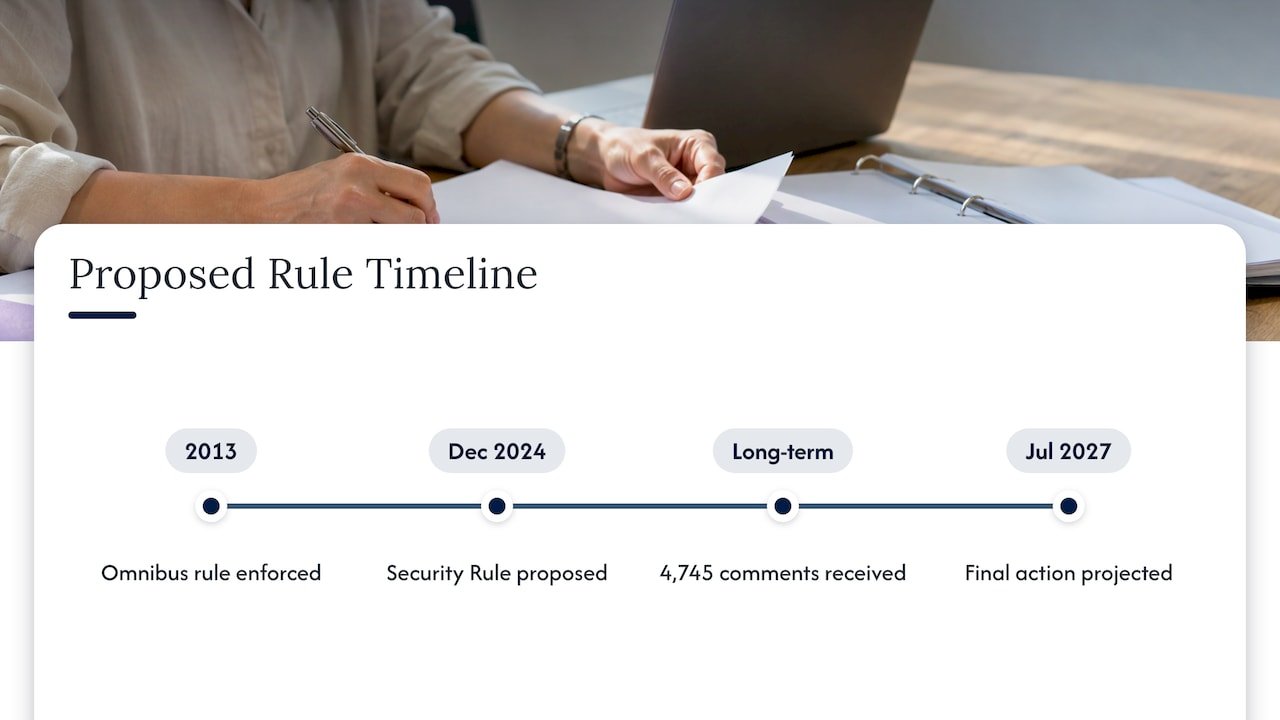
In December 2024, HHS proposed the most sweeping overhaul of the Security Rule since 2013. According to RubinBrown’s analysis, it would remove the required versus addressable distinction, make security awareness training a required specification and require new workforce members to be trained within 30 days.
The proposal has not been finalised. Breach Craft’s compliance guide reports that the proposal drew 4,745 comments, that the federal regulatory agenda has moved it to long-term actions with final action projected for July 2027, and that the 2013 Omnibus version of the rule remains what the Office for Civil Rights enforces until a final rule is published. The timetable can shift, so check the HHS website for the current status before you plan around it.
The sensible response is to build now for where the rule is heading. Treat all four security awareness topics as standard, set a 30-day onboarding target and keep clean records. If the proposal is finalised, you will already comply. If not, you will simply have a stronger programme.
Building your programme: a six-step routine
- Map your workforce. List every role, including volunteers, trainees and temporary staff, and note how each handles PHI.
- Write or refresh your policies first. Training is on your policies, so these must be current and readable.
- Define modules by role. One core module plus role modules, as in the table above.
- Set the timing rules. Onboarding within a short, fixed window (30 days is a good internal target), refreshers annually, and an extra session whenever a material policy changes.
- Record everything. Keep completion records for six years from creation or last effect.
- Review after incidents and audits. Feed every near miss back into the content.
The hard part is steps 2 and 3, because off-the-shelf content rarely matches a particular organisation’s policies, and the training must. That is why customisable delivery matters more than a course title.
Training support from Oxford Centre
Oxford Centre provides professional training with global accreditation, customised for corporate teams and delivered on-site, online or blended. For the security and governance side of a HIPAA programme, our Security Awareness and Threat Prevention course addresses the behaviours the Security Rule’s awareness requirement is about, and our Security Governance and Compliance course suits the leads who own the programme. For onboarding, the Employee Onboarding and New Hire Orientation course fits the new-joiner window, and the HR Policy Development and Handbook Design course supports the policy work in step 2.

To discuss a programme shaped around your teams and formats, start from our professional training courses in London or the Oxford Centre home page.
Our view on HIPAA training
We see HIPAA training as a policy problem before it is a course problem. The rule asks you to teach your own policies, role by role, and to prove you did it. A well-chosen external programme does not replace that work. It gives your people the skills to carry it out.
That is why we build customisable programmes: expert trainers who work from real workplace challenges, delivered on-site, online or blended so each team can attend in the way that suits it. Our accredited qualifications give individual professionals recognised proof of their own learning, while the organisation keeps its own records of who was trained and when.
For HR managers, the best investment is a clear structure: a shared core, role modules, a fixed onboarding window and an annual refresher. For compliance leads, it is security awareness that changes daily habits, and governance skills that keep the programme alive when the rules move.
Sam
FAQ
Is HIPAA training mandatory?
Yes, for covered entities and business associates. The Privacy Rule requires training for all workforce members on the organisation’s PHI policies, and the Security Rule requires a security awareness and training programme for all staff, management included. The law leaves the format and length to you.
Who needs HIPAA training?
Everyone in the workforce of a covered entity or business associate: employees, volunteers, trainees and others under the organisation’s direct control, whether or not they are paid. The depth varies by role, but nobody is exempt because they rarely see records.
How often should staff be retrained?
HIPAA ties training to events: when staff join, and when a material policy change affects their work. Many organisations add an annual refresher for consistency, which is a good practice to write into your own policy. Keep the records for six years.
Do I need a certified HIPAA course?
No. HHS says no single standardised programme could suit every organisation, and the regulation does not require a certificate. What counts is training that fits your policies and roles, plus documentation that it took place.
Does a UK organisation need HIPAA training?
Only if it acts as a covered entity or business associate, for example as a supplier handling US patient data. In that case its staff need HIPAA training as well as UK GDPR awareness. If you handle only UK personal data, UK GDPR is the framework that applies.
Sources
- Chapter 2: Your Practice and the HIPAA Rule (healthit.gov)
- 45 CFR 164.530, Administrative requirements (eCFR)
- 45 CFR 164.308, Administrative safeguards (eCFR)
- Appendix A to Subpart C of Part 164 (eCFR)
- HHS Training Materials
- HHS Privacy Rule FAQ
- HHS: Health Information Technology and HIPAA
- Bricker & Eckler: HIPAA Regulations, Training
- NC DHHS Privacy Manual 2026
- CRS report R43991: HIPAA Privacy, Security, Enforcement, and Breach Notification
- A Legal Guide to Privacy and Data Security 2026
- RubinBrown: HIPAA Security Rule Changes
- Breach Craft: HIPAA Compliance Guide