
For most workplace training, the strongest answer is neither format on its own. Live, instructor-led sessions do the work that needs practice and feedback, online modules carry the knowledge that scales, and a blended programme built around your team’s actual gaps usually beats either. Oxford Center delivers its accredited courses on-site, online or blended, and customises the content to the organisation, so the format follows the learning goal rather than the other way round.
This guide is for HR managers, team leaders, project managers and individual professionals who have to pick a format and justify it. It covers what each format is, what the evidence says, what each costs to run, and how to decide.
TL;DR
- Instructor-led training (ILT) means a live trainer, in a room or online, with real-time questions and practice. eLearning is self-paced content the learner works through alone.
- Evidence on knowledge gains is mixed and often close. Where differences appear, they favour live interaction for leadership and skills, and blended formats for knowledge plus practice.
- eLearning is cheaper to deliver once built, and the saving grows with the number of learners.
- Practical, safety and interpersonal skills point to live sessions. Simple knowledge and refresher needs suit online modules.
- Start with a needs assessment, then choose ILT, eLearning or a blend for each gap.
Table of Contents
- What the two formats actually are
- Where instructor-led training earns its place
- Where eLearning earns its place
- Side by side
- What the research says about blending
- How to choose for your team
- Common mistakes
- What this means for accredited certifications
- Our view
- Getting the format right with Oxford Center
- FAQ
- Sources
What the two formats actually are
Instructor-led training is any training facilitated by a trainer, whether the room is physical or virtual, according to a widely cited ILT overview. The defining feature is the person: someone who answers questions as they arise, adjusts the pace and watches how the group is coping.
That means “instructor-led” and “online” are not opposites. A live virtual classroom is instructor-led. The real contrast is between synchronous learning (everyone together, at a set time, with a trainer) and self-paced eLearning (recorded or interactive modules the learner opens when they like). Many buyers treat the choice as classroom against screen, which hides the more useful question: do you need a person responding to your learners in real time?
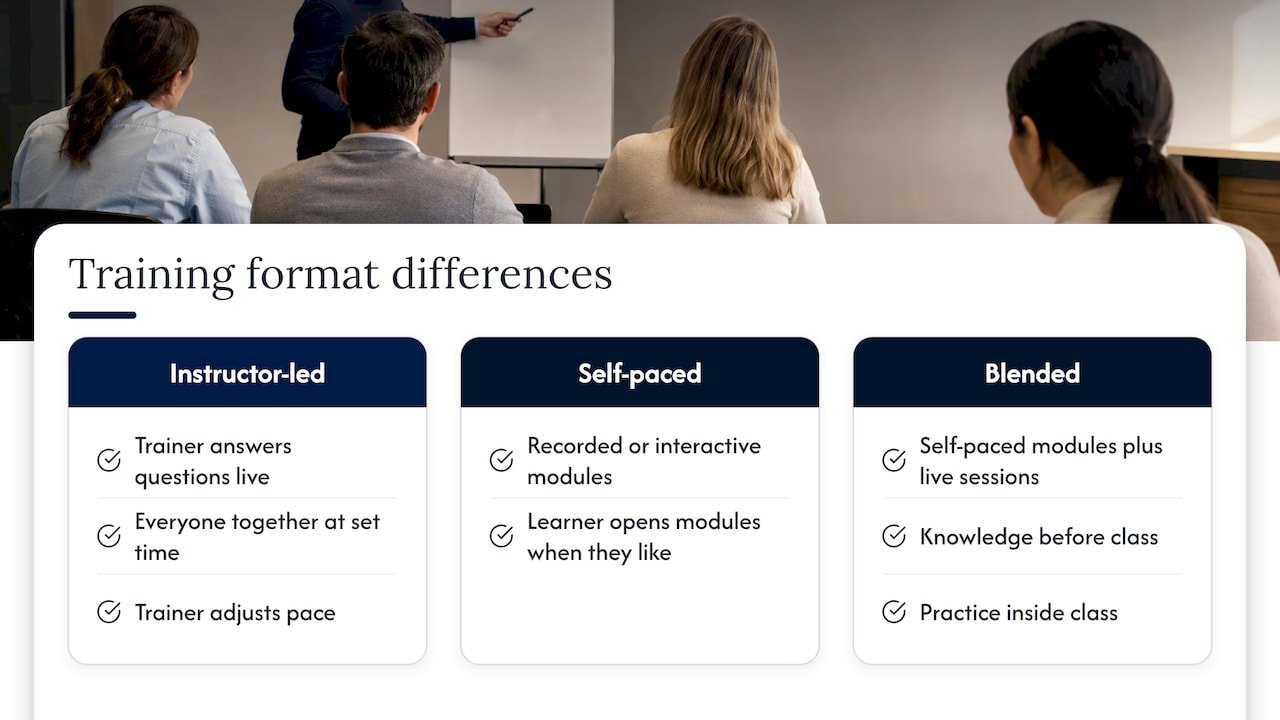
A third option sits between them. Blended learning combines self-paced modules with live sessions, usually putting the knowledge before the class and the practice inside it.
Where instructor-led training earns its place
Interaction and feedback
Live sessions allow immediate clarification, discussion of the organisation’s own cases and correction of mistakes while they are fresh. That matters most when the learner has to do something, not just know something: lead a difficult conversation, run a risk workshop, handle equipment.
The strongest workplace evidence comes from leadership development. A summary of a 2017 meta-analysis found leadership training produced a 25% increase in learning, 28% in on-the-job leadership behaviours and 20% in overall job performance. It recommends instructor-led delivery over self-administered formats, because self-administered training showed much smaller effects, and it favours practice-based methods where only one delivery method can be used.
Engagement and confidence
A 2025 study of 899 learners on Ontario’s joint health and safety committee certification found that face-to-face learners scored 2.5% higher on post-training knowledge than distance learners, a small effect. They also reported more favourable engagement, perceived usefulness and self-efficacy, meaning confidence that they could apply what they learned. An earlier meta-analysis of 71 effect sizes similarly found that trainees reacted more favourably to stand-alone classroom instruction.
For an HR manager, that matters beyond test scores. Confidence and engagement are what turn a certificate into changed behaviour on Monday morning.
Hands-on and safety skills
Where the skill is physical or high-stakes, the evidence base for fully remote delivery is thinner. A set of 2021 rapid reviews from the Institute for Work & Health found that synchronous online and face-to-face learning are similarly effective for learners at undergraduate level or above, but that evidence is lacking for hands-on practical training and for occupational health and safety training specifically.
In practice, that is why courses such as confined space entry training are taught with a trainer present and equipment in hand. If your team needs to prove competence, a live element with assessed practice is the safe design. Our own guide to choosing safety and security courses that prove hands-on skills sets out what to look for.
Where eLearning earns its place
Reach, consistency and cost
eLearning gives every learner the same content, at any hour, in any location. The Food and Agriculture Organization’s e-learning guide lists the conditions that favour it: large volumes of content for many learners, dispersed learners, a need for homogeneous background knowledge, long-term training needs and a need to track learner data. The same guide notes that building e-learning costs more than preparing classroom materials, but delivery costs are considerably lower than classroom facilities, instructor time, travel and lost working time.
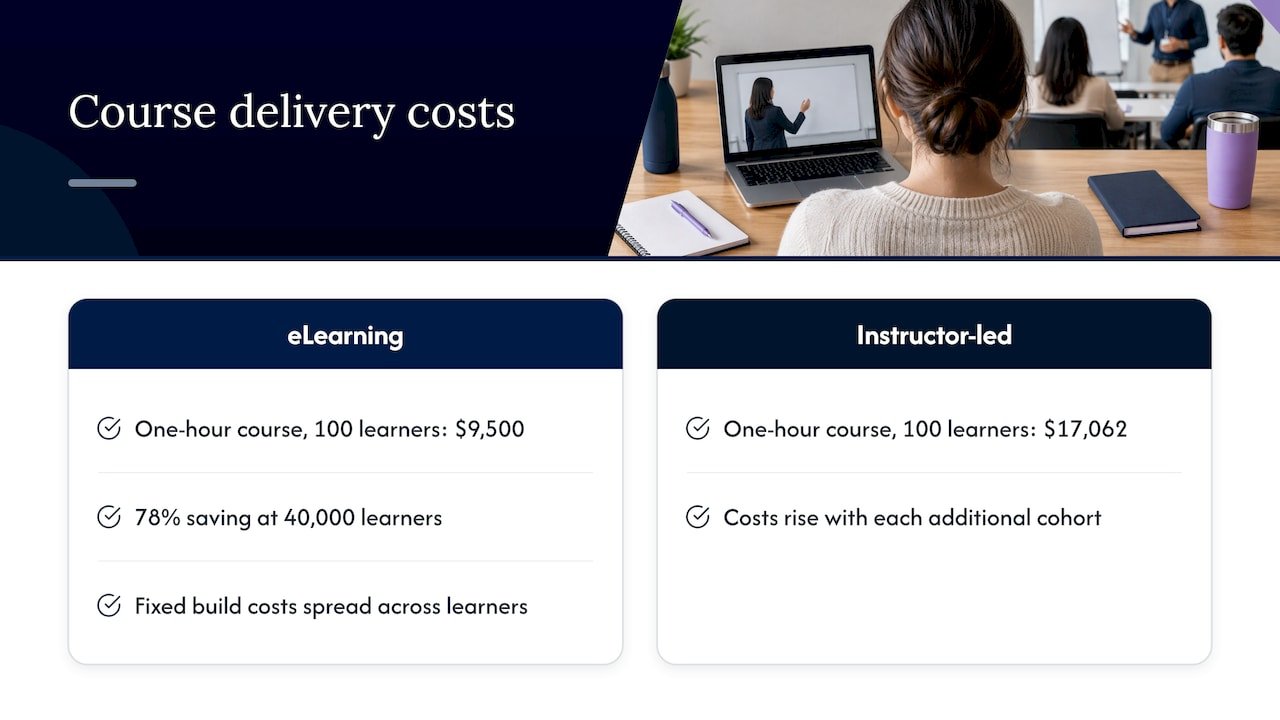
The arithmetic favours online delivery as numbers grow. A Caterpillar University cost model put a one-hour course for 100 learners at $9,500 online against $17,062 instructor-led. At 40,000 learners, the saving reached 78%. That is a US corporate model from a very large employer, so treat it as an illustration of the shape of the curve rather than a quote for your team. The point is that fixed build costs are spread over more learners, while ILT costs rise with each additional cohort.
Knowledge that does not need a room
For facts, procedures and policy, self-paced modules can match live teaching. A 2024 systematic review of 34 studies of e-learning in psychotherapy training found learning outcomes broadly equivalent to conventional training, with added access, scalability and cost-effectiveness. A randomised trial with 130 midwifery students in Nigeria found a digital course as effective as small-group teaching for knowledge and thinking skills (post-course scores of 75.26% against 75.02%).
So for compliance refreshers, product knowledge, software orientation and the theory half of a certification, online delivery is a sound choice. It works best when it is well designed: a 2013 integrative review of health worker education found computer-based learning can be as effective as live instruction and more cost-efficient when effective techniques are used, whereas passive lecture-style delivery has little impact whatever the medium. Learning design matters more than the channel. For readers who want to test knowledge after any format, practice tests and exam preparation are a good way to check what has stuck.
Side by side
| Criterion | Instructor-led | eLearning (self-paced) | Blended |
|---|---|---|---|
| Interaction | Real time, with questions and discussion | Limited to built-in activities | Live where it counts |
| Flexibility | Fixed schedule | Learner chooses time and place | Self-paced prep, scheduled practice |
| Cost pattern | Rises with each cohort | High build cost, low delivery cost | Lower than full ILT in the studies below |
| Scale and consistency | Depends on trainer and group | Identical for everyone | Consistent theory, tailored practice |
| Best for | Practical, interpersonal, leadership, safety skills | Knowledge, procedures, refreshers | Most accredited programmes |
| Evidence of outcomes | Strong for leadership and skills | Equivalent for much knowledge content | Often equal or better than either alone |
What the research says about blending
The most consistent finding across studies is that combining formats tends to do at least as well as the traditional classroom and often better.
- A US Department of Labor literature review from 2014 found blended interventions likely to be as effective as, or more effective than, traditional ones, with synchronous and blended formats more reliably comparable to classroom teaching.
- In the 2006 meta-analysis, blended web-based instruction was 13% more effective for declarative knowledge and 20% more effective for procedural knowledge than classroom teaching alone.
- A 2020 Taiwanese trial of 832 adults found a blended CPR course (an 18-minute online module plus a 30-minute hands-on session) matched a 90-minute traditional class on compression depth, knowledge, skill and retention at 6 and 12 months.
- A 2020 Swedish trial with 2,623 workplace laypersons found that adding preparatory online education and a feedback device to instructor-led life support training raised practical skill scores six months later.
- A 2024 German randomised trial of 350 students found an 89% pass rate for a blended course against 74.6% for synchronous teaching.
- On cost, a 2025 evaluation in Ethiopia found blended training cost US$262.81 per trainee against US$360.10 for full face-to-face, a 27% saving, alongside improved quality scores.
The pattern is useful for a buyer: put the knowledge online, so live time is spent on practice, feedback and application.
How to choose for your team
1. Start from the gap, not the format
A needs assessment comes first. Simple knowledge gaps and compliance needs can often be met with eLearning, job aids and manager follow-up, while interpersonal skills, practical application and deeper competency challenges point toward instructor-led delivery, as the ILT coordinator guide puts it. Some requests also reveal problems that training alone will not fix, such as unclear processes or missing tools. Find that out before spending budget.
2. Match the format to the skill
| If the goal is… | Lean towards |
|---|---|
| Policy awareness, annual compliance refreshers | eLearning |
| Project management theory ahead of an exam | eLearning or blended |
| Leading people, coaching, managing change | Instructor-led |
| Safety procedures with equipment | Instructor-led with assessed practice |
| Technical upskilling across several sites | Blended |
| Rolling out one message to hundreds of staff | eLearning with live follow-up |
3. Weigh cohort size and cadence
The same ILT guide notes that small cohorts with frequent training may favour eLearning, while larger cohorts with infrequent training may favour instructor-led delivery. If you train two people a month, a live class is hard to fill. If forty managers need the same programme once a year, one customised live cohort is efficient.
4. Check learner readiness and distribution
Self-paced learning suits staff with basic computer and internet skills and long-term development needs. Teams spread across time zones can use live online sessions, which keep the instructor in the loop without the travel.
5. Plan the tracking
If you need completion data across a large workforce, a learning platform helps. Our comparison of an LMS and an LXP explains which system fits which organisation. If you are building around skills frameworks, competency-based training for HR shows how to map courses to defined competencies.
Common mistakes
- Treating online as a single thing. A live virtual class and a recorded module are very different products. Decide which you mean.
- Converting a classroom course screen for screen. Lecture slides read aloud are passive in any medium. Redesign for practice and questions.
- Judging by satisfaction scores alone. Learners often rate classroom sessions more highly, yet knowledge differences between formats can be small. Measure behaviour and results, not just feedback forms.
- Using one format for everything. The best programmes assign each format the job it does best.
What this means for accredited certifications
For project managers and individual professionals chasing an accredited qualification, the exam usually tests knowledge, while the job tests judgement. A blend covers both: self-paced study for the body of knowledge, and live sessions for scenarios, discussion and feedback from an experienced trainer. If you are comparing routes, our guide to project management training in London sets out how the main certifications differ. For leaders, the live element is worth protecting, given the leadership evidence above; our outcome-based leadership training course is built around that principle.
For distributed teams, the format question is also a management one. Our managing remote and hybrid teams course addresses the skills those teams need.
Our view
We do not think the useful question is which format wins. It is which format does which job.
Our courses are globally accredited and led by industry expert trainers, and we deliver them on-site, online or blended. That flexibility exists because organisations rarely have a single kind of learning need. A compliance update, a leadership programme and a technical certification each ask for something different.
We customise course content to the organisation’s own challenges, so a team is not working through generic examples. The evidence points the same way: live interaction and practice for the skills that change behaviour, online delivery for knowledge that scales, and a blend where you need both.
If you are unsure where to begin, begin with the gap you are trying to close. The format usually becomes clear once that is written down.
Sam
Getting the format right with Oxford Center
Oxford Center runs professional training in project management, healthcare, oil and gas, civil engineering, IT, management, leadership, compliance and safety. Each course can be delivered on-site, online or blended and shaped to your organisation. If you are weighing formats for a project management programme or a certification, start with our project management courses or look at the full range on oxfordcentre.uk.
FAQ
Is instructor-led training more effective than eLearning?
Not in every case. For leadership and practical skills the evidence favours instructor-led delivery, while for much knowledge content the outcomes are close to equal. A 2025 study found only a small knowledge advantage for face-to-face learners. Blended formats often match or exceed both.
Is eLearning cheaper than instructor-led training?
Usually once it is built, because delivery avoids venue, travel and trainer time for each cohort. Building quality content costs more upfront, so the saving grows with the number of learners. Published cost models show the gap widening sharply above about 100 learners.
What is the difference between instructor-led training and virtual instructor-led training?
Both have a live trainer. The first usually takes place in a room and the second through video, so people can join from anywhere. The learning benefits of real-time questions and discussion apply to both.
When should we choose blended learning?
Choose it when learners need both knowledge and practice, for example a certification with an exam and a workplace skill component. Learners cover theory at their own pace, then use live time for application and feedback. Studies on safety, health and professional education report equal or better results than classroom-only teaching.
Sources
- Leadership Training, Quality Improvement Center for Workforce Development
- Instructor-led training: coordinator guide
- Differences in the Effectiveness of Three OHS Training Methods, 2025
- The Comparative Effectiveness of Web-Based and Classroom Instruction, 2006
- Institute for Work & Health, synchronous online learning review, 2021
- FAO e-learning methodologies guide, 2011
- Cost Comparison: Instructor-Led Training vs E-learning
- Learning Outcomes of E-Learning in Psychotherapy Training, JMIR, 2024
- Digital vs conventional instructor-led training, Frontiers in Education, 2024
- Effective in-service training design and delivery, 2013
- US Department of Labor literature review on technology-based learning
- Traditional versus blended CPR training programme, Scientific Reports, 2020
- Learning Outcome After Different Combinations of Seven Basic Life Support Training Elements, 2020
- A Blended Learning Course on the Diagnostics of Mental Disorders, 2024
- Cost-effectiveness of a blended learning approach, BMJ Public Health, 2025