
An ISO 9001 internal audit is a planned check, carried out by your own people, of whether your quality management system (QMS) does what the standard and your own procedures say it does. The process runs in a fixed order: build an audit programme, plan each audit around processes, gather objective evidence, record findings, agree corrective actions and report the results to top management. Done well, it is also the best preparation for an external certification audit. Done badly, it is a paperwork exercise that an external auditor sees through quickly. Trained auditors are the difference, which is why many organisations treat internal auditor competence as a training decision rather than a side task.
TL;DR
- Clause 9.2 requires audits at planned intervals, under an audit programme that sets frequency, methods, responsibilities, planning requirements and reporting.
- Audit processes, not clauses: follow a process from input to output and sample real records.
- Auditors must be competent and impartial, and must not audit their own work.
- Every nonconformity needs a stated requirement, evidence and a clear gap, then a corrective action that is checked for effectiveness.
- ISO 9001:2026 was published on 16 September 2026, so certified organisations should plan their transition with their certification body.
Table of Contents
- What the standard requires
- What has changed with ISO 9001:2026
- The ISO 9001 internal audit process, step by step
- How often should you audit?
- An ISO 9001 internal audit checklist you can adapt
- Common mistakes that external auditors notice
- Building audit competence in your team
- Where Oxford Centre fits
- Our perspective
- FAQ
- Sources
What the standard requires
Clause 9.2 of the standard is short. Clause 9.2.1 of ISO 9001:2026 requires internal audits at planned intervals to show whether the QMS conforms to your own requirements and to the standard, and whether it is effectively implemented and maintained. Clause 9.2.2 then requires you to plan, establish, implement and maintain an audit programme covering frequency, methods, responsibilities, planning requirements and reporting. The programme has to take into account the importance of the processes concerned, the results of previous audits and changes affecting the organisation.
In plain terms, you need:
- A programme, meaning the plan for the whole cycle, usually a year.
- Defined objectives, criteria and scope for each audit.
- Auditors chosen so that the process is objective and impartial.
- Results reported to relevant management.
- Documented evidence that all of this happened.
The audit results also feed the management review under clause 9.3, so top management sees what the audits found, not a tidied summary.
How it differs from a certification audit
An internal audit is a first-party audit: your organisation, or someone working for it, examines your own system. A certification audit is third-party: an independent certification body decides whether to certify you, normally through a Stage 1 readiness review, a Stage 2 certification audit, annual surveillance visits and recertification. A good internal audit prepares you for that, but it does not replace it. The two have different jobs: the internal audit exists to improve the system and find weak links early, while the external audit exists to verify conformity.
What has changed with ISO 9001:2026
ISO published the sixth edition of ISO 9001 on 16 September 2026. According to ISO’s launch announcement, it places more emphasis on leadership, a culture of quality and ethical behaviour, gives more clarity on risks and opportunities, and adopts the latest Harmonized Structure so it integrates more easily with other management system standards. A new informative Annex A explains terminology and the intent of requirements.
For audit planning, this means three practical things:
- Leadership and quality culture are now more visible in the text, so audit questions to top management should be more than a formality.
- Risk and opportunity coverage should be checked against the clearer wording.
- Your audit criteria, checklists and procedure references should be updated to the new clause text.
ISO states that organisations certified to ISO 9001:2015 must move to the 2026 edition within the time frame set by their certification cycle, and should contact their certification body for the details. Build the transition into your audit programme: an internal audit against the new edition is a sensible gap check. If your team is also adding AI governance to its management systems, this overview of ISO 42001 and AI readiness is a useful companion to transition planning.
The ISO 9001 internal audit process, step by step
Step 1: Build the audit programme
The programme is the umbrella for all audits in the cycle. Record, for each audit, the scope, timing, auditor, method and criteria. The standard does not set a frequency, duration or scope. ISO’s Auditing Practices Group (APG) notes that your own risk-based approach defines these.
Where it goes wrong: auditing everything equally. Processes with severe consequences of failure, customer dissatisfaction risk, regulatory exposure or a history of nonconformities should come first, and past audit results should shape the next plan, as the APG’s internal audit guidance says. Auditing some areas less often is acceptable if you record the justification, according to the APG audit-planning paper.
A worked example: a manufacturer with a history of late deliveries and a recent change of supplier schedules purchasing and despatch twice in the year. Document control, which has been stable for three years, is audited once, with a note explaining why.
Step 2: Set objectives, scope and criteria for each audit
Every audit needs three statements: what it is trying to find out (objectives), which processes, sites and period it covers (scope), and what it is measured against (criteria). Criteria usually include the standard, your own procedures, customer requirements and applicable legal requirements. Writing these down stops an audit drifting into opinion.
Step 3: Appoint competent, impartial auditors
The central rule is that auditors do not audit their own work. In a small company this is the usual sticking point: the quality manager who wrote the procedures cannot be the one to audit them. Swap auditors between departments, or bring in someone from outside the function.
Competence matters as much as independence. ISO 19011, the guidance standard on auditing management systems, covers principles of auditing, managing audit programmes, conducting audits and auditor competence. The APG notes that ISO 9001 does not require you to use it, but external auditors will look at the competence, objectivity and impartiality of your auditors and at how you use audit outcomes to judge QMS effectiveness.
For HR managers, this is where a skills gap often shows. Nominating a volunteer with no audit training produces thin findings and a weak programme. We return to training options below.
Step 4: Prepare the audit plan
The APG’s planning guidance advises building the plan around processes rather than clauses, auditing linked processes together to expose problems between internal customers and suppliers, reviewing existing documented information beforehand to help with time allocation and sampling, and auditing the internal audit process itself last.
Before the day, the auditor should:
- Read the relevant procedures and the previous audit report.
- Check whether earlier findings were closed and stayed closed.
- Prepare open questions and a list of records to sample.
- Agree dates and interviewees with the process owner.
Step 5: Hold the opening meeting
A short meeting with the process owner confirms scope, timing, who will be interviewed and how findings will be communicated. It is also where you make clear that the aim is to improve the system, which gets you more honest answers.
Step 6: Gather objective evidence
Objective evidence means records, observations and measurements, not opinions. Use open questions (“show me how you decide which orders to expedite”) and then check the answer against what you can see. An interview statement is a lead, not proof, until a record or an observation backs it up.
The audit should be process-based: follow an order, a complaint or a purchase from the first input to the final output. Ask where decisions are made and where records are kept. Sample a few of each, and note both normal work and exceptions.
Where it goes wrong: a clause-by-clause tick-through that only checks documents exist. Clause 9.2 asks whether the system is effectively implemented, which can only be answered by looking at what happens on the shop floor, in the ward, on site or at the desk.
Step 6b: Weigh the evidence and classify findings
The APG warns that audit outcomes become unreliable if auditors miss material matters, choose inappropriate samples, weight evidence badly or drift from the plan. A sample of two records is a weak basis for a conclusion about a process that handles hundreds. Record how many items you sampled and why.
Most organisations use three categories: major nonconformity, minor nonconformity and opportunity for improvement. Define them in your procedure so every auditor classifies the same way.
Step 7: Write the findings properly
The SPI Quality Auditing and Verification Guidebook sets out a three-part nonconformity statement:
- The exact requirement that applies.
- The objective evidence, with identifiers such as record numbers or dates.
- A clear statement of how the evidence fails the requirement.
An example: “Clause 8.4 and procedure PUR-02 require an annual assessment of each active supplier. Three of five active suppliers on the approved list (A, C and D) have no assessment dated within the last twelve months. Supplier performance is therefore not being evaluated as required.” It cites the requirement, gives evidence and states the gap, with no blame attached.
Discuss findings with the auditee as they develop, so nothing in the closing meeting is a surprise.
Step 8: Close with a meeting and a report
The closing meeting presents the findings and agrees who will respond. The report should state the criteria, scope, evidence, findings and any limitations, so a reader understands the basis for each conclusion. At minimum include the date, scope and auditor, then for each finding the subject, requirement, evidence and category, plus approval and the date when open actions will next be reviewed.
Step 9: Correct, fix the cause and verify
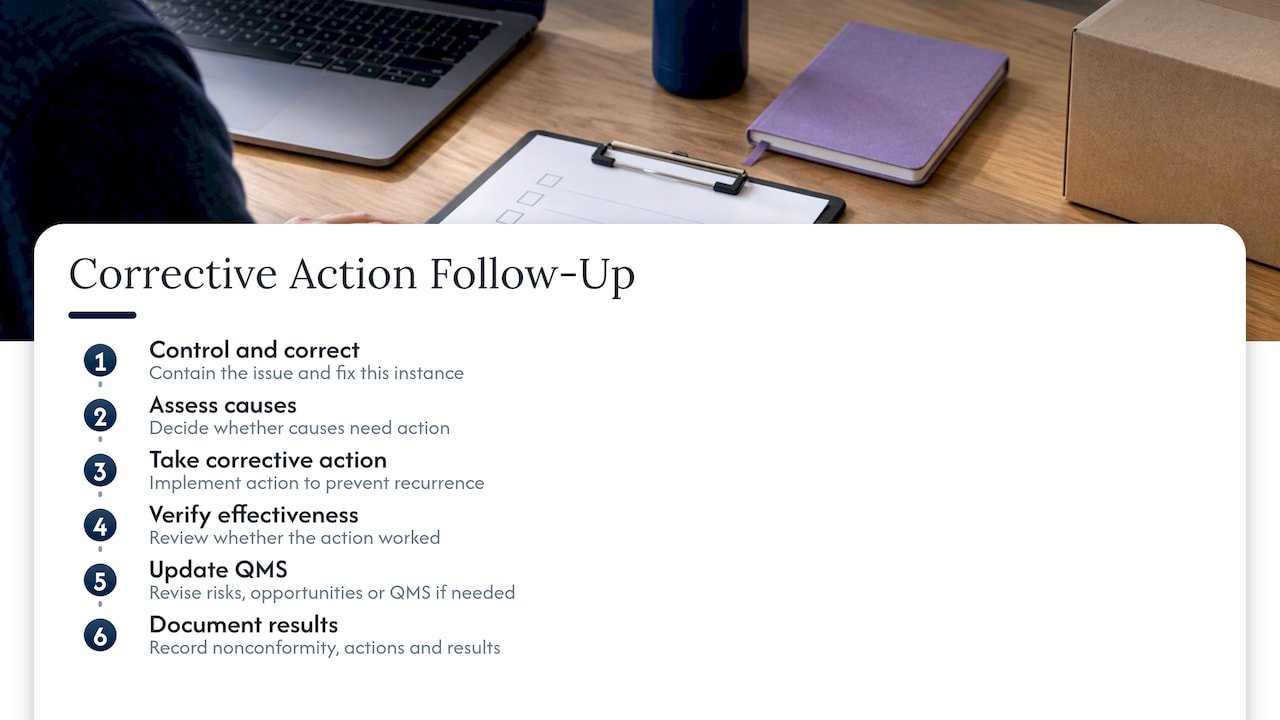
Clause 10.2 requires you to react to a nonconformity, control and correct it, evaluate whether the causes need action, implement that action, review its effectiveness, update risks and opportunities if needed and change the QMS if needed. Documented information must show the nature of the nonconformity, the actions taken and the results.
The SPI guidebook separates the stages that people often blur together: correction (fix this instance), containment, root cause, corrective action, implementation evidence and effectiveness verification. Commitments should be SMART. Its example contrasts a vague “improve training” with a named quality manager revising a work instruction, briefing all twelve final inspectors, recording competence confirmation and finishing by a set date.
Assign each finding an owner and track it in a corrective action log. Follow-up works best as a mini-audit: look at fresh records and confirm the problem has stopped, not just that a form was signed. Findings that persist past their deadline go to higher management.
Step 10: Report to top management
Results must reach the management review under clause 9.3. The APG describes the internal audit as a feedback mechanism for top management, and says third-party auditors examine whether audits lead to tangible improvements in the QMS. Trends matter more than totals: repeat findings in the same process say something a single finding cannot.
How often should you audit?
The standard says “planned intervals” and leaves the number to you. Many organisations cover every process at least once a year, but that is a choice, not a rule. What counts is the recorded rationale: higher-risk or poorly performing processes more often, stable and low-risk ones less often, with the justification written down. Time your audits so that findings can be closed well before a surveillance or recertification visit, because open nonconformities are what an external auditor will look at first.
An ISO 9001 internal audit checklist you can adapt
A checklist is a prompt, not a script. The APG says checklists can raise audit quality when designed to promote it, so build yours around the process you are auditing and the evidence you expect to see. This clause-based starting point reflects the structure of the standard:
| Clause | What to look for | Typical evidence |
|---|---|---|
| 4 Context | Issues and interested parties identified and reviewed; QMS scope defined | Context analysis, scope statement |
| 5 Leadership | Quality policy communicated and understood; roles and responsibilities clear | Policy, interviews with staff, organisation chart |
| 6 Planning | Risks and opportunities current; quality objectives measurable and monitored | Risk register, objectives with results |
| 7 Support | Competence documented; resources and infrastructure adequate; documents controlled | Training records, current procedures |
| 8 Operation | Customer requirements reviewed; nonconforming outputs recorded; suppliers assessed | Order reviews, nonconformance log, supplier evaluations |
| 9 Performance evaluation | Customer satisfaction measured; audit results addressed; management review held | Survey data, minutes, previous audit reports |
| 10 Improvement | Nonconformities recorded, causes investigated, corrective action shown effective | Corrective action log, effectiveness checks |
Use the clauses to make sure nothing is missed, but run the audit by process. One order traced from enquiry to delivery will touch clauses 7, 8, 9 and 10 in a single pass.
Common mistakes that external auditors notice
- No findings at all. Every system has improvement points. An audit that finds nothing invites questions about whether it was done seriously.
- Auditing your own work. It breaks the impartiality requirement.
- Findings without evidence. “Training seems weak” is an opinion. A named record is evidence.
- Closing actions on paperwork. Check that the fix works on new records.
- A programme that never changes. Risks, results and organisational changes should alter the plan from year to year.
Building audit competence in your team
For corporate teams and HR managers, the cheapest way to improve an audit programme is a trained auditor pool, with enough people to rotate so nobody audits their own area. Compliance, quality, safety and project roles all benefit, because the skill (planning, sampling, interviewing, writing a precise finding) carries across management systems. Teams that run environmental or safety systems alongside quality can see how the requirements line up in our guides to ISO 14001 training requirements and ISO 45001 training requirements.
Where Oxford Centre fits
Oxford Centre provides professional training with global accreditation across project management, management, leadership, compliance and safety, among other fields. Courses can be customised to an organisation’s own needs and delivered on-site, online or blended, so a team can be trained on its own processes and procedures. Browse the full course range to find programmes for your compliance and quality roles, or look at our project management courses if audit findings are driving improvement projects.

Our perspective
We see the internal audit as the cheapest improvement project a company runs. The standard asks for planned audits, but the value comes from people who know how to look: who follow a process end to end, ask open questions and write findings that nobody can argue with.
That is a skills question before it is a procedure question. A well-written programme in the hands of an untrained auditor produces a pile of forms. A trained auditor with a modest programme produces corrective actions that change how work is done.
This is why we build training around the organisation rather than around a generic syllabus. Our courses are customisable, globally accredited and delivered on-site, online or blended, led by industry experts who work on real-world problems. For a team preparing for the 2026 edition of ISO 9001, that means auditors who understand your own processes and can test them against the new requirements.
Sam
FAQ
What are the main steps of an ISO 9001 internal audit?
Plan the audit programme, set objectives, scope and criteria, appoint competent and impartial auditors, and prepare the plan. Then hold an opening meeting, gather objective evidence, write findings, hold a closing meeting and issue the report. Finish by agreeing corrective actions, verifying that they worked and reporting results to management.
How often must ISO 9001 internal audits be done?
The standard requires audits at planned intervals but does not fix a frequency, duration or scope. Your risk-based approach decides, giving priority to higher-risk and poorly performing processes. If you audit some areas less often, record the reason.
Can the quality manager carry out the internal audit?
The quality manager can audit processes they do not own. Auditors cannot audit their own work, so anything the quality manager wrote or runs needs another auditor. Smaller organisations often rotate auditors between departments to achieve this.
Do we need to follow ISO 19011?
ISO 9001 does not require it, but it is the recognised guidance on auditing management systems, covering programmes, conduct and auditor competence. Using it gives you a sound structure and shows external auditors a considered approach.
Does ISO 9001:2026 change how we audit?
The clause 9.2 intent remains audits at planned intervals under a programme. The new edition puts more weight on leadership, quality culture and risk wording, so update your criteria and checklists and confirm your transition timeline with your certification body.
Sources
- ISO 9001:2026 – Quality management systems, Requirements (ISO)
- ISO launches update to ISO 9001 (ISO news, September 2026)
- ISO 9001:2026 factsheet (ISO)
- ISO 9001:2026 text, clauses 9.2 and 10.2
- ISO 9001 Auditing Practices Group: internal audit guidance (2016)
- ISO 9001 Auditing Practices Group: internal audit guidance (2020)
- ISO 9001 Auditing Practices Group: audit planning (2017)
- SPI Quality Auditing and Verification Guidebook
- ISO 19011 Guidelines for auditing management systems (ISO)