
The best leadership training topics are the ones that close a gap your managers actually have. A long list of generic subjects is easy to find. A programme that changes how people lead on Monday morning starts with a needs analysis, covers a small number of core topics in depth, and gives managers time to practise. This guide sets out the topics worth considering, which groups need which, and how to choose. At Oxfordcentre we build customisable, globally accredited leadership courses, delivered on-site, online or blended, so the choice of topics can follow your organisation rather than a fixed syllabus.
TL;DR
- Core leadership topics fall into five groups: communication, managing people, decision-making, leading change and self-leadership.
- General management skills such as goal-setting, appraisal and time management transfer to behaviour best, according to the CIPD’s 2023 evidence review.
- New managers, experienced leaders, project managers and executives need different topic mixes, not the same course at different speeds.
- Programmes built on a training needs analysis outperform generic ones, so diagnose before you choose topics.
- Training works best when managers have the authority to apply it and the time to practise.
Table of Contents
- The core leadership training topics
- A practical leadership skills list
- Which topics transfer to real behaviour
- Matching topics to the leader
- How to choose topics for your team
- What good leadership training delivers
- Format, length and follow-through
- Where Oxfordcentre fits
- Our view on leadership topics
- FAQ
- Sources
The core leadership training topics
Most lists of leadership topics repeat the same twenty or so subjects. They group naturally into five families. Treat the families as a menu: very few teams need all of them at once.
Communication and listening
This is the most common starting point because every other skill runs through it. Typical content includes giving clear instructions, active listening, structured feedback, running one-to-ones and presenting to different audiences. Our own piece on manager communication training for hybrid teams shows how this works when people are not in the same room.
Managing and developing people
Delegation, performance conversations, coaching and mentoring, motivating individuals and handling conflict sit here. Coaching is worth singling out: a manager who asks good questions develops people faster than one who only gives answers. Our guide to coaching and mentoring as a leadership advantage covers the practical habits, and ready-made coaching templates can give managers a structure for their first conversations.
Decision-making and problem-solving
Leaders need frameworks for deciding with incomplete information, weighing risk and explaining the reasoning to others. Topics include structured problem analysis, prioritisation, escalation and ethical judgement.
Leading change and strategy
This family covers vision setting, goal alignment, execution planning, change management and building resilience in teams under pressure. It matters most for senior leaders and anyone running transformation work.
Self-leadership
Emotional intelligence, accountability, confidence, authenticity, time management and handling stress belong here. These are the topics that make the other four stick, because they shape how a manager behaves when things go wrong. Our Leadership Psychology and Human Behaviour course addresses this territory directly.
A practical leadership skills list
Searches for a skills list or leadership competencies usually want something short enough to use in an appraisal or a training plan. Ten competencies cover most of what employers mean by good leadership:
- Clear communication, spoken and written
- Active listening
- Delegation and empowerment
- Goal-setting and accountability
- Giving and receiving feedback
- Decision-making under uncertainty
- Conflict resolution
- Coaching and developing others
- Adaptability and leading change
- Emotional intelligence and self-awareness
A competency is a skill described as observable behaviour. “Communicates well” is vague. “Explains the reason behind a decision before the team asks” can be observed, which makes it trainable and measurable. When you build a competency framework, write each item as two or three behaviours like this.
If you want depth on the basics, our guide to basic leadership skills for managing employees walks through the foundations. For goal-setting specifically, the Managerial Goal Setting and Accountability course is built around that single competency.
Which topics transfer to real behaviour
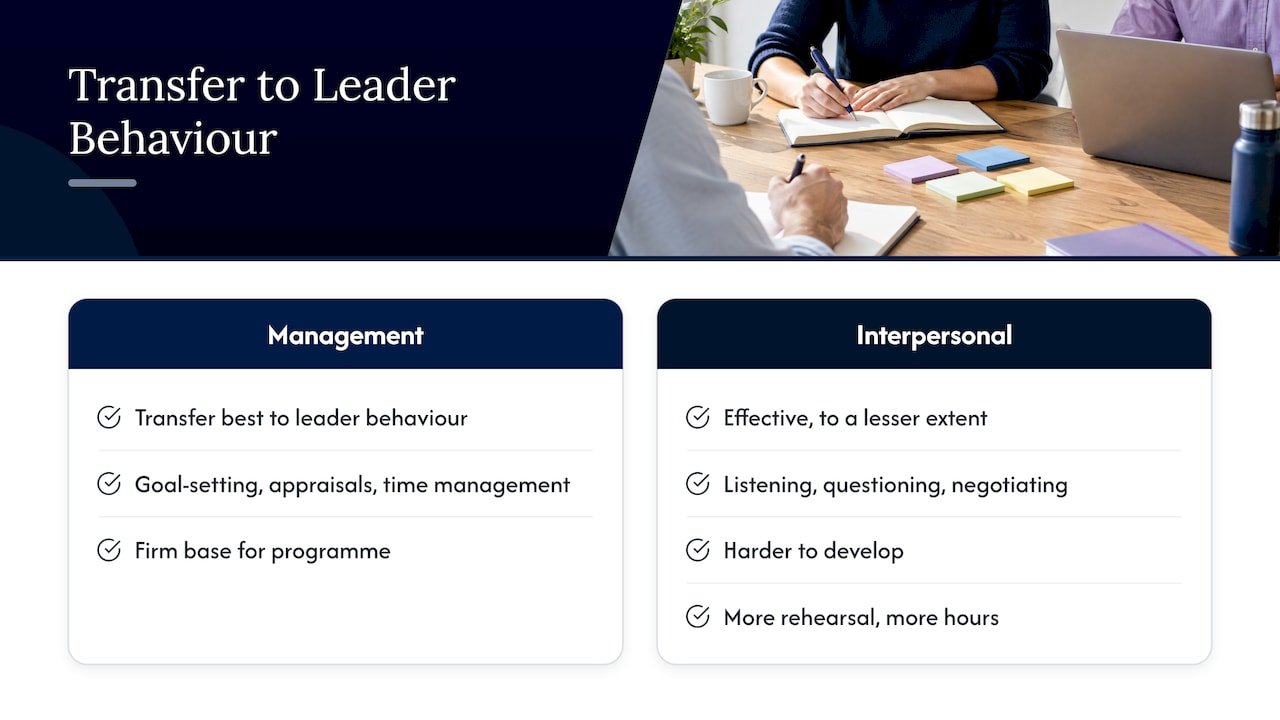
Not every topic changes what leaders do. The CIPD’s 2023 review cites a meta-analysis of controlled studies (Taylor and colleagues, 2009) finding that general management skills such as goal-setting, performance appraisal and time management transfer best to leader behaviour, with interpersonal skills such as listening, questioning, negotiating and mentoring also effective to a lesser extent. The CIPD’s practice summary suggests the smaller effect may simply reflect that interpersonal skills are harder to develop, not that they are less worth training.
The practical reading is to build the programme on a firm base of management routines (setting goals, running appraisals, managing time) and layer interpersonal topics on top with plenty of practice. Interpersonal topics need more rehearsal, so give them more hours, not fewer.
Matching topics to the leader
The same topic list does not suit everyone. Match content to the stage the person has reached.
| Audience | Priority topics | What success looks like |
|---|---|---|
| New managers | Delegation, feedback, one-to-ones, time management, basic conflict handling | Moves from doing the work to getting work done through others |
| Experienced managers | Coaching, difficult conversations, managing managers, change, influencing without authority | Develops people and handles complexity without escalating everything |
| Project managers | Stakeholder communication, accountability, cross-functional and matrix leadership, risk-based decisions | Leads people who do not report to them |
| Senior leaders and executives | Strategy, vision, organisational change, ethics, resilience, leading leaders | Aligns the organisation behind a direction and sustains it |
Project managers and matrix leadership
Project managers often lead without formal authority, so influence, negotiation and clear accountability matter more than traditional supervision. Our Cross-Functional Leadership Skills course and Matrix Management and Leadership course address this kind of leadership. If you are weighing a certification alongside, our project management courses sit in the same catalogue.
Healthcare, engineering and regulated sectors
In sectors with safety and compliance duties, leadership topics usually add a technical layer: leading safety conversations, escalation, and accountability for standards. The structure above still applies. What changes is the scenarios used for practice, which should come from your own operations.
How to choose topics for your team
The CIPD’s evidence points to one decision above all: start with a needs analysis. Programmes designed on the basis of a careful training needs analysis are more effective than generic untailored programmes, and the analysis also raises trainees’ motivation to learn. A simple routine for HR and learning teams:
- Define the gap. A training need exists where there is a meaningful difference between the capability required and the capability people currently show, as the open textbook on strategic HR management puts it. Gather evidence from surveys, interviews, focus groups and real incidents.
- Check the cause. Separate performance gaps from training gaps. If managers lack the authority to decide, the same source warns that leadership training may have little impact. If workloads stop teams talking to each other, cross-functional teamwork training will have limited effect.
- Analyse at three levels. Look at the organisation (strategy and risk), the role (competencies the job needs) and the individual (what each person shows now).
- Prioritise. The same chapter suggests weighing safety, regulatory requirements, the number of people affected, the size of the gap, strategic importance and the likelihood that training will improve performance.
- Set specific goals. The CIPD review notes that learning transfer is greater when trainees set clear, specific learning goals.
Our step-by-step guides to a five-step training needs analysis and to running a skills gap analysis give HR teams the templates and decision record to work through.
A worked example
Suppose a department’s engagement survey shows that staff feel they rarely get useful feedback, and appraisal records show that half the team leaders skip one-to-ones. That gap affects many people and has a clear behavioural cause, so it ranks high on both impact and reach. The first module would be feedback and one-to-one conversations, with practice on real cases from the department. Strategic planning for the director group can wait or be handled through individual coaching. One focused need is solved first, rather than ten topics being skimmed.
What good leadership training delivers
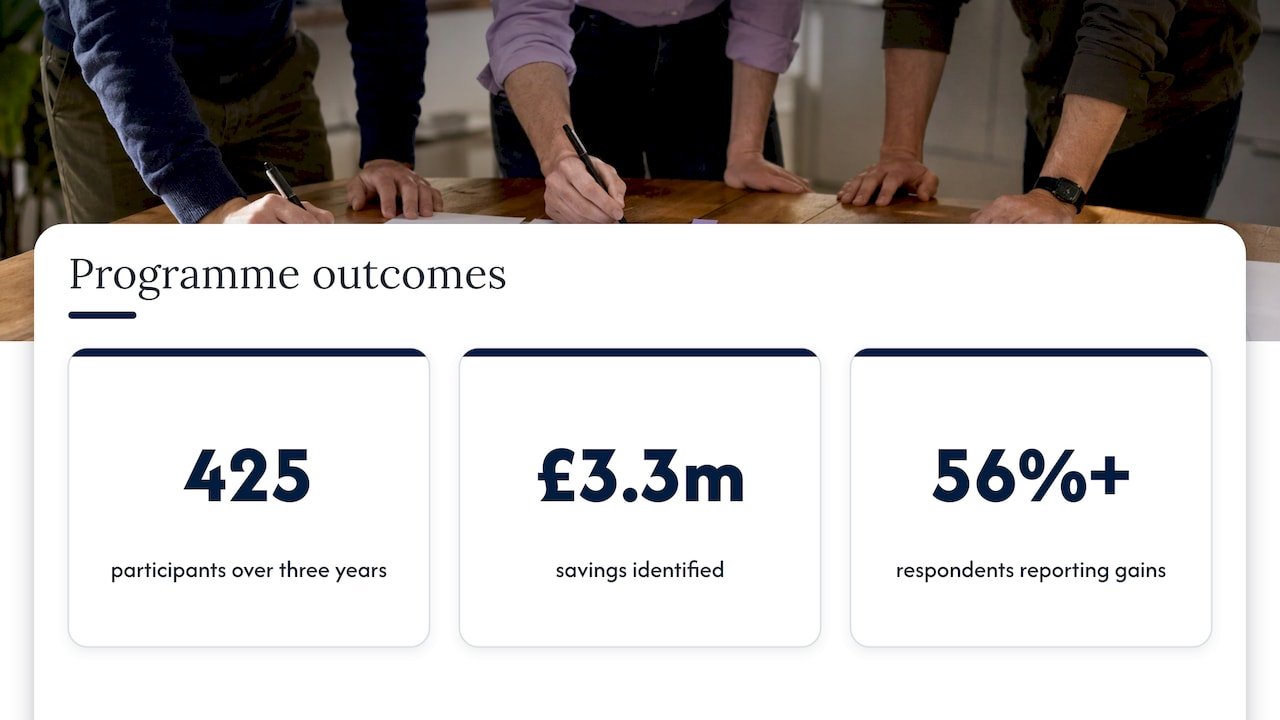
Evidence from UK healthcare shows what a well-run programme can achieve. A BMJ Leader study of a service line leadership programme at Nottingham University Hospitals NHS Trust found that over three years the programme drew 425 participants and identified £3.3 million of savings through 11 initiatives, with participants changing behaviours around trust, empowerment and the confidence to challenge assumptions.
A mixed-methods evaluation of an Emerging Leaders Programme at a UK hospital trust, with 54 participants across three cohorts, reported significant gains in all seven domains of the Medical Leadership Competency Framework. At least 56% of respondents reported increases in job satisfaction, resilience, confidence and motivation.
A review of 23 studies of formal leadership development programmes found that the most frequent participant outcomes were knowledge of leadership roles and responsibilities, greater confidence and better communication skills, with networking and job satisfaction also common. These are realistic expectations: better conversations, more confident managers and better-run teams, which then show up in the business measures you already track.
Format, length and follow-through
Topic choice is only half the design. The CIPD review reports, on level-A evidence, that effective training should be of reasonable length, at least three days or longer, and repeated periodically. Spaced learning beats one-off events, although short, punchy courses with clear objectives can also work. It also finds that effective programmes combine input, tutorials and reflection, use several methods such as lectures, group work and action learning projects, and link practice to real situations. A safe learning climate with feedback, mentorship and organisational support helps learning carry into daily work.
In practice:
- Split a programme into modules a few weeks apart, with a workplace task between each.
- Use scenarios from your own teams, not generic case studies.
- Brief line managers beforehand so they back the new behaviours.
- Ask each participant to set two or three specific goals at the start and review them at the end.
Where Oxfordcentre fits
Our courses cover leadership, management, project management, healthcare, oil and gas, civil engineering, IT, compliance and safety. The content can be customised to an organisation’s needs, and it is delivered on-site, online or blended, with globally accredited qualifications and expert trainers who work on real-world challenges. For leadership specifically, the Leadership Behaviour and Management Practices course is a good first look at the day-to-day habits of managing people, and you can browse the full course catalogue to see the rest.
If you already know which topics your managers need, tell us the audience, the format you prefer and the outcome you want. We will shape the programme around that. Start from the Oxfordcentre home page to get in touch.
Our view on leadership topics
Teams often ask us for a list of topics. We would rather start with a question: what should your managers be doing next quarter that they are not doing now?
Our approach is to keep the core small. Goal-setting, feedback, delegation and difficult conversations carry most of the weight, and a manager who does these four well changes a team. Then we tailor the rest: a project manager leading a matrix team needs influence and accountability, a new supervisor needs delegation and one-to-ones, a director needs strategy and change.
That is why we build customisable programmes and deliver them on-site, online or blended. The syllabus should fit your people and your sector, with practice drawn from your own work. Accredited, expert-led training gives that practice credibility, and it gives the individual professional a qualification that travels.
Sam
FAQ
What are the most important leadership training topics?
Communication, delegation, feedback, goal-setting, decision-making, conflict handling and leading change cover most needs. For the strongest effect on behaviour, put general management routines such as goal-setting and appraisal at the centre, and add interpersonal skills with plenty of practice.
What should leadership training cover for new managers?
New managers benefit most from delegation, one-to-one meetings, giving feedback, time management and basic conflict handling. The aim is to shift from doing the work personally to achieving results through other people. Strategy and organisational change can wait until later in their career.
How long should leadership training last?
The CIPD’s 2023 review says effective training should run at least three days or longer and be repeated periodically, with spaced sessions working better than a single event. Short, focused courses with clear objectives can also work well when they target one specific skill.
How do we decide which leadership topics our team needs?
Run a training needs analysis: compare the capability the roles require with what managers show now, using surveys, interviews and real incidents. Then rank gaps by impact and by how many people they affect, and check that the cause is a skills gap, not a lack of authority or time.
Sources
- CIPD, Leadership development: An evidence review (2023)
- CIPD, Effective people managers: Evidence review (2023)
- Strategic Human Resources Management, 6.2 Identifying Training and Development Needs
- BMJ Leader, How leadership training saves money
- Impact and outcomes of the Emerging Leaders Programme
- Journal of Healthcare Leadership, review of formal leadership development programmes
- Coaching templates