
Compliance training requirements are the duties that a law, regulator or contract places on an organisation to train specific people on specific subjects, within a set time. No single UK list covers every employer. What you must deliver depends on your sector, the roles involved and the risks of the work. The practical answer is to map each obligation to a role, schedule it, record it and review it. We build that kind of programme with organisations, customised to their sector and delivered on site, online or blended.
TL;DR
- A training requirement is binding only when a statute, regulation or contract creates it. Best practice and regulator expectation are not the same thing, so label each item in your plan.
- Safety training is typically due at recruitment, on a change of job, when new equipment or processes arrive, and repeated when risks change.
- “Annual” is a common habit, not a universal rule. Some regimes fix an interval, many do not.
- A training plan is a matrix of roles, topics, frequency, provider, planned date and completion date, backed by a register of the legislation that drives it.
- Keep records of who was trained, when, by whom and on what content, and check understanding with more than a click-through.
Table of Contents
- What a compliance training requirement actually is
- The main subject areas employers train on
- Safety training: when it is due
- Is annual compliance training required?
- A recent change: AI literacy in the EU
- How to build a compliance training plan
- Records and proof of understanding
- A worked example: a 120-person engineering firm
- Our view: compliance training is a system, not an event
- Where we can help
- FAQ
- Sources
What a compliance training requirement actually is
A requirement exists when something obliges you to deliver specific content to a defined group. That something can be a statute, a regulation, a regulator’s guidance or a contractual standard. National Compliance describes the scope as set by three things: the jurisdiction, the covered population (all staff, supervisors or particular roles) and the subject matter.
The legal weight behind each obligation differs, and mixing the levels up causes real mistakes. Rupture Labs separates four classes: binding regulation, supervisory or examiner guidance, industry or contractual standards, and topics with no statutory mandate at all. Treating a binding rule as optional is a compliance failure. Describing a good habit as a legal duty sends you spending on training nobody required and misleads your staff.
For an HR manager this gives a simple first step: write down every training item you deliver and mark which class it belongs to.
The main subject areas employers train on
Most programmes draw on the same families of topic:
- Health and safety. Induction, hazard awareness, manual handling, equipment, emergency procedures, and hazardous substances where relevant.
- Data protection and information security. Handling personal data, recognising phishing, reporting breaches. The GDPR is among the regimes with an explicit training element (Article 39(1)(b), which assigns awareness-raising and staff training to the data protection officer’s tasks).
- Financial crime and conduct. Anti-money-laundering, sanctions and ethics rules for regulated firms.
- Equality, harassment and conduct. Policies, reporting routes and manager responsibilities.
- Sector-specific rules. Healthcare, oil and gas, construction and civil engineering each carry their own safety and competence expectations.
- Artificial intelligence literacy. A newer duty in the EU, covered below.
If you operate in several countries, treat each jurisdiction separately. Examples from the US, such as HIPAA workforce training or OSHA hazard communication, are useful for comparison but do not apply to a UK-only business.
Safety training: when it is due
Health and safety is where the training duty is clearest. In Great Britain, employers have a general duty to give employees the information, instruction and training needed to work safely, and the duty is backed by regulations on risk management. Check the Health and Safety Executive’s guidance for the wording that applies to your sector.
The EU framework shows the pattern most systems follow. Under the EU Framework Directive 89/391, as summarised by EU-OSHA, workers must receive adequate safety and health training:
- at recruitment,
- on a transfer or change of job,
- when new work equipment or technology is introduced,
- and it must be adapted to new or changed risks and repeated periodically where necessary.
That is a trigger-based model, not a calendar-based one. WorkSafe New Zealand says the same in different words: training should be suitable and adequate, understandable to the worker and tailored to the work, not a tick-box exercise. It should be reviewed when equipment, processes or incidents change.
Two practical points follow. Training must be understood, so use language and examples your workforce can follow. And it should happen in paid working time: Ireland’s Health and Safety Authority states that employees are entitled to receive it without loss of earnings, and the same principle is a sound default anywhere.
Is annual compliance training required?
Sometimes, but not always. Whether you need annual compliance training depends on the rule behind each topic.
Some regimes set a fixed interval. The US Federal Select Agent Program requires refresher training annually for approved individuals, or sooner if security or biosafety plans change. Minnesota’s hazard communication enforcement guidelines call for updates at intervals no longer than a year. These are specific rules in specific US settings, not a general principle.
Others set none. HIPAA Journal reports that HIPAA requires training for new workforce members, after material policy changes and in certain other situations, with no fixed refresher date, although many experts still recommend an annual refresher to keep staff current. That is a useful model for any topic without a statutory interval.
So how often should you train? Use this logic:
| Situation | Sensible frequency |
|---|---|
| A rule sets an interval | Follow it exactly and record the date |
| A rule requires training but sets no interval | Train at induction, after changes, and refresh on a cycle you can justify, commonly yearly |
| High-risk tasks or past incidents | More often, driven by the risk |
| Policy, equipment or law has changed | Immediately for the affected roles |
An annual cycle is a good default for many topics, because it gives you a fixed point for reminders and records. Present it to staff as your policy rather than as a legal rule unless a regulation says so.
A recent change: AI literacy in the EU
If you employ people or provide services in the EU, one change is worth noting. Cuatrecasas’ guide to the EU AI Act explains that Article 4 requires providers and deployers of AI systems to take measures for staff AI literacy. Documenting training and awareness actions applies from 2 February 2025, and oversight and penalties apply from 2 August 2026. The European Commission’s FAQs, as the guide reports them, extend the duty to contractors and other people who operate AI on your behalf, require no formal certificate, and suggest regular programme reviews.
The sensible response is role-based training: what a manager who approves AI use needs differs from what a frontline user needs. This overview of AI governance in leadership hiring shows how those responsibilities play out in one function. For managers who must put the duty into practice, our guide to implementing intelligent solutions in your organisation is a good starting point.
How to build a compliance training plan
A plan turns scattered obligations into a schedule you can defend. The Abu Dhabi OSH System Framework describes a method that works in any country: compile a register of the legislation affecting your operations, identify the training each item requires, run a training needs analysis, and summarise the result in a training matrix.
Step 1: Build the legal register
List every law, regulation, contract term and industry standard that touches your work. Next to each, note the training it requires and its legal class: binding, supervisory, contractual or good practice. This is the step most often skipped, and everything else rests on it. Your sector regulator and trade body are the places to confirm what applies, and a qualified adviser should check anything you are unsure of.
Step 2: Map the requirements to roles
A matrix lists roles down one side and topics across the top. The Abu Dhabi guidance says it should show what each role or individual needs, the frequency, planned dates, whether delivery is internal or external, and the completion date. A site supervisor, a finance analyst and a new starter will have different rows. Our guide on building a safety training matrix that holds up walks through the layout.
Step 3: Set the triggers and the cycle
For each cell, decide what prompts training: joining, a change of role, new equipment, an incident, a rule change, or the calendar. Write the trigger into the matrix so that managers know when to act without being reminded.
Step 4: Choose how to deliver it
Match the format to the content. Practical, equipment-based or site-specific training works best on site. Policy and awareness content suits online delivery. Many organisations blend the two. We deliver courses in all three formats, and can customise content to your organisation’s own procedures and risks.
Step 5: Record, test and review
Training that is not recorded cannot be shown to a regulator, insurer or tribunal. The next section covers what to keep. Then review the plan whenever your operations, incidents or the law change, as WorkSafe New Zealand advises.
Records and proof of understanding
In many jurisdictions, records are the evidence that training happened. The detail varies, but the content is consistent. Minnesota’s guidelines require records kept for three years showing the dates, the trainer’s name, title and qualifications, the names and job titles of employees trained, and a summary of the content. OSHA’s model hazard communication programme goes further, recommending that you also keep the lesson title, objectives, outline and test results showing the objectives were met.
Not every rule requires records. WorkSafe New Zealand notes that written or electronic records are not legally required there, yet it advises keeping a register or log. Our advice is to keep them regardless: they cost little and settle disputes quickly.
A minimum record per course:
- Course title and content summary
- Date and duration
- Trainer name and qualifications
- Names, job titles and signatures or digital confirmation of attendees
- Assessment result or evidence of understanding
- Next review or refresher date
And do not rely on attendance alone. A mandatory quiz, a scenario question or a short practical demonstration shows whether a person can apply the rule. That is what a regulator means by training that is “adequate”, and it is what protects your people.
A worked example: a 120-person engineering firm
Take a firm with site crews, an office team and a handful of managers. Its legal register shows health and safety duties, data protection duties and a client contract demanding annual conduct training.
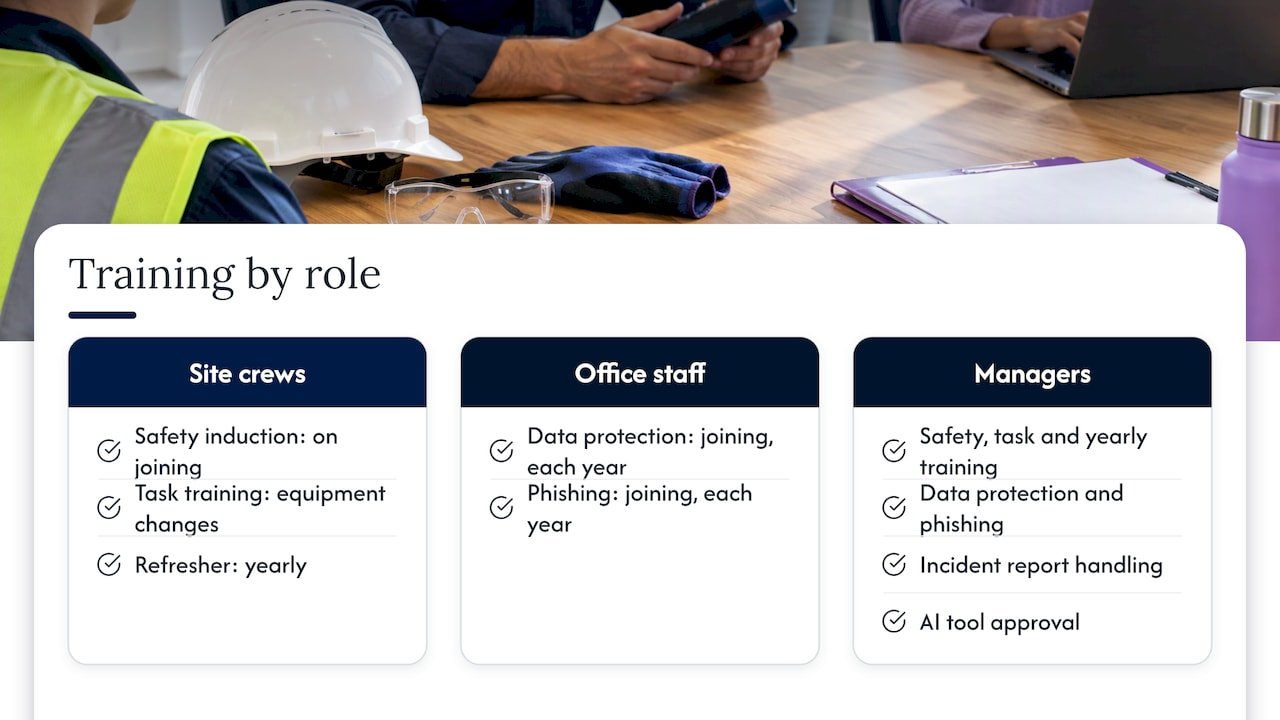
Its matrix has three role groups. Site crews get safety induction on joining, task-specific training when equipment changes and a yearly refresher. Office staff get data protection and phishing training on joining and each year. Managers get all of the above plus training on handling incident reports and on approving the use of AI tools. Each row notes the legal class: the safety and data protection rows are binding, the client conduct row is contractual and the yearly refresher is the firm’s own policy.
The HR manager reviews the matrix every quarter and after any incident. Records sit in one register, and a completion report shows gaps by role. That is the whole system, and it is the same for a hospital department, a contractor or a public body, with different content in the cells.
Perspective
Our view: compliance training is a system, not an event
We see the same pattern whenever organisations ask us about compliance training. The question starts as “what do we have to do?” and ends as “how do we show that our people can actually do it?”
Our view is that a certificate on its own is a weak answer. The regimes cited above ask for training that is suitable, understood and repeated when risks change, and that is a property of the content and the delivery, not of the attendance sheet. That is why we build our courses around the real work of your teams. Our programmes are customisable, led by industry experts and delivered on site, online or blended, so the examples your people meet in the room are the ones they will meet at work.
We also think compliance and capability belong together. Safety, leadership, project management and technical training work best when they share one plan, one matrix and one set of records. Our globally accredited courses are designed to fit into that plan, whether you are upskilling a whole team or one professional.
Sam
Where we can help
If your matrix shows gaps, we can help you close them. Oxford Centre provides professional training with global accreditation across safety, compliance, healthcare, oil and gas, civil engineering, project management, IT, management and leadership. Courses can be customised for your teams and run on site, online or blended. Browse the full course catalogue to find the subject you need, or look at our project management training if your team needs an accredited certification.

For healthcare environments, our Facilities Management for Healthcare Environments course is one example of sector-specific content. For organisations adopting AI, see our AI for Government and Public Sector course.
FAQ
Is compliance training a legal requirement?
It is when a statute, regulation or contract says so, and many safety and data protection duties do. Other items are regulator expectations or good practice. Separate the two in your legal register so you know which are binding.
How often should compliance training be repeated?
Follow any interval a rule sets. Where none exists, train at induction, when roles, equipment or rules change, and refresh on a cycle you can justify. Yearly is the common choice, as experts on HIPAA training note.
What should a compliance training plan include?
A register of the relevant legislation, a training needs analysis and a matrix. The matrix lists the courses by role, the frequency, planned dates, whether delivery is internal or external, and the completion date.
What records should we keep?
Keep the date, the content, the trainer and their qualifications, the names and job titles of attendees and a result showing understanding. Minnesota’s rules, for example, require three years of retention, and keeping similar records is sound practice elsewhere.
Does everyone in the organisation need the same training?
No. Content is set by role and by risk. A frontline worker, a manager and an office employee need different material, which is why a role-based matrix is the standard tool.
Sources
- Compliance Training Requirements, National Compliance
- Which Regulations Actually Require Compliance Training?, Rupture Labs
- OSH training, OSHwiki, EU-OSHA
- Providing information, training, instruction or supervision, WorkSafe New Zealand
- Tips for Procuring Occupational Safety and Health Training, Health and Safety Authority
- Guidance for Select Agent Regulation Training Requirements
- Hazard communication enforcement guidelines, Minnesota Department of Labor and Industry
- How Often is HIPAA Training Required?, HIPAA Journal
- AI literacy obligation in EU companies, Cuatrecasas
- Abu Dhabi Occupational Safety and Health System Framework, training guideline
- Draft model training program for hazard communication, OSHA
- AI governance in leadership hiring: Strategies for 2026