
FIDIC contracts are internationally recognised standard forms of construction contract. They fix who designs, who carries which risks, how the contractor is paid, how time and claims are handled and how disputes are settled. Which “colour book” a project uses depends mainly on who is responsible for the design. How well it works depends on whether the people administering it understand the notice deadlines, which is a skill your team can be trained in. This guide covers the types, the mechanics and the comparison with NEC, so you can see what your team needs to know before the first notice is due.
TL;DR
- FIDIC is the International Federation of Consulting Engineers. It publishes standard conditions of contract between an employer and a contractor, and the engineer is not a party to the contract.
- The main books are split by design responsibility: Red (employer designs), Yellow (contractor designs), Silver (turnkey) and Gold (contractor also operates).
- The 2017 editions have 21 clauses. Claims sit in Clause 20 and disputes in Clause 21, with strict time limits such as 28 days for a notice of claim.
- FIDIC is clause-based and formal, while NEC is plain-language and built around collaborative management. Both reward trained contract administrators.
- Most disputes come from missed notices rather than the form itself, so people training matters as much as the choice of book.
Table of Contents
- What FIDIC contracts are and who uses them
- The FIDIC colour books and what each is for
- 1999 or 2017: which edition applies
- How a FIDIC contract runs day to day
- FIDIC vs NEC: the differences that matter
- Who needs to understand FIDIC in your organisation
- Training your team on FIDIC with Oxford Centre
- Our perspective
- FAQ
- Sources
What FIDIC contracts are and who uses them
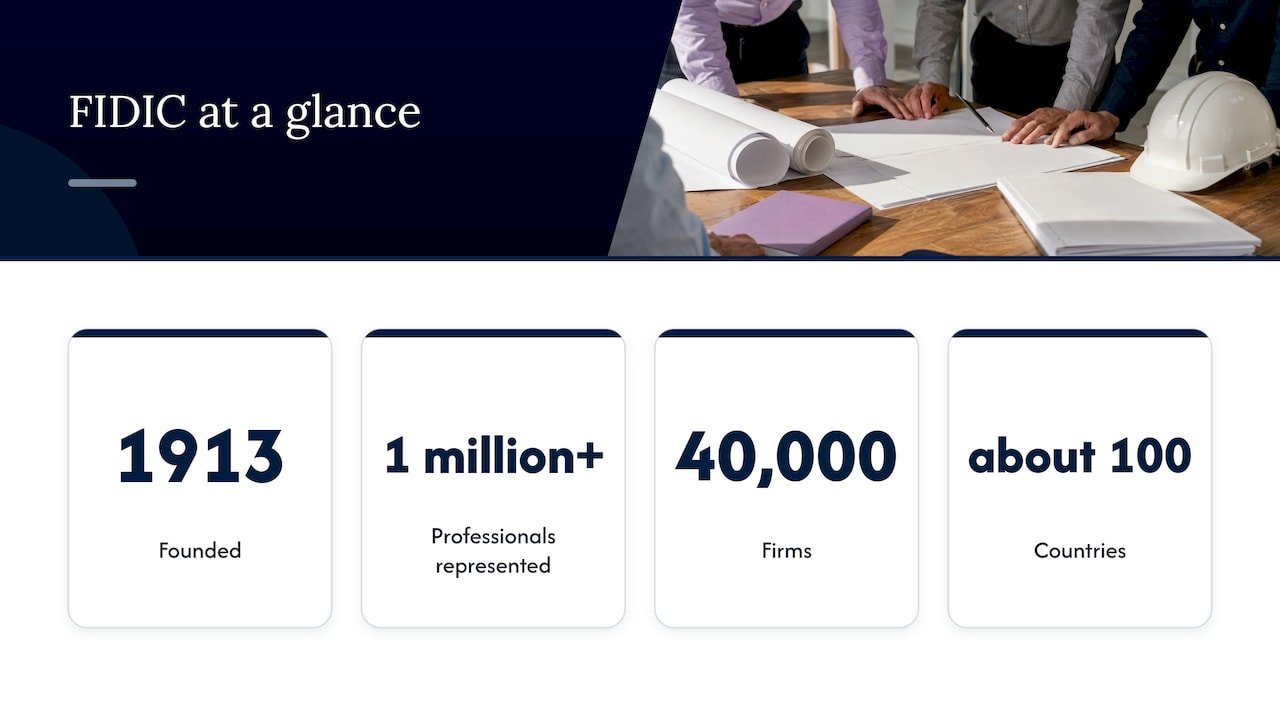
FIDIC stands for Fédération Internationale des Ingénieurs-Conseils. It was founded in 1913 and, according to its own site, represents over one million engineering professionals and 40,000 firms in about 100 countries. It publishes international standard forms for works and also for clients, consultants, sub-consultants and joint ventures.
The construction contracts share one structure. FIDIC’s publications page describes them as standard conditions between a client (the employer) and a contractor. The consulting engineer is not a party. The engineer acts as the employer’s representative and administers the contract.
Why do so many international projects use them? A 2021 Taylor Wessing briefing describes FIDIC conditions as widely used for decades and the contract of choice for many international process plant and infrastructure projects, particularly in Europe, the Middle East and Asia. Muckle LLP adds a practical point. On cross-border projects, a single negotiable set of terms known to every party saves time and money.
The forms are standard, but they are not used untouched. Employers normally add project-specific amendments in the Particular Conditions, and the governing law of the contract affects how the terms are applied. A team that only knows the standard text is therefore half-prepared. It also has to read the amendments.
The FIDIC colour books and what each is for
FIDIC’s main forms are organised around how much design the contractor takes on. The FIDIC Suite of Contracts overview sets out the logic: Red where the employer designs, Yellow where the contractor designs, Silver for turnkey projects, and Gold where the contractor also operates the asset.
| Book | Colour | Who designs | Typical use |
|---|---|---|---|
| Construction Contract | Red | Employer | Works designed by the employer or its engineer, usually paid against measured quantities |
| Plant and Design-Build Contract | Yellow | Contractor | Plant and building or engineering works where the contractor designs |
| EPC/Turnkey Contract | Silver | Contractor | Turnkey delivery, where the employer wants a finished facility |
| Design, Build and Operate | Gold | Contractor | Projects where the contractor also operates the asset |
| Short Form | Green | Either | Simple or short works |
| MDB Harmonised Edition | Pink | Employer | Bank-financed projects |
Red Book: employer design
The Red Book is the form people usually mean when they say “FIDIC”. Muckle LLP explains that it is used where the employer is responsible for most of the design. Payment is typically made against bills of quantities, or agreed lump sums. A third-party engineer administers the contract, monitors the works and certifies interim payments. If your team measures and values work, bill of quantities skills matter here, and our Quantity Surveying and Bill of Quantities course covers that ground.
Yellow and Silver Books: contractor design
Under the Yellow Book the contractor designs the works. The Silver Book is the turnkey version, written for projects where the employer wants a single point of responsibility for a completed facility. For teams in process plant, energy and offshore work, the contracts often overlap with EPC arrangements. Our EPC Contracts course and our EPCIC course for offshore and marine projects are aimed at those readers.
Gold, Green and Pink Books
The Gold Book is for design, build and operate arrangements. The Green Book is the short form for simpler work. FIDIC’s own record of its 1999 suite lists the Pink Book as the MDB construction contract for bank-financed projects only. It replaced the 1987 Red and Yellow Books and the 1995 Orange Book. Hill Dickinson notes that the latest forms include the Green Book (2021) and the Emerald Book (2019, reprinted 2023).
1999 or 2017: which edition applies
FIDIC unveiled the second editions of the Red, Yellow and Silver Books in December 2017 at its contract users conference in London. Its press release says the 1999 editions can still be used and that the changes were meant to increase clarity and certainty, reflect best practice and reduce disputes. In practice you will meet both. Older projects and some employers still contract on the 1999 forms, and the amendments to the 2017 forms were reprinted in 2022.
The main changes, according to Taylor Wessing:
- 21 clauses instead of 20, because the old Clause 20 was split into claims (Clause 20) and disputes and arbitration (Clause 21).
- An “Advance Warning” obligation (Sub-Clause 8.4) and management meetings (Sub-Clause 3.8).
- A confirmed obligation of engineer neutrality (Sub-Clause 3.7).
- Fitness-for-purpose rules. If no purpose is stated, the works must be fit for their ordinary purpose (Sub-Clause 4.1).
Taylor Wessing’s experts describe the 2017 suite as more prescriptive but also more proactive than 1999. The aim is more active contract management and clearer dispute avoidance. For a project team, that means more procedure to follow and more records to keep.
How a FIDIC contract runs day to day
The contract is easier to understand through its three working relationships: employer, contractor and engineer. Cost, time, variations and claims all flow through the engineer. That is why the engineer’s role is so important and why Hill Dickinson describes the FIDIC engineer as employed by the employer and acting as a “skilled professional” rather than being required to act impartially.
Notices and claims
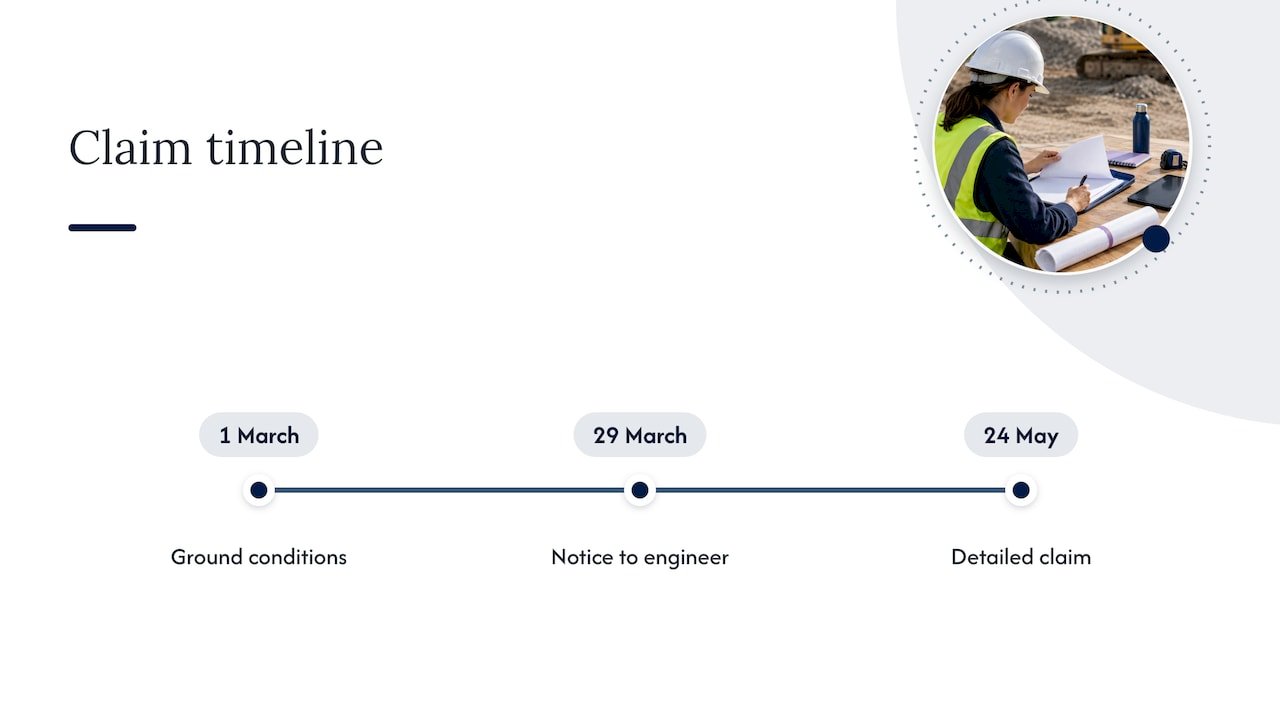
Under the 2017 Red Book, claims by either side sit in Clause 20 and follow the same procedure. Fenwick Elliott explains that a Notice of Claim is due within 28 days and a fully detailed claim within 84 days, or another agreed period. The engineer must give further notices before rights can be lost for late compliance.
A worked example makes the timing clear. Suppose a contractor hits unforeseen ground conditions on 1 March. Under the 28-day rule the notice of claim must reach the engineer by 29 March. Under the 84-day rule the detailed claim, with its cost and time calculation, is due by 24 May. A site team that only realises on 15 April what the ground conditions mean may already be late. This is why site engineers, planners and commercial staff all need to know the clauses, not just the contracts manager. Our Claims and Disputes under FIDIC Contracts course and our Construction Delay Analysis and Claims Management course are the ones to look at here.
Weather shows how precise the wording is. Gowling WLG notes that the 2017 Red and Yellow Books give an extension of time for “exceptionally adverse climatic conditions”, meaning unforeseeable conditions judged against climatic data made available by the employer or published for the site’s location.
Disputes: the engineer, the DAAB and arbitration
FIDIC uses a staged route. Gowling WLG explains the steps:
- A claim is notified to the engineer within 28 days of the event.
- The engineer’s decision is binding but open to a Notice of Dissatisfaction.
- The dispute goes to a Dispute Avoidance/Adjudication Board (DAAB) under the 2017 forms, or a Dispute Adjudication Board (DAB) under 1999. It must give a reasoned decision within 84 days.
- A dissatisfied party has 28 days to issue a Notice of Dissatisfaction, after which the matter may go to arbitration.
- Failure to comply with a DAAB decision can be referred directly to arbitration.
The 2017 change is that the board stands from the start of the project. Pinsent Masons explains that a standing DAAB is appointed at project start, within an agreed time or 28 days after the letter of acceptance (Sub-Clause 21.1). FIDIC is the default appointing official if the parties fail to appoint (Sub-Clause 21.2). The DAAB has new dispute-avoidance duties, including site visits and informal assistance when both sides ask for it (Sub-Clause 21.3).
The point for managers is simple. The route is a strict timetable, and rights can depend on meeting it.
FIDIC vs NEC: the differences that matter
If you work in the UK, you will often be asked how FIDIC compares with NEC, the other family of contracts used widely in UK public works. KPMG’s Infrastructure Advisory describes FIDIC as clause-based, prescriptive and legally formal. It suits design-bid-build or design-build models with clearly defined risk allocation and a multi-tiered dispute process. NEC is a flexible, plain-language, options-based form suited to collaborative, performance-based delivery, with the Accepted Programme at its core.
| Point | FIDIC | NEC |
|---|---|---|
| Style | Clause-based, prescriptive, formal | Plain language, options-based |
| Administration | Engineer employed by the employer, acting as a skilled professional | Project manager with proactive, positive obligations |
| Risk and time | Early warning and clearly specified grounds for extension of time | Compensation events, with the Accepted Programme at the core |
| Claims | Notice, then a detailed claim within set periods | Notification and assessment as events occur |
| Weather | Exceptionally adverse climatic conditions | Weather less frequent than once in 10 years may be a compensation event |
| Typical reach | Widely used internationally, including domestic projects with international parties | Common in UK and domestic-style programmes |
The administration and weather rows come from Hill Dickinson and Gowling WLG. Hill Dickinson also describes FIDIC as the most widely used form of construction contract across the globe. The same article says NEC4 was released in 2017 with amendments in 2019, 2020 and 2023.
Which is better? That depends on the project and the parties. KPMG’s view is that adopting NEC for collaboration needs a cultural shift, and that FIDIC can still support collaboration, for example through value engineering, depending largely on the people rather than the form. The practical conclusion is that both forms need trained administrators. A team moving between the two should be taught the logic of each, because the habits that work under one can cost money under the other.
Who needs to understand FIDIC in your organisation
FIDIC is not only for lawyers. Each role meets it differently:
- Contract and commercial managers run the notices, valuations and variations.
- Site and project engineers must record events fast enough to protect a claim.
- Planners produce the time evidence that supports extension of time.
- Procurement and HR leads choose which colour book and which amendments suit the project, and decide who needs training.
- Individual professionals gain a credential that travels, because the forms are used in about 100 countries.
For a team starting from scratch, a broad programme such as our Construction Contracts Masterclass lays the foundations. Our Advanced FIDIC Contracts in International Contracting course is for people who already administer these contracts. Oil and gas teams can look at our Oil and Gas Contracts course. If you are weighing options, our guide to construction contract management training explains what to look for.
Training your team on FIDIC with Oxford Centre
Oxford Centre offers professional training with global accreditation across project management, civil engineering, oil and gas, compliance and other fields. Courses can be customised for corporate teams and delivered on-site, online or blended, so a project team can learn on the contract it will actually administer. Our trainers are industry experts who work from real-world challenges.

If you manage a team or your own career in contracts, start with our project management training, or see what we run in London. You can also look at the full range on our home page.
Our perspective
Most of the FIDIC problems we hear about are not about the form. They come from a notice that nobody sent, a record that nobody kept or an amendment that nobody read.
That is why we build training around the contract a team will actually run. The colour book matters, but so do the Particular Conditions, the people in the roles and the habits they bring from the last project.
A site engineer, a planner and a commercial manager each need a different part of the same clause set. Our customisable format, delivered on-site, online or blended, lets a team learn it together, with expert trainers who tie each clause to the decisions made on a real project. That is how accredited learning becomes fewer surprises on site.
Sam
FAQ
What is a FIDIC contract?
A FIDIC contract is a standard form of construction contract published by the International Federation of Consulting Engineers. It sets the terms between an employer and a contractor, with an engineer administering the contract on the employer’s behalf. It is used on projects in many countries.
What are the main FIDIC contract types?
The main forms are the Red Book (employer designs), the Yellow Book (contractor designs), the Silver Book (turnkey) and the Gold Book (design, build and operate). There is also a Green Book short form and a Pink Book for bank-financed projects. The right choice depends mainly on who takes the design risk.
Are the 1999 FIDIC contracts still used?
Yes. FIDIC’s press release says the 1999 editions can still be used after the 2017 second editions were launched. Check which edition your contract uses, and read its Particular Conditions, because the clause numbers and dispute procedure differ.
What is the difference between FIDIC and NEC?
FIDIC is clause-based and formal, with an engineer administering the contract and strict notice periods. NEC is plain-language and options-based, with a project manager who has positive duties and an Accepted Programme at its centre. Both work best when the people administering them are trained in them.
How long do I have to make a claim under FIDIC?
Under the 2017 Red Book, you give a Notice of Claim within 28 days and submit a fully detailed claim within 84 days, unless another period is agreed. Your contract’s amendments may change this, so check the contract itself and take legal advice on a live claim.
Sources
- FIDIC: About Us
- FIDIC: About Publications
- Taylor Wessing: 2017 FIDIC Suite
- Muckle LLP: A brief introduction to FIDIC forms of construction contract
- FIDIC: The FIDIC Suite of Contracts
- FIDIC: Which FIDIC Contract should I use?
- FIDIC: Rainbow Suite 2017 press release
- Fenwick Elliott: Changes to the claims provisions in the 2017 FIDIC Red Book
- Gowling WLG: A guide to dispute resolution under FIDIC
- Pinsent Masons: How the FIDIC Red Book handles enforcing dispute adjudication board decisions
- Gowling WLG: Adverse weather claims
- KPMG: Driving success in complex built environment programmes
- Hill Dickinson: NEC, JCT and FIDIC contract differences