
Coaching skills for managers come down to a few habits: listening properly, asking open questions, giving specific feedback and helping people choose their own next step instead of handing them yours. They are learnable, but they are learnt by practising in real 1:1s with feedback, not by reading a list. That is why the most reliable route for a team is structured, expert-led training built around your own situations, which is what we offer at Oxford Centre in on-site, online or blended formats.
This guide is for HR managers, learning leads and managers who want to know what the skills are, how a coaching conversation runs, and how to turn the habit into something the whole organisation uses.
TL;DR
- Coaching as a manager means guiding people through conversation and questions so they find their own solutions, while still holding them accountable.
- The core skills are active listening, open questions, specific feedback, goal setting and knowing when to stop advising.
- A simple structure such as GROW (Goal, Reality, Options, Way forward) keeps a coaching conversation on track.
- Coaching differs from mentoring and training: pick the approach that fits the person’s skill, will and need.
- Skills stick when managers practise them on live work with expert feedback, which is where tailored training earns its place.
Table of Contents
- What coaching means when you are a manager, not a professional coach
- Coaching, mentoring and training: which one fits
- The coaching skills that matter most
- How to run a coaching conversation with GROW
- Where coaching fits in a manager’s week
- What the evidence says about results
- Why practice with feedback beats reading about it
- Building a coaching culture at work
- Our approach to training managers to coach
- Our view: coaching is a habit, not a course
- FAQ
- Sources
What coaching means when you are a manager, not a professional coach
A manager who coaches is not running therapy sessions or acting as an external coach. The International Coaching Federation (ICF) is the professional body for coaches. Its research found that managers and leaders typically guide team members through conversation and questioning rather than professional coaching. The same study found that coaching skills have a positive effect on the manager and employee relationship and can raise engagement.
The practical shift is from telling to asking. MIT’s HR team describes coaching as a move from controlling and monitoring performance to a consultative, participative partnership. It also stresses that coaching is not hands-off: employees stay accountable to the performance plans you agree together.
The University of Sussex contrasts the two styles clearly. A coaching approach empowers people and encourages self-reflection, while a purely directive approach limits initiative, assumes there is one right way and can lead to disengagement. You still tell people things when that is the right move. Coaching adds a second gear.
Coaching, mentoring and training: which one fits
Managers often mix these up, and the mix-up leads to the wrong tool being used. The ICF’s literature review separates four distinct activities: leading, managing, coaching and mentoring. The CIPD, the UK’s professional body for HR, describes coaching as a non-directive development approach focused on specific skills and goals, and mentoring as a longer-term relationship in which a more experienced colleague shares knowledge.
Training is the third piece: structured teaching of a defined skill or body of knowledge, usually to a group.
| Coaching | Mentoring | Training | |
|---|---|---|---|
| Core move | Asks questions so the person finds their own answers | Shares experience and advice | Teaches a defined skill or method |
| Who leads | The person being coached chooses the issue | A more experienced colleague | A trainer with a set curriculum |
| Time frame | A defined period or an ongoing management style | Usually longer term | A course or programme |
| Best when | The person has the skill but needs clarity, confidence or ownership | They need guidance from someone who has done it | They lack the knowledge or technical skill |
A quick test for a manager: if the person does not yet know how to do the task, train or show them. If they know how but are stuck, unsure or not owning the result, coach. If they want to learn how a career path works, a mentor helps. The Otago HR toolkit, following Max Landsberg, frames the first step of coaching as diagnosing the other person’s skill and will before choosing an approach. The CIPD adds that coaching is not the answer to every development need and that readiness should be assessed first.
That is also the answer to leadership coaching versus leadership training. Training gives a leader the tools. Coaching helps them apply the tools to their own team and decisions. The strongest programmes use both.
The coaching skills that matter most
The pages that rank for this topic list slightly different numbers of skills, but the same core keeps appearing. Here is that core, with what each skill looks like in a real conversation.
Active listening
Google’s re:Work team suggests leaders start small, for example by focusing on active listening in the next 1:1. In practice this means letting the person finish, summarising what you heard in your own words, and noticing what they leave out. Most managers find the hard part is staying quiet for ten seconds after asking a question.
Open questions
Open questions start with “what” or “how” and cannot be answered with yes or no. “What have you already tried?” gets more than “Have you tried restarting the process?” The same re:Work guide recommends open-ended “what” and “how” questions over closed ones. “Why” questions can sound like blame, so swap “Why did that slip?” for “What got in the way?”
Specific, timely feedback
Coaching needs feedback that is about behaviour and given close to the event. “The client summary was clear and you answered their budget question before they asked” helps someone repeat it. “Good job” does not. When the feedback is corrective, the same rule applies: describe what happened, the effect, and ask how they would handle it next time.
Goal setting and accountability
The University of Minnesota’s HR office defines coaching as equipping people with the tools, knowledge and opportunities they need to develop themselves. Its five-step process ends with application and accountability: the person commits to an action and you agree when you will look at it together.
Knowing when to stop advising
This is the skill most managers lack, because advice feels helpful. Google’s guidance is to reflect on your own assumptions, facilitate a two-way discussion and know when to stop giving advice. A useful rule: ask two more questions before you offer your own answer.
Creating a safe space
MIT’s HR team notes that the coach has to create a safe environment for creativity and risk-taking, where mistakes are treated as lessons learned. If people fear the consequences of an honest answer, no question technique will work.
How to run a coaching conversation with GROW
GROW is a four-step framework developed in the UK. Google’s re:Work guide recommends it to guide managers from an initial goal toward a clear course of action. It works best when the team member wants to be coached and chooses the issue they bring.
- Goal. Agree what the person wants from the conversation. “What would a good outcome of this chat look like?” Keep it specific enough to check later.
- Reality. Explore where things stand now. “What is happening at the moment? What have you tried? What is in your control?” Resist solving yet.
- Options. Ask for ideas before offering yours. “What could you do? What else? What would you advise a colleague to do?” Aim for at least three.
- Way forward. Turn one option into a commitment. “What will you do, by when, and what might get in the way?” Agree when you will follow up.
Here is a worked example. A team leader says a report keeps going out late. A telling manager says, “Start earlier.” A coaching manager asks what a good outcome would be (Goal: reports out by Thursday noon), what currently happens on Wednesdays (Reality: three urgent requests arrive from other teams), what could change (Options: block two hours, agree a cut-off for requests, delegate data gathering), and what the leader will try first (Way forward: block Wednesday mornings and tell the other teams by Monday). The leader owns the plan, so it is far more likely to happen.
The Otago toolkit wraps GROW in a three-stage structure: set the context, provide ongoing coaching, then conclude effectively by encouraging reflection, eliciting feedback and agreeing next steps. For managers who want to see how session scripts and question prompts can be laid out, these coaching session script models are a handy reference.
One caution on frameworks. A meta-analysis of 20 workplace coaching studies found that no single framework outperformed the others, while an integrative approach combining frameworks produced the best outcomes. Treat GROW as a scaffold, not a script.
Where coaching fits in a manager’s week
Coaching is not a separate event. The University of Sussex lists the everyday moments where a coaching approach works: development reviews, regular 1:1s, difficult conversations such as performance issues, managing the impact of change, team coaching and day-to-day interactions.
Some practical ways to build it in:
- In 1:1s. Spend the first half on the other person’s agenda. Ask what they want to talk about before you share yours.
- In delegation. Instead of explaining how to do a task, ask how they plan to approach it. Our Delegation and Empowerment Skills training course and the Management by Delegation training course sit naturally alongside coaching for this reason.
- In difficult conversations. Start with the person’s view of the problem before giving yours. Our Difficult Conversations for Managers course covers this territory for managers.
- During change. Ask what worries people and what would help, rather than repeating the plan louder.
If you want more on how the leadership side fits together, our article on coaching and mentoring as a leadership advantage goes deeper, and basic leadership skills for managing employees covers the foundation underneath.
What the evidence says about results
The research on workplace coaching is encouraging, though effects vary by outcome. The 2022 meta-analysis of 20 studies with 957 participants found a moderately positive overall effect (g=0.51), with the largest effect on goal attainment (g=1.29) and smaller but significant effects on self-efficacy, other-rated performance and wellbeing. In plain terms, coaching helps people reach the goals they set and feel more capable of doing so.
A study of managerial coaching specifically found that coaching and time spent with managers explained 36% of the variance in personal learning and 24% in organisational commitment, and that coaching was negatively associated with intention to leave. The authors suggest coaching fosters trust and ownership, which feeds commitment. The ICF reaches a similar view: managers’ use of coaching skills is best seen as a form of participative management that builds relationships and job satisfaction.
The point for an HR lead: the return does not come from a one-off workshop. It comes from managers using the habit every week.
Why practice with feedback beats reading about it
SHRM’s 2026 guidance on moving managers from bosses to talent coaches says managers need clarity on why coaching matters, specific behaviours to adopt, and real practice opportunities in delegation, feedback sessions and 1:1s. It also suggests that managers benefit from experiencing coaching themselves.
That list explains why self-study alone tends to stall. A manager can learn the GROW stages in ten minutes and still fall back on advice-giving in the first stressful conversation. What changes the habit is rehearsing with realistic scenarios, receiving feedback from an experienced trainer, and trying the skill on live work between sessions.
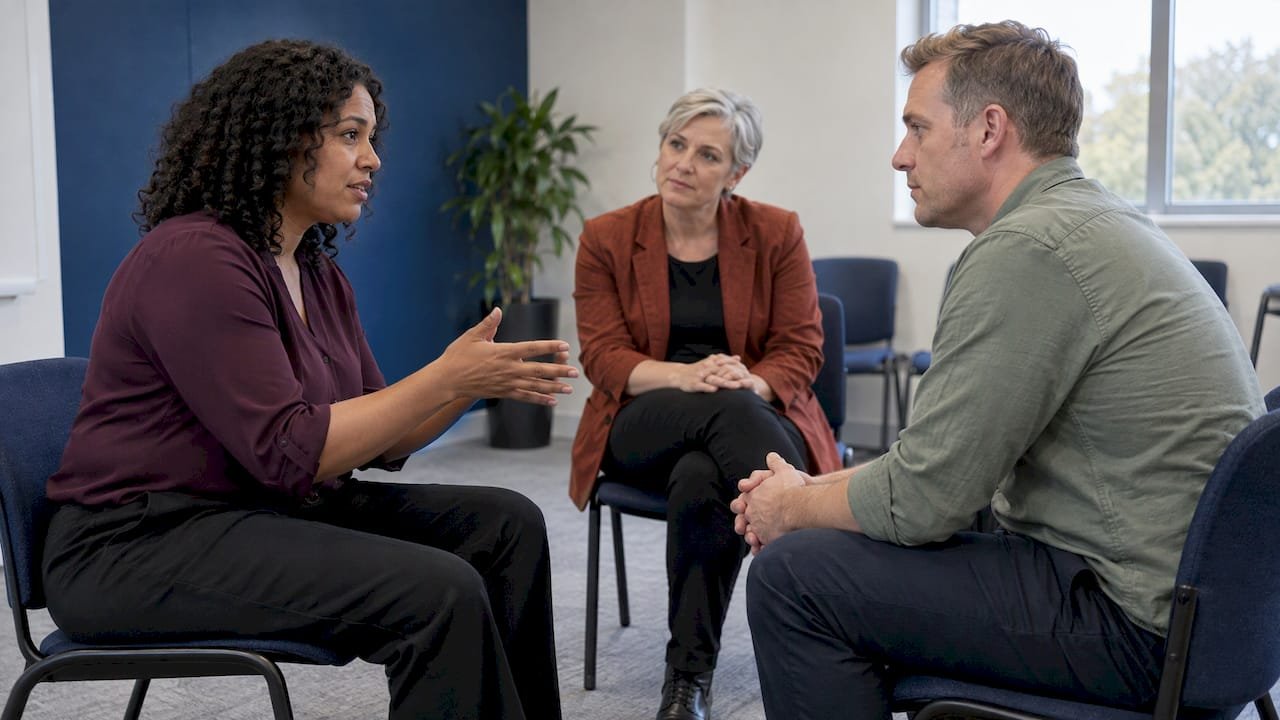
Training that mirrors your own context works better than generic material. A manager in a hospital team, an engineering project office and a finance function faces different conversations. Our courses are customisable to the organisation, delivered on-site, online or blended, and led by industry expert trainers, so the scenarios in the room are the ones your managers actually face. Our Coaching for Performance Excellence training course is the starting point for this topic.
Building a coaching culture at work
A coaching culture exists when asking questions, giving feedback and owning development are normal across teams, not just in the departments with a keen manager. An ICF case study of MD Anderson Cancer Center reports that developing internal coaches through an ICF-accredited programme increased access to coaching, strengthened the culture and became a scalable, sustainable model.
For most organisations the steps are:
- Start with senior managers. People copy what leaders do. If directors only issue instructions, the programme will not spread.
- Define the behaviours. Write down what you expect: for example, a 1:1 every fortnight, open questions first, a written next step.
- Train in cohorts. Managers from different departments practise together and share what works.
- Give them somewhere to practise. Build coaching into existing 1:1s and reviews rather than adding meetings.
- Review and reinforce. Ask in performance reviews how people were helped to develop, not just what they delivered.
- Keep clear agreements. The ICF notes obstacles such as a lack of written coaching agreements and varying confidentiality, so state what stays between manager and employee and what does not.
HR can also look at how coaching and mentoring are used across the organisation. Our piece on leadership coaching and mentoring for HR professionals is a good companion, and manager communication training for hybrid teams helps when teams are split across locations.
Our approach to training managers to coach
Oxford Centre provides professional training courses with global accreditation across leadership, management, compliance, safety, project management, healthcare, oil and gas, civil engineering and IT. For a coaching programme, the useful part is that the content is customisable: we can shape it around your sector, your managers’ level and the conversations they find hardest, and deliver it on-site, online or blended.
If you are an HR manager planning a cohort, or an individual professional moving into people management, you can browse our full course list or start from the Coaching for Performance Excellence course and tell us about your team.
You can also reach us through the Oxford Centre site to discuss what a programme for your managers would look like.
Our view: coaching is a habit, not a course
We think the biggest mistake organisations make is treating coaching as a topic to be covered. A workshop that explains GROW and ends at lunchtime gives managers a new word for what they already do.
What changes behaviour is repetition in realistic conditions. A manager rehearses a hard conversation with an expert trainer, sees where they slip back into telling, and tries again. Then they take the same skill to a real 1:1 the following week.
That is why we build programmes around the organisation’s own situations and offer them on-site, online or blended, led by trainers from industry. The goal is a manager who asks a better question on Tuesday morning, not a certificate on a wall.
If your managers already have technical skill, coaching is the layer that turns it into a stronger team. We would start with the conversations that matter most to you.
Sam
FAQ
What are the most important coaching skills for managers?
Active listening, open questions, specific feedback, goal setting and the discipline to stop advising are the core set. Add a safe environment and clear accountability for actions. Practise one skill at a time, for example listening in your next 1:1.
What is the difference between coaching and mentoring?
Coaching is non-directive and focused on specific skills and goals, helping a person find their own answers. Mentoring is a longer-term relationship where a more experienced colleague shares knowledge and advice, according to the CIPD factsheet. A manager can use both, depending on what the person needs.
Is GROW the only framework managers can use?
No. GROW is popular because it is simple: Goal, Reality, Options, Way forward. Research on workplace coaching found no single framework outperformed the rest, so use it as a structure and adapt the questions to the person and the situation.
When should a manager not coach?
When the person lacks the knowledge to do the task, teaching or training comes first. The CIPD also advises assessing readiness before coaching. Coaching works best when the person wants it and brings their own issue.
How long does it take to become a good coaching manager?
The basics can be learnt in a short programme, but the habit builds over weeks of real conversations. Regular 1:1s, a defined structure and feedback from a trainer or peers speed it up. Cohort training for several managers at once also helps the habit spread.
Sources
- Coaching skills for managers, University of Sussex
- What Is Coaching? MIT Human Resources
- An Exploration of the Coach Approach to Managing and Leading, ICF
- Coaching and mentoring factsheet, CIPD
- Coaching, University of Minnesota Office of Human Resources
- Moving Managers from Bosses to Talent Coaches, SHRM
- Coach using the GROW model, Google re:Work
- HR Manager’s Toolkit: Coaching, University of Otago
- Meta-analysis of psychologically informed workplace coaching
- An Examination of Relationships between Managerial Coaching and Employee Outcomes
- MD Anderson Cancer Center case study, ICF