
ISO 31000 is a short, flexible set of guidelines that any organisation can apply to any kind of risk. COSO ERM is a longer, strategy-led framework built around governance, risk appetite and board reporting. Neither is simply better: ISO 31000 suits teams that want a practical risk process, COSO ERM suits organisations that need risk tied tightly to strategy and internal control, and many use both. The sections below show where they differ, how to choose, and what your people need to learn to apply either one.
TL;DR
- ISO 31000:2018 is guidance, not a certifiable standard. You use it to design and audit your own risk management.
- COSO ERM (revised in 2017) is a framework from US professional bodies that places risk inside strategy, performance and board oversight.
- ISO 31000 is a broad, process-based guide; COSO ERM is more detailed and control-oriented, and speaks most directly to accountants and auditors.
- Many organisations combine them: COSO ERM for enterprise governance and appetite, ISO 31000’s process for day-to-day and project risk.
- Whichever you pick, the real gain comes from trained people who can apply it consistently.
Table of Contents
- What each framework is
- ISO 31000 and COSO ERM side by side
- Where they differ most
- How they work in practice
- Which one should you use?
- Whichever framework you pick, people make it work
- How Oxford Centre can help your team
- Our view
- FAQ
- Sources
What each framework is
ISO 31000
ISO 31000:2018 is the international standard for risk management. It gives principles and guidelines for identifying, analysing, evaluating, treating, monitoring and communicating risk across an organisation. ISO reviewed and confirmed the 2018 edition in 2023.
One point trips up many buyers of training: ISO states that ISO 31000 cannot be used for certification. You will not see a “certified to ISO 31000” badge for an organisation. What you can do is use it to guide internal or external audit programmes and to compare your practice against an internationally recognised benchmark. Individuals, by contrast, can take accredited training in how to apply it.
COSO ERM
COSO is the Committee of Sponsoring Organizations of the Treadway Commission. Founded in 1985, it is made up of five US professional bodies, including the Institute of Internal Auditors and the American Institute of CPAs, and issues guidance on internal control, enterprise risk management (ERM), governance and fraud deterrence.
Its ERM framework was updated in 2017 to reflect growing risk complexity and boards’ demand for better risk reporting, and COSO also published a compendium of worked examples. The Airmic guide describes its principles as grouped under governance and culture, strategy and objective setting, performance (risk in execution), information, communication and reporting, and monitoring of ERM performance.
ISO 31000 and COSO ERM side by side
| Question | ISO 31000:2018 | COSO ERM (2017) |
|---|---|---|
| Origin | International standards body | Five US professional bodies |
| Length | About 16 pages | Executive summary of 16 pages, full framework over 100 pages |
| Structure | Separates principles, framework and process | Combines them in one structure of five components |
| Main audience | Broad: any organisation or function | Accounting, auditing and finance professionals |
| View of risk | Uncertainty that can bring threats and opportunities | Focused on threats to strategy, with opportunities considered at strategy setting |
| Key concept | Risk criteria | Risk appetite, tolerance and capacity |
| Certification | Not certifiable | Framework, used for design and assurance |
The page counts and the appetite versus criteria distinction come from a TechTarget comparison.
Where they differ most
Structure and level of detail
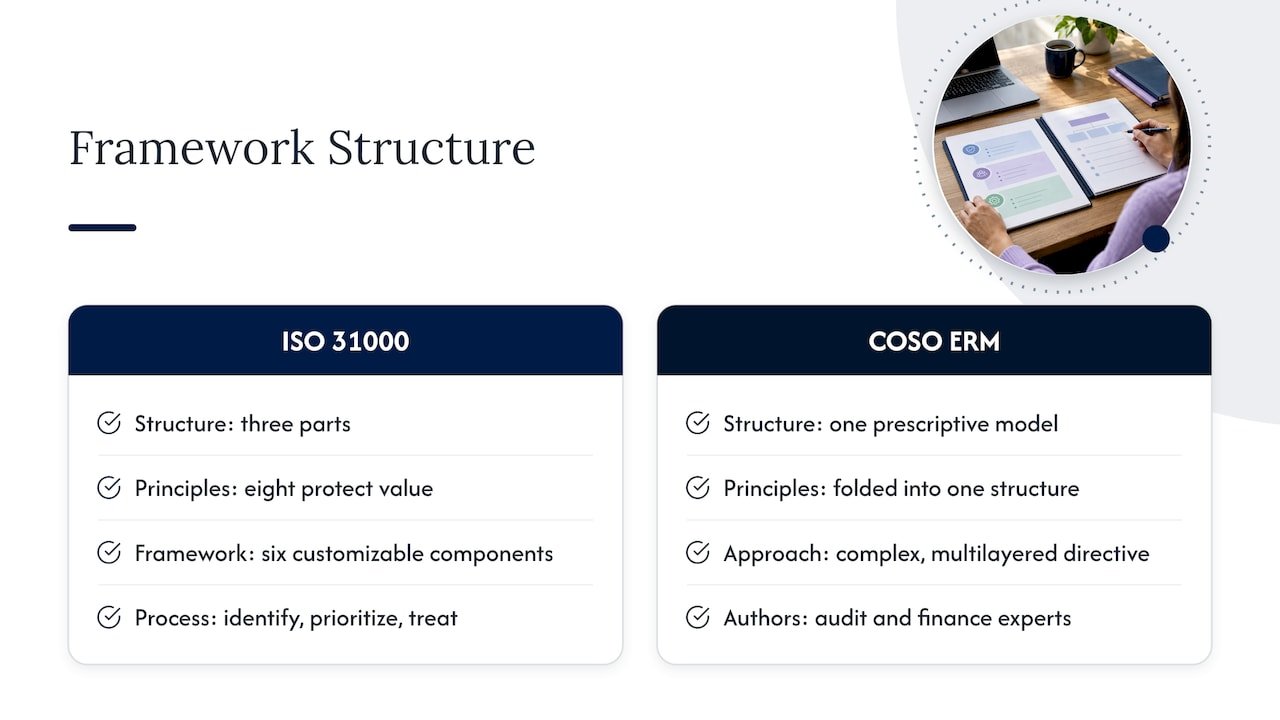
ISO 31000 has three parts. Its eight principles explain why risk management exists, which is to create and protect value. Its framework has six customisable components: leadership and commitment, integration, design, implementation, evaluation and improvement. Its process covers risk identification, evaluation, prioritisation and treatment, with communication, monitoring, review and reporting running alongside.
COSO ERM folds all of that into a single, more prescriptive structure. A 2011 comparison for the Society of Actuaries described COSO as a complex, multilayered directive that many organisations found hard to implement, written by auditors, accountants and financial experts, while ISO offers a more streamlined, process-based approach written by risk practitioners.
That is why ISO 31000 tends to feel quicker to start with, and COSO ERM feels more thorough once you are building governance around it.
Risk appetite and tolerance
COSO makes appetite central. Risk appetite is a broad, entity-wide concept of how much risk the organisation is willing to take in pursuit of its goals. Tolerance is narrower and set per operating unit, and the combined tolerances should sit within the appetite set by top management and the board. ISO 31000:2018 talks instead about risk criteria, the terms against which the significance of a risk is judged. In practice the two ideas overlap, but COSO gives boards a more explicit vocabulary for it.
Governance and accountability
Both give leadership a role. ISO 31000 assigns accountability so that top management is accountable for managing risk and oversight bodies for overseeing it. COSO’s governance and culture component stresses board oversight, defined responsibilities and a risk-aware culture.
The actuaries’ paper raised one governance point worth knowing: under COSO, there is a conflict if internal audit both runs and audits the programme, whereas ISO leaves room for independent audit at the monitoring and review stage. When you design your own set-up, decide early who owns the risk process and who assures it. Splitting those roles clearly is the same discipline you see in operational settings, such as fire safety manager collaboration with engineers, where each party knows what it owns.
How they work in practice
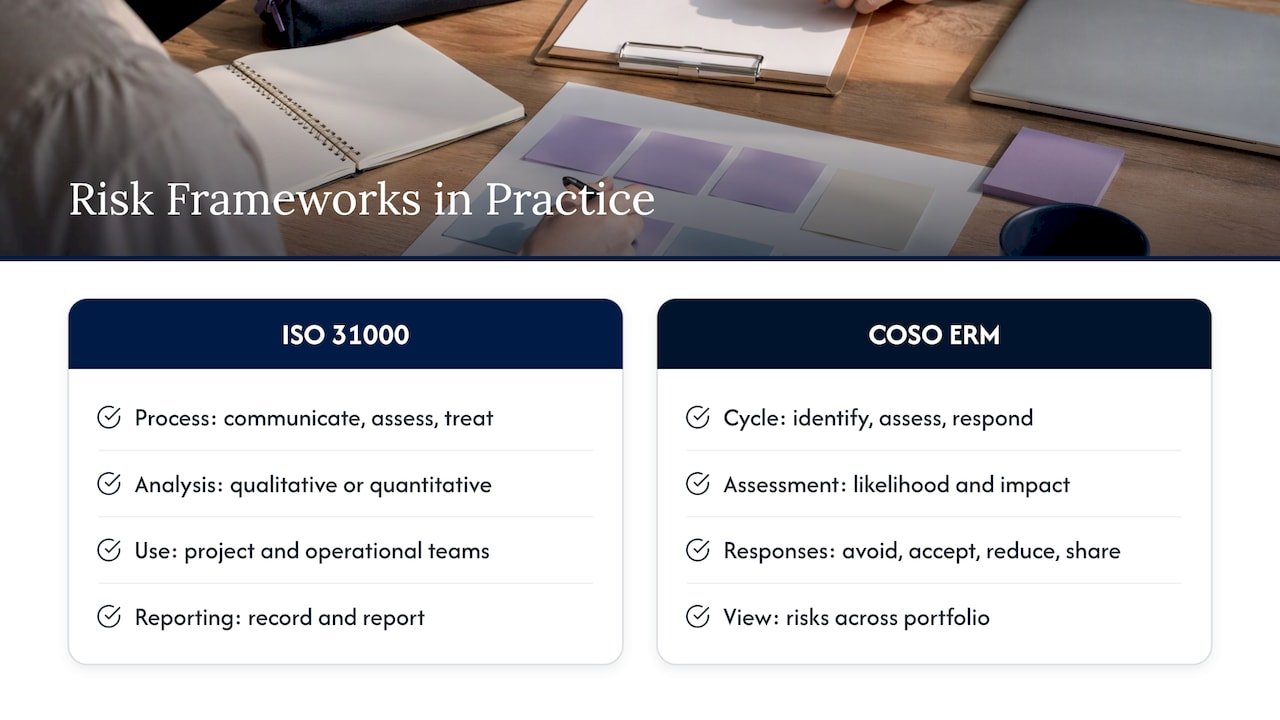
In ISO 31000, the working core is the process in clause 6: communication and consultation, scope, context and criteria, then identification, analysis, evaluation, treatment, monitoring and review, and recording and reporting. Analysis can be qualitative, quantitative or a mix, which suits project teams, safety managers and operational leads who need a method they can apply this week.
In COSO ERM, the identify, assess and respond cycle sits in the Performance component. Risks are assessed by likelihood and impact, then answered by avoiding, accepting, reducing or sharing them, and the organisation builds a portfolio view of how risks interact. The other components around it cover governance, strategy, reporting and review, which is why COSO feels more like a board-level operating model.
A practical test: if your immediate problem is “our project and operational teams have no common risk method”, ISO 31000’s process answers it directly. If it is “our board cannot see how risk links to strategy and internal control”, COSO ERM’s structure answers it.
Which one should you use?
Compare the two against your own situation rather than against each other in the abstract.
- Broad, mixed operations or project-heavy work: ISO 31000. Its flexible process suits teams in construction, energy, healthcare or IT that need a shared method.
- Listed, finance-led or heavily regulated organisations, especially with US exposure: COSO ERM. Its control and reporting focus matches what auditors and boards expect.
- Small and medium organisations: either. The ILO’s 2023 guide says both frameworks share many attributes and can be tailored and simplified to be realistic for smaller businesses.
- Organisations that want both strategy and day-to-day control: combine them. TechTarget’s comparison suggests reviewing both and choosing what fits your culture, or combining ISO 31000’s broader directives with COSO’s relevant principles.
A common layered model uses COSO ERM at enterprise level for governance, appetite and board reporting, and ISO 31000’s process at project and operational level, with project risks rolling up into the enterprise view. Another route is to start with ISO 31000 and add COSO components as the organisation matures.
Whichever framework you pick, people make it work
A framework on paper changes nothing until managers use the same language, score risks consistently and escalate them properly. That is a training problem as much as a design problem, and it is where HR and learning teams come in. Typical gaps include:
- Risk owners who cannot tell a risk from an issue.
- Project managers who record risks once at kick-off and never review them.
- Boards that receive long registers but no view of appetite.
- Compliance and safety leads working to separate, unconnected methods.
For individuals, risk-framework knowledge sits well alongside governance, contract and project skills. It is useful for project managers moving into programme roles, auditors and compliance officers, and operational managers who inherit risk responsibilities.
How Oxford Centre can help your team
Oxford Centre delivers professional training with global accreditation across project management, healthcare, oil and gas, civil engineering, IT, management, leadership, compliance and safety. Courses can be customised for corporate teams and delivered on-site, online or blended, so a team can learn the risk method that matches the framework your organisation has chosen.
For governance and risk, start with the Corporate Governance, Risk and Ethics Compliance course or the Contract Risk Management course. Project teams can look at our project management courses, and safety-focused teams at the ISO 45001 Occupational Health and Safety course. For information security risk, there is also the ISO 27005 Information Security Risk Management course. You can see everything we offer on the Oxford Centre home page.
Our view
Most organisations that ask us about ISO 31000 versus COSO are really asking a different question: how do we get everyone managing risk the same way? The framework matters less than the habit.
We design training around the organisation, not around a brochure. Our approach is highly customisable course content, delivered on-site, online or blended, by industry expert trainers working on your real-world challenges. A project team in construction and a compliance team in healthcare face different risks, and they should practise on their own.
Our advice is to settle your governance model first, whether that is ISO 31000, COSO ERM or a layered mix, then train the people who will run it, from board reporting to the project risk register. Accredited, role-specific learning is how a framework becomes a routine.
Sam
FAQ
Is ISO 31000 the same as COSO ERM?
No. ISO 31000 is a short international guideline with separate principles, framework and process. COSO ERM is a longer US-origin framework that links risk to strategy, performance and board oversight. They overlap in aims, and the ILO notes they share many attributes.
Can you be certified in ISO 31000?
Organisations cannot be certified to it, because ISO states the standard is not intended for certification. It can still guide internal or external audit programmes. Individuals can attend accredited training on applying it.
Which is easier to implement?
ISO 31000 is usually quicker to start with because it is short and process-based. COSO ERM is more detailed, which helps where boards and auditors need defined governance, appetite and reporting, but it takes more effort to set up.
Can we use both frameworks together?
Yes, and many organisations do. A common pattern is COSO ERM for enterprise governance, appetite and board reporting, with ISO 31000’s process for operational and project risk feeding upward.
Is ISO 31000 being revised?
The 2018 edition was reviewed and confirmed by ISO in 2023 and remains the published edition. Check the ISO standard page for the current status before you plan around any change.
Sources
- ISO 31000:2018 Risk management guidelines, ISO
- Enterprise Risk Management, COSO
- ISO 31000 vs. COSO: Comparing risk management standards, TechTarget
- The New International Standard on the Practice of Risk Management, Society of Actuaries
- URMIA Enterprise Risk Management Resource for Higher Education
- Enterprise Risk Management: Frameworks, Elements, and Integration, St. John’s University
- Airmic Explained: risk and managing risk
- Enterprise Risk Management guide, ILO
- Risk management frameworks compared, SmartSuite
- Risk management principles: Understanding ISO 31000 and COSO ERM, Wolters Kluwer