
NEBOSH and IOSH are not two brands of the same product. NEBOSH is an awarding body: it writes the syllabus and sets the exams for its qualifications. IOSH is the Chartered body for health and safety professionals: it runs membership and also offers its own courses. So the practical choice is this. Pick an IOSH course when you need a short, practical grounding for managers or staff. Pick a NEBOSH qualification when someone is building a health and safety career or taking on formal responsibility for it.
This guide is written for HR managers, learning and development leads, project managers and individual professionals who have to decide which route to book, and who want to avoid paying for the wrong level.
TL;DR
- NEBOSH awards formally assessed qualifications. IOSH is a membership body that also offers shorter courses. They are not direct rivals.
- IOSH courses suit managers and supervisors who need working knowledge in a few days. NEBOSH suits people who want a recognised qualification and a career in health and safety.
- Match the course to the job: a line manager, a site supervisor and a full-time safety adviser need different things.
- Check how the course is assessed, who it is delivered by, and whether it will be recognised by your employer, client or insurer before you book.
- For teams, a customised programme in a safety standard such as ISO 45001 can sit alongside either route.
Table of Contents
- What each organisation actually is
- NEBOSH vs IOSH at a glance
- Is NEBOSH above IOSH?
- How to choose by role
- Study time, difficulty and pass rates
- What affects the cost
- Questions to ask before you book
- What has changed recently
- Where a customised safety programme fits
- Our perspective
- Plan your team’s safety training with us
- FAQ
- Sources
What each organisation actually is
The confusion starts because people use “IOSH” and “NEBOSH” as if both were exam brands. They are different kinds of organisation.
NEBOSH: the awarding body
NEBOSH stands for the National Examination Board in Occupational Safety and Health. It develops qualifications, sets the assessments and awards the certificate. The teaching itself is delivered by approved learning partners, so two people on a NEBOSH course in different towns sit the same assessment standard even if their classrooms differ.
NEBOSH qualifications are laddered. Many people start with a General Certificate, then move on to a Diploma if they want to work as a full-time health and safety practitioner. There are also industry-specific certificates, for example for construction, fire safety or environmental management, so you can match the topic to the sector you work in.
IOSH: the membership body that also trains
IOSH, the Institution of Occupational Safety and Health, is a Chartered professional body. Safety practitioners can join it, work towards recognised membership grades, and use its resources and networks. Alongside that, it offers a set of its own courses. The best known are Working Safely, aimed at people who are not managers, and Managing Safely, aimed at supervisors and line managers.
That dual role is why you see comparison pages arguing that NEBOSH is “more academic” while IOSH is “more accessible”. Both statements point at the same real difference: one is a qualification route, the other is partly a professional community with short courses attached.
NEBOSH vs IOSH at a glance
| Question | IOSH courses | NEBOSH qualifications |
|---|---|---|
| What is the body? | Chartered membership body that also offers courses | Awarding body that sets syllabuses and assessments |
| Typical learner | Managers, supervisors, general staff | Aspiring and practising health and safety professionals |
| Typical length | Short: often a few days | Longer: usually spread over weeks, and longer again for a Diploma |
| Depth | Practical awareness and management basics | Deeper theory, legal context and risk management |
| Assessment | Usually a short assessment at the end of the course | Formal examinations and, for many units, a practical or project element |
| Main outcome | Working knowledge and a course certificate | A recognised qualification and a route to further study |
| Best for | Meeting a training need quickly | Building a safety career or taking formal responsibility |
Treat the lengths and assessment formats as typical rather than fixed. They change by course, by provider and by delivery mode, so confirm them on the awarding body’s page and the booking page before you commit.
Is NEBOSH above IOSH?
In terms of depth and formality, yes: NEBOSH qualifications generally go further than an IOSH short course, and they sit on a progression ladder that leads to Diploma level. But “above” suggests one replaces the other, and that is the wrong way to think about it.
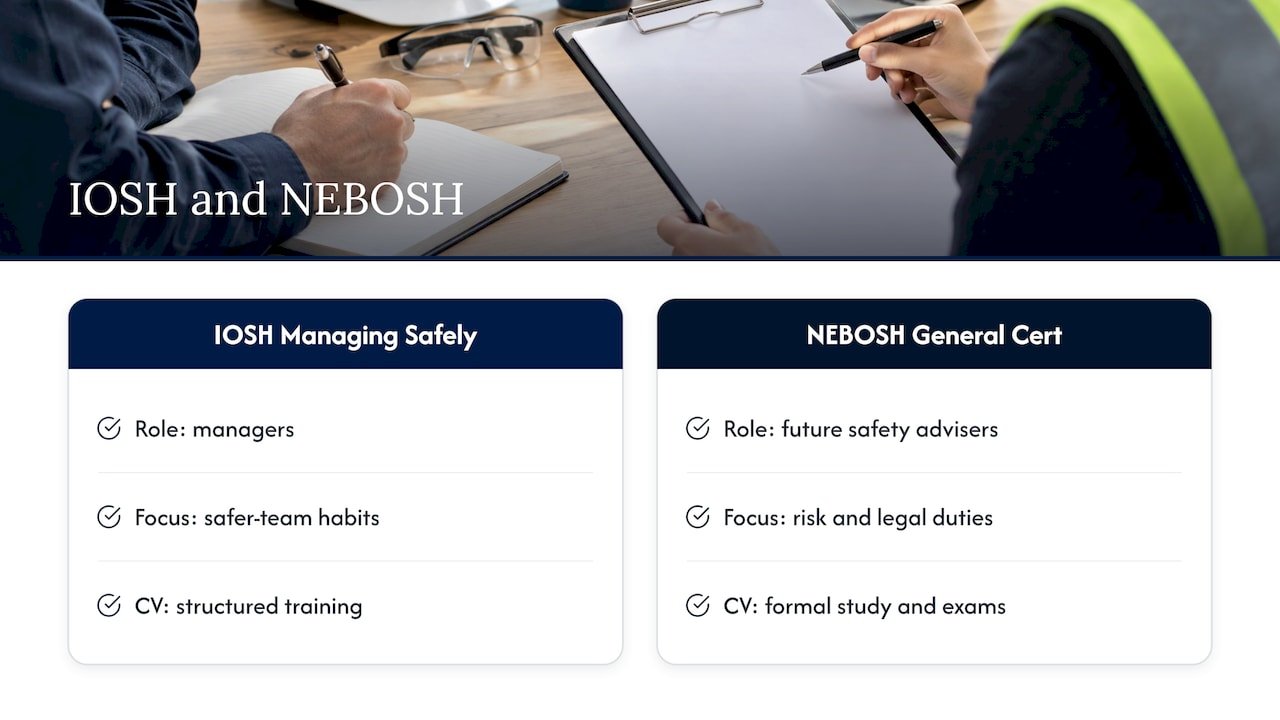
An IOSH Managing Safely certificate does a different job from a NEBOSH General Certificate. The first gives a manager the vocabulary and the habits to run a safer team. The second gives a future safety adviser the knowledge to carry out risk assessments, understand legal duties and advise others. A site manager who takes a Diploma-level course to learn how to brief a crew is overspending. A new safety officer who takes only a short awareness course is under-qualified for the role.
Hiring managers tend to read the two differently as well. A NEBOSH qualification on a CV signals formal study and examination. An IOSH course signals that the person has had structured training for their level of responsibility. Neither signal is wrong; they answer different questions.
How to choose by role
The fastest way to decide is to start with the job rather than the badge.
Frontline staff and new starters
People who are not responsible for others’ safety mostly need to understand hazards, report problems and follow procedures. A short awareness course, such as IOSH Working Safely, fits this. A NEBOSH qualification would be more than the role requires.
Supervisors, team leaders and line managers
This group is where most corporate decisions are made. Supervisors need to run briefings, spot unsafe conditions, deal with incidents and understand what the law expects of them. A managers’ course at the short end of the range usually covers that. If the supervisor is moving into a dedicated safety role within a year, starting at NEBOSH General Certificate level saves a second round of training.
Project managers
Project managers carry responsibility for planning, contractors and schedules, and safety decisions sit inside all three. For most, a manager-level course gives enough grounding to run safe projects and talk to the safety team in the same language. A project manager in construction, oil and gas or other high-hazard work may want a sector-specific NEBOSH certificate, because clients in those industries often ask what safety qualifications a lead holds. Our guide on what UK construction sites require sets out how that works on site.
Aspiring and practising safety professionals
If you want to be the person who advises the business, NEBOSH is the natural starting point, with the Diploma as the step towards senior roles. IOSH membership then adds professional standing and networking. The two work together, which is another reason not to frame them as rivals.
HR and L&D teams buying for a group
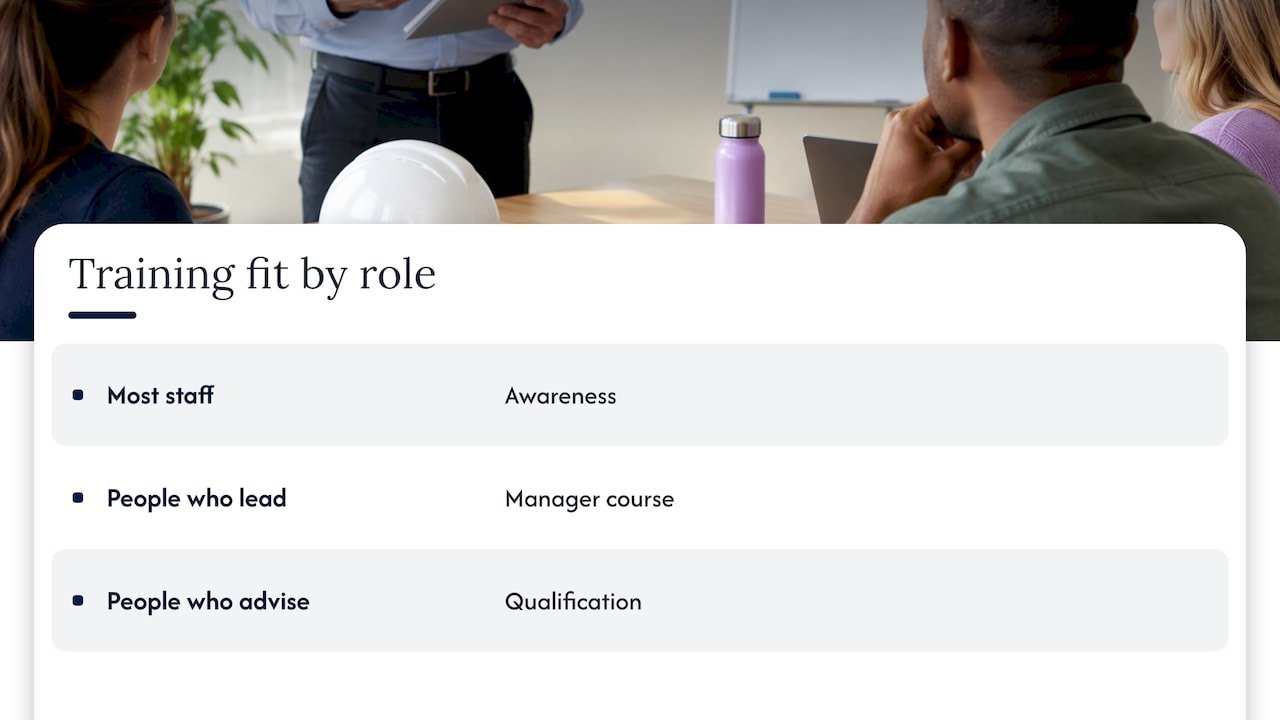
When you are buying for twenty or two hundred people, split the group first. Map each job to what it requires: awareness for most, a manager course for those who lead, a qualification for those who advise. Then book each tier separately. This avoids two common waste patterns: sending everyone on the longest course, or sending the future safety lead on the shortest. If you are weighing up health and safety options by role and career goal more broadly, this overview of hazard recognition training shows how training choice follows the work a person does.
Study time, difficulty and pass rates
People often ask whether NEBOSH is hard to pass. It is more demanding than a short course, simply because it covers more ground, takes longer and is assessed formally. That is also what gives the certificate its weight. The qualification is built to be passed by learners who attend, study and use their tutor, and retakes exist if an assessment goes badly.
For a corporate learner, the more useful question is workload. A NEBOSH course asks for time outside the classroom for revision and, on some units, practical work. If your employee is also running a site or a project, protect that time in advance. Most failed attempts at any formal qualification come from squeezing study into gaps between other work.
Pass rates are published in several places and they vary by qualification, cohort and exam period. Use them as a rough picture only, and ask the learning partner for their own results before booking.
What affects the cost
Fees differ by qualification, provider, delivery mode and group size, and they are updated from time to time, so we do not quote a figure here. The factors that move the price are consistent, though:
- Level. A short course costs far less than a multi-unit qualification, and a Diploma costs more again.
- Delivery. In-person, online and blended formats are priced differently, and in-person courses carry travel and time away from work.
- Exam fees and materials. Check whether assessment fees, books and any resits are included or charged separately.
- Group size. Training several employees together usually changes the per-head cost and the scheduling.
- Time off the job. A longer qualification means more days of lost productivity, which is often the larger cost for the employer.
When you compare quotes, compare the same things: course length, assessment, materials, tutor support and the awarding body’s name on the certificate.
Questions to ask before you book
Whichever route you choose, a few checks prevent expensive mistakes.
- Is the provider approved? IOSH courses must be delivered by an approved provider, and NEBOSH qualifications by an approved learning partner. Each body publishes its approved list on its own site.
- Who will recognise it? Ask your clients, insurers or contract specifications whether they name a particular qualification. Some tenders do.
- What is the next step? If the learner might progress, choose a course that fits the ladder.
- How is it delivered? Online, on-site and blended options exist. Match the format to shift patterns and location.
- Does the content fit your hazards? A generic course is fine for general office risks. A plant, site or offshore workforce benefits from sector examples.
For high-hazard sectors, the content and approval questions matter even more. Our pages on offshore safety training and process safety management training explain what to look for in those fields.
What has changed recently
Both bodies update their syllabuses and assessment methods from time to time, including the format and delivery of exams. Rather than rely on a summary written months ago, check the current specification on the NEBOSH site for the qualification you intend to take, and the course page on the IOSH site for its short courses, before you book. A recent certificate from an approved provider is what employers and clients will ask to see.
Where a customised safety programme fits
NEBOSH and IOSH courses answer a personal-qualification question. Many organisations also have a management-system question: how does our whole operation manage risk, and can we show it? That is where a standard such as ISO 45001 comes in. It sets requirements for an occupational health and safety management system, and training in it helps leaders and auditors work from one framework. Our ISO 45001 course and our occupational safety and health management systems course cover that ground, and they pair naturally with individual qualifications.
If you are deciding who in the business needs what, our guide for HR and L&D teams on choosing safety and security courses that prove hands-on skills is a useful next read.
Our perspective
Most of the training requests we see start with a badge: “we need NEBOSH” or “we need IOSH”. Our advice is to start with the work instead. Write down what each group of people has to do on a bad day, and train for that.
We build customisable programmes, so a team’s course content can be shaped around its own sites, hazards and processes rather than a generic example. That matters in safety more than in most subjects: people remember a scenario they recognise.
Our courses are globally accredited and led by expert trainers, and they can be delivered on-site, online or blended. For organisations that need compliance and safety training across several roles, that flexibility means one plan can cover awareness for many people and deeper study for a few, without sending everyone to the same classroom.
Qualifications such as NEBOSH and IOSH courses are a strong part of a safety career. Combined with management-system training and role-specific upskilling, they give the whole organisation a shared standard.
Sam
Plan your team’s safety training with us
If you are an HR manager, L&D lead or project manager building a training plan, we can help you turn the role map above into a programme. Oxford Centre offers professionally led courses with global accreditation across safety, compliance, project management and other sectors. Content can be customised for your organisation and delivered on-site, online or in a blended format.
See our full course list or visit oxfordcentre.uk to discuss a programme for your team. If the people you are developing are project leads, our project management courses are a good place to start.
FAQ
Which is better, NEBOSH or IOSH?
Neither is better in general, because they do different jobs. IOSH courses suit managers and staff who need practical working knowledge quickly. NEBOSH suits people who want a formally assessed qualification and a career path in health and safety. Choose by the role the learner holds or wants.
Can I do both NEBOSH and IOSH?
Yes, and many professionals do. A person might take a short IOSH course as a manager, later complete a NEBOSH General Certificate when moving into a safety role, and join IOSH as a member as their career grows. The two are complementary rather than competing.
Is NEBOSH hard to pass?
It is more demanding than a short course because it is longer, deeper and formally examined. Learners who attend, revise and use their tutor are in a good position to pass, and retakes are available. Protect study time in the working week to give yourself the best chance.
How much do NEBOSH and IOSH courses cost?
Fees depend on the level, the provider, the delivery format and whether exam fees and materials are included. Short courses cost less than multi-unit qualifications. Ask for a written quote that lists exactly what is included so you can compare like with like.
Which should a project manager choose?
For most project managers, a manager-level safety course gives the right grounding. If your sector is high-hazard, such as construction or oil and gas, or clients ask for a recognised qualification, a sector-relevant NEBOSH certificate is worth considering.