
OSHA 10 is built for entry-level, non-supervisory workers and takes a minimum of 10 hours. OSHA 30 is built for supervisors, forepersons and anyone with genuine safety responsibility, and runs a minimum of 30 hours. Neither course is a prerequisite for the other, since OSHA 30 already covers the foundational material found in OSHA 10, so you pick based on what you actually do at work, not which card you got first.
TL;DR:
- OSHA 30 is essential for anyone responsible for safety management or supervising others, as it covers management tasks and deeper hazard analysis.
- The OSHA 10 course only provides basic hazard recognition and can usually be completed in two days, making it suitable for entry-level workers.
- Both courses have separate industry-specific tracks, so a general industry OSHA 30 does not automatically cover construction hazards or vice versa.
- Completing OSHA 30 offers career benefits in safety roles but does not replace formal safety qualifications or site-specific training requirements.
- Beware of fraudulent trainers promising instant cards; always verify trainers are OSHA-authorized and confirm your card through official channels.
Table of Contents
- OSHA 10 vs OSHA 30: key differences at a glance
- Which should you take: a decision guide based on duties
- What’s covered: curriculum, mandatory topics and electives
- Duration, delivery formats and typical cost ranges
- How to get a legitimate OSHA card and avoid fraudulent trainers
- Career value and the real limits of an OSHA card
- Matching training to roles: an editorial view
- How to book OSHA 10 or OSHA 30 with Oxfordcentre
- Sources
OSHA 10 vs OSHA 30: key differences at a glance
The gap between these two courses isn’t really about difficulty. It’s about scope and who the material is written for.
- Hours: OSHA 10 requires a minimum of 10 hours; OSHA 30 requires a minimum of 30 hours.
- Minimum days: Online OSHA 10 can be completed in as few as two days; OSHA 30 usually needs four or more, because OSHA caps how many training hours can be delivered per day online.
- Audience: OSHA 10 targets entry-level, non-supervisory staff. OSHA 30 targets supervisors, safety coordinators and anyone directing the work of others.
- Purpose: OSHA 10 builds basic hazard awareness. OSHA 30 adds management-level content, including how to run a safety programme rather than just follow one.
- Industry tracks: Both courses run separate Construction and General Industry versions, so a warehouse supervisor and a site foreman end up with different curricula despite holding the same “OSHA 30” card.
That last point trips people up constantly. A general industry OSHA 30 card doesn’t automatically cover construction hazards, and vice versa.
Which should you take: a decision guide based on duties
Forget your job title for a moment. The honest question is: do you enforce safety rules, direct other workers, or investigate incidents when something goes wrong? If yes to any of those, OSHA 30 is the right call, regardless of what your business card says.
- You’re new to the trade and follow instructions rather than give them. OSHA 10 is enough for now.
- You lead a crew, run toolbox talks, or sign off on hazard checks. Go straight to OSHA 30, since it already includes the OSHA 10 material.
- You’re being groomed for a safety officer or site management role. Take OSHA 30 now rather than OSHA 10 followed by OSHA 30 later; it’s usually the more time and cost efficient route.
- Your state, city or employer mandates a specific level. Check that requirement before booking anything, since some jurisdictions and companies set their own Outreach rules beyond federal minimums.
Pro Tip: If you’re unsure which side of the line you sit on, ask whether you’d be the one explaining a near-miss to management. If the answer is yes, take OSHA 30.
What’s covered: curriculum, mandatory topics and electives
Both courses share a mandatory core: an introduction to OSHA, walking and working surfaces, electrical hazards, fall protection, and personal protective equipment. Where they split is depth and scope.
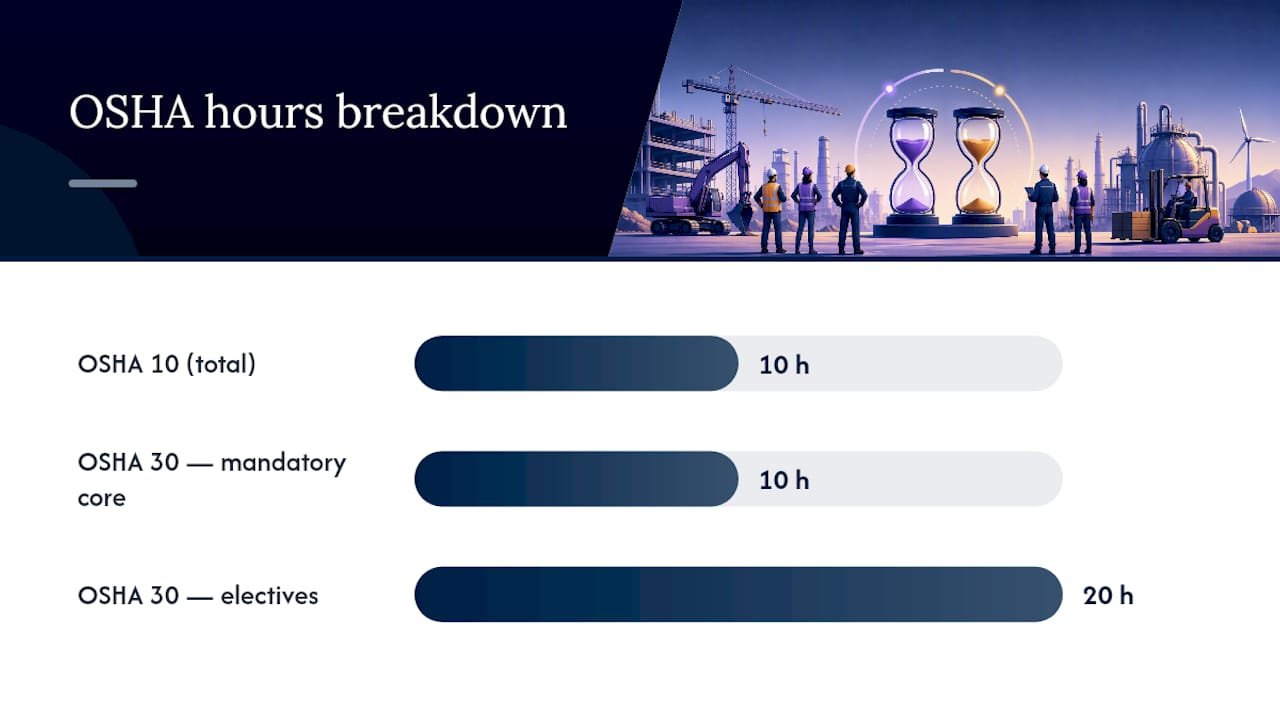
OSHA 10 sticks close to that mandatory core, with only a light elective component layered on top. It’s designed to be absorbed quickly by someone who needs to recognise hazards, not manage them.
OSHA 30 keeps the same mandatory foundation but adds a far wider elective menu and genuine management content:
- Managing safety and health programmes
- Incident investigation and root-cause analysis
- Recordkeeping requirements and injury/illness logs
- Deeper coverage of confined spaces, excavation, and struck-by/caught-in hazards
- Supervisory responsibilities under OSHA’s General Duty Clause
That extra elective depth is the entire point of the extra 20 hours. It’s not padding. It’s the difference between recognising a hazard and being accountable for fixing it before it hurts someone.
Duration, delivery formats and typical cost ranges
Scheduling depends heavily on delivery method and OSHA’s daily hour caps for online training.
- OSHA 10: Minimum 10 contact hours, typically spread over 2 to 4 days depending on format.
- OSHA 30: Minimum 30 contact hours, typically spread over 4 or more days, since online courses can’t be compressed past OSHA’s daily maximum.
- Formats: In-person, fully online, or blended, with authorised trainers required for all three.
- Cost drivers: Group bookings for a whole crew usually cost less per head than individual enrolment; industry-specific electives, printed materials, and expedited card processing can add to the base price.
Prices vary by trainer and region, so treat any figure you see elsewhere as a starting point rather than a fixed rate, and confirm the total before you book.
How to get a legitimate OSHA card and avoid fraudulent trainers
Card fraud is a real and growing problem, and it’s an easy trap to fall into if you’re booking on price alone.
- Check the OSHA-authorised trainer list before paying for anything.
- Walk away from any seller promising an “instant card” with no actual training hours logged, since only authorised trainers can issue completion cards.
- After finishing the course, confirm your card was issued through OSHA’s system and keep your completion paperwork on file.
Pro Tip: Fraudulent vendors often advertise on job boards and social media with suspiciously fast turnaround times. A legitimate authorised trainer will never guarantee a card before you’ve completed the hours.
Career value and the real limits of an OSHA card
OSHA 30 genuinely helps career progression toward safety officer and supervisory roles, and it pairs well with further professional certifications later on. It signals to an employer that you understand programme management, not just hazard spotting.
What it doesn’t do is replace formal safety qualifications. Outreach training is baseline awareness, and OSHA is explicit that site-specific and job-specific training still has to be layered on top. Plenty of experienced professionals hold both cards over a career, upgrading from 10 to 30 as their responsibilities grow rather than as a box-ticking exercise.
Matching training to roles: an editorial view
Most people ask “which OSHA course is better” when the real question is what they’re accountable for on site. Oxfordcentre builds training around that same principle across safety and compliance programmes for managers and safety representatives, delivered flexibly across sectors. Pick by hazard exposure and responsibility, not job title, and you’ll rarely need to redo the training later.
— Sam
How to book OSHA 10 or OSHA 30 with Oxfordcentre
Training for OSHA 10 and OSHA 30 courses is available online, on-site, or blended, through authorised trainers, offering recognized cards in various formats.

Organisations can book group training for an entire crew in one go, which usually works out more efficient than enrolling people one at a time. Individuals can enrol directly if they’re upgrading from OSHA 10 to OSHA 30 or starting fresh. Head to the Oxfordcentre training courses page to check current schedules and get a group or individual booking arranged.