

Competency-based training is a mastery-based approach where learners progress only after they demonstrate specified skills to a defined standard, rather than after sitting through a fixed number of hours. The practical payoff is demonstrable workplace capability: someone who completes a competency-based programme can actually do the job, because progression is judged on evidence, not attendance.
TL;DR:
- Use recognition of prior learning to assess experienced staff before placement, so they can bypass competencies they already demonstrate instead of repeating unnecessary training.
- Build standards, evidence guides, assessment tools, assessor training, moderation, and practice settings before launch; gaps can produce inconsistent decisions or certificates without job skills.
- Use observation, simulation, portfolios, or workplace assessment against fixed criteria, and moderate assessor decisions because assessment quality depends on consistent, qualified judgment.
- Pilot the toughest role first, then update standards as jobs, technology, and regulations change; the pilot can expose assessment gaps before a full rollout.
- A review of nursing trials involving 639 new nurses found better clinical ability, critical thinking, and communication than traditional training, with a 1.52 effect size.
Table of Contents
- What competency-based training actually means
- How the learner journey runs from analysis to demonstration
- Core components every competency-based programme needs
- How competence gets judged: methods and evidence
- How this differs from traditional, time-based training
- Examples and use cases across sectors
- A practical framework for building and scaling a programme
- What the evidence says about benefits for learners and employers
- How we deliver competency-based training at Oxford Center
- What I’d prioritise if you’re building this from scratch
- How Oxford Center can help you build this
- FAQ
- Sources
What competency-based training actually means
A competency is the combination of knowledge, skill and judgement needed to perform a task to a defined standard under realistic conditions. That is different from a qualification, which is the certificate or credential awarded once competencies have been verified, and different again from a learning outcome, which describes what a learner should be able to do by the end of a unit of instruction.
Competency-based programmes are built from modules or units of competency, each specifying performance conditions (the tools, environment and constraints under which a skill must be shown) and outcome statements often written in “I can” language, such as “I can safely isolate electrical supply before maintenance work.” This phrasing keeps the focus on demonstrable action rather than passive knowledge.
Two related mechanisms matter here:
- Recognition of prior learning (RPL) lets people skip training for competencies they already hold, verified through assessment rather than a course.
- Lifelong learning frameworks treat competencies as cumulative, so a person can add new units over a career instead of restarting qualifications from zero.
This vocabulary matters because it shapes everything that follows: how programmes are structured, how progress is tracked, and how assessors decide whether someone is ready to move on.
How the learner journey runs from analysis to demonstration
Competency-based training follows a fairly consistent operational pathway, whether it sits inside a hospital, a technical college or a corporate academy.
- Occupational or competency analysis. Subject-matter experts (SMEs) break down a job role into discrete tasks and the skills behind them, often using structured methods such as DACUM workshops recommended in the ILO’s competency-based training manual.
- Pre-assessment and placement. Learners are assessed against existing competencies first, so RPL can place them at the right starting point instead of repeating what they already know.
- Modular instruction and practice. Learners work through self-paced or guided modules, practising in simulated or real workplace conditions rather than listening to lectures alone.
- Repeated assessment opportunities. Learners are assessed when ready, and can retake an assessment after further practice rather than failing a course outright.
- Progression and record-keeping. Each confirmed competency is logged against the standard it meets, building an auditable record that follows the learner rather than the course.
Pro Tip: Build the record-keeping system before the first learner starts; retrofitting evidence trails after a cohort has already progressed is far harder than designing them in from day one.
What makes this different from a conventional course schedule is that nobody moves forward on a calendar. They move forward on evidence.
Core components every competency-based programme needs
Programme teams tend to underestimate how many supporting documents a competency-based system requires before it can run reliably. The components below are the minimum architecture.
- Competency standards, performance criteria and evidence guides that define exactly what “competent” looks like for each unit.
- Module or learning guide structures that map each learning activity to a specific competency outcome, so nothing is taught without a reason tied to the standard.
- Assessment instruments, covering checklists, observation forms, written tests and simulation scenarios, matched to the type of evidence each competency requires.
- Assessor training and moderation arrangements, so judgements of “competent” or “not yet competent” are consistent across assessors and cohorts.
- Learning resources and practice environments, whether a real workplace, a simulated lab or an online platform, that let learners rehearse before being assessed.
Skipping any one of these tends to show up later as inconsistent assessment decisions or learners who pass on paper but cannot perform on the job.
How competence gets judged: methods and evidence
Competency-based assessment is criterion-referenced: a learner’s performance is measured against a fixed standard, not ranked against classmates. This contrasts with norm-referenced testing, where marks are distributed on a curve and “pass” depends partly on how others performed. Assessment guidance from the University of Tasmania frames criterion-referencing as central to any assessment system built around defined standards rather than relative ranking.
In practice, assessors triangulate evidence across several methods:
- Direct observation of a task performed under realistic conditions.
- Simulation, used where observing the real task is unsafe, costly or rare.
- Portfolios, collecting evidence built up over time, such as logs, photographs or supervisor sign-offs.
- Workplace assessment, where a qualified assessor judges performance on the job itself.
A systematic review of competency-based assessment in TVET found that assessment quality depends heavily on assessor competence, moderation processes and standardised frameworks rather than on any single assessment method alone. That is the quality control layer often missing from informal “tick the box” training: sampling of assessment decisions, periodic moderation meetings, and a requirement that assessors themselves hold a recognised assessor qualification.
How this differs from traditional, time-based training
The practical differences between competency-based and traditional training show up in three areas:
- Progression logic. Traditional training moves learners through a fixed timetable regardless of mastery; competency-based training moves them forward only once they demonstrate the skill, however long that takes.
- Assessment style. Traditional courses typically rely on a single end-of-course exam; competency-based programmes use ongoing, multi-method assessment spread across the programme.
- Resource implications. Competency-based delivery demands flexible scheduling, enough assessor capacity to handle assessment on demand, and closer engagement from employers who provide the workplace evidence.
These are not cosmetic differences. An organisation moving from a fixed classroom schedule to competency-based delivery usually has to rebuild its timetable, its assessor team and its record-keeping system at the same time.
Examples and use cases across sectors
Competency-based training shows up differently depending on the sector, but the underlying logic (defined standard, evidence-based progression) stays constant.
- Healthcare. A 2022 meta-analysis of seven randomised controlled trials involving 639 new nurses found that competency-based training improved clinical nursing ability, critical thinking and interpersonal communication compared with traditional training methods.
- Technical and vocational education (TVET). National systems such as the Philippines’ TESDA require formal competency assessment and issue National Certificates once a learner is judged competent against published Training Regulations, with RPL pathways allowing experienced workers to be assessed directly rather than retrained from scratch.
- Corporate learning and development. Organisations build role-based competency clusters, often mapping digital skills against external frameworks such as the European Commission’s DigComp 3.0, which structures digital competence into defined areas and proficiency levels.
- Regulated professional training. Aviation has moved the same way: a recent industry discussion of competency-based training and assessment standards for pilots describes how flight hours are being replaced by demonstrated competency as the basis for certification.
A practical framework for building and scaling a programme
Most successful rollouts follow a similar sequence, whether the programme covers one job role or an entire function.
- Run an occupational analysis with stakeholder validation. Work with SMEs and supervisors to decompose the job into tasks, then have frontline staff and managers confirm the breakdown reflects reality, not an idealised job description.
- Define competencies, proficiency levels and mapping. Write each competency as an observable outcome, assign proficiency levels where relevant (entry, intermediate, advanced), and map every competency to the business need it serves.
- Build modules and assessment evidence guides. Develop the learning content and, in parallel, the evidence guide that tells assessors exactly what counts as proof of competence.
- Train assessors, run a pilot and moderate results. Qualify assessors before launch, test the programme with a small cohort, and hold a moderation session to check assessors are applying standards consistently.
- Review, update and scale. Treat competency definitions as living documents: revisit them as roles, technology or regulations change, then extend the programme to further cohorts once the pilot proves stable.
Pro Tip: Pilot with the toughest job role first, not the easiest. If the assessment framework survives a complex role, scaling it to simpler ones is straightforward; the reverse often is not true.
Teams that skip the pilot step tend to discover gaps in their assessment instruments only after a full cohort has already progressed, which is far costlier to fix.
What the evidence says about benefits for learners and employers
The clinical evidence is specific: the 2022 nursing meta-analysis reported a standardised mean difference of 1.52 for clinical care ability when competency-based training was compared with traditional methods, alongside improvements in critical thinking and communication.
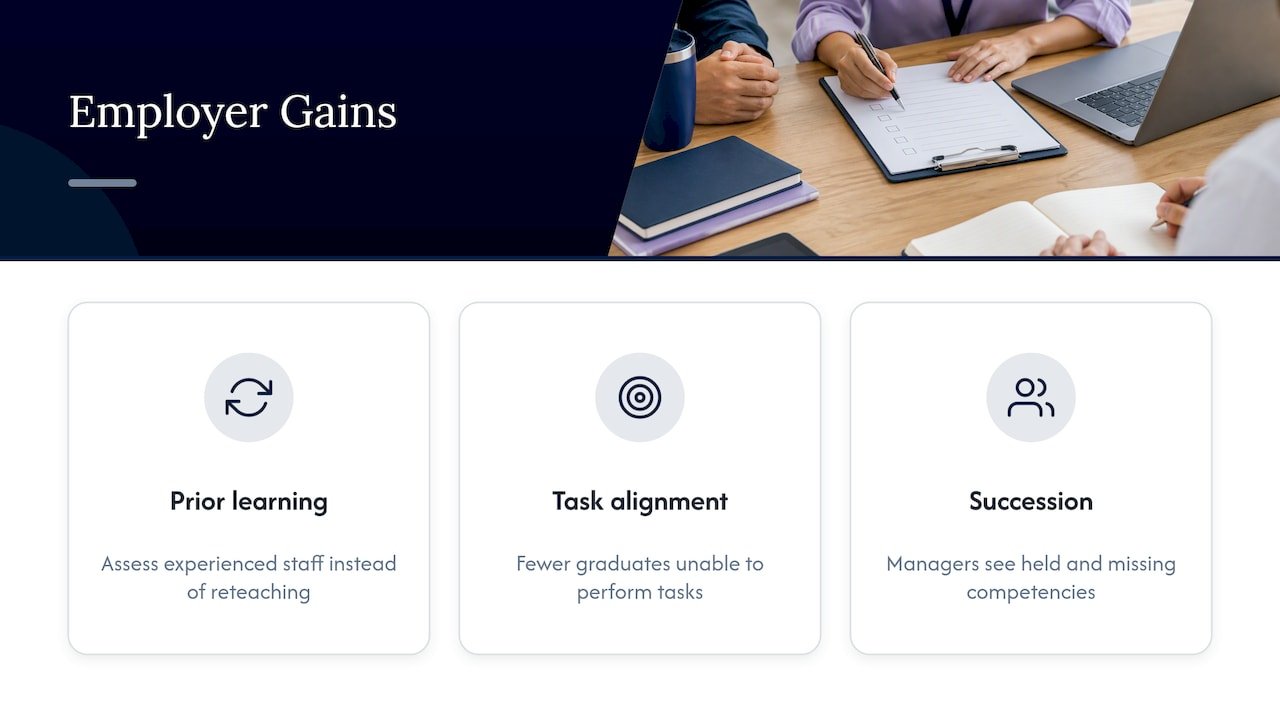
Beyond clinical settings, the organisational case rests on three practical gains. Recognising prior learning cuts training time for experienced staff, since they are assessed rather than re-taught. Closer alignment between training content and actual job tasks means fewer graduates who hold a certificate but cannot perform the task. And because competencies are mapped to real role requirements, succession planning becomes more precise: managers can see exactly which competencies a potential successor already holds and which remain to be developed.
How we deliver competency-based training at Oxford Center
We build customisable training modules delivered on-site, online or in blended formats, shaped around the specific role profiles our clients bring to us. Our approach starts by mapping a role’s requirements against recognised competency standards, then designing assessment methods, observation, simulation or portfolio evidence, that fit the realities of the workplace rather than a generic template. Courses span sectors including project management, healthcare, oil and gas and civil engineering, with experienced trainers leading delivery throughout.
What I’d prioritise if you’re building this from scratch
The pitfall I see most often is treating competency standards as a one-off document rather than something reviewed regularly as roles and technology shift. A standard written three years ago for a role that has since absorbed new tools or compliance requirements will quietly stop measuring what actually matters.
Assessor capability deserves more attention than most programmes give it. A well-designed framework is only as good as the people applying it consistently, so invest in assessor training and moderation before worrying about course content polish. Finally, tie every competency back to a measurable business outcome, fewer errors, faster onboarding, better retention, rather than treating “competence” as its own reward.
— Sam
How Oxford Center can help you build this
If mapping competencies, designing assessment instruments and training assessors feels like more than your team can take on alone, we run competency mapping workshops, help design pilot courses, and train assessors to apply standards consistently across cohorts.

Our project management course is one example of how we structure a role-based programme, built around defined competencies rather than fixed seat time. To see the full range of sectors and delivery formats we cover, visit the Oxford Center homepage and get in touch to scope a workshop for your team.
FAQ
What is competency-based training in TESDA?
In the Philippines’ TESDA system, competency-based training means instruction and assessment organised around Training Regulations that define national competency standards for a given occupation. Learners are assessed against these standards and, once judged competent, receive a National Certificate; recognition of prior learning lets experienced workers be assessed directly without repeating training they do not need.
What are the main types of training?
Common categories include orientation, on-the-job, classroom-based, simulation-based, e-learning and competency-based training, though definitions vary by organisation and sector. Competency-based training is distinct because it is defined by how progression and assessment work (mastery of a standard) rather than by delivery format alone.
What are the five Cs of competency?
Definitions of the “five Cs” vary across industries and are not drawn from a single standardised framework, so there is no universally agreed list. Rather than relying on a fixed acronym, most competency frameworks, including those referenced in the ILO’s competency-based training guidance, focus on clearly defined performance standards, evidence requirements and assessment criteria instead.
What are the main objectives of training?
Training generally aims to build the knowledge, skills and judgement needed to perform a role safely and effectively, close gaps between current and required performance, and prepare people for new responsibilities. Competency-based training sharpens these objectives further by tying each one to a specific, assessable standard rather than a general learning goal.
How does Oxford Center support competency mapping?
We work with organisations to map role profiles against recognised competency standards, then design modules and assessment instruments, observation, simulation or portfolio evidence, suited to the workplace context. Delivery is available on-site, online or blended, with pricing available on request through our project management course page or the main Oxford Center site.