
The most practical route into Scrum Master work runs through one of three certifications: Certified ScrumMaster (CSM) for general entry roles, Professional Scrum Master (PSM) for employers who value independent exam rigour, or SAFe Scrum Master (SSM) for organisations running scaled Agile programmes. Pick the one matching your target employer, then book a short preparation course or sit a mock exam before the real thing.
TL;DR:
- CSM requires a course that lasts two days, while PSM permits independent study; confirm exam thresholds, question counts, and retake fees with providers before booking.
- Employers value delivery evidence beyond ceremonies, so document cycle time, sprint predictability, resolved dependencies, and team feedback rather than listing facilitation duties alone.
- Track one or two delivery measures in your first three months, demonstrate cross team outcomes by month nine, then build toward programme leadership.
- Newcomers benefit from structured instruction and nearby mentorship, while experienced Agile practitioners can pair self paced study with scenario practice on real delivery challenges.
Table of Contents
- CSM, PSM and SAFe SSM: what each certification shows and which to pick
- What to expect on exam day and high-impact study methods
- Skills employers look for beyond the certificate
- Your career progression map: from certified to leading transformation
- How structured training turns certification into workplace results
- What separates candidates who pass from those who advance
- Build your Scrum Master skills with structured, flexible training
- FAQ
- Sources
CSM, PSM and SAFe SSM: what each certification shows and which to pick
Each certification tests a different slice of the Scrum Master job, and employers read them differently depending on team size and industry.
CSM, issued by Scrum Alliance, requires a mandatory two-day course taught by a certified trainer before you can sit the exam. It leans on foundational theory and group discussion, which suits people new to Agile teams. PSM, from Scrum.org, has no mandatory training requirement: you can self-study the Scrum Guide and sit the exam independently, which appeals to candidates who prefer self-paced learning or already have Agile exposure. SAFe SSM adds scaled-Agile concepts such as programme increments and release trains, aimed at Scrum Masters working inside larger, multi-team organisations.
- CSM suits first-time Scrum Masters entering small or mid-size teams where employers expect classroom training.
- PSM suits candidates who want a rigorous, self-directed route and often works well for technical professionals moving into Agile roles.
- SAFe SSM suits Scrum Masters in large organisations running multiple coordinated teams under a scaled framework.
For junior roles at smaller companies, CSM remains the most commonly requested credential in job postings. For scaled environments inside large enterprises, SAFe SSM tends to carry more weight because it demonstrates familiarity with programme-level coordination that CSM and PSM do not cover.
What to expect on exam day and high-impact study methods
Entry-level Scrum Master exams are short, multiple-choice tests designed to check working knowledge rather than deep theory. A typical format runs a multiple-choice exam with a pass mark commonly set near a mid-range percentage, though the exact threshold and question count vary by certifying body and should be confirmed on the provider’s own exam page before you book.
A focused study plan beats casual reading every time:
- Read the Scrum Guide cover to cover at least twice, since it is the canonical source most exam questions draw from.
- Use active recall: cover definitions and test yourself on accountabilities, events and artefacts rather than re-reading passively.
- Sit at least one timed mock exam under real conditions to build pace and spot weak topics.
- Work through scenario-based practice questions that mirror real sprint situations, not just definitions.
- Review mistakes with a peer or mentor who can explain why an answer is wrong, not just that it is wrong.
Registration is usually online, with remote proctoring common for self-study certifications like PSM, while CSM exams are typically unlocked after completing the required course. Retake policies and costs differ by provider, so check the current fee schedule before scheduling a second attempt.
Pro Tip: Book your mock exam for the same time of day as your real exam. Matching your mental rhythm to exam conditions reduces last-minute nerves.
Skills employers look for beyond the certificate
A certificate proves you know the framework. What gets you hired and promoted is evidence that you can apply it under real pressure.
Employers increasingly judge Scrum Masters on delivery outcomes rather than ceremony attendance. The role is shifting from pure facilitation towards enabling product value, with measurable business impact such as cycle-time improvement and stakeholder management now weighing heavily in hiring decisions.
Core skills worth demonstrating in interviews and performance reviews:
- Facilitation and coaching: running retrospectives that produce real behavioural change, not just a list of complaints.
- Dependency management: spotting cross-team blockers before they derail a sprint.
- Stakeholder influence: translating technical delays into language a product owner or sponsor understands.
- Metrics literacy: tracking cycle time, sprint predictability and retrospective action completion rather than relying on activity counts.
Soft skills remain hard to measure formally. A 2026 empirical study found no standardised industry process for tracking soft-skill development in Scrum Master roles, which means candidates should pair qualitative evidence, such as team feedback and case notes, with any hard metrics they present.
Your career progression map: from certified to leading transformation
Certification opens the door. What you do in the following months decides how far you walk through it.
- Months 0 to 3: Apply your certification on a live team, track one or two delivery metrics such as cycle time, and document the change you drove.
- Months 3 to 9: Build toward a senior Scrum Master or delivery leader title by showing consistent cross-team outcomes, not just ceremony facilitation.
- Months 9 to 18: Move towards programme-level work, such as a Release Train Engineer role, by demonstrating coordination across multiple teams and stakeholder groups.
- Months 18 to 36: Position yourself for Agile coach or transformation leadership by mentoring other Scrum Masters and showing organisation-wide impact.
On your CV, pair each certification with a concrete outcome: a cycle-time reduction, a dependency resolved early, a retrospective action rate that improved. Interviewers remember numbers tied to a story far longer than a list of acronyms.
How structured training turns certification into workplace results
Passing an exam and performing well on a live team are different skills, and the gap between them is where structured training earns its place.
Scrum Master preparation is available across on-site, online and blended formats, so learners can study around shift patterns, remote teams or a packed project calendar. The course content can be customised to weight sessions towards scenarios organisations actually face: stakeholder negotiation, dependency mapping or metrics reporting, rather than generic theory alone.
Sessions can include expert-led facilitation, providing practice time on facilitation and coaching scenarios before applying them with a live team. Mentorship and project-based practice are often included in programmes, helping certificates to be supported by demonstrable, practised skill rather than exam memory alone.
What separates candidates who pass from those who advance
Passing the exam is the easy part. The candidates who go on to senior roles pair their certification with live project mentorship and track a real outcome, not just a badge on LinkedIn.
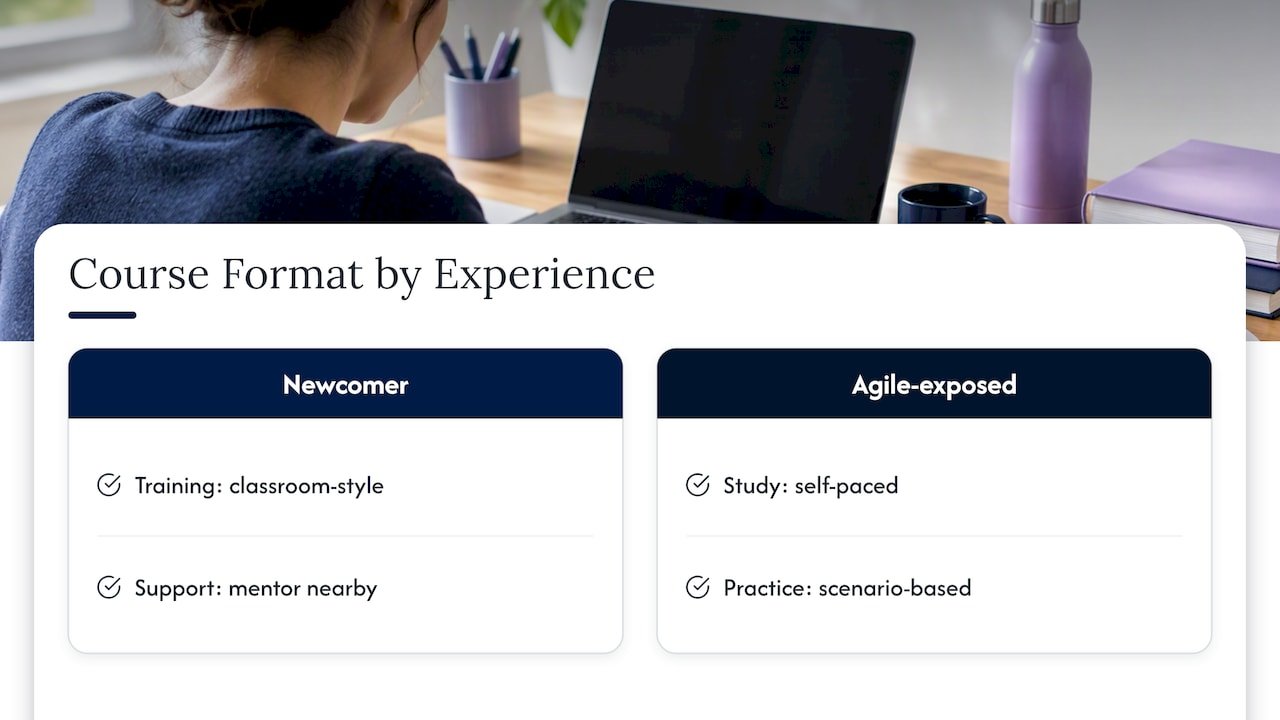
Choose your course format deliberately. A newcomer benefits from structured, classroom-style training with a mentor nearby. Someone with existing Agile exposure often moves faster through self-paced study paired with scenario practice. Match the format to where you actually are, not where you wish you were.
— Sam
Build your Scrum Master skills with structured, flexible training
Choosing between CSM, PSM and SAFe SSM matters less than what you do with the certification afterwards, and that is where flexible, customisable training earns its keep. We run our courses on-site, online or blended, with globally accredited content built around real delivery scenarios rather than theory alone.
If you are weighing up certification routes or want a group training plan built around your organisation’s own delivery challenges, view our project and delivery-focused training or get in touch through our course catalogue to request a bespoke session.
FAQ
What is the best certification for Scrum Master?
There is no single best certification: CSM suits newcomers who want structured classroom training, PSM suits self-directed learners comfortable studying the Scrum Guide independently, and SAFe SSM suits candidates targeting scaled, multi-team organisations. The right choice depends on your target employer and team structure.
How difficult is the certified scrum master exam?
CSM-style exams are generally considered approachable for candidates who complete the required course and review the Scrum Guide thoroughly. Entry-level Scrum Master exams commonly use a multiple-choice format with a pass mark in the mid-70s, though the exact threshold varies by certifying body.
Is Scrum still relevant in 2026?
Yes, though the Scrum Master role is shifting away from pure ceremony facilitation towards enabling measurable delivery and product value. Employers now weigh outcomes like cycle-time improvement and stakeholder management alongside traditional facilitation skills.
What is the 3 5 3 rule in Scrum?
The “3 5 3” shorthand commonly refers to Scrum’s structure of 3 accountabilities, up to 5 events, and 3 artefacts, though this phrasing is not an official term used in the Scrum Guide itself. For the authoritative breakdown, the Scrum Guide defines these elements directly rather than through a numbered mnemonic.
How much does Scrum Master certification cost?
Costs vary by certifying body and training provider, and most publish their own current fee schedules rather than a single fixed industry price. Check the certifying body’s official site for the exact fee before booking, since course and exam costs are typically listed separately.
Sources
This guide draws on the Scrum Guide, the canonical definition of Scrum used across certifying bodies, alongside current observations on how the Scrum Master role is evolving and a 2026 empirical study on learning paths and team dynamics in Scrum Master roles. For broader context on leadership development, see this companion piece on team leadership training.