
CISSP validates deep technical and architectural security skills; CISM validates security leadership, governance and programme management. Most senior professionals could clear the bar for either, and many eventually hold both. If you lead technical controls and system design, start with CISSP; if you report to boards and run governance programmes, CISM fits better. Our decision framework below walks through the choice in detail.
TL;DR:
- CISSP requires five years of experience across two or more domains; a relevant degree or approved credential can waive one year, and endorsement follows passing.
- CISM requires at least five years of information security management experience, and candidates must apply for certification within five years of passing the exam.
- CISSP’s breadth calls for timed practice across eight domains, while CISM tests judgment through scenario questions; map experience against each syllabus, then target weak areas.
- Both credentials require annual maintenance fees and continuing professional education credits, so compare the ongoing obligations alongside exam preparation before committing to either certification.
- ISACA’s September 2026 CISM outline adds strategy and enterprise architecture, so candidates should account for its increased technical content when choosing study priorities.
Table of Contents
- CISSP vs CISM: a side-by-side comparison
- What each exam actually covers
- Eligibility, exam format and renewal requirements
- How hard is each exam, and how long should you study?
- How employers value CISSP and CISM in hiring
- Which certification should you choose?
- What’s changing in CISM for 2026, and why it matters
- Our perspective on preparing for either path
- FAQ
- Sources
CISSP vs CISM: a side-by-side comparison
CISSP is a broad, technical credential covering eight domains of security practice, from asset security to software development security. CISM is a four-domain, management-focused credential built around governance, risk, programme development and incident response, as ISACA’s certification page describes it.
- Focus: CISSP leans technical and architectural; CISM leans managerial and governance-driven.
- Domains: CISSP has eight domains; CISM has four, each weighted toward strategy and oversight.
- Experience: Both require several years in the field, though the qualifying experience areas differ.
- Typical roles: CISSP appears on job postings for security engineers and architects; CISM appears for security managers and CISOs.
What each exam actually covers
CISSP’s eight domains span security and risk management, asset security, security architecture and engineering, communication and network security, identity and access management, security assessment and testing, security operations, and software development security, according to the CISSP exam outline. Security architecture, for example, means designing systems that resist intrusion by design, not just patching them afterwards.
CISM’s four domains cover information security governance, risk management, programme development and management, and incident management, per the CISM exam content outline. Governance work looks like writing policy and reporting risk posture to a board, not configuring a firewall.
- Overlap: both certifications test risk management, though CISSP applies it to systems and CISM applies it to the organisation.
- CISSP emphasis: technical controls, architecture and operational security.
- CISM emphasis: strategy, programme oversight and communicating risk to leadership.
Eligibility, exam format and renewal requirements
CISSP requires five years of cumulative, paid work experience in two or more of its eight domains, with a one-year waiver available for a relevant degree or approved credential, plus endorsement by an existing credential holder after passing, as set out in the CISSP exam outline. The exam uses Computerised Adaptive Testing, and maintenance runs on an annual fee with continuing professional education credits.
CISM requires five or more years of professional information security management experience, and candidates must apply for certification within five years of passing the exam, per ISACA’s CISM page. Exam delivery runs through approved test centres or remote proctoring, with maintenance tied to annual CPE reporting.
- CISSP: register through ISC2, confirm domain-specific experience before applying.
- CISM: register through ISACA, track the five-year application window from the day you pass.
- Both: budget for an annual maintenance fee and ongoing CPE hours to keep the credential active.
How hard is each exam, and how long should you study?
CISSP’s difficulty comes from breadth: you need working knowledge of eight distinct domains, including technical specifics like cryptographic protocols and network architecture. CISM’s difficulty comes from judgement: scenario questions test how you’d prioritise risk or justify a security investment to a board, which rewards managerial experience over memorised facts.
- Map your actual work experience against the official domain list before choosing a study plan, so you target genuine gaps rather than everything.
- Combine self-study materials with timed practice tests to build exam-day pacing for either certification.
- Consider instructor-led or blended courses if you’re weak in a domain outside your day-to-day role, such as governance for a technical candidate or architecture for a manager.
- Ask your employer about sponsorship before committing to a self-funded study route, since budgets and support vary by organisation.
Pro Tip: Sit a full-length practice exam under timed conditions at least once before booking the real thing, it tells you more about readiness than any revision guide.
How employers value CISSP and CISM in hiring
Job adverts for security engineer and security architect roles commonly list CISSP, while security manager and CISO postings lean toward CISM. Many organisations now expect certification even for mid-level roles, and the ISC2 hiring trends study notes that employers increasingly request credentials like CISSP or CISM for senior positions, even as sponsorship budgets for certification have tightened.
- Technical track: CISSP signals readiness for architecture, engineering and operational security roles.
- Leadership track: CISM signals readiness for governance, risk oversight and executive reporting.
- Combined credibility: holding both increases weight for roles that bridge technical delivery and board-level accountability.
- Regional variation: salary outcomes depend heavily on sector and location, so treat any single figure as a local data point rather than a universal benchmark.
If you’re building a CV around either credential, a structured approach to career development can help you position the certification alongside your actual project history rather than listing it in isolation.
Which certification should you choose?
- If your daily work involves designing systems, configuring controls or leading technical assessments, start with CISSP.
- If your daily work involves writing policy, managing risk registers or reporting to leadership, start with CISM.
- If you want both, take the one matching your current role first, then add the other once you’ve accumulated experience in its domains, since qualifying experience is easier to document while you’re actively doing that work.
- If your employer sponsors certification, confirm which one aligns with your next promotion before applying, since sponsorship budgets are tightening industry-wide.
- If you’re self-funding, check the official syllabus for both exams and pick the one where you already meet most domain requirements, to shorten study time.
- Once decided, register with the relevant body, build a study plan around your weakest domains, and gather documentation of your qualifying experience early, since endorsement and application windows both carry deadlines.
ISACA’s own commentary suggests CISA, CISM and CISSP work as complementary credentials rather than competing ones, which supports sequencing rather than choosing permanently.
What’s changing in CISM for 2026, and why it matters
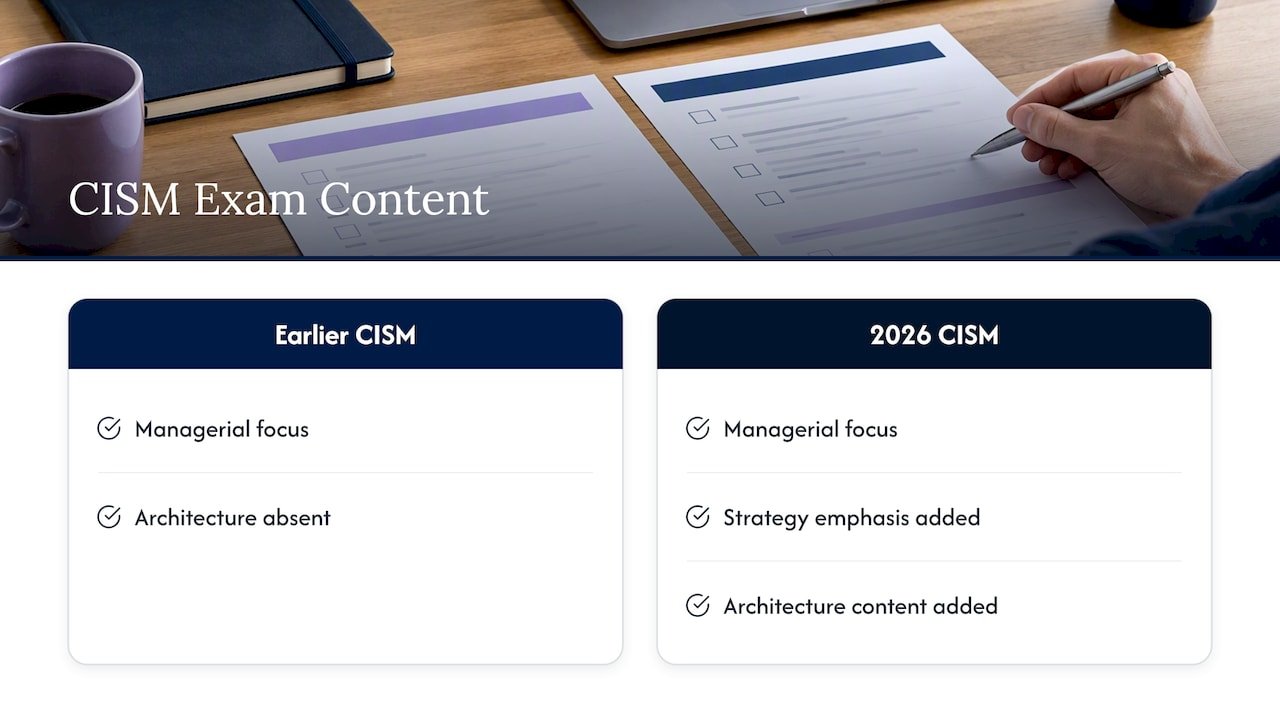
ISACA updated the CISM exam content outline in September 2026, adding emphasis on information security strategy and introducing enterprise and information security architecture content, according to the ISACA press release. That narrows the historical gap between CISM’s managerial focus and CISSP’s technical depth.
The 2025 ISC2 Cybersecurity Workforce Study highlights persistent skills shortages and rising employer demand for certified professionals. This shift suggests managers who hold CISM may increasingly need some architecture fluency, while technical candidates eyeing leadership roles may find CISM a shorter path than before, per the 2025 ISC2 workforce study.
Our perspective on preparing for either path
We built our training formats around the reality that CISSP and CISM candidates rarely study the same way twice. Our instructor-led, online and blended courses adapt to a candidate’s existing role, whether that means deepening architecture knowledge for a technical track or building governance fluency for a managerial one. We work with organisations and individual professionals who need globally accredited training that fits around real operational demands, not a fixed classroom schedule.
— Sam
FAQ
Is CISSP still relevant in 2026?
Yes. CISSP remains one of the most widely requested credentials for technical security roles, and ISC2’s own hiring trends research shows employers continuing to expect it for senior and architecture-focused positions, per the ISC2 hiring trends study.
What are the top cybersecurity certifications?
CISSP and CISM consistently rank among the most referenced credentials in job adverts, alongside CISA for audit-focused roles. Which one matters most depends on whether the role is technical, managerial or audit-oriented, so check the specific job description rather than assuming one credential covers every path.
What is the difference between CISSP and ISC2?
ISC2 is the organisation that administers the CISSP certification; CISSP itself is the credential you earn by passing its exam and meeting experience requirements. Confusing the two is common, but ISC2 also offers other certifications beyond CISSP.
Is CISM difficult?
CISM’s difficulty comes from scenario-based judgement questions rather than pure memorisation, which can feel harder for candidates without management experience. Professionals with governance, risk or programme leadership backgrounds typically find the content maps closely to their existing work.