

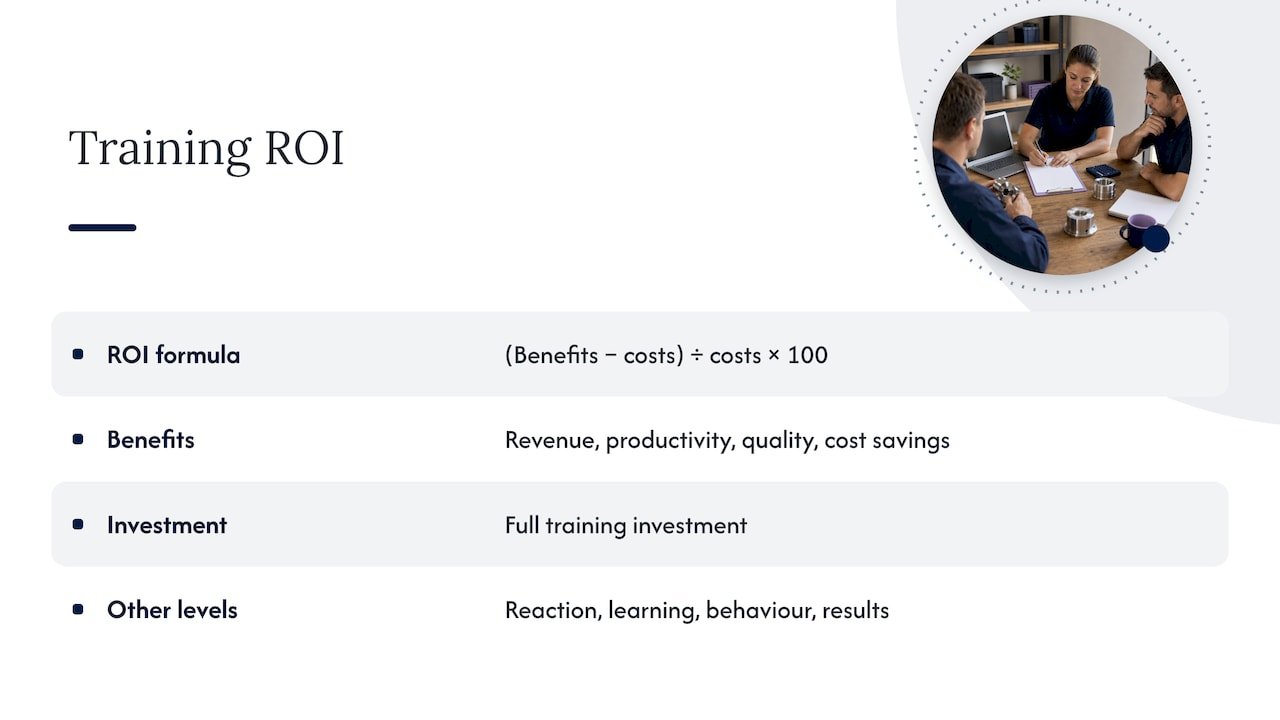
Training ROI is the net money benefit of a course divided by its full cost, shown as a percentage: (benefits − costs) ÷ costs × 100. The formula is the easy part. The result is only as credible as the costs you load into it and the share of the improvement you can honestly credit to training. That is why we design our courses around a business outcome agreed before anyone enrols, so there is something to measure afterwards.
TL;DR
- Training ROI (%) = (monetary benefits of training − total training costs) ÷ total training costs × 100.
- Count every cost, including participants’ paid time, not just the course fee.
- Pick one business measure before training starts, record a baseline, and credit training only with the share of change it caused.
- A benefit–cost ratio above 1 means benefits exceed costs. Report morale and satisfaction separately instead of forcing a pound value onto them.
- Use the result to compare programmes and decide what to change, not as a one-off verdict.
Table of Contents
- What training ROI measures
- The calculation, step by step
- What belongs in the cost side
- What belongs in the benefit side
- How to isolate what training caused
- A worked example
- Reading and reporting the result
- Intangible benefits and the limits of ROI
- Building ROI into the training you buy
- Our approach to training that can be measured
- Our view: ROI starts before the course
- FAQ
- Sources
What training ROI measures
Training ROI compares the monetised improvements attributable to training, such as revenue, productivity, quality or cost savings, with the full investment. UNESCO-UNEVOC’s practical guide gives the formula as training benefits minus training costs, divided by training costs, multiplied by 100. The Project Management Institute describes the same idea as value created divided by investment, where value can include extra revenue, lower costs, quality, satisfaction, efficiency and productivity.
ROI sits at the top of a ladder of evaluation. SHRM’s instructor manual lists reaction, learning, behaviour change and results as the levels below it, with ROI comparing costs against benefits. If you want the detail of those lower levels, our guide to the Kirkpatrick model with examples walks through them.
The calculation, step by step
The UNESCO-UNEVOC guide sets out a sequence that works for most corporate programmes.
- Define the target outcome and the measurement period. Choose one measure the business already tracks: errors per week, on-time delivery, customer complaints, staff turnover. Decide how long after training you will look. Benefits can appear during training or much later, so a window that is too short understates the result.
- Collect baseline and follow-up data. Record the measure before the course and again after. Without a baseline you can only guess at change.
- Monetise the change. Turn the difference into pounds: hours saved multiplied by loaded hourly cost, scrap avoided multiplied by unit cost, and so on.
- Isolate the share caused by training. More on this below.
- Total the programme costs. Fully loaded, as in the next section.
- Calculate. ROI (%) = (monetary benefits − costs) ÷ costs × 100. The benefit–cost ratio is benefits ÷ costs.
When the programme runs over several years, costs and benefits arise at different times. Australia’s DFAT cost-benefit framework says future benefits should be discounted to present value, and an investment is worthwhile when the present value of benefits exceeds costs. For a course whose effect is measured within a year, simple ROI is normally enough.
What belongs in the cost side
A training cost-benefit analysis fails most often because costs are undercounted. The PMI article lists development, delivery, instructors, materials, equipment, travel, assessment, facilities, participant salary and benefits, licensing, overhead and administration. The ILO’s 2018 review adds trainee wages and benefits, trainer wages, learning materials, room rent, external courses, exam fees, and setup or recruitment costs. A workbook on government training from the ROI Institute recommends fully loading every programme cost.
The OECD’s analysis of vocational training also names paid staff time and mistakes or wasted time among employer costs. In practice, the line most often forgotten is the salary of people sitting in the classroom or online session.
The delivery format changes the cost picture. On-site delivery for a whole team removes travel and lets the content use your own processes. Online or blended delivery reduces time away from work. We offer all three, so the cost line you build can reflect the format that suits the team.
What belongs in the benefit side
Benefits need to be things you can put a number on. SHRM lists hard output measures: output per hour, on-time work, task time, equipment utilisation, costs saved, customer complaints and returns, accidents, scrap, rework and grievances. The PMI article points to reduced management turnover, productivity gains, cost savings and extra revenue linked to customer satisfaction as longer-term business results. The OECD adds avoided recruitment and integration costs.
For a compliance or safety course, the benefit might be fewer incidents and less rework. For a project management course, it might be fewer overruns. For leadership training, lower turnover in the managed teams. Choose the measure that matches the reason you bought the course.
How to isolate what training caused
This is the step that separates a defensible number from a hopeful one. Market shifts, new tools and staffing changes all move business measures. A 2000 study by Muñoz and Muñoz says stronger practice links training to strategic goals, uses varied data, attempts to isolate effects, defines units of measurement, monetises improvements and measures before and after. It argues that evaluation should borrow from research design, especially baseline and follow-up measures.
Practical ways to isolate the effect:
- Compare with a group that was not trained over the same period.
- Ask participants and their managers what share of the improvement they credit to the course, and by how much they are confident. Use the lower, adjusted figure.
- Remove known outside influences, such as a new system launched the same month.
A 2017 healthcare framework describes the same chain: identify outcomes, collect evidence, isolate training effects, monetise the marginal improvement.
A worked example
SHRM’s manual uses a data-entry team: 40 full-time clerks each spend five hours a week correcting errors. A training programme that cuts error correction by 20% saves one hour per clerk per week. Here is the same logic with illustrative figures of our own, not real client results.
| Item | Figure |
|---|---|
| Clerks trained | 40 |
| Hours saved per clerk per week | 1 |
| Loaded hourly cost (illustrative) | £20 |
| Weeks measured | 26 |
| Gross benefit | 40 × 1 × £20 × 26 = £20,800 |
| Share attributed to training after adjustment | 75% |
| Net programme benefit | £15,600 |
| Total programme costs (fees, materials, trainer, paid time in class, admin) | £9,000 |
| ROI | (£15,600 − £9,000) ÷ £9,000 × 100 = 73% |
| Benefit–cost ratio | £15,600 ÷ £9,000 = 1.73 |
The 73% means every £1 spent returned £1 of cost back plus 73p. If the attribution share had been 40%, the benefit would be £8,320 and the ROI negative, which is why the isolation step deserves the time.
Reading and reporting the result
SHRM states that a benefit–cost ratio above 1 means benefits outweigh costs, while below 1 means costs exceed benefits and changes may be needed. Report the result to stakeholders alongside the data behind it, and use ROI to compare programmes and find what to improve. A 2015 Praxis Paper likewise recommends evaluating training and applying the results to future learning.
State your assumptions plainly: the period, the attribution share, the cost definitions. A number with visible assumptions is more persuasive to a finance director than a bigger number without them.
Intangible benefits and the limits of ROI
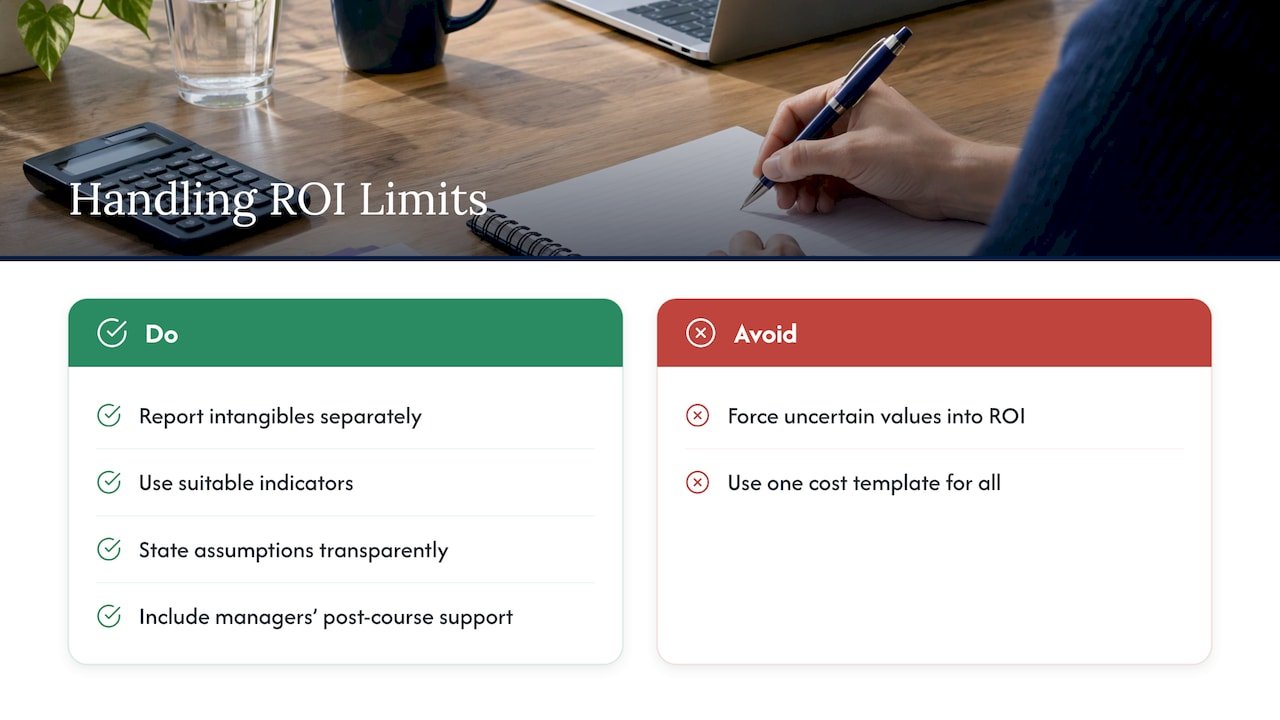
Morale, engagement and satisfaction can be real gains that resist a monetary value. The UNESCO-UNEVOC guide advises reporting intangibles separately with suitable indicators and transparent assumptions, rather than forcing uncertain values into the financial calculation. It also notes that costs and benefits vary by organisation, and a single cost template will not fit everyone, a point the ILO review makes about firm size, sector and duration.
A 2017 South African model adds a risk check: even when learning and financial evaluation are done, barriers to applying learning at work can block improvement. Managers’ support after the course is therefore part of the ROI, not an extra. Our competency-based training guide shows how to define the skills you expect people to use.
Building ROI into the training you buy
The cheapest time to plan measurement is before booking. Agree the target measure, the baseline and the review date with the provider. Our courses are customisable, so content can be built around your own processes and the problem you want to move. Courses such as Maintenance KPIs and Performance Benchmarking and HR Budgeting and Cost Control also help teams own the numbers behind a training business case. For the wider planning picture, see our learning and development strategies for HR.
Our approach to training that can be measured
We offer professionally accredited courses in project management, healthcare, oil and gas, civil engineering, IT, management, leadership, compliance and safety, delivered on-site, online or blended and led by industry experts. Whether you are enrolling a team or yourself, you can browse the full course catalogue or start with our project management courses.
If you want to talk through a measurable outcome for a team before booking, begin from the Oxford Training Centre home page.
Our view: ROI starts before the course
Most training ROI disputes begin months earlier, when nobody wrote down what the course was supposed to change. We would rather spend the first conversation on that than on the syllabus.
Our customisable format exists for this reason. When content is built around your own workflows, delivered on-site, online or blended, and led by experts who have worked on the same real-world challenges, the link between what was taught and what you measure is shorter and easier to show.
Accreditation matters for the same reason: it gives individuals a recognised qualification, and gives the organisation a clear standard to point to when it reports results to finance.
Our advice to HR managers: choose one metric, take the baseline, and review at a fixed date. Report the intangibles beside the number, not inside it.
Sam
FAQ
What is a good training ROI?
Any result above 0% means the monetised benefits exceeded the costs, and a benefit–cost ratio above 1 says the same thing. What counts as good depends on your cost definitions, the period and how carefully you isolated the effect, so compare programmes within your own organisation using one consistent method.
How do you calculate training ROI as a percentage?
Subtract total training costs from the monetary benefits attributable to training, divide by total costs and multiply by 100. For example, £15,600 of benefits against £9,000 of costs gives 73%.
How long should I wait before measuring?
Benefits can arise during training or much later, according to the OECD. Choose the window when you set the target, often several months for operational measures, and review again later for outcomes such as turnover.
Can soft skills training be included in ROI?
Yes, where a business measure connects to it, for example turnover or error rates in teams whose managers were trained. Where no honest monetary link exists, report the result as a separate indicator such as engagement.
Sources
- Project Management Institute: The ROI of management training
- SHRM: Return on Investment: Training and Development
- DFAT: Annex J, a cost-benefit framework for evaluating APTC
- ILO: A review of methodologies for measuring the costs and benefits of apprenticeships
- ROI Institute: The Bottomline on ROI
- OECD: Costs and Benefits in Vocational Education and Training
- ERIC: Evaluating Training: Return on Investment
- Bukhari et al.: A Framework for Determining the Return on Investment of Simulation-Based Training
- Praxis Paper 30: Monitoring and Evaluating Training
- Acta Commercii: Measuring return on investment and risk in training