
Key Points
- Saab UK and Kraken Technology Group have developed and tested an experimental autonomous “drone seeker” vessel for maritime environments.
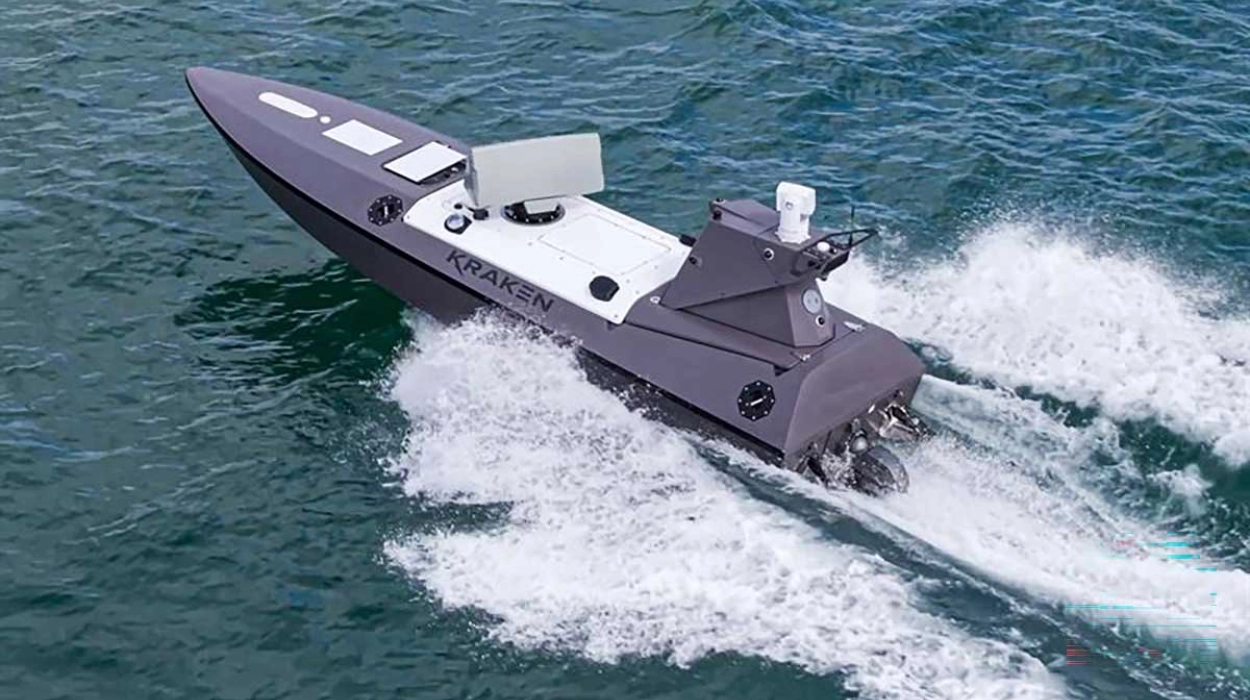
- The prototype combines Saab’s Giraffe 1X lightweight 3D radar with Kraken’s K3 SCOUT uncrewed surface vessel.
- The system is designed to detect and track airborne threats and provide early warning of potential drone activity around maritime infrastructure.
- The vessel has been tested through sea trials to assess radar performance in maritime conditions.
- Saab UK and Kraken say they moved the concept to a working prototype in less than seven months.
- Andy Fraser, Managing Director of Saab UK, described the system as a UK-manufactured and deployable capability developed with Kraken.
- Mal Crease, Chief Executive and Founder of Kraken Technology Group, said the K3 SCOUT was designed to integrate mission-specific payloads for demanding maritime environments.
- The companies see potential applications around shipping, ports, offshore energy installations and other critical infrastructure.
- The system remains experimental, with no commercial deployment or specific customer announced by the companies.
- The development comes as the UK increases its focus on autonomous and uncrewed maritime systems and the development of a “hybrid navy”.
- Other industry reporting has highlighted that both Kraken and Saab UK have operations in Fareham and that the K3 SCOUT has also undergone Royal Navy-supported airdrop trials.
- The development has particular relevance to Shipping, Maritime and Ports and Safety and Security, given its focus on maritime monitoring and protection from drone threats.
What have Saab UK and Kraken developed?
Saab UK and Kraken Technology Group have developed and tested an experimental autonomous surface vessel designed to detect potential drone threats in maritime environments, combining Saab’s Giraffe 1X radar with Kraken’s K3 SCOUT uncrewed surface vessel. The companies have positioned the prototype as a potential early-warning capability for shipping, ports, offshore energy installations and other critical infrastructure, although it remains at the experimental stage and no commercial deployment or specific customer has been announced.
As reported by the News Desk of IoT Insider, Saab UK and Kraken Technology Group have developed an autonomous surface vessel that combines maritime robotics with radar sensing to detect potential aerial threats around shipping and critical infrastructure.
The report said the experimental system integrates Saab’s Giraffe 1X 3D radar with Kraken’s K3 Scout uncrewed surface vessel, creating a prototype counter-drone detection platform for maritime environments.
The development was also announced by Saab UK on 5 October 2026, with the company describing the vessel as an experimental autonomous “drone seeker” surface vessel intended to help protect shipping and critical infrastructure from emerging aerial threats.
The project represents a combination of two separate capabilities: Saab’s radar technology for identifying and tracking airborne targets and Kraken’s autonomous maritime platform for operating at sea without a crew on board.
How does the autonomous drone seeker vessel work?
The prototype is based on Kraken’s K3 SCOUT, an uncrewed surface vessel designed to operate autonomously and accommodate different mission-specific payloads.
The central sensing component is Saab’s Giraffe 1X radar. Saab describes the system as a lightweight, three-dimensional radar capable of detecting and tracking airborne threats in real time.
According to IoT Insider’s News Desk, adding the radar to the K3 Scout gives the vessel the ability to detect and track airborne targets, potentially providing early warning of drone activity around ports, shipping and offshore infrastructure.
Ocean News, in a report edited by Ed Freeman, similarly said the Giraffe 1X was integrated into the K3 SCOUT’s modular payload bay. The report said the radar is expected to provide enhanced early warning of aerial threats, including the detection of small airborne targets at extended ranges.
The combination is significant because the radar does not have to be placed on a conventional crewed vessel. Instead, the sensing equipment can be carried by an autonomous surface platform that can operate independently or alongside conventional maritime assets.
This creates the possibility of extending surveillance coverage without requiring another crewed ship to remain continuously in the relevant area.
What did Andy Fraser say about the Saab and Kraken project?
Andy Fraser, Managing Director of Saab UK, said the companies had developed what he described as a pioneering UK-manufactured and deployable capability in less than seven months.
As reported by IoT Insider’s News Desk, Fraser said: “This is a pioneering, UK-manufactured, deployable capability that, together with Kraken, we’ve developed in less than seven months.”
Fraser added that the development reflected the strength of the partnership between Saab and Kraken, as well as what he described as the maturity and flexibility of their respective technologies.
He also linked the pace of development to the companies’ ability to respond to changing threats and customer requirements.
Saab’s own announcement carried the same statement from Fraser and said the prototype had been developed in less than seven months.
The speed of development is one of the notable commercial and technological aspects of the project. Rather than being a long-term concept without a physical demonstration, the companies have taken the system through development and sea trials within a relatively short period.
What did Mal Crease say about the autonomous vessel?
Mal Crease, Chief Executive and Founder of Kraken Technology Group, said the prototype represented the type of application for which the K3 SCOUT had been designed.
As reported by IoT Insider’s News Desk, Crease said: “Kraken and Saab UK’s prototype ‘drone seeker’ vessel is exactly what the K3 SCOUT was designed to do: integrate with mission-relevant payloads to then operate in austere maritime environments.”
The statement highlights the modular design of the K3 SCOUT. Rather than being restricted to one particular function, the vessel can carry different payloads depending on the operational requirement.
That approach allows sensors and other mission equipment to be integrated onto an autonomous maritime platform without necessarily designing an entirely new vessel for every task.
Ocean News also reported Crease’s statement, while noting that the integration demonstrates the ability of the K3 SCOUT’s modular architecture to bring sensors and payloads to sea rapidly.
Where could the autonomous vessel be used?
Saab and Kraken have identified several potential maritime applications for the technology.
According to IoT Insider, the companies are positioning the system for potential use around ports, shipping, offshore energy installations and other critical infrastructure.
Saab UK said the experimental system could strengthen protection for shipping, ports, offshore energy assets and national infrastructure against drone threats.
The potential applications are broader than conventional naval surveillance. Commercial ports, offshore installations and other critical infrastructure can also require monitoring against unauthorised or potentially hostile aerial activity.
A vessel capable of remaining at sea while carrying a radar system could provide another layer of surveillance in locations where continuous monitoring by crewed vessels may be expensive, difficult or operationally unsuitable.
However, the distinction between potential capability and operational deployment remains important. The companies have not announced a commercial deployment or named a specific customer for the prototype.
The system should therefore be viewed as an experimental capability rather than a fully deployed maritime security product.
What did the sea trials demonstrate?
The prototype has undergone sea trials designed to examine how the radar performs in maritime conditions.
IoT Insider reported that Saab and Kraken moved the project from concept to working vessel in less than seven months, with the development period including a series of sea trials.
Ocean News also reported that the companies carried out sea trials to test radar performance under maritime conditions.
Testing radar aboard a moving autonomous surface vessel introduces different requirements from operating the same radar in a fixed installation or conventional land-based environment.
The vessel itself has to operate reliably, while the radar must detect and track airborne objects despite movement and changing maritime conditions.
The trials therefore provide an opportunity for Saab and Kraken to assess how the combined system performs as an integrated maritime capability rather than testing the radar and vessel separately.
Are Saab and Kraken developing the system for a hybrid navy?
The development is also connected to the wider concept of a hybrid navy, in which crewed and uncrewed platforms operate together.
Saab said the K3 Scout can operate entirely autonomously and can be deployed independently or alongside conventional surface vessels. The company said the integration of Giraffe 1X onto the autonomous platform represents a step towards the hybrid navy concept outlined in the UK Government’s Defence Investment Plan.
The UK Government has separately set out plans for a greater role for autonomous and uncrewed systems. Its Defence Investment Plan, published in June 2026, included investment in drones and autonomous systems and described a future Royal Navy incorporating crewed and uncrewed platforms.
This wider policy context helps explain why developments involving autonomous maritime vessels are attracting attention from defence and maritime technology companies.
The Saab-Kraken prototype, however, should not be interpreted as evidence of a specific procurement decision. The companies have described it as experimental, and no customer or commercial deployment has been announced.
What is the UK connection to the Saab and Kraken development?
The project has a significant UK industrial element.
Kylie Bielby, writing for Unmanned Airspace, reported that Kraken Technology Group and Saab UK are both based in Fareham, where the K3 SCOUT and Giraffe 1X are manufactured.
Bielby also reported that Kraken is scaling production to 1,000 vessels per year.
The Fareham connection adds a corporate and manufacturing dimension to the development, showing that the project involves UK-based industrial activity rather than simply the overseas deployment of an existing foreign system.
The same report noted that the Royal Navy demonstrated in July that the K3 SCOUT could be airdropped and operated without the need for a support ship or nearby port.
The Royal Navy separately reported on those trials in July, saying a K3 Scout was deployed from a military transport aircraft using an aerial delivery system. The vessel was pushed from the aircraft at about 1,300 feet into waters reaching Sea State 4, with waves of up to eight feet.
The Royal Navy said the trials demonstrated the potential for rapidly deploying small uncrewed surface vehicles directly into difficult-to-access waters.
That earlier work provides additional context for the latest Saab-Kraken trial, although the July airdrop demonstration and the October drone-seeker prototype are separate developments.
How does the development fit into the wider UK autonomous maritime programme?
The Saab-Kraken project arrives during a period of increased UK investment and interest in autonomous systems.
The Government’s Defence Investment Plan announced more than £5 billion for drones and autonomous systems, while the wider plan described a future force in which autonomous systems operate alongside conventional platforms.
The Government has also described plans for a hybrid Royal Navy incorporating crewed and uncrewed systems.
For maritime technology companies, this creates an environment in which autonomous vessels can be developed for surveillance, force protection, logistics and other missions.
The Saab-Kraken prototype fits within that broader technological direction because its purpose is not to replace conventional ships outright. Instead, the concept is to add an autonomous sensing platform that can work alongside crewed maritime assets.
Ocean News reported that the prototype could operate independently or alongside conventional surface vessels, extending sensing and early-warning capabilities without requiring an additional crewed platform.
Why is maritime drone detection becoming important?
The development reflects a wider shift in the security environment surrounding maritime infrastructure.
Drones can be relatively small and difficult to detect, while ports, shipping routes, offshore energy installations and other infrastructure can cover large geographical areas.
Traditional surveillance arrangements may rely on fixed sensors, aircraft, crewed vessels or a combination of systems. An autonomous surface vessel provides another potential method of distributing sensors across maritime areas.
The Saab-Kraken concept therefore combines autonomous mobility with radar-based detection.
Its significance is not simply that a vessel can travel without a crew. The more important element is the integration of autonomous navigation and mission-specific sensing into a single platform.
Such systems could potentially allow maritime operators to place surveillance capability closer to areas of interest while keeping personnel away from the immediate operating environment.
Nevertheless, operational effectiveness will depend on factors including detection performance, reliability, communications, weather and sea conditions, autonomy, integration with existing command systems and the ability to respond appropriately when a potential threat is identified.
Those questions cannot yet be answered fully by the current prototype because the system remains experimental.
What happens next for the Saab-Kraken prototype?
For now, the companies have not announced a commercial deployment or named a customer for the autonomous drone-seeker vessel.
The immediate significance of the project is therefore its demonstration of how two established technologies can be combined into a new maritime security capability.
Saab brings the Giraffe 1X radar and its experience in airborne-threat detection, while Kraken contributes an autonomous maritime platform designed around modular payload integration.
The sea trials provide an initial opportunity to assess how the combined technology performs in real maritime conditions.
Future development would need to establish whether the prototype can progress from experimental testing to operational or commercial use.
Potential users could include organisations responsible for ports, shipping, offshore energy infrastructure and national security, but any future adoption would depend on further testing, requirements and procurement decisions.
For the wider maritime technology sector, the project illustrates the growing role of autonomous platforms as complementary assets rather than simply replacements for conventional vessels.
As reported by IoT Insider’s News Desk, Saab and Kraken envisage autonomous platforms operating alongside crewed maritime assets, extending the reach of sensing systems where continuous monitoring may otherwise be difficult or costly.
The development therefore combines several trends in the maritime technology market: autonomous surface vessels, modular payloads, radar-based aerial threat detection and the increasing use of uncrewed systems for security and surveillance.
For professionals working across Shipping, Maritime and Ports, understanding these technologies is increasingly relevant as autonomous vessels become part of broader maritime operations. Similarly, developments in maritime threat detection connect directly with Safety and Security, particularly where ports, offshore assets and critical infrastructure require additional layers of monitoring and protection.
The Saab-Kraken vessel remains a prototype, but its rapid development and sea trials demonstrate how autonomous maritime platforms can be adapted for emerging security requirements. Whether the system eventually enters commercial or operational service will depend on further testing and customer demand, but the trial provides a concrete example of the direction in which maritime autonomy and counter-drone technology are developing.