
In Great Britain, every employer must provide first-aid arrangements that are adequate and appropriate for their workplace, workforce and risks. The law does not fix a headcount or a kit list. It asks you to assess your own needs and then provide the people, equipment and information that assessment points to. The minimum, even for a small low-risk business, is a suitably stocked first-aid kit, an appointed person to take charge in an emergency, and information telling staff where both are (HSE).
This guide walks through what that means in practice: the needs assessment, how many first aiders to plan for, what training they need, what goes in the kit, and the facilities and information that complete the system.
TL;DR
- The Health and Safety (First-Aid) Regulations 1981 require adequate and appropriate equipment, facilities and trained people, decided by a first-aid needs assessment.
- The minimum for any workplace is a stocked kit, an appointed person and clear information for employees. Higher risk or bigger workforces need trained first aiders.
- There is no mandatory UK kit list or universal headcount. HSE gives suggested numbers, and your assessment decides the rest.
- Cover must follow shifts, holidays, remote working and multiple sites, and everyone must know who and where the first aiders are.
- Rules differ by country, so teams in Ireland, Canada or Australia need to follow local law.
Table of Contents
- What the law actually requires
- Start with a first-aid needs assessment
- How many first aiders do you need?
- First aider training and qualifications
- What belongs in a workplace first-aid kit
- Facilities, information and procedures
- The aims and rules of first aid
- Rules differ outside Great Britain
- Perspective
- Build first aid into your wider safety training
- A practical checklist for employers
- FAQ
- Sources
What the law actually requires
The Health and Safety (First-Aid) Regulations 1981 require employers to make first-aid arrangements for their employees and to tell them what those arrangements are (legislation.gov.uk). HSE’s L74 guidance explains the purpose: employees should receive immediate attention if they are injured or taken ill at work, and professional help should be summoned where needed (HSE L74).
The regulations apply to employers, but HSE also expects you to consider non-employees such as visitors, contractors and members of the public when you assess needs. Self-employed people must make their own provision for themselves.
Two points catch employers out:
- Nothing is automatic. A small, low-risk workplace may need only a first-aid box and an appointed person, and that person need not have formal first-aid training (HSE).
- Nothing is optional either. If the assessment shows trained first aiders are needed, a certificate-holding first aider must be in place whenever people are working.
Start with a first-aid needs assessment
The needs assessment is the foundation. HSE’s L74 guidance asks you to consider the following (HSE L74):
- the hazards and likely risks in your workplace
- the size and make-up of your workforce
- shift patterns and absences such as leave and sickness
- your accident and ill-health history
- remote workers and lone workers
- how spread out your sites are
- how easily emergency services can reach you
- non-employees who are on site
HSE does not require you to write the assessment down. Keeping a written record is still sensible, because it shows how you reached your decisions and makes it easier to review them when something changes (HSE L74).
A simple way to run it
Walk each site with a short list of questions:
- What could injure someone here: machinery, chemicals, heights, vehicles, manual handling, heat, sharp tools?
- Who is on site, and when? Count nights, weekends, agency staff and visitors.
- How long would an ambulance take to reach us?
- Does anyone have a known health condition that colleagues should be prepared for?
- Who works alone or off site, and how do they get help?
Review the answers after any incident, move, change in headcount or new process. Good practice is to revisit them at least once a year.
When hazards go beyond the desk
Offices, workshops, depots and vehicles all create different injury patterns. Employers whose staff travel or work on the road may find it useful to read about health and safety in transport when thinking through mobile and lone working. High-hazard sectors such as construction, offshore and confined-space work carry their own rules, covered further below.
How many first aiders do you need?
There is no single UK headcount rule. HSE’s approach is risk-based: the right mix of people, equipment and facilities depends on hazards, workforce, work patterns, access to emergency care and previous incidents (HSE L74). The regulations require suitable people in adequate and appropriate numbers, with training and qualifications appropriate to the circumstances.
HSE does give suggested minimums in its guidance, which most employers use as a starting point:
| Workplace type | Fewer than 25 staff (low hazard) / fewer than 5 (higher hazard) | Mid-size | Larger |
|---|---|---|---|
| Lower hazard, such as offices and shops | At least one appointed person | 25 to 50 staff: at least one EFAW-trained first aider | One FAW-trained first aider for every 100 staff |
| Higher hazard, such as heavy machinery, chemicals, construction | Fewer than 5 staff: an appointed person | 5 to 50 staff: at least one EFAW or FAW first aider, depending on likely injuries | One FAW-trained first aider for every 50 staff |
These figures come from HSE’s guidance on the 1981 regulations (HSE L74). Treat them as the number available at any time people are working, not the number you employ. Once you allow for holidays, sickness, shifts and separate buildings, you will usually need more people trained than the table suggests.
Construction sites
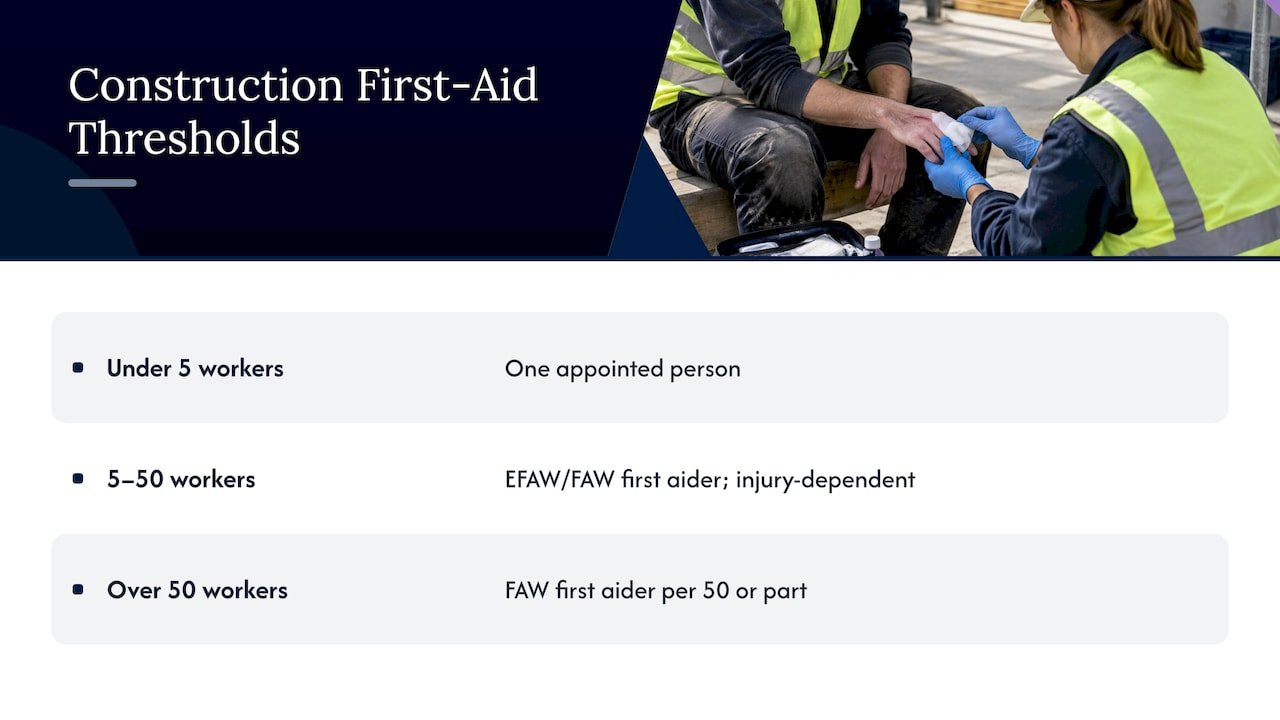
HSE is more specific for construction. Fewer than five workers requires at least one appointed person. Between five and 50 requires at least one EFAW- or FAW-trained first aider, depending on likely injuries. Above 50 requires at least one FAW-trained first aider per 50 workers or part of 50 (HSE construction). If you manage site teams, our guide to construction safety training covers what else UK sites expect.
Appointed person or first aider?
An appointed person looks after the first-aid equipment and calls the emergency services when needed. They do not need a first-aid qualification and should not attempt treatment they have not been trained for. A first aider has completed training and holds a valid certificate. Appointed persons also provide cover when a first aider is absent, so even a workplace with trained first aiders usually needs a few of them.
First aider training and qualifications
HSE says UK first aiders must hold a valid First Aid at Work (FAW) or Emergency First Aid at Work (EFAW) certificate (HSE construction). In general terms, EFAW is a shorter course covering emergency situations, while FAW covers a wider range of injuries and illnesses. Your needs assessment tells you which suits your risks.
Some practical points for HR and safety leads:
- Diarise renewals. Certificates expire, and an expired certificate means that person is no longer a valid first aider for your numbers.
- Choose a recognised route. Check that the training organisation or awarding body is acceptable for your sector before you book.
- Specialist risks need specialist training. Where your assessment identifies particular hazards, such as offshore work, infection exposure or hazardous atmospheres, first-aid training sits alongside sector training. See our guides to offshore safety training, infection control training and confined space entry.
- Mental health first aid is a different thing. It can support wellbeing, but it does not replace the physical first-aid cover your assessment requires.
What belongs in a workplace first-aid kit
HSE states there is no mandatory list of first-aid kit contents. Contents should follow the needs assessment. For a low-hazard workplace, its guide suggests a minimum of (HSE L74):
- a leaflet of general first-aid guidance
- 20 individually wrapped sterile plasters in assorted sizes
- 2 sterile eye pads
- 2 individually wrapped triangular bandages
- 6 safety pins
- 2 large and 6 medium sterile unmedicated wound dressings
- at least 3 pairs of disposable gloves
A kit that contains only this is a starting point. HSE notes that you may need extra items such as foil blankets, cleansing wipes or cutting shears, and that larger sites may need more than one kit (HSE). Kits should be easy to reach, checked often and restocked soon after use.
Matching the kit to your risks
Guidance from other countries shows how the same principle plays out. New Zealand’s WorkSafe, for example, says eye pads may be particularly necessary where workers handle open chemical containers, use sprays or hoses, face flying particles, risk infectious splashes, or weld, cut or machine (WorkSafe NZ). The same logic applies to a UK workshop: look at what could realistically go wrong, then stock for it.
A routine that works:
- Name one person responsible for each kit.
- Check kits on a fixed schedule and after every use.
- Log expiry dates on sterile items and replace them before they lapse.
- Keep a kit in each building, on each floor if the site is large, and in company vehicles where staff drive for work.
- Put a list of contents inside the lid so gaps are obvious.
Facilities, information and procedures
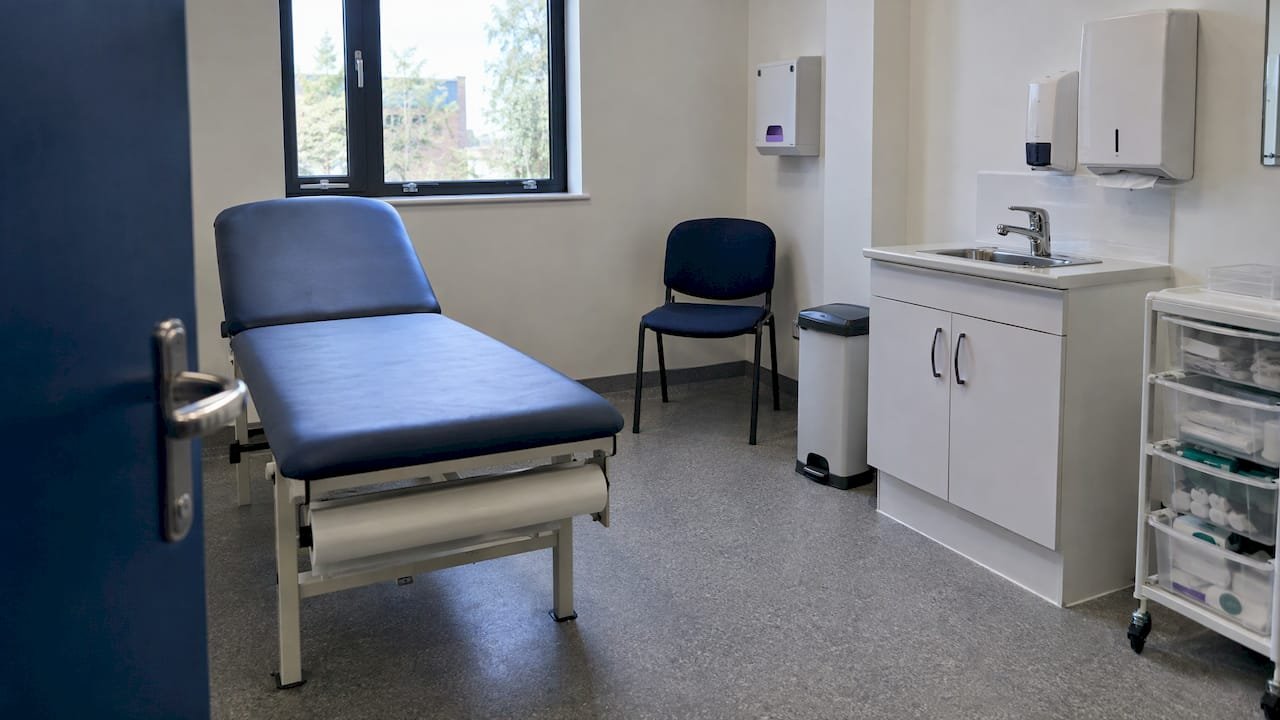
Kits and people are only part of the system. HSE says a first-aid room may be needed where the assessment identifies one, usually in larger or higher-hazard premises. It should be clean, accessible whenever employees are working, suitably lit, ventilated and heated, with a medical couch and ideally hot and cold running water. Where a room is provided, it should show the names and locations of first aiders (HSE).
The International Labour Organization sets out the same baseline in broader terms: a stocked first-aid box, an appointed person, and notices identifying who they are and where the box is, with a first-aid room where national law requires one (ILO).
HSE’s guidance is clear that arrangements only work when everyone knows and understands them, and they must cover all shifts and working patterns (HSE L74). In practice that means:
- a poster at each site entrance, kitchen or staff noticeboard naming first aiders and showing kit locations
- first-aid details in inductions for new starters, agency staff and contractors
- a clear emergency routine: who calls 999, who meets the ambulance, who stays with the casualty
- an accident book or reporting process that feeds back into your next assessment
The aims and rules of first aid
Readers often ask about the “aims” and “rules” of first aid. A common four-part formulation, used in Scottish national qualification materials, is to promote a safe environment, preserve life, prevent the injury or illness becoming worse, and provide reassurance (SQA). In a workplace these principles are not a substitute for your legal arrangements. They explain why those arrangements exist: your first aiders can only do this if the right people, kit and communication are reliably available.
Rules differ outside Great Britain
Because we train teams across many countries, a note for international employers: requirements are set locally, not globally. The Red Cross and Red Crescent movement’s 2020 guidelines say workplace first-aid education should reflect the organisation’s risk profile while meeting applicable legislation (IFRC guidelines). Some examples:
- Ireland: the Health and Safety Authority expects equipment, trained occupational first aiders based on workplace size and hazards, and first-aid rooms where premises size, activity and accident frequency make them necessary (HSA). PHECC First Aid Response is the recognised minimum training standard (HSA FAQ).
- New South Wales, Australia: SafeWork NSW gives risk-based ratios, including one first aider per 25 workers for high-risk workplaces (SafeWork NSW).
- Quebec, Canada: the CNESST sets numbers per shift and requires certificates to be renewed every three years (CNESST).
Rules also move. In Canada, proposed federal amendments published in the Canada Gazette on 3 October 2026 would incorporate CSA Z1220 into kit requirements, including a risk assessment to determine kit type (Canada Gazette). None of this changes what applies in Great Britain, but it is a good reason to check the regulator’s current page for every country where you employ people.
Perspective
Most first-aid failures we see discussed are not failures of kit. They are failures of system: a certificate that lapsed, a first aider who left, a night shift nobody planned for.
We build training programmes around the real conditions of an organisation, delivered on site, online or blended, and aligned to globally accredited standards. The same thinking applies to first aid. The needs assessment is the starting point, and it should be revisited whenever work changes.
Our view is that first aid sits within a wider safety culture. Teams that understand their hazards, from confined spaces to infection exposure to fire, make better assessments and respond with more confidence. Training that is customised to your sites and led by industry experts is how that culture is built.
Sam
Build first aid into your wider safety training
First-aid cover is one part of managing risk. If you are planning compliance and safety development for a team, we provide professional training courses with global accreditation, customisable for your organisation and delivered on site, online or blended. For an overview of how to choose safety courses that prove practical skills, read our guide for HR and L&D teams, explore the ISO 45001 occupational health and safety course, or see everything we offer on Oxford Centre.
A practical checklist for employers
- Complete and date a first-aid needs assessment for every site.
- Appoint at least one appointed person per shift, and trained first aiders where the assessment or HSE’s suggested numbers call for them.
- Record certificate expiry dates and book renewals early.
- Stock kits to match your risks, and check them on a schedule.
- Decide whether a first-aid room is needed.
- Tell everyone who and where, including contractors and visitors.
- Review after incidents, changes in headcount or changes in work.
FAQ
Is it a legal requirement to have a trained first aider at work?
Not always. The law requires adequate and appropriate provision, and your needs assessment decides whether trained first aiders are needed. A small low-risk workplace may only need a first-aid box and an appointed person (HSE). Higher-risk or larger workplaces will usually need certificated first aiders.
What should be in a workplace first-aid kit?
There is no mandatory UK list. HSE’s low-hazard guide suggests plasters, eye pads, triangular bandages, safety pins, sterile dressings, disposable gloves and a guidance leaflet. Add items to match the risks you identified in your assessment, and restock soon after use.
How many first aiders do I need for my workplace?
There is no fixed number. As a starting point, HSE suggests an appointed person for fewer than 25 staff in low-hazard workplaces, one EFAW first aider for 25 to 50, and one FAW first aider per 100 beyond that. Higher-hazard workplaces need more, and you must also allow for absences and shifts.
Do I need to write down my first-aid needs assessment?
HSE says you do not have to, but a written record helps you show how you decided on your provision and makes reviews easier when circumstances change (HSE L74).
Sources
- HSE: What employers need to do for first aid
- HSE: First aid at work, L74
- HSE: Construction first aid FAQs
- legislation.gov.uk: The Health and Safety (First-Aid) Regulations 1981
- ILO: First aid
- IFRC international first aid guidelines 2020
- SQA: Introduction to Basic First Aid
- WorkSafe New Zealand: First aid at work
- HSA Ireland: Guidelines on first aid at places of work
- HSA Ireland: First aid FAQ
- SafeWork NSW: First aid in the workplace
- CNESST: First aid in the workplace training
- Canada Gazette, Part 1, 3 October 2026
- Jobs in Transport: The role of health and safety in transport