
Scrum is a framework for one small team. SAFe (the Scaled Agile Framework) is a way of coordinating many teams, and it uses Scrum inside it. So the choice is rarely “either/or”. If one team owns one product, Scrum is usually enough. If several teams must deliver one large solution together, you need something that handles planning, dependencies and alignment across them, and SAFe is one option for that.
This guide sets out the differences in scale, roles, events and certification, then gives you a simple way to decide. It is written for project managers, HR and learning leads, and professionals weighing which skills to build next.
TL;DR
- Scrum is built for a single team, working in short sprints with a product owner, a Scrum Master and developers.
- SAFe coordinates many teams in an Agile Release Train, adding portfolio, programme and planning layers on top of team-level practice.
- SAFe does not replace Scrum: its teams commonly run Scrum events, so the two are often used together.
- Scale is the deciding factor. If you do not have several teams building one product, you probably do not need SAFe.
- Certifications follow the same split: Scrum credentials cover team practice, SAFe credentials cover agile at scale.
Table of Contents
- SAFe vs Scrum at a glance
- What Scrum is
- What SAFe is
- The key differences
- Does SAFe replace Scrum?
- When to choose Scrum, SAFe or both
- Scrum vs SAFe certifications
- Our perspective
- Building the skills around the framework
- Talk to us about your team’s training
- Common mistakes when choosing
- FAQ
- Sources
SAFe vs Scrum at a glance
| Question | Scrum | SAFe |
|---|---|---|
| What is it? | A lightweight framework for one team | A framework for coordinating many teams and the wider organisation |
| Typical size | A team of around 10 or fewer | An Agile Release Train of roughly 50 to 125 people |
| Planning horizon | One sprint (up to a month) | A Program Increment of about 8 to 12 weeks, plus sprints inside it |
| Core roles | Product Owner, Scrum Master, Developers | Team roles plus release train and portfolio-level roles |
| Feel | Light, few rules | More prescriptive, more layers |
| Best when | One team, one product | Several teams, one large solution, many dependencies |
The rest of this article unpacks each row.
What Scrum is
Scrum is a small set of roles, events and artefacts built around short cycles called sprints. The current Scrum Guide describes a Scrum Team as small enough to stay nimble, typically 10 or fewer people, and says that if a team grows too large it should split into several cohesive Scrum Teams that share the same Product Goal, Product Backlog and Product Owner. Earlier editions of the guide gave a narrower range for the development team: more than nine members means too much coordination for an empirical process to manage well.
Scrum centres on four team-level events: Sprint Planning, the Daily Scrum, the Sprint Review and the Sprint Retrospective. Sprints usually run from one to four weeks. The team is cross-functional, so it has the skills to turn an idea into a working increment without waiting on another group.
That simplicity is the appeal. Scrum tells you very little about the organisation around the team, which is exactly why it struggles when ten teams need to ship one product.
What SAFe is
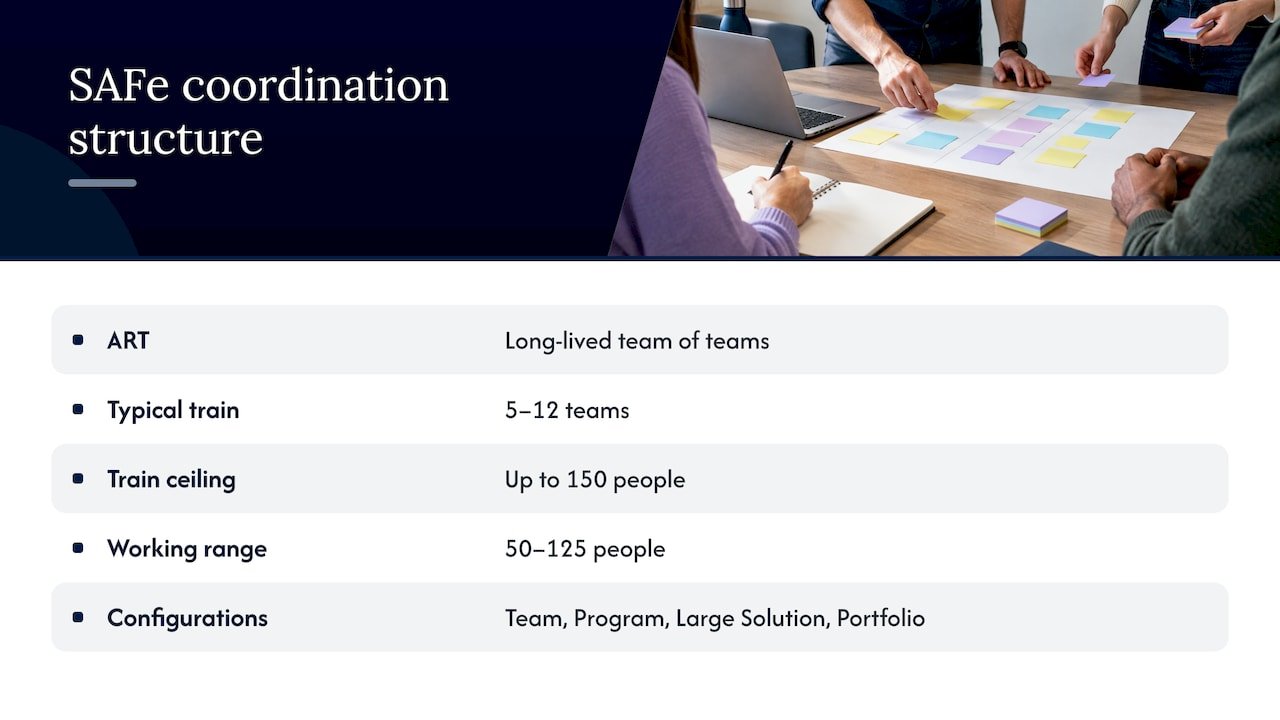
SAFe is a framework for applying agile and lean thinking across a larger organisation. Its original whitepaper names agile development, lean product development and systems thinking as its three main bodies of knowledge. It is modular: Team, Program, Large Solution and Portfolio configurations support progressively broader coordination, and a foundation supplies lean-agile leadership, principles and values.
Its main coordination device is the Agile Release Train, or ART. That is a long-lived team of agile teams and stakeholders organised around a value stream. The early SAFe whitepaper described a typical train as five to twelve teams, and independent guidance puts a train at up to 150 people, with multiple trains recommended beyond that. A commonly quoted working range is 50 to 125 people.
Atlassian describes SAFe as more prescriptive and enterprise-oriented, suited to portfolio alignment, cross-team planning and dependency management. That prescriptiveness is a feature for organisations that want a defined structure, and a cost for those that prefer to grow their own.
The key differences
Scale and team structure
Scrum is designed for a single autonomous team that can talk directly and decide together. SAFe starts from the opposite problem: many teams, shared dependencies, a roadmap that spans quarters. Toptal’s comparison of scaling approaches makes the practical point that scaling is only needed when several teams deliver one large product. If each team has its own product, no scaling framework is required.
Planning cadence
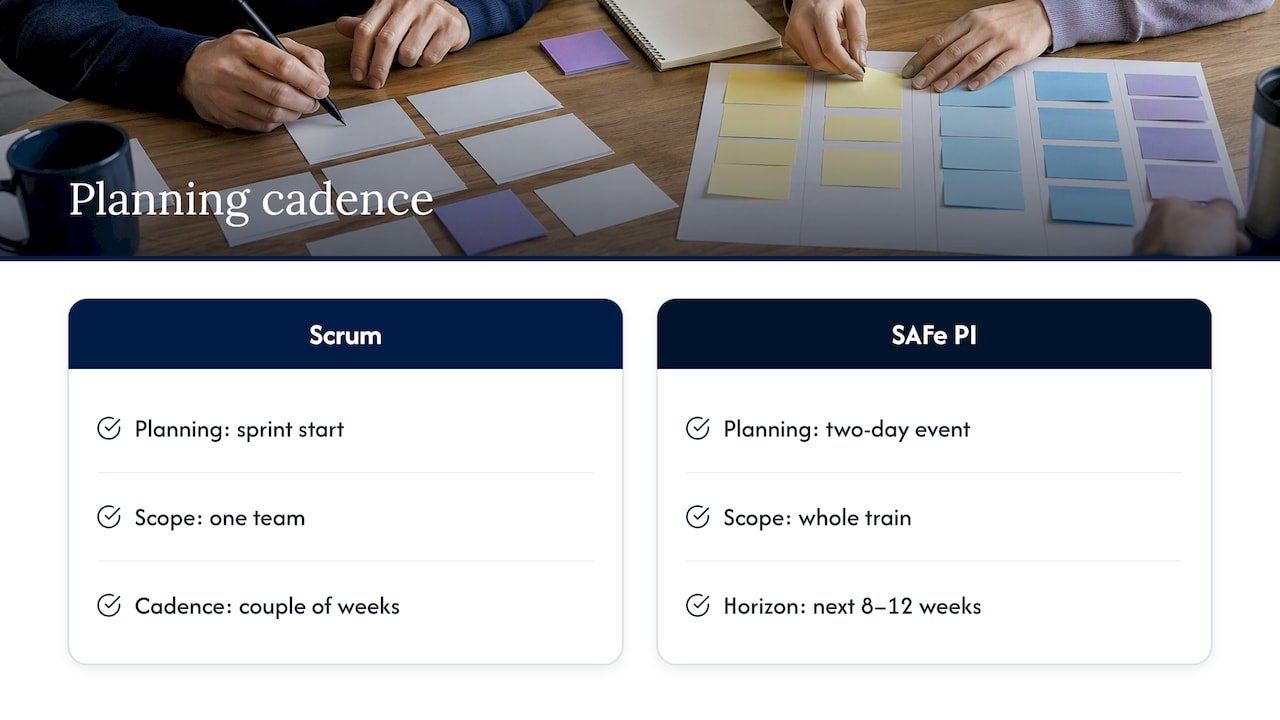
In Scrum, planning happens at the start of every sprint and involves one team. SAFe adds a bigger rhythm above it. Program Increment planning is a two-day event in which every team on the train plans the next 8 to 12 weeks together, so cross-team dependencies surface on a planning board rather than halfway through delivery. Sprint planning aligns one team for a couple of weeks. PI planning aligns the whole train for a full increment.
Events and roles
SAFe’s own guidance says it adds events and planning beyond ordinary Scrum, including PI Planning, ART-level synchronisation and solution demonstrations. Scrum’s roles stay at team level. SAFe layers further roles around them for the train and for portfolio management. If you are a Scrum Master today, you would still facilitate your team, but you would also take part in train-level events and help manage dependencies with other teams.
Prescription versus freedom
Scrum deliberately leaves a lot open: how you estimate, how you slice work, how you organise the wider company. SAFe fills in more of those answers. Some leaders find that reassuring. Others find it heavy. Common challenges reported with SAFe include administrative overhead, rigid planning boundaries and a steep learning curve, and the usual advice is to start with a single train and build from there.
Scope
Scrum stops at the team. SAFe reaches into portfolio funding, strategy and leadership behaviour. That wider scope is why it appeals to organisations where agile adoption is stuck at the point where team-level practice meets budgeting and governance.
Does SAFe replace Scrum?
No. This is the most common misunderstanding behind the search “scaled agile vs Scrum”. SAFe describes how teams on a train work, and Scrum is one of the ways they can do it. The official guidance on SAFe Scrum says its teams use iterations, Kanban systems and Scrum events to plan, execute, demonstrate and retrospect their work while cooperating with other teams and train stakeholders.
The same guidance notes that these teams also apply built-in quality practices that Scrum itself does not define. So “SAFe Scrum” is Scrum team execution inside a larger operating model, not Scrum under a new name.
The scaling approaches InfoQ compares share a common starting point: cross-functional, self-organising Scrum teams that slice requirements into deployable increments and invest in technical practices such as continuous integration and automated regression testing. Many organisations therefore combine the two: Scrum for local agility, a scaling layer for enterprise coordination. For a wider tour of how agile and other delivery approaches relate, this overview of software methodologies is a helpful companion.
When to choose Scrum, SAFe or both
Use this as a decision sequence rather than a rulebook.
- Count the teams building one product. One team: use Scrum. Two or three teams with light dependencies: Scrum with a simple coordination routine may be enough.
- Look at the dependencies. If teams regularly block each other, or releases need synchronising across groups, a scaling structure starts to earn its keep.
- Check your agile maturity. Atlassian suggests that teams still building agile foundations may do better starting with Scrum or Kanban. Toptal’s expert makes a similar point: scaling a team that is not yet proficient in agile creates more problems, and engineering practices such as CI/CD pipelines and automated testing need to be in place first.
- Decide how much structure you want. If your leadership wants a defined model for planning, roles and governance, SAFe supplies one. If you prefer a lighter approach, other scaling options exist, described by Atlassian as lighter Scrum-network scaling, a simpler Scrum-based model and a context-driven toolkit.
- Pilot before you roll out. Start with one train or one product area, review what works, then extend.
A worked example
Imagine a company with three product teams of seven people each. Each team owns a separate app. They have no shared release. Scrum, run independently, fits well. Now imagine the same company building one platform with eight teams that share a database, a release date and a customer launch. Now the dependencies are the main risk, and a shared planning event every few weeks, a common backlog structure and a clear way to track cross-team work become valuable. That is the territory SAFe was designed for.
Scrum vs SAFe certifications
Certification choices follow the same line. Scrum Guide-based credentials focus on a small-team approach to software development, while SAFe credentials presuppose knowledge of release trains and events such as Scrum of Scrums, and are about agile at scale.
Which is better for you depends on your role:
- You work in or lead a single team: a Scrum-based credential matches your daily work.
- You coordinate several teams, a programme or a portfolio: a scaling credential covers the planning and alignment you actually do.
- You want to move into programme or transformation roles: learn Scrum first, then add scaling knowledge. It is hard to coordinate teams whose practice you do not understand.
Before paying for either, check that the course content matches the way your organisation really works. A certificate is most valuable when you can apply it the next Monday.
Our perspective
We see the same pattern in many organisations. A team learns Scrum, gets results, and leadership asks how to repeat that across the business. The temptation is to pick a framework first and think about people second.
In our experience the framework is rarely the hard part. The hard part is that managers, team leads and project professionals need shared habits: how to plan together, how to handle dependencies, how to hold people accountable without strangling autonomy. That is why we build training around your organisation’s real situation rather than a fixed script. Our programmes are customisable, delivered on-site, online or blended, and led by industry experts who work on real-world challenges.
If your teams are starting out, build team-level skill and project management fundamentals first. If you are already coordinating several teams, invest in the leadership and cross-team management skills that make any scaling approach work. Either way, train the people who will run the model, not only the people who sit inside it.
Sam
Building the skills around the framework
Whichever model you choose, results depend on the people running it. Project managers and team leads need planning, prioritisation and stakeholder skills. Leaders need to create accountability without micromanaging. Our project management training is designed for professionals who want accredited, globally recognised qualifications, and for corporate teams who want content shaped around their own projects.
If your agile teams sit inside a matrix organisation, our Matrix Management and Leadership course addresses the reporting-line tension that scaling often exposes. For managers who want to build clear ownership of outcomes, there is also our Leading Employee Accountability course, and Managerial Time and Priority Management helps leads protect the focus that sprints and increments depend on.
Talk to us about your team’s training
Tell us how many teams you run, how they work and where delivery stalls, and we will help you shape a programme that fits: on-site, online or blended, for a corporate group or for an individual professional. See the Oxford Centre homepage for the full range, or go straight to the project management courses.
Common mistakes when choosing
- Adopting SAFe for a single team. The extra layers add cost without solving a problem you have.
- Scaling before the basics work. If sprints are missed, backlogs are unclear and quality is inconsistent, more structure will multiply the problems.
- Treating the framework as the goal. The goal is shipping valuable work predictably. The framework is a means.
- Ignoring engineering practice. Cross-team agility needs automated testing, integration and deployment habits behind it.
- Training only the Scrum Masters. Product owners, managers and executives shape the system. Include them.
FAQ
Is SAFe better than Scrum?
Neither is better in general. Scrum suits a single team, and SAFe suits several teams that must deliver one solution together. SAFe also uses Scrum at team level, so the question is usually whether you need a scaling layer on top.
Which certification is better, a Scrum or a SAFe one?
Choose by role. A Scrum-based credential fits people who work within one team. A SAFe credential fits people who coordinate teams on a release train, plan across teams or support an enterprise rollout.
What is the difference between SAFe and agile?
Agile is a set of values and principles for delivering work in small, adaptive steps. Scrum and SAFe are frameworks that put agile into practice, one at team level and one across a larger organisation.
Can you use Scrum and SAFe together?
Yes. Many organisations run Scrum within teams and use SAFe’s planning and alignment structure across them. This keeps local agility while adding enterprise coordination.
Sources
- The 2020 Scrum Guide
- The Scrum Guide (earlier edition)
- SAFe 4.0 Introduction whitepaper
- Extended Guidance: SAFe Scrum
- Scaled Agile Framework (SAFe) Values and Principles, Atlassian
- 5 Agile Scaling Frameworks Compared, Toptal
- Doing Scrum with Multiple Teams, InfoQ
- What Is PI Planning?, AxioPlan
- 7 Scrum certifications and career paths, TechTarget
- Software Methodologies: A Complete Guide