
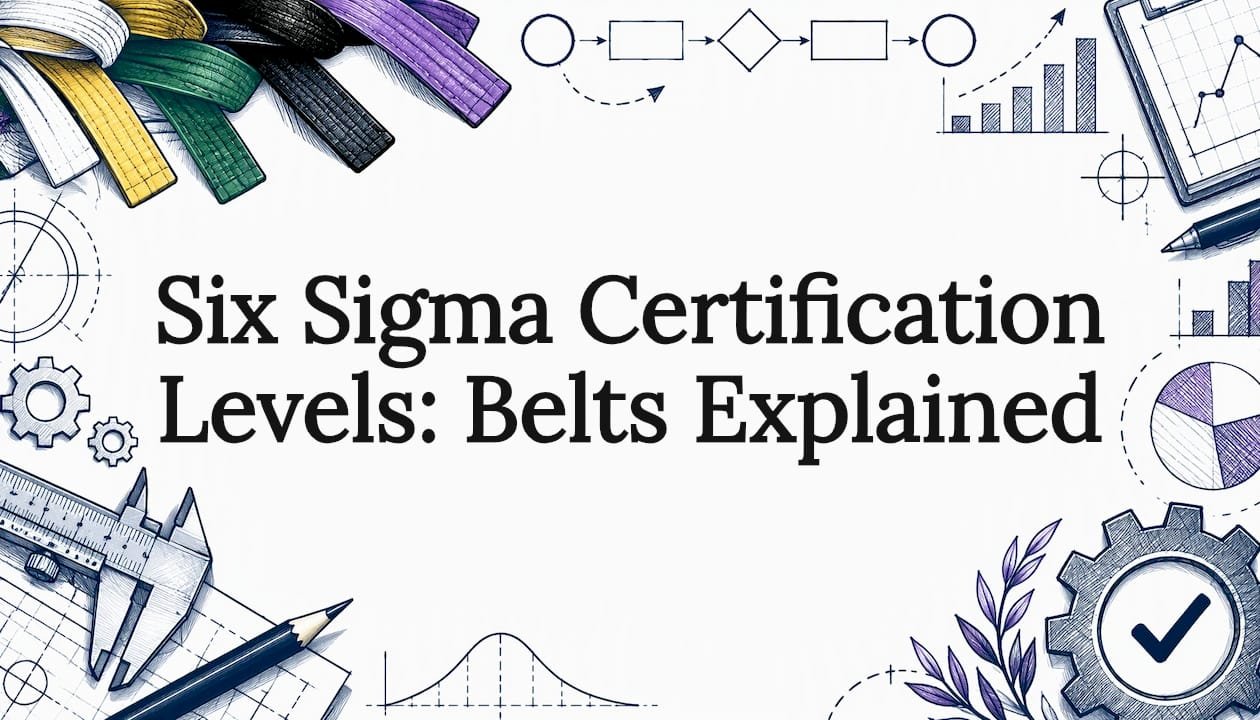
Six Sigma certification has five main levels, named after martial arts belts: White, Yellow, Green, Black and Master Black. Each one marks a bigger role in improvement projects. White Belts understand the basics, Yellow Belts join project teams, Green Belts lead smaller projects alongside their day job, Black Belts lead complex projects, and Master Black Belts coach the Black Belts and shape the programme. This guide explains what each level involves, how Lean Six Sigma fits in, how to choose between Green and Black Belt, and how to get certified.
TL;DR
- There are five belts: White, Yellow, Green, Black and Master Black. Each takes on more responsibility for improvement projects.
- Green Belts usually apply Six Sigma part-time within their own function. Black Belts typically lead larger, cross-functional projects and coach others.
- Lean Six Sigma adds waste reduction to Six Sigma’s focus on variation. The belt names are the same, but requirements differ between certifying bodies.
- Choose the belt that matches the projects you will actually lead, not the highest one on offer.
- Certification combines training, an exam and, with many providers, a completed project. Check the exact rules of the body you choose.
Table of Contents
- The six sigma belts at a glance
- White Belt and Yellow Belt: the entry levels
- Green Belt: the working practitioner
- Black Belt: the project leader
- Master Black Belt: the programme owner
- Lean Six Sigma levels: what changes
- Green Belt or Black Belt: which one suits you
- How to get Six Sigma certified
- How hard is it, and how much preparation do you need?
- Our perspective
- Build the right training for your team
- FAQ
- Sources
The six sigma belts at a glance
Six Sigma is a data-driven quality method. It aims to cut process defects to fewer than 3.4 per million opportunities by removing variation and the root causes of errors, using the DMAIC cycle: Define, Measure, Analyse, Improve, Control. The belts describe how deeply someone works with that cycle.
ASQ lists five project-level roles, and the ASME describes the same five belts as globally recognised designations based on skill, experience, knowledge and training. The table summarises them.
| Belt | Typical role | Project involvement |
|---|---|---|
| White | Awareness of basic concepts | Supports local problem-solving teams |
| Yellow | Project team member | Takes part in and reviews improvements for Green and Black Belt projects |
| Green | Functional specialist or manager | Collects and analyses data, leads Green Belt projects or teams |
| Black | Improvement leader | Leads problem-solving projects, trains and coaches teams |
| Master Black | Programme-level expert | Trains and coaches Black and Green Belts, sets metrics and strategic direction |
You may also see a Brown Belt. ASQ notes it is not traditionally used and is not recognised by most organisations or accrediting bodies, so it is rarely worth chasing.
White Belt and Yellow Belt: the entry levels
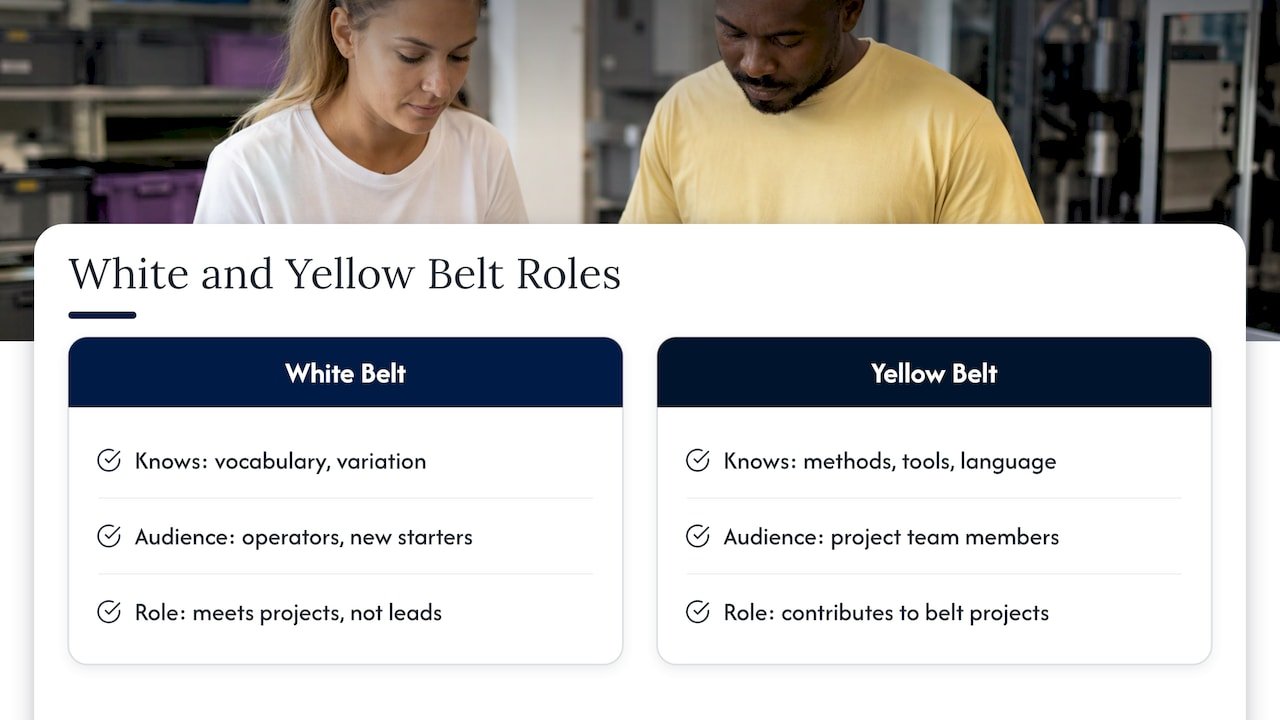
A White Belt gives you the vocabulary. You understand what Six Sigma is for, why variation matters and how a local team might fix a recurring problem. It suits staff who will meet improvement projects but not run them, such as operators, administrators or new starters in a quality-minded business.
A Yellow Belt goes a step further. Yellow Belts are usually team members on Black Belt or Green Belt projects, familiar with the methods, tools and language, and expected to contribute effectively. If your manager asks you to join a process improvement team next quarter, this is the natural level.
Entry requirements are light. For example, ASQ’s Yellow Belt exam needs no education or work experience and consists of 90 multiple-choice questions, 80 of them scored, with a 2 hour 18 minute time limit. Other providers set their own formats.
Green Belt: the working practitioner
The Green Belt is the most common level for people who want to apply Six Sigma in their own area. Green Belts keep their functional job and work Six Sigma projects in areas related to it, with projects that are more narrowly focused than a Black Belt’s. They help with data collection and analysis on Black Belt projects and lead their own smaller ones.
ASQ describes its Green Belt as aimed at someone with at least three years of work experience who wants to show knowledge of Six Sigma tools and processes, working in support of or under the supervision of a Black Belt.
A realistic Green Belt project might be reducing the rate of rework in an invoicing process, shortening the time to close maintenance requests, or cutting errors in a patient discharge checklist. The scope is one team or process, and the result can be measured.
Black Belt: the project leader
Black Belts lead complex, often cross-functional projects. In many organisations the role is a dedicated full-time position focused on process improvement through DMAIC or DMADV cycles. Black Belts are highly skilled with the tools, and often mentor Green Belts and Yellow Belts. They also train and coach project teams.
That leadership side matters as much as the statistics. A Black Belt has to win support from sponsors, keep a team on schedule and turn analysis into change that sticks. If you want a sense of what that looks like on a factory floor, this walkthrough of production quality improvement steps shows how measured data feeds improvement decisions, which is the heart of Black Belt work.
The benchmark exam gives a sense of the depth. ASQ’s Black Belt exam is a single 165-question paper (150 scored, 15 unscored), offered in English only. It is open book, so you bring your own reference materials, and the total appointment is four and a half hours. The exam fee is $585; fees change, so confirm the current amount on the official page. ASQ expects a thorough understanding of every aspect of DMAIC, team leadership and basic knowledge of Lean enterprise concepts.
Master Black Belt: the programme owner
Master Black Belts work at programme level: they develop key metrics and strategic direction, act as the organisation’s Six Sigma technologist and internal consultant, and train and coach Black Belts and Green Belts. Most organisations have very few of them, often only one.
This is not a level most people pursue directly. It is where an experienced Black Belt goes after leading many projects and teaching others. Requirements are set by the certifying body and usually look at project history and mentoring, not just an exam.
Lean Six Sigma levels: what changes
Search for Lean Six Sigma levels and you will find the same belt colours. The difference is in the content. The term goes back to 2002 and a book by Michael George and Robert Lawrence, who saw the two methods as complementary.
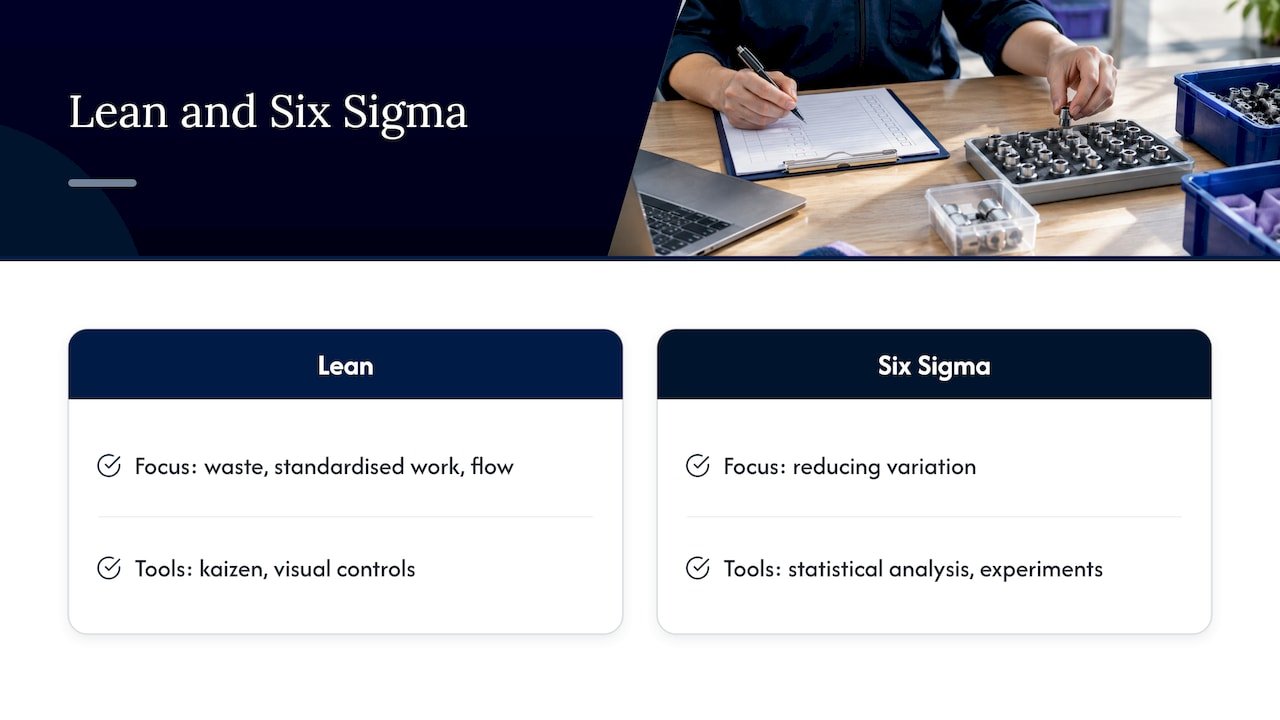
Lean focuses on waste reduction, standardised work and flow, using relatively simple tools such as kaizen, workplace organisation and visual controls. Six Sigma emphasises reducing variation with statistical analysis, designed experiments and statistical process control. ASQ notes the distinction has blurred and that Lean Six Sigma is now used more often because improvement projects usually need both.
One caution applies to every belt: there is no single universal definition. The exact specification for each Lean Six Sigma belt differs depending on the certifying organisation. One framework, the Lean Competency System, even avoids belt names in its official levels and only offers guidance on how accredited organisations may map them. So before you pay, compare the syllabus, assessment and any project requirement, not only the colour.
Green Belt or Black Belt: which one suits you
The honest answer depends on what you will do on Monday morning. Use these questions.
- Will improvement be part of your job or all of it? If you manage a team or function and want to improve your own processes, Green Belt fits. If you will spend most of your time running improvement projects, Black Belt fits.
- How broad are your projects? Single-process, single-department work points to Green. Projects that cross departments, sites or suppliers point to Black.
- Do you need to coach others? Black Belts train and coach project teams. If that is part of the role, aim higher.
- How much experience do you have? Green Belt programmes commonly assume around three years of work experience, and many Green Belts are manager-level, according to GoSkills as summarised in our research. Black Belt routes normally assume solid project experience as well.
- What does your employer recognise? Ask HR or your quality lead which bodies and levels carry weight in your sector.
For most professionals, the sensible path is Yellow, then Green, then Black, with real projects between each step. Skipping straight to Black Belt without applied experience makes the content harder to absorb and the credential harder to use.
For teams, a mixed approach works well: train many people to Yellow or Green level so improvement becomes a shared habit, and develop a small number of Black Belts to lead the bigger projects.
How to get Six Sigma certified
Certification is earned through practical experience, course-based training and exams. The route usually looks like this.
- Pick the level. Use the questions above. Start at the level where you can apply what you learn within weeks.
- Choose the certifying body and format. Some bodies certify through an exam only, with no training requirement, while training providers bundle teaching with their own assessment. Check which one your employer or sector expects.
- Complete training. Courses can run on-site, online or blended. Look for worked examples using real process data, not only theory.
- Do a project. Many Green and Black Belt programmes ask for a completed project with measured results. Even where it is optional, a project is the best way to make the learning stick.
- Sit the exam. Read the exam format first. Open-book papers still reward people who have practised the tools, because time is tight.
- Keep records. Save your project report, data and sponsor sign-off. They support your certificate in interviews and audits.
How hard is it, and how much preparation do you need?
Difficulty rises with each belt, mainly because the statistics and the leadership expectations grow. Yellow Belt content is mostly concepts and terminology. Green Belt adds hands-on data analysis, process mapping and control charts. Black Belt adds advanced statistics, project and change leadership, and coaching.
Practical preparation looks similar at every level:
- Refresh basic statistics: averages, spread, distributions, and how to read a chart.
- Learn DMAIC phase by phase and be able to name the tools used in each.
- Practise on real data from your own workplace, even a small set.
- Work through sample questions in the exam’s own style and time yourself.
- For open-book exams, organise your reference material so you can find formulas quickly.
People who find it easiest are those who already have a live process problem to work on while they study.
Our perspective
We see Six Sigma belts most often misused in one way: organisations buy the highest level for a few people and leave everyone else with nothing. Improvement rarely survives that. It works when the people who run processes every day share a common language and a method.
That is why we favour customisable training built around your own processes and delivered in the format your teams can actually attend, on-site, online or blended. Our courses are globally accredited and led by trainers with industry experience, so the examples reflect real operational challenges, not textbook cases.
If you are choosing a level, start with the project, not the belt. Define the problem you want solved, decide who needs to be involved and who needs to lead, and then match the level. That order saves money and produces results people can measure.
Sam
Build the right training for your team
If you are planning continuous improvement or quality training for a team, we can help you shape it around your sector, your people and your delivery preference. Our project management courses are designed for professionals who need accredited skills, and our Facilities Continuous Improvement Management training course covers improvement in facilities settings.
We deliver on-site, online or blended learning, and you can explore all our professional training courses to see what suits your organisation. Tell us your goals and we will recommend a sensible route.
FAQ
What are the Six Sigma certification levels in order?
The usual order is White, Yellow, Green, Black and Master Black Belt. Each step adds responsibility, from understanding the basics to leading projects and finally coaching Black Belts and shaping the programme. Some providers also list a Champion role for executive sponsors.
Is Green Belt or Black Belt better?
Neither is better in general. Green Belt suits people who improve processes within their own function while doing their normal job. Black Belt suits people who lead larger, cross-functional projects and coach others, often as their main role.
Do I need a Green Belt before a Black Belt?
Some programmes require it and others do not, because requirements vary by certifying body. Building experience through Green Belt projects first is a sound route, since it gives you applied practice before leading bigger work.
Is Lean Six Sigma different from Six Sigma?
Lean Six Sigma combines Six Sigma’s focus on reducing variation with Lean’s focus on removing waste and improving flow. The belt names are the same, though the exact syllabus depends on the certifying organisation.
Sources
- Six Sigma Belts, Levels & Roles, ASQ
- The 5 Six Sigma Belts, ASME
- What is Six Sigma? ASQ Glossary
- Fitting the Right Belts for Design for Lean Six Sigma, iSixSigma
- Six Sigma Yellow Belt certification insert, ASQ
- Six Sigma Certifications, ASQ
- Six Sigma Black Belt Certification, ASQ
- Six Sigma Definition and Lean Six Sigma, ASQ
- The LCS and Lean Six Sigma
- Lean Six Sigma, Investopedia
- Six Sigma Certification, Investopedia
- Step-by-step production quality improvement