
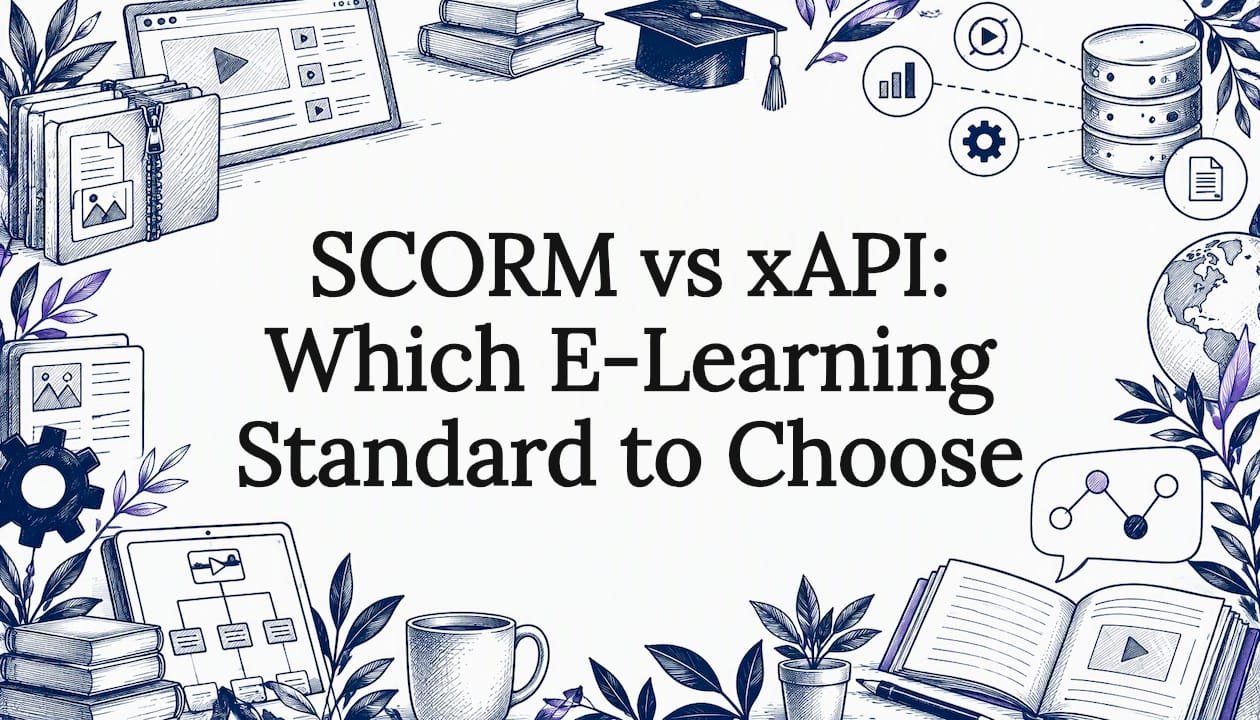
SCORM packages a course so an LMS can launch it and record completion, time and a score. xAPI records almost any learning activity, on or off the LMS, as a stream of statements sent to a Learning Record Store (LRS). Choose SCORM when formal, LMS-based courses are all you need to report on. Choose xAPI when you need to see what happens in simulations, classrooms, mobile tools or on the job. Many organisations sensibly run both. “Tin Can”, the original project name for xAPI, refers to the same comparison.
TL;DR
- SCORM tracks a course launched from an LMS: completion, time, pass/fail and a single score. xAPI tracks any experience, wherever it happens.
- SCORM content is launched by the LMS and its status stays there. xAPI sends “Actor-Verb-Object” statements to an LRS, with no tie to a particular LMS.
- SCORM is not dead. It remains the workhorse for compliance and formal training, while xAPI and cmi5 grow where richer data matters.
- You do not have to choose one. Dual tracking and cmi5 let you keep SCORM libraries and add xAPI step by step.
- Your LMS is still needed for enrolments and user management, even in an xAPI setup.
Table of Contents
- What SCORM and xAPI actually are
- What each standard can track
- SCORM vs xAPI at a glance
- The catch: xAPI needs more planning
- When SCORM is the right choice
- When xAPI is the better fit
- Has xAPI replaced SCORM?
- Using SCORM and xAPI together
- How to decide: five questions
- Our perspective
- Training that fits how you track learning
- FAQ
- Sources
What SCORM and xAPI actually are
SCORM is a standard for a particular style of e-learning course that you upload to a learning management system. The course is a zipped package with a manifest file, and it talks to the LMS through JavaScript in the browser. The LMS launches the content and keeps the learner’s progress and status. That tight link between content and LMS is what made SCORM so portable between systems, and it is also what limits it.
xAPI, also called the Experience API, is different in kind. The IEEE technical report describes it as an application programming interface designed for learning, which lets software applications exchange data about human activity and performance. Each record is a statement with an “Actor-Verb-Object” shape, in plain terms “I did this”, and statements can be stored in an LRS.
Is Tin Can the same thing as xAPI?
Yes. Tin Can was the project name that led to the Experience API, and vendors’ own documentation notes that the two terms are used interchangeably. So a search for SCORM vs Tin Can leads to the same comparison as SCORM vs xAPI. If you meet the older name in a supplier’s brochure, read it as xAPI.
What each standard can track
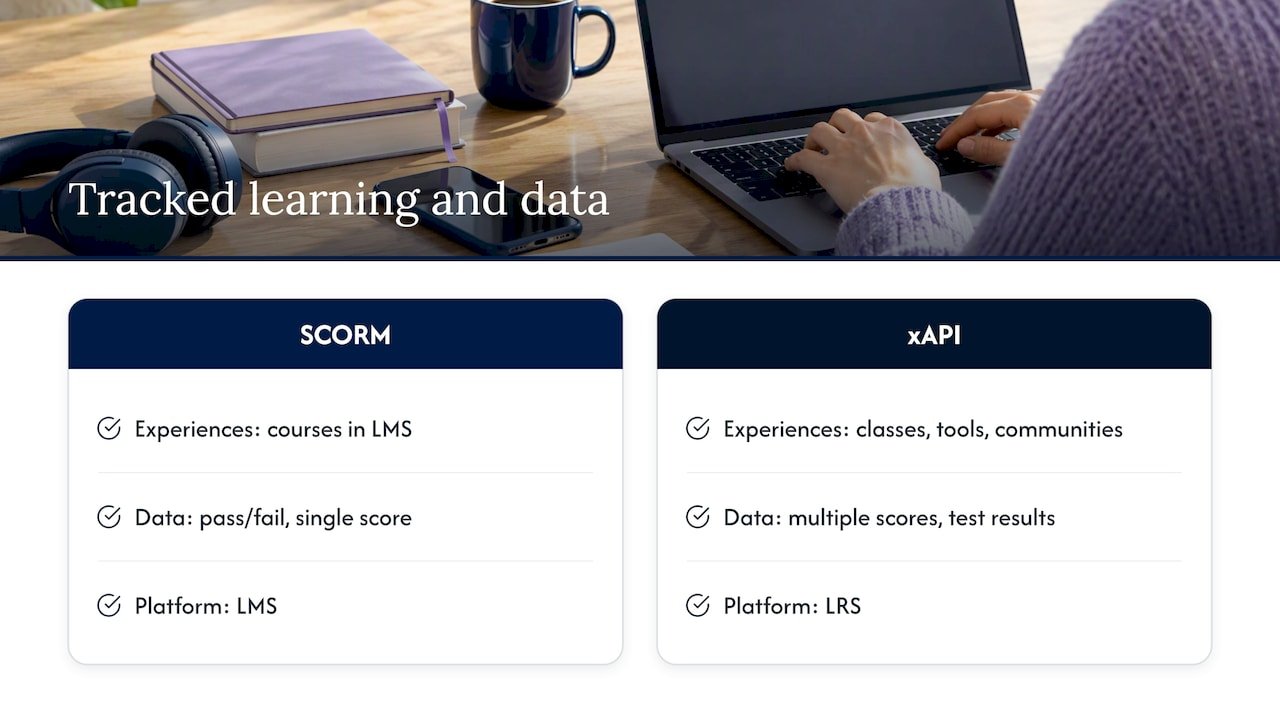
This is the difference most buyers care about. SCORM tracks course completion, time, scores and perhaps location within an LMS. xAPI can also capture classroom activities, performance-support tools, online communities, mentoring, performance assessment and business results, with the records aggregated in an LRS.
The detail matters too. SCORM records completion, time, pass/fail and a single score. xAPI can add multiple scores, detailed test results, real-world performance, serious games, simulations and informal learning. ADL’s own SCORM profile adds that SCORM tracking applies to individual learners, so group learning and data about instructors, tutors, mentors and peers cannot be recorded.
Devices matter as well. Any enabled device, from a phone to a simulator, a game or even a CPR dummy, can send xAPI statements, and a constant network connection is not required. That is a real advantage for field teams, site engineers or clinical trainers who are rarely sitting at a desk with a browser open.
A worked example
Imagine a site safety induction. With SCORM, your LMS shows that a supervisor opened the module, spent 25 minutes and passed with 85%. With xAPI, the same course can also report which question types caused trouble, and a separate statement can record that the supervisor then completed a practical assessment on site, observed by an instructor. The first answers “did they finish?”. The second starts to answer “can they do it?”.
SCORM vs xAPI at a glance
| Question | SCORM | xAPI |
|---|---|---|
| What it records | Completion, time, pass/fail, one score | Any activity as an Actor-Verb-Object statement |
| Where learning happens | Inside content launched by an LMS | Anywhere: classroom, mobile, simulation, on the job |
| How it communicates | JavaScript API in the browser | RESTful HTTP requests |
| Where data lives | In the LMS | In an LRS, which can share data with other systems |
| Content location | Same server or domain as the LMS | Anywhere |
| Learners tracked | Individuals | Individuals and groups, plus instructors and peers |
| Set-up effort | Smoother, well documented | More planning, needs a defined vocabulary |
The technical split comes from the same developer guidance: SCORM uses a JavaScript API, while xAPI uses RESTful HTTP requests and a flexible data format with fewer limitations. On hosting, SCORM content must sit on the same server or domain as the LMS, whereas xAPI supports activities residing anywhere.
On architecture, ADL states that xAPI can run as a stand-alone system that collects learner experiences without SCORM’s coupling between content and LMS. Data can also travel further: LRSs can share data between organisations, and learners can hold their own personal data lockers.
The catch: xAPI needs more planning
Flexibility has a price. Because xAPI lets you record almost anything, it will not tell you what is worth recording. Statements can be hard to analyse meaningfully without a defined vocabulary and instructions. Two teams can describe the same activity with different verbs, and your reports will then not line up.
In practice, a successful xAPI project starts with the questions you want answered, not the technology. Decide which behaviours or business measures matter, agree the verbs and activity names, and only then build the tracking. SCORM, by contrast, gives you a fixed set of data points that every compliant LMS understands, which is why implementation is usually quicker and the documentation so plentiful.
When SCORM is the right choice
SCORM is suitable when its tracking is enough for formal learning. That covers a lot of workplace training:
- Compliance and mandatory training. You need proof that people completed the course and passed. A single score and a completion record are exactly that.
- Large existing libraries. If hundreds of modules already run in your LMS, the content works today and moving it has a cost.
- Simple procurement. Almost every LMS and authoring tool supports SCORM, so you are rarely locked in.
- Small L&D teams. If no one has time to design a data strategy, a standard that just works is a sensible choice.
When xAPI is the better fit
xAPI is a viable option for tracking learning that happens offline, informally, in classrooms or on the job. It earns its place when:
- you train on equipment, simulators or games, where SCORM’s assumption that an LMS manages and launches the content is difficult to meet;
- you want to connect training to performance data, such as error rates, safety observations or project outcomes;
- learning is blended: workshops, coaching, mobile practice and e-learning all feed one record;
- you need group, instructor or peer data, which SCORM cannot hold.
There is also a longer-term point. The IEEE report suggests xAPI may somewhat mitigate exposure to latent obsolescence, a value associated with open-source specifications and standards. If you are building a learning data strategy for the next decade, that counts.
Has xAPI replaced SCORM?
Not yet, and it is unlikely to disappear overnight. xAPI is often described as the next generation of SCORM, but SCORM 1.2 remains the industry workhorse and is expected to be around for a long time. In 2019 the Learning Guild reported that vendors were expected to keep supporting SCORM because customers had large SCORM libraries, while ADL would not update it and the US Department of Defense was pursuing cmi5 as a path away from it.
More recent evidence points the same way. A December 2024 analysis found SCORM still widely adopted and interoperable, while xAPI and cmi5 were gaining traction for learning outside an LMS and for more interactive experiences. So “Is SCORM outdated?” has a fair answer: its feature set is fixed, but it still does what formal course delivery needs.
Using SCORM and xAPI together
You rarely face an either/or decision. Organisations can keep using SCORM courses in an LMS while converting that data to xAPI alongside natively tracked xAPI courses and other interactions. ADL acknowledges that switching entirely can be cost-prohibitive for organisations with heavy SCORM investment, and advocates dual tracking as a low-impact transition.
What dual tracking involves
According to ADL, implementers identify activities, define the experiences and map them to xAPI statements, register content credentials with the LRS, update the content to issue statements, and validate those statements. There is also a practical shortcut: a published cookbook shows how to send xAPI statements based on events in the SCORM data model, and SCORM-style interactions such as true/false, choice and Likert can be replicated as xAPI statements.
Do not plan to drop your LMS. For many organisations, functions such as managing users and enrolments remain necessary alongside one or more LRSs.
Where cmi5 fits
cmi5 is the bridge. It combines xAPI’s tracking flexibility with the structure of SCORM, so an LMS can launch content and manage enrolments while the data travels as xAPI statements. If you are commissioning new digital educational content, asking whether it can be delivered as cmi5 keeps your options open without forcing a full xAPI programme on day one.
How to decide: five questions
- What decision will the data support? If it is “has everyone passed?”, SCORM is enough. If it is “is training changing performance?”, you need richer records.
- Where does learning happen? Entirely in the LMS points to SCORM. Classrooms, field work, simulators and mobile point to xAPI.
- What do you already own? A large SCORM library argues for dual tracking, not a rebuild.
- Who will analyse the data? xAPI needs someone to define vocabulary and read reports. Without that, you collect statements nobody uses.
- How will you grow? If your plans include more technology in education and connected tools, an LRS gives you a place to gather the data as it arrives.
Our perspective
In our work with corporate teams, the standard is rarely the real question. The real question is what you want training to change, and how you will know it did.
We design courses to fit the organisation, whether on site, online or blended, and that mix is exactly where a completion-only record starts to feel thin. A workshop, a practical assessment and an e-learning module are one learning journey, so we encourage clients to think about the whole record, not one module at a time.
At the same time, we would never tell a team to abandon formal, LMS-based courses. For compliance and safety, a clear completion and score record is exactly what auditors expect. Start there, then add richer tracking where it answers a question your managers actually ask.
Our advice: agree the outcomes first, choose the standard second, and let accredited, expert-led content do the teaching.
Sam
Training that fits how you track learning
Whether your organisation reports through an LMS today or is building towards richer learning data, the training itself still has to be right for the job. We run accredited professional courses for corporate teams and individuals across project management, healthcare, oil and gas, civil engineering, IT, leadership, compliance and safety, delivered on site, online or blended, and tailored to your organisation’s challenges.
See our project management courses or browse the full course list to find a programme for your team.
FAQ
Is xAPI better than SCORM?
It is more capable, not automatically better for you. xAPI tracks far more kinds of activity and works outside an LMS. SCORM is simpler to implement and universally supported, so it remains the sensible choice for formal, LMS-based courses.
What has replaced SCORM?
Nothing has fully replaced it. xAPI is described as its next generation, and cmi5 is the profile that lets an LMS launch xAPI content. SCORM is still widely used, particularly SCORM 1.2, and most organisations run it alongside newer approaches.
Is SCORM outdated?
Its specification is no longer being developed, and it cannot track informal, group or offline learning. Even so, it remains widely adopted and interoperable, and a large share of workplace compliance training still depends on it.
What is the difference between an API and xAPI?
An API is any interface that lets software systems talk to each other. xAPI is one specific API designed for learning, with a standard statement format, “Actor-Verb-Object”, for recording what a person did and sending it to a Learning Record Store.
Sources
- xAPI: A Guide for Technical Implementers (IEEE)
- xAPI SCORM Profile: dual tracking (ADL)
- xAPI SCORM Profile (ADL, GitHub)
- What Is xAPI? (Association for Talent Development)
- Launch xAPI Content From An LMS: cmi5 Adoption by ADL (The Learning Guild)
- Developer’s guide to xAPI
- What is xAPI aka the Experience API or Tin Can API
- SCORM vs the Experience API
- Comparison of SCORM, xAPI and cmi5
- SCORM to xAPI cookbook
- SCORM Versions: the Evolution of eLearning Standards
- Is SCORM dead? Let’s look at the numbers
- SCORM and xAPI (Tin Can) overview
- From Learning Management Systems to the Experience API
- Digital educational content case study