
Most professionals budget roughly US$950 to US$1,500 for the complete PMP certification process, though the final figure depends heavily on which training format you choose. The main cost drivers are the exam fee itself, whether you join PMI before paying it, your training format, study materials or simulators, and any retake or rescheduling fees if your first attempt does not go to plan.
TL;DR:
- PMI membership costs $139 to $164 annually and saves roughly $230 on the exam, but it must be active before you pay.
- Online courses cost $15 to $300, while university programs run $1,050 to $3,500; choose live instruction if you need scheduled accountability.
- Starting December 1, 2026, live eligibility hours count only through authorized training partners, registered education providers in China, or eligible academic programs, so verify provider status before paying.
- Candidates have one year and up to three attempts after paying; canceling or failing to appear within 48 hours can mean forfeiting the exam fee.
Table of Contents
- Cost breakdown: exam fees, membership, training and materials
- Three realistic PMP budget scenarios for different needs
- How training format changes your cost and your pass odds
- How to lower your net cost without cutting corners
- Timeline, eligibility window and administrative fees to expect
- Where Oxford Centre fits into your PMP preparation
- Where to spend and where to economise on PMP preparation
- FAQ
- Sources
Cost breakdown: exam fees, membership, training and materials
The PMP exam fee is the one cost you cannot avoid, and it comes in two tiers. PMI prices the exam significantly lower for members than for non-members, with the gap between the two rates running to roughly US$230. That single decision, whether to join PMI before you pay, is the first budgeting fork in the road.
PMI membership itself costs approximately US$139 to US$164 a year, and it usually comes with a free digital copy of the PMBOK Guide, which saves you buying a reference text separately. The catch is timing: PMI handbook guidance makes clear that the member exam rate only applies if your membership is active before you pay the certification fee. Pay the exam fee first and join afterwards, and you are locked into the non-member rate with no refund of the difference. Confirming membership status before you click “pay” is the cheapest decision in the whole process.
Training is where the range widens dramatically. According to cost research from the University of Washington’s project management programme, discounted commercial self-paced online courses can be found for as little as US$15 to US$300, while university continuing-education programmes typically run from US$1,050 to US$3,500. Live virtual bootcamps and blended instructor-led courses tend to sit between those two extremes, and classroom-based options usually cost more than online equivalents once you factor in venue and instructor time.
Beyond the headline training fee, a few smaller costs add up:
- Study materials: beyond any free digital PMBOK Guide that comes with membership, many candidates buy supplementary guides or question banks.
- Exam simulators: these realistic practice-test tools are commonly recommended by instructors to build timing and confidence under exam conditions.
- Retake fees: if you need a second or third attempt, PMI charges a reduced but still meaningful retake fee rather than the full original rate.
- Rescheduling or cancellation fees: moving your exam date within certain windows triggers tiered fees, and missing an appointment entirely can mean forfeiting it.
The retake and rescheduling structure deserves particular attention because it is where unprepared candidates lose unplanned money. The PMI Certification Handbook sets out tiered rescheduling fees, with a fee applying to late changes made within 30 days of the appointment, and full forfeiture of the exam fee if you cancel or fail to appear within 48 hours of your scheduled slot. Treat your exam date as fixed once booked, and budget your study time accordingly, because the financial penalty for last-minute changes is real.
Three realistic PMP budget scenarios for different needs
Turning these components into an actual number is easier with concrete scenarios. The three budgets below assume the exam is paid at the PMI member rate, since that is the financially sensible default for almost everyone.
- Lean budget: a discounted self-paced course at the low end of the US$15 to US$300 range, digital-only study materials, PMI membership, and the member exam fee. This path can land close to the lower end of the US$950 to US$1,500 total range that most candidates report, assuming no retakes.
- Typical budget: a live virtual bootcamp or blended instructor-led course priced in the mid-range, paired with a practice simulator, PMI membership and the member exam fee. This scenario generally sits in the middle of the overall cost band and reflects what most working professionals actually spend.
- Premium budget: a university continuing-education programme or an extended in-person classroom course, priced toward the US$1,050 to US$3,500 range, plus simulators, materials and membership. This route pushes the all-in total toward the upper end of what professionals typically budget, sometimes beyond it.
Your actual number will shift with regional currency differences and provider promotions, since course prices are rarely fixed year-round. A course that costs US$400 in one country’s commercial market might carry a different price elsewhere, and providers frequently run limited-time discounts around certification deadlines or new fiscal years. Treat the ranges above as planning anchors rather than fixed quotes, and check current pricing before committing funds.
How training format changes your cost and your pass odds
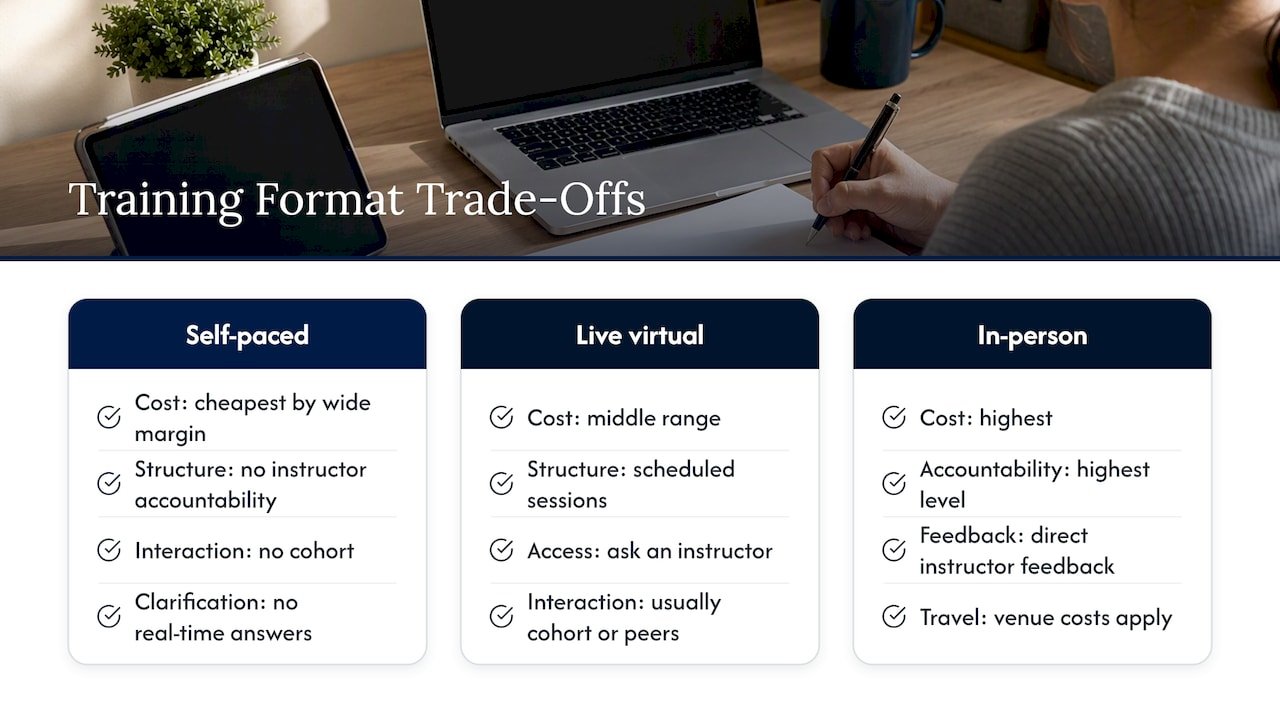
Self-paced online courses are the cheapest route by a wide margin, and for a disciplined, experienced project manager who already understands the PMBOK framework, that can be money well spent. The trade-off is structure: there is no instructor keeping you accountable, no cohort pushing you forward, and no one to clarify a confusing concept in real time. If you are the kind of learner who needs deadlines to actually study, a self-paced course that sits unused on your laptop is the most expensive option of all, because you still have to pay for a retake if you sit the exam under-prepared.
Live virtual instructor-led courses sit in the middle on both price and structure. You get scheduled sessions, an instructor to ask questions of, and usually some form of cohort or peer interaction, without the added cost of travel or venue hire that classroom courses carry.
In-person classroom training costs the most but offers the highest level of accountability and direct feedback. For candidates who have struggled with self-directed study before, or who are juggling full-time work and family commitments that make independent study time hard to protect, the extra upfront cost of an instructor-led format can work out cheaper overall. A retake fee, plus the additional study time, may exceed the price difference between a self-paced course and a structured one.
There is also a genuine timing issue worth building into any format decision. From 1 December 2026, PMI is updating the eligibility rules for live training hours: live-class hours will count toward PMP eligibility only when delivered by a PMI Authorized Training Partner, a China Registered Education Provider, or an eligible accredited academic programme. Self-paced courses from any provider remain acceptable. If you are planning a live or classroom course for your eligibility hours, confirm the provider’s accreditation status before you pay, particularly for courses scheduled around or after that date.
Pro Tip: If you have ever abandoned an online course halfway through, assume you will need the accountability of a live format, and budget for it from the start rather than discovering it after a failed self-paced attempt.
How to lower your net cost without cutting corners
A few deliberate choices can meaningfully reduce what you spend without weakening your preparation.
- Confirm PMI membership before paying the exam fee. This single step captures the member exam rate and the roughly US$230 saving it represents, plus a free digital PMBOK Guide.
- Ask your employer for a training budget or sponsorship. Many organisations have learning and development funds that go unused simply because no one asks; frame the request around the project outcomes your certification will support, not just your own career development.
- Use free or low-cost official resources where they genuinely suffice, such as the digital PMBOK Guide included with membership, and reserve spending for a reliable practice simulator if your self-assessment shows you need realistic exam-condition practice.
- Look for accredited provider discounts and bundles. PMI Authorized Training Partners and other accredited providers occasionally bundle course access with materials or simulators at a lower combined price than buying each separately.
- Watch for seasonal or promotional pricing, particularly around the start of a new year or before policy changes take effect, since providers often discount ahead of demand spikes.
- Factor the December 2026 live-training eligibility change into your format decision early, so you are not forced into a late, more expensive, accredited option because your original course does not qualify.
If you are approaching your manager about sponsorship, the case is straightforward: certified project managers bring a structured, recognised methodology to delivery, and the cost of training is small relative to the risk of running projects without that structure. Point to the specific project types in your organisation that would benefit most.
Pro Tip: Before paying for any course, ask the provider directly whether it is a PMI Authorized Training Partner, since that status affects both eligibility hours and sometimes pricing through official partner discounts.
Timeline, eligibility window and administrative fees to expect
Once you have paid the certification fee, the clock starts on a strict administrative window. The PMI Certification Handbook confirms that you have one year to schedule the exam, and may take it up to three times within that year if needed.
Rescheduling and cancellation carry their own fee structure, and it is worth knowing before you book a date:
- Rescheduling within 30 days of your appointment typically incurs a fee, cited at around US$70 for some late changes.
- Cancelling or failing to appear within 48 hours of your scheduled slot can mean forfeiting the exam fee entirely.
- Each retake attempt within your one-year eligibility window carries its own reduced retake fee, separate from the original certification payment.
A short practical checklist keeps you on the right side of these rules: confirm your PMI membership is active before you pay the exam fee, save your eligibility ID the moment it is issued, and keep a copy of every scheduling confirmation in case you need to reschedule. None of this is complicated, but missing a 48-hour window because a confirmation email was never saved is an expensive way to learn the policy.
Where Oxford Centre fits into your PMP preparation
We deliver accredited professional training across project management and several other sectors, with course content built to be customised for the organisation or individual sitting it. Our courses are available on-site, online, or in a blended format, which gives you the flexibility to choose a delivery style that matches your schedule and your learning habits rather than forcing you into a single fixed format.
Our courses are designed to address real-world project challenges alongside theory. For PMP preparation, consider whether a course helps you practise applying project management knowledge. If your organisation is weighing up training budgets, our flexible delivery options make it straightforward to fit certification preparation around existing workloads instead of pulling teams out of operation for a fixed block of time.
If you would like course details or a corporate quote, our project management training page sets out what is available, and you can reach our broader course catalogue through the Oxford Centre training overview.
Where to spend and where to economise on PMP preparation
If I were allocating a typical PMP budget, I would weight it roughly as follows: the smallest, fixed share goes to the exam fee itself since you cannot change that number, a moderate share goes to study materials and a simulator because realistic practice genuinely reduces retake risk, and the largest, most flexible share goes to training format, scaled up or down based on how honestly you can assess your own study discipline.
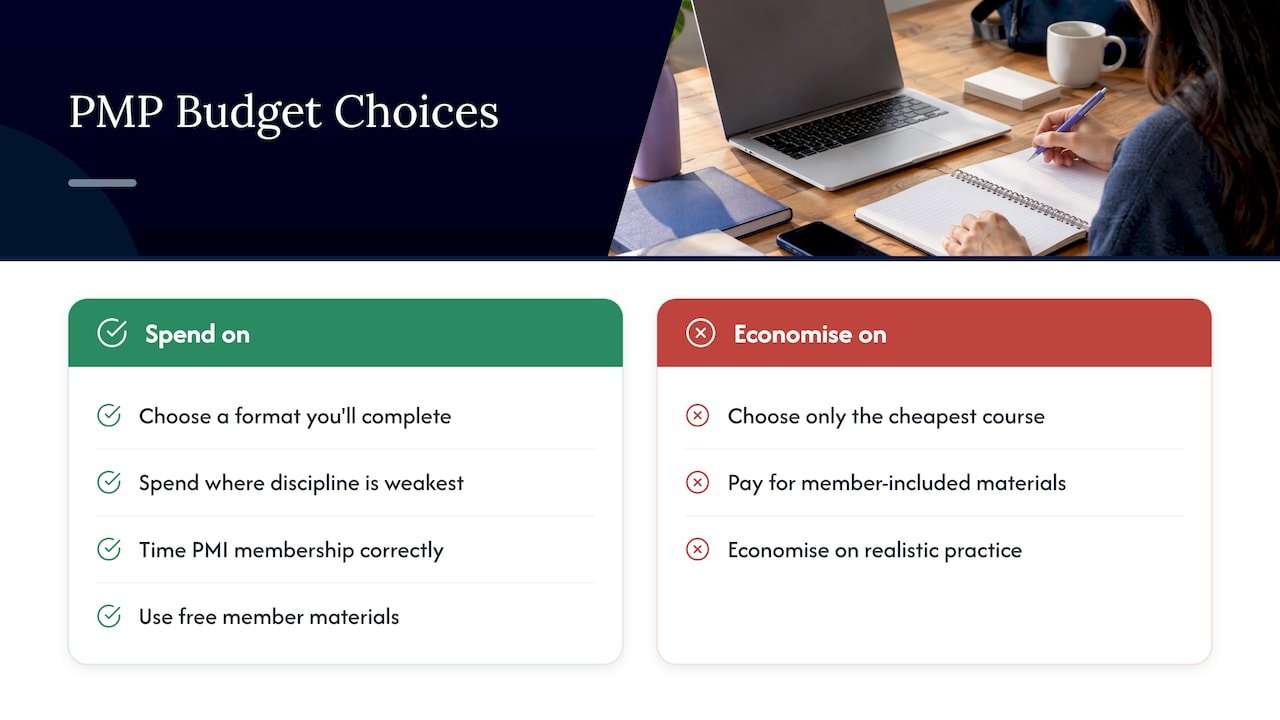
The conventional advice to “just take the cheapest course” misses the point. A low-priced self-paced course is not actually cheap if you do not finish it and end up paying a retake fee on top of your original exam cost. The right question is not which format costs least, but which format you will actually complete and feel prepared from. Spend where your discipline is weakest, whether that is structure, accountability or expert clarification, and economise everywhere else, including by timing your PMI membership correctly and skipping materials you can get for free through membership itself.
For professionals considering career paths after certification, including freelance or consulting routes, resources aimed specifically at freelance construction project managers can offer useful context on how certification translates into independent work.
— Sam
FAQ
What is the total cost of PMP certification?
Most professionals budget roughly US$950 to US$1,500 for the complete process, covering the exam fee, PMI membership, training and study materials. University continuing-education routes can push the total toward US$1,050 to US$3,500, while discounted self-paced courses keep the training portion much lower.
What is project management?
Project management is the practice of planning, organising and overseeing resources, timelines and tasks to deliver a specific outcome within defined constraints such as budget and schedule. It spans industries from construction to IT, and certifications like PMP are intended to demonstrate knowledge and applied skill in that discipline.
Can I pass PMP in three months?
Passing within three months is achievable for many candidates, particularly those using a structured course with clear milestones rather than studying without a plan. Your realistic timeline depends on your existing project management experience, the hours you can dedicate weekly, and whether you choose a self-paced or instructor-led format that keeps you accountable.
Is PMP equal to an MBA?
PMP and an MBA are not equivalent: PMP is a focused professional certification in project management practice, while an MBA is a broader postgraduate degree covering general business and management disciplines. Many professionals hold both, using PMP to validate hands-on delivery skills and an MBA for wider strategic and leadership grounding.
How much does PMI membership cost and is it worth it?
PMI membership costs approximately US$139 to US$164 annually and typically includes a free digital copy of the PMBOK Guide. It is generally worth it for most candidates because the member exam rate saves roughly US$230 compared with the non-member rate, more than covering the membership cost itself.