
A 30-60-90 day training plan gives new managers defined goals, measurable milestones and a repeatable template for their first three months. It sets out who does what, by when, so a first-time manager moves from listening and discovery toward a visible team improvement by day 90 rather than guessing at priorities. The template below sets objectives, actions and metrics for each phase, ready to copy into a document or spreadsheet.
TL;DR:
- During days 1 to 30, hold individual meetings with every direct report, confirm system access and decision rights, and deliver one small piece of work.
- By day 60, resolve one recurring process bottleneck and agree on three KPIs with your manager; by day 90, launch one visible team initiative.
- Treat the 70/20/10 model as a guide: spread training across two hour modules every one to two weeks, with real assignments between sessions.
- Scale actions to team size and sector: regulated fields require early safety and compliance training, while larger teams need team leads and dashboards.
- Review progress at days 30, 60, and 90 using delivery, team sentiment, and checklist completion; schedule manager check ins for months 4 and 6.
Table of Contents
- What a 30-60-90 day training plan actually does for retention
- Why phase the plan in 30-day blocks, and where it goes wrong
- The 30/60/90 day plan: actions, objectives and KPIs by phase
- How to structure training delivery across the first 90 days
- Tracking progress: milestone check-ins and the KPIs that matter
- Template and checklist: what to include and how to adapt it
- Why an accredited provider can accelerate the outcomes above
- Customising the plan for industry and team size
- Key leadership skills every new manager needs to practise
- Tools and technology that support the plan without replacing it
- Weaving company culture and values into the first 90 days
- One habit that stops support dropping off after day 90
- Bespoke manager training
- FAQ
- Sources
What a 30-60-90 day training plan actually does for retention
A structured plan targets three things a new manager needs before anything else works: role clarity, confidence in the job (sometimes called self-efficacy) and acceptance by the team they now lead. Skip any one of these and the rest of the plan struggles to land.
The stakes are real. Roughly 60% of new managers receive no formal training before stepping into the role, and poor onboarding is strongly linked to early departures, according to Emory research on manager onboarding. Replacing a manager who leaves early can cost a significant portion of their annual salary when recruitment, lost productivity and team disruption are accounted for.
Ownership matters as much as content:
- HR typically owns the structure: the template, the checklist and the milestone review calendar.
- The new manager owns the execution: the 1:1s, the shipped work and the day-to-day relationship building.
- The manager’s own manager owns the sponsorship: removing blockers and attending key milestone check-ins.
Why phase the plan in 30-day blocks, and where it goes wrong
Phasing works because it builds momentum in order: listen first, earn trust, then act. A new manager who tries to change everything in week one spends credibility they have not yet earned, and a manager who delays visible contribution past day 60 starts to look passive to their own team.
Two pitfalls show up repeatedly:
- Changing too much too soon, before understanding why things are done a certain way.
- Leaving social support to chance, so the manager never gets introduced into the informal networks that make work easier.
The 70-20-10 leadership development model is useful here as a design heuristic rather than a strict formula: roughly 70% of the learning should come from doing the job, 20% from coaching and peers, and 10% from formal coursework. A 30-60-90 plan built on this ratio spends far more time on real assignments than in a classroom, which is exactly why early shipped work matters more than extra training hours.
The 30/60/90 day plan: actions, objectives and KPIs by phase
Each phase has a different job. Days 1 to 30 are for listening and earning trust rather than making changes; days 31 to 60 are for small, visible wins; days 61 to 90 are for delivering something the whole team can point to, according to 30-60-90 planning guidance. The structure below turns that sequencing into concrete steps.
Days 1 to 30: discovery and early credibility
- Hold individual 1:1s with every direct report to learn their goals, frustrations and working style.
- Confirm provisioning: systems access, reporting lines and decision rights are often half-finished when a new manager starts.
- Ship one small piece of real work (a decision, a fix, a document) rather than spending the whole month in orientation.
- Example SMART objective: complete 1:1s with 100% of direct reports and document one team process gap by day 30.
Days 31 to 60: small wins and process fixes
- Implement one visible quick win the team has been asking for, however minor.
- Agree KPIs with your own manager for the next phase, so success is defined rather than assumed.
- Fix one recurring process friction point identified during discovery 1:1s.
- Example SMART objective: resolve one named process bottleneck and agree three KPIs with your manager by day 60.
Days 61 to 90: a strategic initiative and handover to steady state
- Launch one initiative with team-wide visibility, sized to be finished or clearly in motion by day 90.
- Set individual development goals with each report for the following quarter.
- Move from weekly check-ins to the cadence that will run long term.
- Example SMART objective: launch one team-level initiative with a measurable outcome and set development goals for every direct report by day 90.
Suggested KPIs across the three phases:
- 1:1 completion rate against the full direct report list.
- Time to first shipped deliverable, measured from start date.
- A simple team sentiment score, tracked monthly.
- Onboarding checklist completion rate for the manager themselves.
A written plan with a timeline, named goals and clear responsibilities, reviewed at each milestone, is what separates a plan from a list of good intentions, according to employee onboarding evidence.
How to structure training delivery across the first 90 days
Short, spaced sessions beat a single long induction. Training delivered in roughly two-hour modules, spread across the first 90 days with a chance to apply each one before the next, produces better on-the-job transfer than a front-loaded week of classroom time, according to guidance on pacing new manager training.
A practical delivery mix looks like this:
- One two-hour module every one to two weeks, each tied to a current, real task the manager is handling.
- A stretch assignment between modules, such as running a difficult conversation or leading a cross-team meeting.
- A peer learning slot, pairing the new manager with another recent hire to compare notes.
- A structured mentor or buddy relationship with a standing weekly agenda covering wins, blockers and one specific skill.
Pro Tip: Set the mentor meeting as a recurring calendar invite before day one, not after the new manager asks for help.
Tracking progress: milestone check-ins and the KPIs that matter
Milestone reviews at day 30, 60 and 90 give HR and the sponsoring manager a fixed point to judge progress rather than relying on impressions. Each review should involve the new manager, their own manager and, ideally, an HR partner who can spot patterns across multiple new managers at once.
Useful signals to track at each review:
- 1:1 completion rate with direct reports.
- Delivery of the first shipped piece of work.
- A short team sentiment pulse, even three questions.
- Completion rate of the onboarding checklist itself.
| Milestone | Primary focus | Example KPI |
|---|---|---|
| Day 30 | Listening and trust | 1:1 completion rate with all direct reports |
| Day 60 | Small wins | One process fix delivered and agreed KPIs set |
| Day 90 | Visible contribution | Initiative launched and development goals set per report |
Recalibrate the plan when a KPI is consistently missed two reviews in a row rather than waiting for a formal complaint or a resignation.
Template and checklist: what to include and how to adapt it
Build the template as a simple table with seven columns: phase, focus area, SMART objective, actions, owner, metric and due date. That structure works equally well pasted into a spreadsheet or a shared document, and it keeps every objective tied to a named owner and a date rather than left open-ended.
Checklist items worth including before and during the first week:
- Pre-day-one: systems access requested, desk or remote setup confirmed, welcome message sent to the team.
- Day one: introductions to direct reports, calendar set up for recurring 1:1s, first-week schedule shared.
- First week: initial 1:1s scheduled, mentor or buddy assigned, first small task identified.
For a senior manager, weight the plan more heavily toward strategic initiatives and stakeholder mapping from day one. For a first-line or junior manager, weight it toward the fundamentals: 1:1 skills, delegation basics and process familiarity. The onboarding checklist and automation examples used by HR consultants offer a useful starting structure for building this out as a repeatable document.
Why an accredited provider can accelerate the outcomes above
Building every module in-house takes time most HR teams do not have, particularly for specialised sectors. We design customisable training programmes across various sectors and leadership, delivered flexibly, with accredited qualifications. Bringing in an external partner makes most sense when a programme needs to scale across many new managers at once, when accreditation matters to the business, or when a bespoke module (conflict resolution for a healthcare team, delegation for an engineering site) needs expert design rather than a generic template.
Customising the plan for industry and team size
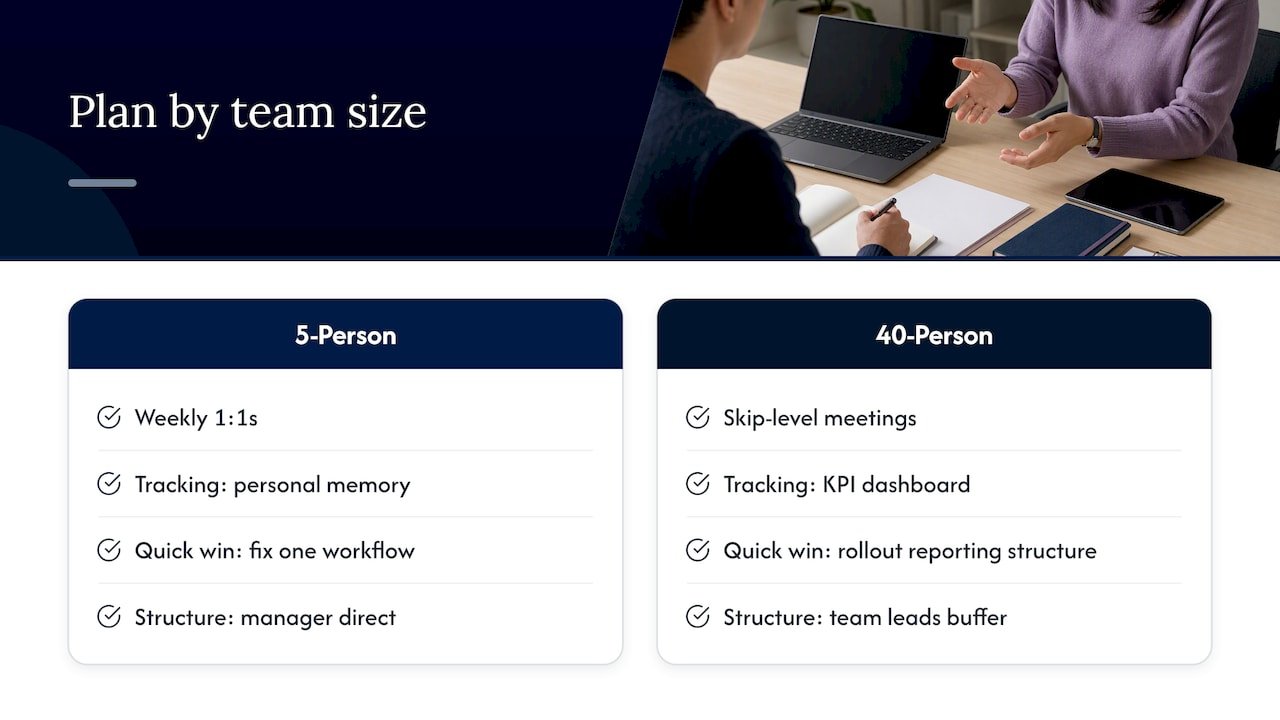
A 30-60-90 plan for a five-person retail team looks nothing like one for a 40-person engineering department, and treating them the same is a common reason plans get abandoned by day 60.
Team size changes the mechanics first. A manager of five can run meaningful weekly 1:1s with everyone; a manager of 40 needs skip-level meetings, team leads as a buffer layer, and a KPI dashboard rather than personal memory to track sentiment and progress. The checklist items stay the same in principle, discovery, a small win, a visible initiative, but the actions scale differently: a small win for a five-person team might be fixing one workflow, while for a 40-person department it might mean rolling out a new reporting structure across several sub-teams.
Industry changes the content. In regulated sectors such as healthcare or oil and gas, the first 30 days need to include compliance and safety induction alongside the usual discovery 1:1s, because skipping it creates real risk rather than just a training gap. In faster-moving sectors like IT or project delivery, the 60-day quick win is often a process or tooling fix rather than a compliance item.
The template itself does not need to change, phase, objective, action, owner, metric and due date still work for any sector or team size. What changes is the content inside each cell: the objectives, the specific compliance steps, and the definition of what counts as a meaningful quick win for that particular team.
Key leadership skills every new manager needs to practise
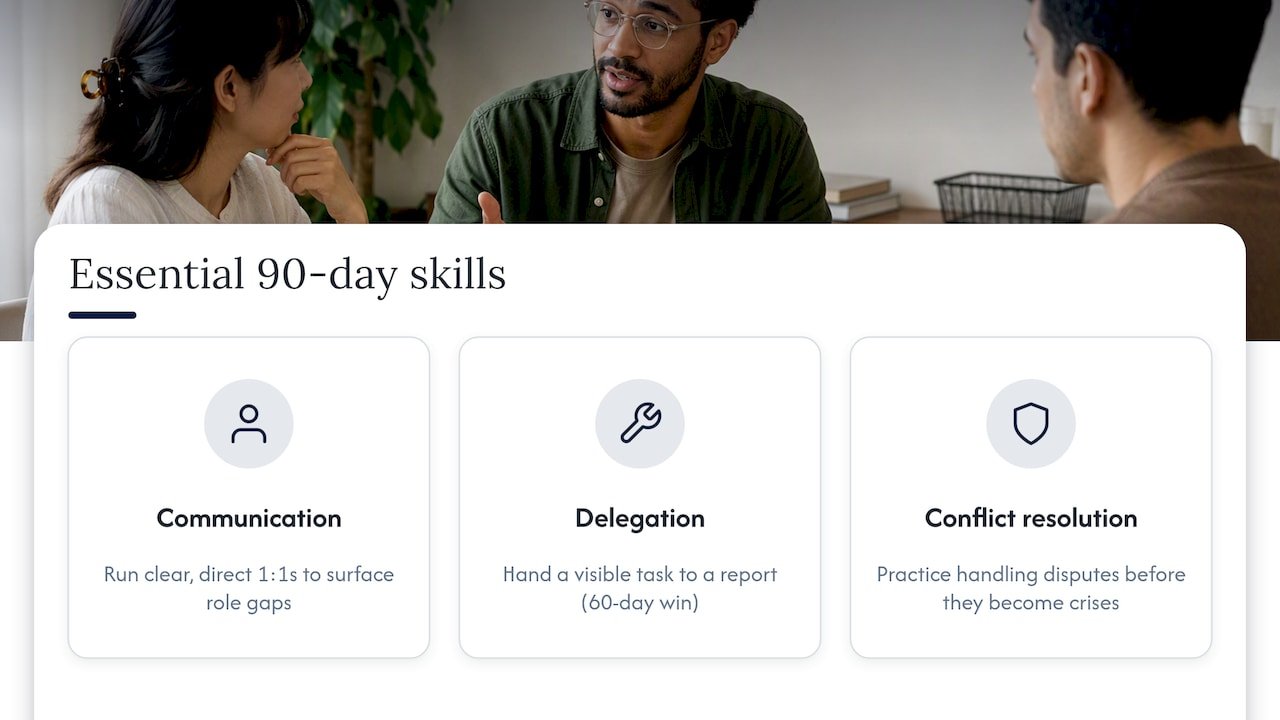
Training topics matter less than the handful of skills that show up in almost every new manager’s first 90 days. Three stand out consistently.
Communication comes first, not as a soft skill but as the mechanism for everything else: clear, direct 1:1s are what surface the role clarity and self-efficacy gaps that onboarding research points to, according to evidence on onboarding outcomes and socialisation. A manager who cannot run a clear 1:1 cannot diagnose what their team actually needs.
Delegation is the second, and it is where many first-time managers struggle most, often because they were promoted for doing the work well themselves and now need to let others do it. The 60-day quick win in the plan above is a natural place to practise this: handing a visible task to a direct report rather than doing it personally builds both delegation skill and the report’s own confidence.
Conflict resolution rounds out the set. Most new managers will hit at least one disagreement, between team members or with another department, inside their first 90 days. Treating this as a scheduled training topic rather than something to learn by accident during a crisis makes the eventual conflict far easier to handle.
Tools and technology that support the plan without replacing it
The plan itself does not need specialist software, a shared document or spreadsheet using the seven-column template covers most of it. Where tools add value is in tracking and consistency across many new managers at once.
A calendar tool with recurring invites keeps 1:1s and mentor check-ins from slipping, which matters because missed check-ins are one of the quietest ways a plan quietly stops happening. Simple survey tools can run the team sentiment pulse mentioned earlier without building anything custom. For HR teams managing several new managers simultaneously, a shared tracker, even a basic spreadsheet with phase, owner and due date columns, makes it possible to spot who is falling behind before day 60 rather than after day 90.
None of this replaces the human parts: the 1:1, the shipped work, the mentor conversation. Tools exist to make sure those things happen on schedule, not to substitute for them.
Weaving company culture and values into the first 90 days
A technically perfect plan still fails if it ignores how things actually get done in a particular organisation. Culture needs to be built into the plan deliberately rather than left to osmosis.
The simplest way to do this is to make the day 1 to 30 discovery 1:1s partly about culture, not just tasks: asking direct reports what good leadership has looked like in this team before, and what has not worked, surfaces unwritten norms fast. The day 31 to 60 quick win should be chosen with those norms in mind; a fix that technically works but ignores how the team likes to communicate can do more harm than good.
By day 90, the strategic initiative is a chance to model the values explicitly, through how decisions get made and credit gets shared, not just through what gets delivered. Sharing a high-level version of the plan with the team by the end of month one also reinforces a culture of transparency, since it shows the new manager is working to an open structure rather than an invisible agenda.
One habit that stops support dropping off after day 90
Lock recurring check-ins with your own manager and your direct reports into the calendar before your first day, not after. Support tends to fade once the formal plan ends, so treat the day 90 review as a prompt to schedule a month 4 and month 6 check-in, not a finish line. Onboarding does not have a fixed end date.
— Sam
Bespoke manager training
Where a plan needs expert-led modules rather than a generic deck, we build customisable training programmes across various areas, delivered flexibly, with accredited qualifications behind each one.
If your HR team wants a pilot module or a bespoke template package built around your own industry and team structure, our project management courses are a practical starting point, or get in touch through our main course catalogue to discuss a tailored programme.
FAQ
What is the 30-60-90 rule for a new manager?
It is a phased plan where the first 30 days focus on listening and building trust, the next 30 on delivering a small, visible win, and the final 30 on a larger initiative with measurable team impact, according to 30-60-90 planning guidance. Each phase has its own objectives, actions and metrics rather than one long undifferentiated onboarding period.
What are the 5 C’s in management?
Definitions of key leadership skills vary across sources and training providers, so there is no single agreed list. Common themes include communication, collaboration, commitment, confidence and conflict resolution, all of which show up directly in a 30-60-90 training plan.
What should new managers be trained on?
New managers typically need training in running effective 1:1s, delegating work they previously did themselves, and handling conflict, alongside role-specific technical content. These skills matter because around 60% of new managers get no formal training at all, which Emory research links directly to higher early turnover risk.
What is the 70-20-10 rule for leadership?
It is a learning design heuristic suggesting roughly 70% of development comes from on-the-job experience, 20% from coaching and peer learning, and 10% from formal coursework, according to the 70-20-10 leadership model. It is meant as a guide for designing a learning mix, not a strict formula to follow exactly.
How do I stop onboarding support dropping off after 90 days?
Schedule check-ins at month 4 and month 6 before the formal 30-60-90 plan ends, since support for new managers tends to fade once the structured period finishes. Proactively locking these dates into the calendar early, rather than waiting for a problem to surface, helps prevent the drop-off and the turnover risk that follows it.