
In England, every member of staff in a registered health or social care setting must receive infection prevention and control (IPC) training that suits their role, and the employer must keep a record of it. There is no single fixed course or certificate. The Health and Social Care Act 2008 code of practice is statutory guidance. Registered providers must have regard to it, and it expects suitable and sufficient information, training and supervision relevant to each role throughout employment. This guide explains what that means in practice, with a look at how other national frameworks compare.
TL;DR
- Everyone working in health and social care needs IPC training, pitched to their role: from basic awareness to specialist leadership.
- England’s national framework uses three tiers. Wales uses five levels. The WHO uses three competency levels.
- Refresher training should happen at least annually under CDC guidance, and whenever processes, products or risks change.
- Registered providers in England must keep a record of all staff and volunteer IPC training.
- Training only counts when competence is checked, through knowledge tests and observation of practice.
Table of Contents
- Who needs infection control training
- What the law and guidance require in England
- What infection prevention training should cover
- How often training should be repeated
- Assessing and recording competence
- Perspective
- Training for the teams behind the clinical team
- Build a training plan for your organisation
- Frequently asked questions
- Sources
Who needs infection control training
Short answer: all staff, including those who are not clinical. The principle running through UK and international guidance is that content must fit the job.
NHS England’s IPC education framework, published in March 2023, sets out three tiers:
| Tier | Who it is for |
|---|---|
| Tier 1 | Everyone working in health and social care |
| Tier 2 | Staff who care directly for patients or work in patient environments |
| Tier 3 | Staff responsible for an area of care |
The US CDC takes the same view from a different angle. It says training is needed for anyone with opportunity for contact with patients or medical equipment, and that includes therapists, technicians, housekeeping and maintenance staff, not only nurses and doctors.
That last point matters for employers outside the clinical team. Cleaners, porters, facilities teams and contractors working in care environments all carry IPC duties, even if they never touch a patient.
How requirements differ by role
A competency-based approach starts from the job. The CDC’s competency-based training guide tells organisations to review roles and job descriptions to decide which infection prevention competencies each one needs. It gives the example of how a nursing assistant and an environmental services worker need different domain knowledge, such as microbiology or equipment handling.
In practice, a simple role map works well:
- All staff: hand hygiene, respiratory hygiene, spills, waste, when to report illness.
- Hands-on care staff: PPE selection, safe handling of equipment, aseptic technique, sharps.
- Cleaning and facilities staff: cleaning versus disinfection, frequency by area, decontamination of shared equipment.
- Managers and leads: audit, incident review, outbreak response, accountability for standards.
Wales, WHO and other frameworks
The All Wales IPC training framework sets out five levels, from introductory awareness to specialist knowledge, and recognises that requirements shift with individual roles and responsibilities. The WHO’s in-service education curriculum, published in 2024, describes three competency levels: foundational, intermediate and advanced. Employers working across several countries can use these as a common vocabulary even where the legal basis differs.
What the law and guidance require in England
The code of practice under the Health and Social Care Act 2008 is the anchor document for registered providers. Three points stand out:
- Training suited to the role. All staff should receive suitable and sufficient information, training and supervision relevant to their roles throughout employment.
- Records. Providers must maintain a record of all staff and volunteer IPC training.
- Proficiency before independence. Staff must be trained and show proficiency in procedures needing skills such as aseptic technique before they carry them out independently.
The same guidance asks providers to account for the needs of staff and service users, including people with learning disabilities, dementia or particular vulnerabilities, so that working arrangements are equitable. In training terms, that means accessible formats, enough time and adjustments, not a single slide deck for everyone.
The NHS England framework is the practical tool most providers use to turn the code into a training plan. It also suggests embedding IPC within other subjects, such as wound care or long-term condition management, so staff see it in real clinical context.
What infection prevention training should cover
The CDC’s infection control assessment tool says content should be job-specific and should explain why, how and when each practice is carried out. Typical topics include:
- hand hygiene
- personal protective equipment (PPE)
- environmental cleaning
- reprocessing of medical equipment
- safe injection practices
- point-of-care blood testing
The WHO curriculum goes further on technical depth. Its foundational level covers microbiology, the chain of transmission, healthcare-associated infection epidemiology and waste management. Its advanced level adds leadership, surgical site infection and surveillance.
The basic principles
Readers often ask for the five basic principles of infection control. The CDC’s core practices list five categories: leadership support; education and training; patient, family and caregiver education; performance monitoring and feedback; and Standard Precautions. Standard Precautions are the baseline practices applied to every patient in every setting, whether or not infection is suspected.
The WHO describes Standard Precautions as the minimum practices for all patient care, protecting both workers and patients by reducing transmission of microorganisms.
Why teach the reasoning, not just the routine? The CDC notes that when staff understand the science behind a precaution, they can safely adapt practice when settings, resources or requirements change.
How often training should be repeated
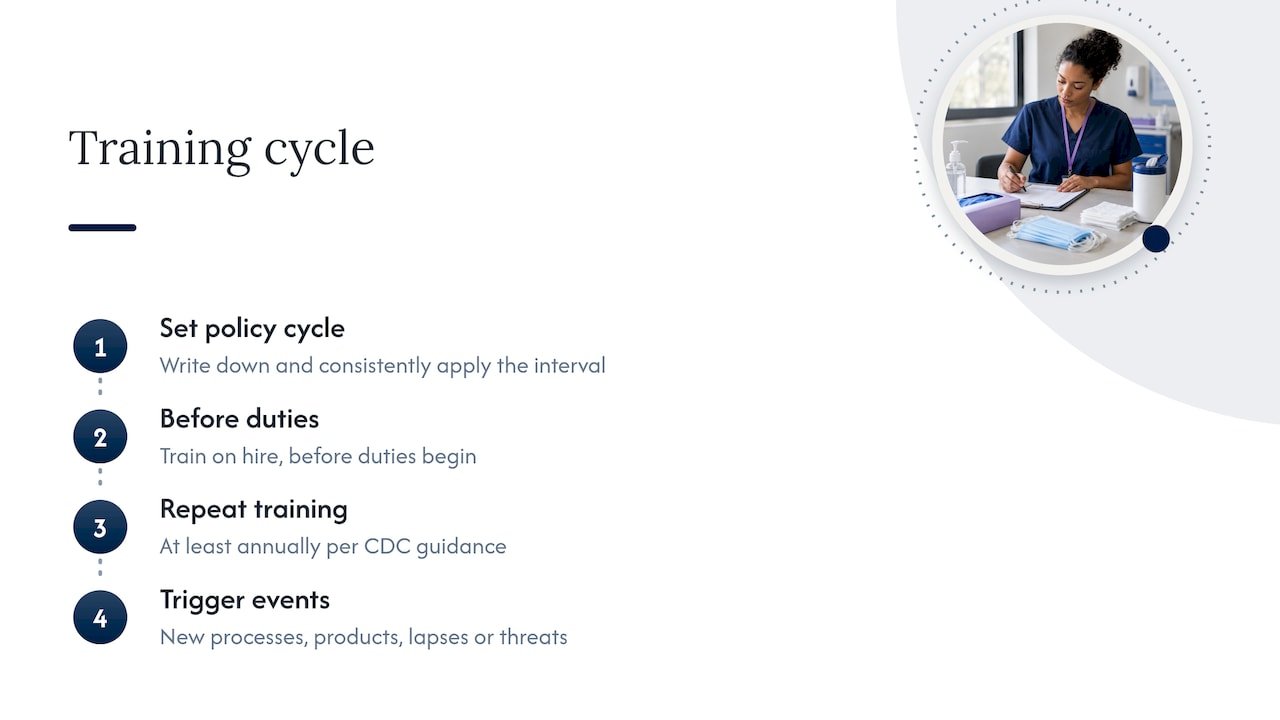
The CDC guidance gives a clear pattern: train on hire and before duties begin, repeat at least annually, and train again when new processes or products arrive or when lapses or new transmission threats appear. You can read it in the CDC assessment tool.
UK employers often set their own cycle in policy, typically tied to their regulator’s expectations and their risk assessment. Whatever interval you choose, write it down and apply it consistently. Add trigger events to the calendar: an outbreak, a near miss, a new piece of equipment or a change in cleaning chemicals.
One practical point: give people time to learn. The CDC recommends dedicated time during normal work hours for healthcare personnel to complete IPC training. Training squeezed into breaks rarely changes behaviour.
Assessing and recording competence
Attendance is not competence. The CDC tool describes verification through knowledge-based testing and direct observation, and where observation is not possible, an alternative method that still shows staff have the necessary knowledge, skills and abilities.
A workable record for each person includes:
- Role and the tier or level assigned to it
- Training completed, with date and provider
- Assessment method and result (quiz, observed hand hygiene, PPE donning and doffing)
- Sign-off by a competent assessor
- Next review date and any trigger-based retraining
This also gives you the evidence trail the English code expects, and it makes inspections far less stressful.
Perspective
In our work with organisations, the gap we see most often is not that nobody was trained. It is that everyone received the same generic session, and the people with the highest exposure, such as cleaning, housekeeping and maintenance teams, were the least covered.
We build programmes around the roles in the building. For facilities and housekeeping managers, that means linking IPC thinking to how cleaning services are specified, how preventive maintenance is scheduled and how pests are controlled, delivered on site, online or blended depending on shift patterns.
Our view is simple: map roles first, train to the map, test competence, and keep the record. That is what turns a compliance requirement into a working habit.
Sam
Training for the teams behind the clinical team
IPC outcomes depend on the environment as much as on clinical technique. If you manage the people and systems that keep a care or healthcare site running, these courses cover the management side:
- Facilities management for healthcare environments
- Housekeeping management for facilities
- Cleaning services management
- Integrated pest management
- Preventive maintenance management
Build a training plan for your organisation
Oxford Centre designs customisable professional training with global accreditation, delivered on site, online or blended, so it can fit the way your teams work. If you are planning role-based training for facilities, healthcare environment or compliance teams, start with our healthcare environments course or browse the full course list.

Tell us the roles, headcount and settings involved, and we will shape the content around them. Prices are not published for this course, so contact us for a quote.
Frequently asked questions
Is infection control training mandatory in the UK?
In England, registered providers must have regard to the Health and Social Care Act 2008 code, which expects all staff to receive suitable training relevant to their role. Providers must also keep a record of it. Check your regulator’s current requirements for your setting.
How often should infection prevention training be repeated?
CDC guidance recommends training at hire, at least annually as a refresher, and whenever processes, products or risks change. Set your own cycle in policy and keep to it.
Do non-clinical staff need it?
Yes. Housekeeping, maintenance and technical staff with opportunity for contact with patients or equipment are included in CDC guidance, and NHS England’s Tier 1 covers everyone in health and social care.
What are the five basic principles of infection control?
The CDC’s core practices are leadership support, education and training, patient and family education, performance monitoring and feedback, and Standard Precautions. Standard Precautions apply to every patient in every setting.
Sources
- Health and Social Care Act 2008 code of practice on infection prevention and control
- NHS England: IPC education framework
- CDC: Fundamental elements to prevent transmission
- CDC: Competency Based Training 101
- All Wales IPC training framework
- WHO: IPC in-service education and training curriculum
- WHO curriculum full text
- CDC: ICAR tool, training and audits
- CDC: Core infection prevention and control practices
- WHO: Standard precautions aide-memoire
- CDC: Occupational IPC education and training