
Key Points
- Bruntwood SciTech has secured nine new and expanded lettings at Manchester Science Park, bringing more than 23,500 sq ft of additional business occupation to its Oxford Road Corridor campus.
- The latest agreements involve companies operating across life sciences, digital technology, gaming, smart sensors, fragrance development, medical diagnostics and social impact.
- Ticketmaster has taken 1,925 sq ft at Base to establish a specialist technical hub for repairing, upgrading and developing audio-visual equipment used in live events.
- Inspired Entertainment has relocated to the Bright Building, occupying 6,900 sq ft to support the expansion of its product development team and strengthen connections with Manchester’s universities.
- Chromition has returned to Manchester Science Park, taking 1,800 sq ft at Rutherford to advance fluorescent nanoparticle technology for applications including cancer detection and bioimaging.
- Bright Biotech has expanded its premises to 2,983 sq ft following recent funding to scale its plant-based recombinant protein platform.
- PhovIR Technologies, a University of Manchester spinout, has taken space at Enterprise following a £4 million fundraising round to support the development of its infrared spectrometer technology.
- Keva Fragrances has established a 7,469 sq ft Global Creative Development Centre at Base, supporting its international expansion and continued investment in the UK.
- Optera, a UK-based smart sensor business, has taken 792 sq ft to support its work tracking satellites and space debris.
- CodeYourFuture, a UK-based non-profit organisation, has taken 1,234 sq ft to deliver software development training to underrepresented groups and connect learners with local employers.
- Accelerated Diagnostics has occupied 254 sq ft to support the development of rapid medical testing devices for human and veterinary applications.
- Joseph Venables, Associate Commercial Director at Bruntwood SciTech, said innovation-led businesses require specialist facilities, talent and expertise alongside workspace to commercialise technologies and scale.
- Rich Terry of Inspired Entertainment highlighted access to Manchester’s universities, specialist expertise and graduate talent as important reasons for the relocation.
- Medha Tawde Bhagat of Keva Fragrances said Manchester would help connect consumer understanding, fragrance creation and technology through its new development centre.
- Manchester Science Park is part of a wider Bruntwood SciTech network supporting more than 1,450 innovation-led businesses, with partnerships involving universities, NHS trusts and research institutions.
- Track, CBRE, Savills and Canning O’Neill are the retained letting agents for Manchester Science Park.
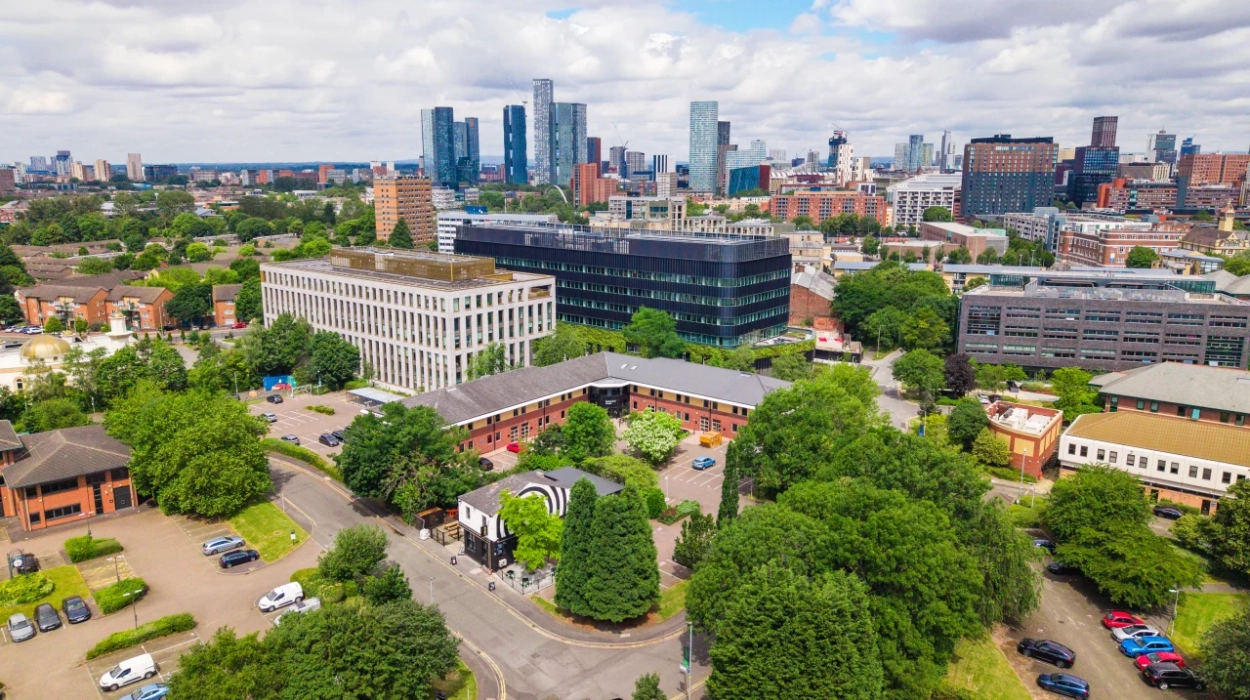
Bruntwood SciTech has secured nine new and expanded lettings at Manchester Science Park, attracting more than 23,500 sq ft of business occupation and reinforcing the campus’s position as an innovation-focused destination for companies operating across technology, life sciences, creative industries and medical research. Announced on 3 November 2026, the agreements involve Ticketmaster, Inspired Entertainment, Chromition, Bright Biotech, PhovIR Technologies, Keva Fragrances, Optera, CodeYourFuture and Accelerated Diagnostics. The latest activity demonstrates the breadth of organisations using specialist workspace, research facilities, university connections and industry partnerships to develop products, commercialise technologies and expand their operations in Manchester.
The latest lettings have taken place at Manchester Science Park, located within the Oxford Road Corridor, one of Manchester’s established centres for research, education, healthcare and technological development. The new and expanding occupiers represent a diverse range of industries, demonstrating how science park environments are increasingly accommodating businesses beyond conventional scientific research.
According to Bruntwood SciTech’s announcement, the campus has welcomed an expanding mix of innovative organisations over the past year. These businesses have been attracted by its specialist facilities, industry partnerships and established innovation environment.
The latest agreements include companies requiring technical infrastructure for live entertainment equipment, specialist research accommodation, product development facilities, laboratory environments and workspace for technology-led operations.
What Is Driving the Nine New Lettings at Manchester Science Park?
The nine agreements reflect different business requirements, but a common factor is the need for an environment that supports innovation, collaboration and commercial growth.
Manchester Science Park provides access to specialist infrastructure and a wider network of businesses, academic institutions and research organisations. This combination has attracted established international companies, university spinouts, emerging technology businesses and non-profit organisations.
The latest lettings also demonstrate the range of activities taking place across the campus. These include the development of medical diagnostics, advanced materials, fragrance solutions, satellite-monitoring technologies and software development capabilities.
Joseph Venables, Associate Commercial Director at Bruntwood SciTech, explained that innovation-led businesses need more than conventional office accommodation to develop and expand.
As stated in the company’s announcement, Venables said: “For innovation-led businesses to scale, they need more than workspace alone – they need access to specialist facilities, talent and the expertise to solve complex challenges quickly. This is because being part of the ecosystem catalyses the commercialisation of innovation.”
He added that Manchester Science Park was attracting businesses from a wider range of industries than those traditionally associated with science parks.
Venables identified life sciences, aerospace, creative technology and social impact organisations among the sectors establishing a presence at the campus. Although these businesses operate in different markets, he noted that many face comparable challenges involving technology, product development and business growth.
He also highlighted the benefits of access to neighbouring organisations, the research and talent base of the Oxford Road Corridor and Bruntwood SciTech’s wider UK network.
Why Has Ticketmaster Established a Technical Hub at Manchester Science Park?
Global ticketing platform Ticketmaster has taken 1,925 sq ft at Base, one of the buildings at Manchester Science Park.
The company is relocating from Ancoats and intends to use the new premises as a specialist technical hub supporting the repair, upgrading and continued development of audio-visual equipment used across live events.
The move provides Ticketmaster with access to dedicated maker space and technical infrastructure that supports practical equipment development and testing.
According to Bruntwood SciTech, the facilities include high-specification loading infrastructure and enhanced floor-to-ceiling height. These features are particularly relevant to operations involving large or specialist audio-visual equipment.
The accommodation will allow Ticketmaster to test and develop equipment at scale while supporting the ongoing technical requirements of its live entertainment operations.
The agreement demonstrates how workspace requirements can differ substantially between businesses. While some occupiers primarily need office accommodation, companies involved in technical production and equipment development require facilities that can accommodate practical operations.
For Ticketmaster, the availability of specialist maker space was an important element of its relocation to the campus.
How Will Inspired Entertainment Use Its New Manchester Science Park Premises?
Inspired Entertainment, a global computer software company headquartered in New York, has relocated to the Bright Building, taking 6,900 sq ft of accommodation.
The company has maintained a presence in Manchester City Centre through serviced workspace for several years. However, its ambition to expand its product development team and establish closer connections with Manchester’s universities contributed to the decision to move to Manchester Science Park.
The relocation is intended to provide a working environment that supports the company’s development objectives while bringing its team closer to other technology-focused organisations.
Bruntwood SciTech has also facilitated introductions between Inspired Entertainment and academic departments at two Manchester universities.
These include the School of Digital Arts at Manchester Metropolitan University and the School of Computer Science at the University of Manchester.
The move also provides proximity to businesses such as Epic Games, which specialises in software and technological graphics development.
Rich Terry, Senior Product Director – Virtuals at Inspired Entertainment, said the company had maintained a presence in Manchester for several years but wanted to deepen its roots in the city.
Terry explained: “We’ve had a presence in Manchester for several years, but our ambition has always been to deepen our roots in the city and build a team that can continue to drive our growth and innovation.”
He said the new location would provide access to an established community of innovative businesses and Manchester’s leading universities.
Terry also acknowledged the support provided by Bruntwood SciTech in facilitating introductions to Manchester Metropolitan University’s School of Digital Arts and the University of Manchester’s School of Computer Science.
According to Terry, access to academic expertise and graduate talent will help Inspired Entertainment develop a stronger recruitment pipeline while creating opportunities to collaborate with emerging digital and technology specialists.
The company’s relocation therefore combines its immediate accommodation requirements with longer-term ambitions involving product development, recruitment and collaboration.
Why Has Chromition Returned to Manchester Science Park?
Chromition has returned to Manchester Science Park, taking 1,800 sq ft at Rutherford.
The company previously occupied premises at the campus before relocating to Bruntwood SciTech’s Alderley Park. Its latest move brings the business back to Manchester as it continues developing and commercialising its fluorescent nanoparticle technology.
The technology is being used to improve diagnostic capabilities in areas including cancer detection and bioimaging.
According to Bruntwood SciTech, Chromition was attracted by the campus’s diverse business community, improved amenities and proximity to organisations working in complementary fields.
One of the organisations identified in the announcement is Vortex Bio.
The return to Manchester Science Park is intended to support the company’s continued technology development and commercialisation activities.
Its relocation also illustrates the importance of connections between businesses working in related scientific and technological areas, particularly where specialist expertise and collaboration can contribute to research and product development.
How Is Bright Biotech Expanding Its Research Operations?
Bright Biotech has expanded its presence at Rutherford, increasing its accommodation to 2,983 sq ft following recent funding.
The company is scaling its plant-based recombinant protein platform, which enables the production of high-quality proteins through plant-based methods.
According to Bruntwood SciTech, the technology is designed to support cost-effective protein production for several applications, including research, therapeutics, agriculture and industrial uses.
The additional accommodation is intended to support the company’s continued development and expansion.
Bright Biotech’s growth highlights the importance of specialist premises for businesses working in advanced biotechnology. Such organisations require environments that can accommodate research activities and the development of technologies intended for wider commercial and industrial applications.
Its expansion also adds to the concentration of life sciences and biotechnology businesses operating at Manchester Science Park.
What Is PhovIR Technologies Developing Following Its £4 Million Fundraise?
PhovIR Technologies, a University of Manchester spinout, has taken space at Enterprise as it progresses the development of its infrared spectrometer technology.
The company is developing what Bruntwood SciTech describes as one of the world’s smallest infrared spectrometers.
The technology is intended to enable molecular-level analysis across a wide range of industries, creating potential applications beyond a single specialist market.
The move to Manchester Science Park follows a £4 million fundraising round, which is supporting the company’s next phase of growth.
As a university spinout, PhovIR Technologies represents the connection between academic research and commercial technology development.
Its presence on campus also reflects the role of Manchester’s university environment in supporting businesses seeking to develop and commercialise scientific innovations.
The additional premises provide accommodation as the company continues advancing its technology following the successful fundraising.
Why Has Keva Fragrances Established a Global Creative Development Centre in Manchester?
Keva Fragrances, an Indian multinational fragrance company with a presence across Europe, Asia and the United States, has established its new Global Creative Development Centre at Base.
The company has taken 7,469 sq ft, making it one of the largest individual lettings highlighted in the latest announcement.
The development represents an important step in Keva’s international expansion and continued investment in the UK.
The new centre brings together creative, technical and commercial expertise. Its facilities include dedicated perfumery, evaluation and application laboratories designed to support fragrance development from initial creation through to application.
Keva has selected Manchester as a strategic location from which to serve customers in the UK and international markets.
The centre is intended to accelerate innovation and support the development of new fragrance solutions while bringing different areas of expertise together in one location.
The company’s decision also reflects the advantages of Manchester’s innovation ecosystem, including access to specialist talent, academic networks and opportunities for collaboration.
Medha Tawde Bhagat, EVP – Global Business Development at Keva Fragrances, explained the company’s reasoning behind the decision.
She said: “Manchester brings together a powerful combination of creativity, science, talent and collaboration. Our ambition is to build a centre that connects consumer understanding with fragrance creation and technology, enabling us to work more closely with customers in the UK while contributing to Keva’s wider global innovation network.”
Her statement highlights the relationship between consumer understanding, scientific development and creative processes in the fragrance industry.
The centre is expected to provide a base for closer engagement with UK customers while contributing to Keva’s broader international innovation activities.
How Are Optera, CodeYourFuture and Accelerated Diagnostics Contributing to the Campus?
The remaining lettings further demonstrate the range of businesses choosing Manchester Science Park.
These include a smart sensor company, a non-profit organisation focused on software development training and a medical diagnostics start-up.
What Does Optera Do in Satellite and Space Debris Monitoring?
Optera, a UK-based smart sensor company, has taken 792 sq ft at Manchester Science Park.
The business specialises in tracking satellites and space debris, using ground-based and in-orbit capabilities.
Its work is supported by the University of Manchester’s International Centre for Neuromorphic Systems.
The company’s presence adds an aerospace and space-monitoring dimension to the campus’s wider innovation community.
Its activities also demonstrate the growing overlap between advanced sensing technologies, research and the development of solutions for the space sector.
How Will CodeYourFuture Use Its New Workspace?
UK-based non-profit organisation CodeYourFuture has taken 1,234 sq ft at the campus.
The organisation delivers software development training to people from underrepresented groups.
Its activities include connecting learners with local companies seeking skilled developers, creating a link between technology education and employment opportunities.
The organisation’s presence introduces a social impact and skills-development element to the latest group of occupiers.
By establishing a base at Manchester Science Park, CodeYourFuture joins a wider business community that includes technology companies and organisations connected to the city’s academic and commercial networks.
What Is Accelerated Diagnostics Developing?
Start-up Accelerated Diagnostics has taken 254 sq ft at Manchester Science Park.
The company is developing a rapid medical testing diagnostic device for both human and veterinary markets.
Its presence adds another medical technology business to the campus, reflecting the continued importance of diagnostic innovation across healthcare and animal health applications.
The company’s accommodation is smaller than that taken by several other new occupiers, but its activities contribute to the diversity of research and development work represented at the site.
Together, Optera, CodeYourFuture and Accelerated Diagnostics illustrate how Manchester Science Park accommodates organisations with different operational requirements, from advanced sensor technology and software education to medical device development.
How Does Manchester Science Park Support Innovation and Business Growth?
Manchester Science Park is located within the Oxford Road Corridor, placing businesses close to major academic and healthcare institutions.
The campus provides proximity to the University of Manchester, Manchester Metropolitan University and key NHS institutions.
According to Bruntwood SciTech, this location gives occupiers access to research capabilities, specialist talent and clinical expertise, alongside connectivity across Manchester and beyond.
Businesses also benefit from links with Bruntwood SciTech’s neighbouring Citylabs campus and the Greenheys development at Manchester Science Park, which opened in 2026.
These connections form part of a wider environment designed to bring together companies, researchers, universities and healthcare organisations.
Bruntwood SciTech’s wider community includes more than 1,450 innovation-led businesses across the UK.
The organisation also maintains strategic partnerships with universities, NHS trusts and research institutions.
These relationships provide opportunities for collaboration, access to funding and talent, and pathways for developing and scaling new technologies.
Joseph Venables emphasised the importance of these connections, explaining that businesses at Manchester Science Park benefit from more than the physical infrastructure available on site.
He highlighted the expertise of neighbouring organisations, the research and talent base of the Oxford Road Corridor and the wider support network provided by Bruntwood SciTech.
His comments indicate that the company’s approach is centred on creating an environment in which businesses can access the resources and relationships needed to progress from technology development to commercialisation.
The diversity of the latest occupiers also demonstrates that science park environments are increasingly relevant to organisations beyond traditional laboratory-based research.
What Do the Latest Lettings Mean for Manchester’s Innovation Economy?
The nine agreements highlight the variety of businesses seeking specialist accommodation and access to research-led commercial environments in Manchester.
The occupiers range from established international companies such as Ticketmaster, Inspired Entertainment and Keva Fragrances to biotechnology businesses, university spinouts, technology start-ups and social impact organisations.
Their different activities demonstrate how innovation increasingly involves collaboration between disciplines.
For example, fragrance development combines creative expertise with scientific research and commercial understanding. Medical diagnostics relies on advances in technology and scientific analysis, while satellite monitoring involves sophisticated sensing systems and specialist research.
Similarly, software development companies benefit from connections with universities and skilled graduates, while organisations such as CodeYourFuture contribute to the development of the workforce required by the technology sector.
Manchester Science Park’s location within the Oxford Road Corridor provides a setting for these different activities to operate alongside established academic and healthcare institutions.
The latest agreements also represent a combination of new arrivals and existing businesses expanding or returning to the campus.
Ticketmaster is relocating from Ancoats, Inspired Entertainment is moving from serviced workspace in Manchester City Centre, Chromition is returning after a period at Alderley Park, and Bright Biotech is increasing its existing footprint.
These developments suggest that occupiers are considering not only the availability of workspace but also the facilities, expertise and relationships that can support their future operations.
The retained letting agents for Manchester Science Park are Track, CBRE, Savills and Canning O’Neill.
As businesses continue to develop new products, technologies and services, capabilities in Product Management, IT and Computer Science, and Data Science and Visualization remain relevant to understanding how organisations manage innovation, develop technical solutions and translate research into commercial applications.
The latest activity at Manchester Science Park therefore provides an example of how specialist infrastructure, university connections and cross-sector collaboration can contribute to the growth of businesses operating in different parts of the innovation economy.