
Choose accredited, trainer-authorised and evidence-driven environmental and EHS training tailored to your organisation’s objectives, not generic compliance modules. This means corporate courses covering environmental management systems, EHS compliance and sustainability, not practical farming instruction. Before signing anything, confirm the provider holds recognised accreditation such as ISO 14001 or IREC, that trainers are individually authorised, and that assessment produces auditable records rather than attendance certificates.
TL;DR:
- Certification must include ongoing surveillance audits, with training content refreshed to align with ISO 14001 recertification cycles.
- Confirm both provider accreditation and trainer authorisation separately, and request sample evaluation templates to ensure assessments are competency-based, not attendance-only.
- Ask vendors for real-world, anonymised evaluation records before purchase to verify practical assessment quality and compliance with hands-on evaluation standards.
- Design custom programmes with modular, site-specific assessments and risk-aligned reassessment intervals, rather than relying on generic, off-the-shelf courses.
- Measure training impact through operational data such as incident, audit, and non-conformance trends, and regularly review results within your EMS management cycle.
Table of Contents
- What corporate environmental and agriculture training courses cover
- Key accreditations and standards to require
- How to evaluate providers with a cross-functional framework
- Designing custom programmes that match organisational goals
- Measuring impact and demonstrating ROI
- Procurement checklist and 12 questions for prospective suppliers
- Oxford Centre: how we meet corporate environmental and EHS training needs
- Key skills and competencies gained from these courses
- Environmental and agricultural regulations covered in corporate courses
- Emerging trends and technologies shaping this training
- Career opportunities and pathways after certification
- Case studies and evidence that training translates to results
- A short HR perspective: procurement mistakes and simple fixes
- How Oxfordcentre can help you get this right
- Sources
- FAQ
What corporate environmental and agriculture training courses cover
Environmental and agriculture training courses, in the corporate sense HR teams actually buy, sit closer to environmental management and EHS compliance than to fieldwork. They build workplace competence in managing environmental risk, meeting regulatory duties, and embedding sustainability into daily operations.
Typical modules include:
- Environmental management systems awareness, often mapped to ISO 14001 requirements
- EHS compliance training covering waste, emissions, and hazardous materials handling
- Sustainability strategy modules for managers setting organisational targets
- Supply chain environmental stewardship for procurement teams
- Role-based competence checks for site operators and supervisors
Audiences range widely: operations staff needing hazard awareness, EHS practitioners building formal qualifications, and procurement teams assessing supplier environmental risk. Course length varies just as much, from half-day induction modules to multi-day programmes with practical assessment components, delivered on-site, online, or blended depending on the skill being tested.
Key accreditations and standards to require
Accreditation is the single biggest differentiator between a training provider you can defend at audit and one you can’t. Two standards matter most for corporate buyers.
ISO 14001 governs environmental management systems, and certification against it involves ongoing scrutiny, not a one-off check.
Statistic Callout: ISO 14001 certified organisations undergo regular surveillance audits and periodic recertification audits at intervals recommended by the standard, so training content needs refreshing on the same rhythm your management system gets audited on.
IREC Standard 01023 sets accreditation requirements for clean energy and sustainability training providers, requiring curricula built from documented job task analyses rather than generic content. That link between job tasks and syllabus design is what separates accredited training from a webinar dressed up as a course.
Two things HR often conflates:
- Provider accreditation confirms the organisation’s quality systems and curriculum design meet a recognised standard.
- Trainer authorisation confirms the specific individual delivering your course is qualified to do so.
A provider can hold accreditation while assigning an unauthorised trainer to your session. Verify both, separately, every time.
How to evaluate providers with a cross-functional framework
Training procurement fails most often when HR runs it alone. Bring in IT, operations, and finance before you shortlist anyone.
- Loop in IT early to confirm LMS hosting requirements, SCORM or xAPI compatibility, and reporting exports before you sign anything.
- Involve operations on site access, equipment availability, and any plant-specific hazards a trainer needs briefing on.
- Ask finance to model total cost of ownership, not just the headline course fee, including LMS licensing and refresher cycles.
- Request trainer authorisation documentation and sample CVs, not just a provider accreditation certificate.
- Ask for sample evaluation templates showing how individual practical assessments get recorded, not just a pass/fail attendance sheet.
- Clarify the LMS model, whether the vendor hosts a full platform, provides a tenant instance, or delivers content only, since this decision affects integration cost and reporting depth considerably.
Pro Tip: Ask for one real, anonymised evaluation record from a past cohort before you buy. If a provider can’t produce one, they’re likely running attendance-only assessment, whatever their brochure says.
Guidance from occupational safety bodies backs this approach directly: check for authorised trainers and hands-on evaluation wherever equipment or safety-critical skills are involved, and insist on documentation you could hand an auditor without embarrassment.
Designing custom programmes that match organisational goals
Off-the-shelf courses rarely fit a specific site, a specific hazard profile, or a specific regulatory obligation. Custom design starts with deciding where practical assessment is non-negotiable.
Insist on on-site practical assessment when training involves specific equipment, confined spaces, or plant-specific hazards that no generic video can replicate. Online or blended formats work well for awareness-level content, policy training, and refresher modules where the risk of getting it wrong is lower.
- Map every module to your existing job task analyses and competency framework, not a generic course outline.
- Build induction, role-specific, and refresher modules as separate blocks rather than one long course.
- Set reassessment intervals tied to risk level, shorter for high-hazard roles, longer for desk-based sustainability awareness.
Research into corporate sustainability training backs this modular, strategy-linked approach: a systematic review of sustainability training found programmes work best when tightly aligned to organisational strategy and evaluated on a regular cycle, not delivered once and forgotten.
Measuring impact and demonstrating ROI
Training spend needs a business case, and EHS training gives you more measurable proof points than most corporate learning categories.
Immediate metrics are the easiest to capture: completion rates, pass rates on competence checks, and practical assessment scores. These tell you whether the course worked at all.
- Track incident rate trends over the following two to three quarters
- Monitor energy or material savings tied to sustainability modules
- Count audit non-conformances before and after training rollout
- Review evaluation data at the same cadence as your ISO management review
Statistic Callout: Empirical research into green training programmes found measurable links to improved environmental performance and financial benefit when training was paired with green supply-chain practices, giving HR a credible basis for a business case beyond compliance box-ticking.
Run your first evaluation immediately post-course, a second at three to six months, and fold the results into your regular EMS management review rather than treating training data as a standalone report.
Procurement checklist and 12 questions for prospective suppliers
A tight checklist before you issue an RFP saves weeks of back-and-forth later. Confirm accreditation status, trainer authorisation, sample documentation, LMS or tracking capability, real customisation examples, and client references before anyone signs a contract.
Twelve questions worth putting directly into your RFP:
- Which accreditation body covers your environmental or EHS curricula?
- Can you provide authorisation records for the specific trainer assigned to us?
- What does a completed individual evaluation record look like?
- How do you customise content to our job task analysis?
- Do you host the LMS, or do we need our own platform?
- Does your platform support SCORM or xAPI reporting?
- What’s your reassessment interval for high-risk competencies?
- Can we pilot with one cohort before a full rollout?
- How do you handle site-specific hazard briefings?
- What’s included in post-training support?
- Can you supply two client references in our sector?
- How do you update content when standards change?
Oxford Centre: how we meet corporate environmental and EHS training needs
Training providers can deliver accredited, customisable training across environmental management, EHS compliance, and sector-specific skills, with courses run on-site, online, or blended to suit operational constraints. Programmes should be expert-led and built to address organisation-specific challenges rather than generic content.
Before booking any programme, ask any provider, including Oxfordcentre, for sample curricula, accreditation certificates, trainer CVs, evaluation templates, and case studies relevant to your sector.
Key skills and competencies gained from these courses
The skills gap in environmental and EHS training tends to show up in three places: technical knowledge, regulatory literacy, and practical judgment under real conditions.
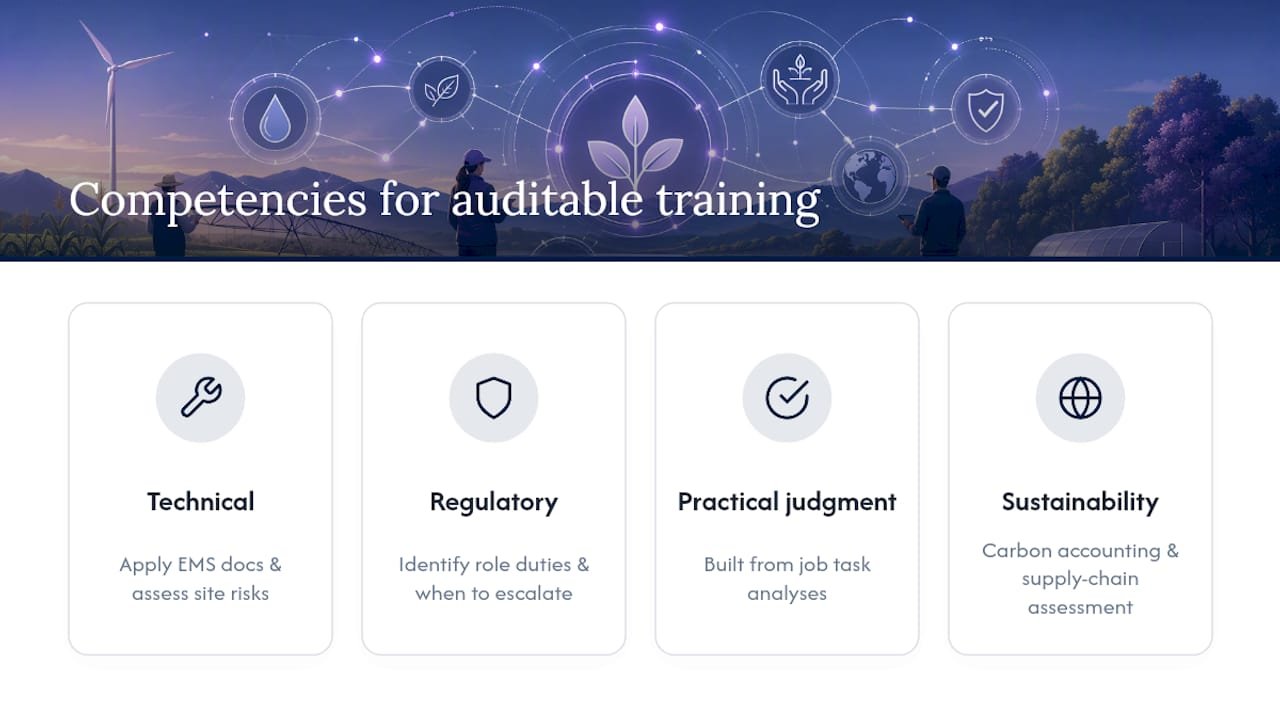
Technical competencies include reading and applying environmental management system documentation, interpreting emissions or waste data, and running risk assessments specific to a site’s hazard profile. These aren’t abstract skills. A supervisor who can correctly classify hazardous waste under local rules prevents fines that a training certificate alone never will.
Regulatory literacy covers understanding which environmental duties apply to a specific role, from reporting obligations to permit conditions, and knowing when to escalate a compliance question rather than guess. This matters more in sectors with layered rules, chemicals, energy, manufacturing, where a single missed obligation carries real financial exposure.
Practical judgment is the hardest to teach and the easiest to fake with a certificate. Courses built around job task analyses, as IREC’s accreditation standard requires, tend to produce stronger practical judgment because the curriculum was built from real workplace tasks rather than a generic syllabus.
Sustainability-specific competencies round out the set: carbon accounting basics, supply chain environmental assessment, and the ability to translate a corporate sustainability target into a team-level action plan. Procurement and operations staff increasingly need at least a working grasp of these, even when their job title has nothing to do with sustainability.
Environmental and agricultural regulations covered in corporate courses
Regulatory content in corporate environmental training tends to cluster around a handful of recurring themes, though the exact rules vary sharply by jurisdiction and sector.
Waste management and hazardous materials handling appear in nearly every EHS course, covering classification, storage, and disposal duties that carry direct legal liability if mishandled. Emissions reporting and permit compliance feature heavily for manufacturing, energy, and heavy industry audiences, where regulators expect documented monitoring, not best-effort estimates.
Environmental management system requirements, tied to standards like ISO 14001, form the backbone of many compliance modules, since certification itself requires internal audits and independent certification audits as evidence of a working system. Supply chain and agricultural-sector regulatory content, covering things like sustainable sourcing standards and environmental due diligence for suppliers, increasingly features in procurement-facing training as organisations face pressure to demonstrate responsible sourcing further down their supply chains.
Because rules differ by country, sector, and even by facility type, no course can promise blanket regulatory coverage. A strong provider will state clearly which jurisdictions its content addresses and flag where local legal advice remains necessary. Treat any course claiming universal regulatory coverage with real scepticism.
Emerging trends and technologies shaping this training
Training delivery in this space has shifted faster in the past few years than most HR teams have had time to notice. Three trends stand out.
Digital and blended delivery has moved from a convenience to a default. Online modules now handle awareness-level content efficiently, freeing practical, in-person sessions for genuinely hands-on skills, equipment operation, confined space work, site-specific hazard recognition, where a screen simply can’t replicate the risk.
Data-driven evaluation is replacing attendance-based certification. LMS platforms now routinely track competence scores, practical assessment outcomes, and refresher due dates automatically, which matters enormously when an auditor asks for evidence rather than a sign-in sheet.
Sustainability-integrated curricula are converging environmental training with broader corporate sustainability strategy, rather than treating them as separate compliance and ethics tracks. This mirrors what the research on training and corporate sustainability consistently finds: training that’s tied directly to strategic sustainability goals outperforms generic compliance content on almost every measure that matters to the business.
Sector-specific customisation, tied to job task analysis rather than off-the-shelf modules, is becoming the accreditation norm rather than the exception, driven partly by standards bodies like IREC requiring it outright.
Career opportunities and pathways after certification
Completing accredited environmental or EHS training opens pathways that go well beyond a single job title, and that’s part of the pitch HR can make to employees when justifying the investment.
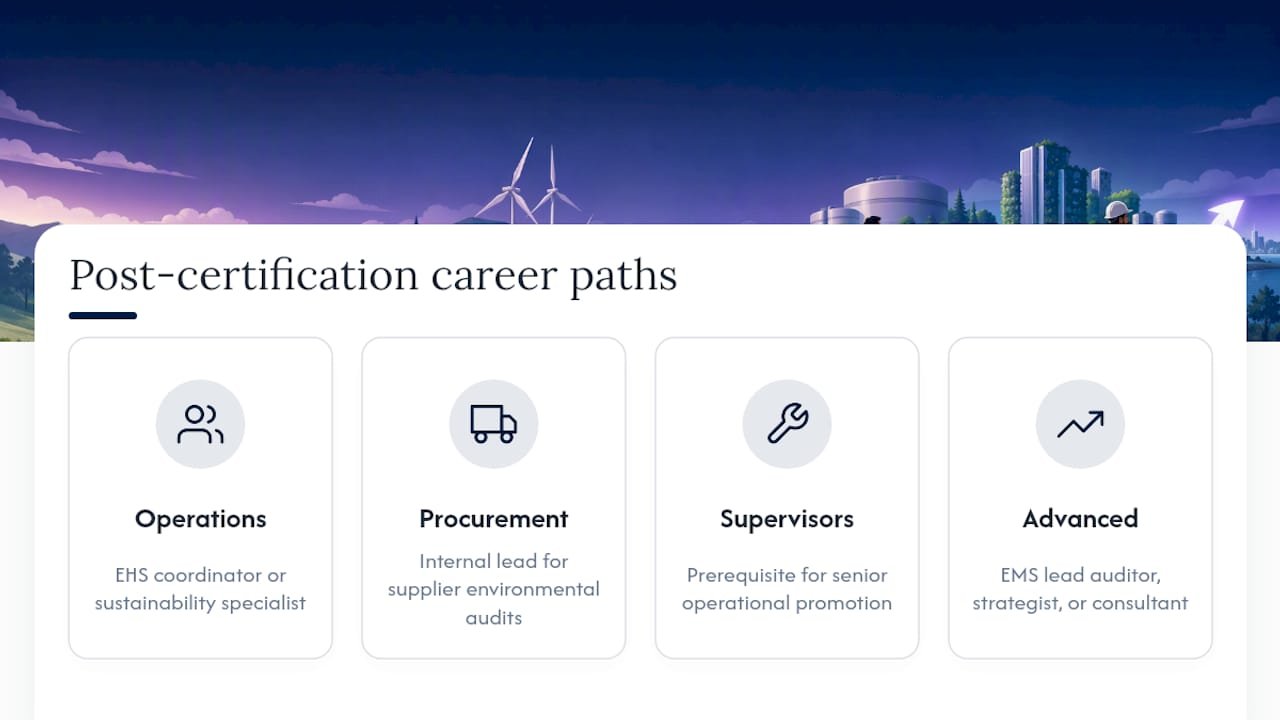
Within operations, certified staff typically move into EHS coordinator, environmental compliance officer, or sustainability specialist roles, positions that increasingly sit at management level rather than as junior support functions. Procurement professionals who complete supply chain sustainability modules often become the internal point person for supplier environmental audits, a role that’s grown in importance as organisations face more scrutiny over their supply chains.
For supervisors and site managers, EHS certification frequently becomes a prerequisite for promotion into senior operational roles, particularly in manufacturing, energy, and construction, where regulatory exposure sits squarely with whoever signs off on-site activity. Formal accreditation, especially where it maps to recognised standards like ISO 14001, also travels well between employers, giving certified staff genuine mobility rather than a credential that only means something internally.
Longer term, staff who build depth in this area often move toward EMS lead auditor roles, sustainability strategy positions, or specialist consultancy work, career tracks that didn’t really exist as distinct disciplines a decade ago. For HR, that mobility is worth naming explicitly when pitching training internally: it’s not just a compliance cost, it’s a retention and progression tool.
Case studies and evidence that training translates to results
The strongest evidence for environmental and EHS training isn’t anecdotal, it’s measurable, and it shows up in operational and financial data when the training is done properly.
Research into green training programmes found consistent links between structured environmental training and improved environmental performance alongside financial benefit, particularly where training was paired with broader green supply-chain practices rather than delivered in isolation. That pairing matters: training alone rarely moves the needle, but training embedded into a wider operational change programme does.
The pattern holds in sector-specific contexts too. Food service and hospitality operators building sustainability into daily operations, as outlined in operator guidance on food service sustainability, show how training-driven behaviour change compounds when it’s tied to concrete operational targets rather than abstract awareness goals.
What separates the organisations that see real impact from those that don’t usually comes down to evaluation discipline. Firms that track competence checks, incident rates, and audit non-conformance trends after training tend to catch problems early and can prove the training worked. Firms that treat a certificate as the finish line rarely have the data to defend the spend when finance asks for justification at renewal time.
A short HR perspective: procurement mistakes and simple fixes
The recurring mistake isn’t picking the wrong provider, it’s accepting attendance-only certificates for high-risk skills because the paperwork looks fine on the surface. Require documented competence checks instead. Insist on stakeholder sign-off, a pilot cohort, and sample record templates before committing budget. These are small process changes, and they’re the difference between a training programme and legal exposure waiting to surface.
— Sam
How Oxfordcentre can help you get this right
Training providers build accredited, customisable environmental and EHS training around your organisation’s actual risk profile, not a generic template, with programmes designed for on-site, online, or blended delivery depending on what the skill actually demands. Expert-led courses should be structured to address real workplace challenges, covering accreditation-aligned content, trainer expertise, and reporting that stands up at audit.
If you’re shortlisting providers, start by requesting a sample curriculum and trainer authorisation documentation for your sector, then compare that against what a generic vendor offers. Oxfordcentre’s project management and compliance training pages outline current course structures, and you can review the full range of programmes and delivery formats on the Oxfordcentre site to request a pilot cohort quote or a custom programme proposal.
Sources
- ISO 14001 — Environmental management systems — Requirements with guidance for use
- The role of training in implementing corporate sustainability: A systematic literature review
- IREC Standard 01023:2019 — General requirements for the accreditation of clean energy technology training
- The effect of green training on sustainable business advantage — Sustainability (MDPI)
FAQ
What counts as an environmental and agriculture training course for HR?
In a corporate context, this means accredited EHS, environmental management, and sustainability training for employees, not practical farming instruction. Courses typically cover environmental management systems, compliance duties, and sector-specific sustainability skills delivered on-site, online, or blended.
Do I need ISO 14001 accreditation specifically, or is any accreditation fine?
ISO 14001 is the most widely recognised standard for environmental management system training and carries an annual surveillance and three-year recertification cycle. Other accreditations, like IREC for clean energy content, matter more depending on your sector, so match the standard to your actual compliance obligations.
How do I verify a trainer is properly authorised?
Ask the provider directly for trainer authorisation documentation and a CV showing relevant qualifications, separate from the provider’s own accreditation certificate. Provider accreditation and individual trainer authorisation are two different things, and both need checking before a course runs.
How often should we reassess staff on EHS competencies?
Reassessment intervals should scale with risk level: high-hazard roles need shorter cycles, often annually, while lower-risk awareness training can run on a longer refresher schedule. Tie the interval to your ISO management review cadence where possible so training and audit cycles stay aligned.
Does Oxfordcentre offer customisable EHS and environmental training?
Yes, Oxfordcentre builds customisable, globally accredited training programmes across environmental management, EHS, and sustainability topics, delivered on-site, online, or blended. Current course details and enrolment options are available on the Oxfordcentre site.