
If you need to hit a site safety standard this month, take a vocational course. If you’re moving into scheduling, estimating or contracts, take a management certificate. If you already hold a P.E. licence and want recognised specialist status, aim for board certification through the ASCE Civil Engineering Certification programme. Whichever path fits, check the prerequisites, accreditation and assessment format before you enrol.
TL;DR:
- Vocational courses are short, practical, and industry-linked, making them most suitable for site operators needing safety tickets or plant operation skills.
- Management certificates cover project planning, estimating, and BIM, typically delivered online or in blended formats, and are aimed at supervisors and project managers.
- ASCE’s board certification demands over 10 years of experience in a specialty, including passing an exam or interview, and requires ongoing PDHs for recertification.
- Practical skills like plant operation require supervised on-site assessments, while theoretical courses can often be completed online, with blended formats combining both.
- Funding options vary from employer sponsorship, grants, instalment plans, and credit transferability, making it essential to verify each course’s accreditation and cost before enrollment.
Table of Contents
- Types of construction and civil engineering training courses
- How do you choose the right construction training course?
- What does ASCE board certification require?
- On-site, online or blended: which delivery format actually works?
- Sample learning pathways from site operative to board certification
- What do construction training courses cost, and is funding available?
- Which industry trends and technologies are courses covering now?
- How do continuing education and certification renewal work?
- What are some well-regarded construction training courses?
- How do simulation and practical training methods work?
- Why tailored, expert-led training closes the university-to-field gap
- How Oxford Center can support your next certification step
- Sources
- FAQ
Types of construction and civil engineering training courses
Construction and civil engineering training courses split into three families, and confusing them wastes both money and time. Each serves a different career stage and a different employer need.
- Vocational and field courses. These cover site skills, plant operation and safety tickets. They’re practical, usually short, and employers hire directly from them. Programmes built with industry partners such as CECA often blend workshops with real site visits, which is exactly the format that gets graduates noticed by hiring managers.
- Management and academic certificates. These sit above the tools and cover project scheduling, cost estimating, contract administration and Building Information Modelling (BIM). Delivery is usually classroom or online, and the audience is supervisors and project managers rather than site operatives. Graduate-level certificates in this category, such as those built around CPM scheduling, EVM and BIM, are often stackable into a postgraduate degree, so the credit isn’t wasted if you later want a master’s.
- Specialist and board certification. This is a post-licence pathway. It requires years of documented experience and leads to recognised specialist status in a defined discipline, such as geotechnical or water resources engineering.
The mistake most professionals make is picking a management certificate when what they actually need is a site-recognised safety ticket, or vice versa. Match the course to the job you’re doing next year, not the job title on your business card.
How do you choose the right construction training course?
Choosing well comes down to five checks, and skipping any one of them is how people end up with a certificate that doesn’t open the door they wanted.
- Match the outcome to the role. A site operative needs a practical ticket. A project manager needs scheduling and contract skills. A licensed engineer eyeing specialist status needs a board-recognised pathway.
- Check prerequisites before you pay. Some vocational assessments demand a minimum age or a current driving licence, and management certificates sometimes assume a prior qualification. Verify sequential dependencies early, because disqualification after enrolment is common and avoidable.
- Confirm accreditation and PDH/CEU recognition. If the course doesn’t carry Professional Development Hours (PDHs) or Continuing Education Units (CEUs) that your licensing body recognises, it may not count toward recertification later.
- Pick the delivery format that matches the skill. On-site suits anything needing a practical assessment. Online suits theory-heavy content. Blended suits most management and mixed-skill courses.
- Weigh cost, time and funding against outcome. Ask whether your employer will sponsor the course, and look for programmes with employer partnerships or guaranteed interviews built in.
Pro Tip: Ask any training provider directly whether their PDHs or CEUs are transferable to your state licensing board’s renewal requirements before you enrol, not after. Some certificates issue their own internal credit that licensing boards don’t accept.
HR managers sourcing training for teams should apply the same five checks per role, not per department, since a site crew and a project controls team rarely need the same course.
What does ASCE board certification require?
ASCE’s Civil Engineering Certification (CEC) programme is the recognised next step after a P.E. licence, and it’s not a short course. The baseline eligibility demands at least 10 years of progressively responsible experience after a bachelor’s degree, with 8 years specifically in the specialty area. Without postgraduate education, that requirement rises to 15 years overall, 13 of them in the specialty.
The pathway itself runs in stages:
- Choose a specialty (geotechnical, water resources, coastal, pipeline and several others are recognised).
- Submit an application demonstrating your experience against the specialty’s criteria.
- Sit an exam or panel interview, depending on the specialty board’s process.
- Maintain the credential through annual recertification and ongoing PDHs.
ASCE frames board certification as a milestone developed by civil engineers for civil engineers, designed to recognise advanced, discipline-specific expertise that a general P.E. licence doesn’t capture. Employers value it because it signals reduced project risk and a narrower, provable skill set in a specialty most firms can’t easily assess themselves.
If you’re eyeing this pathway, start preparing now rather than at the 8 or 9 year mark. Build a portfolio of specialty-relevant projects, line up references who can speak to your specific contributions, and treat every PDH you log from year one as evidence for an application you might file a decade from now.
On-site, online or blended: which delivery format actually works?
The honest answer is that it depends on what’s being assessed. A safety ticket needs hands-on plant time; you can’t assess that through a webcam. Scheduling and contract theory, on the other hand, transfers perfectly well to a screen.
- On-site training delivers practical assessments, supervised site visits and, in some employer-partnered vocational programmes, guaranteed interviews on completion.
- Online training offers flexibility through asynchronous modules, which suits working professionals fitting study around a job, but it can’t replace hands-on skill verification.
- Blended training combines both, and for most management-level and specialist courses it’s the most efficient structure: theory online, assessed practical days on-site.
Whatever the format, assessment evidence tends to follow a similar pattern: logbooks, portfolios, observed practical assessments, and employer sign-off confirming competence in the field. ASCE also points certification candidates toward its own eLearning and PDH resources to prepare for and later maintain a specialty credential, which is worth building into your study plan regardless of delivery format.
Sample learning pathways from site operative to board certification
Concrete sequences help more than abstract advice, so here are two realistic routes.
- Site operative to supervisor. Start with a vocational plant or operations course (often a few weeks to a few months). Add a site safety certificate. Once employed, pursue a supervisory or team leader certificate, often part-funded by the employer. Some employer-partnered programmes build in guaranteed interviews at this stage, which shortens the gap between qualification and paid work considerably.
- Graduate to project controls specialist to board certification. Begin with a graduate certificate covering CPM scheduling, estimating, contracts and BIM, typically 6 to 12 months part-time. Move into a project controls or project engineer role for several years, logging PDHs along the way. Once you hold a P.E. licence and have accumulated the required 10 to 15 years of specialty experience, begin preparing your ASCE CEC application, including your portfolio and references.
- Heavy civil specialist route. For unit-price and heavy civil work specifically, a structured certificate such as ASCE’s Civil Infrastructure Construction programme, built from five courses and completed within a year, provides PDH credit while targeting a documented gap between undergraduate theory and real unit-pricing practice.
What do construction training courses cost, and is funding available?
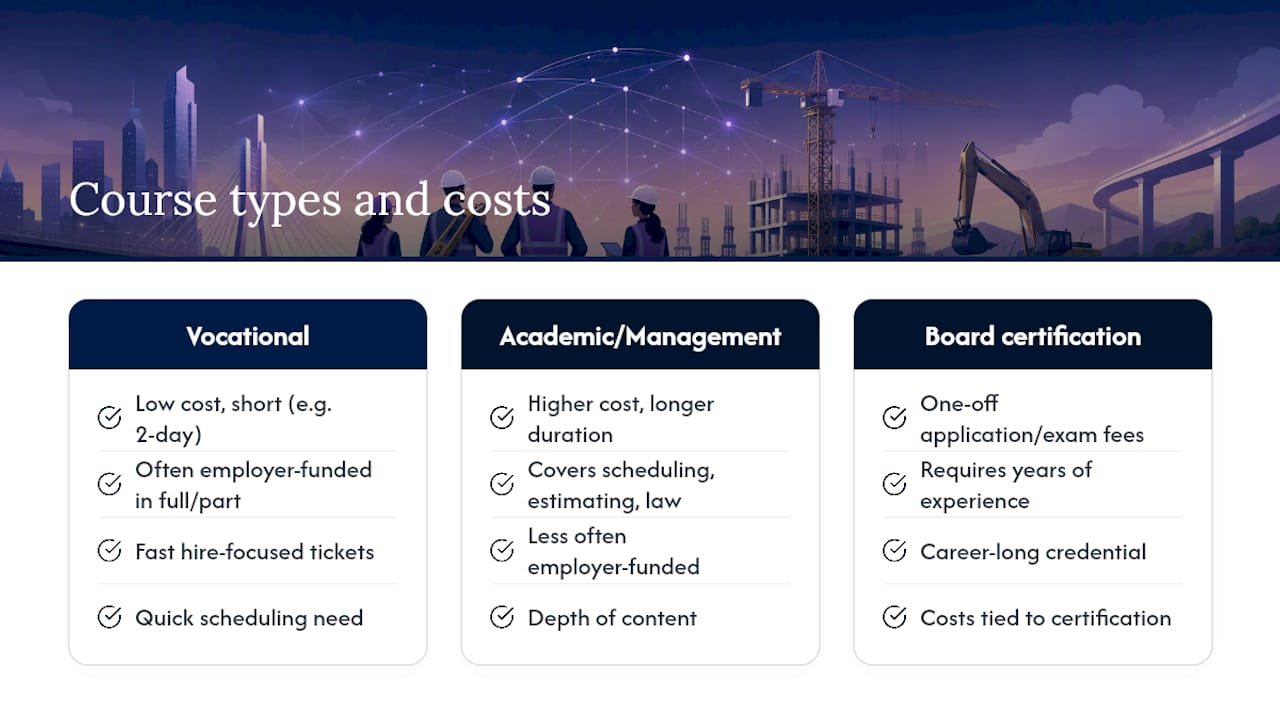
Costs vary enormously by course type, and that variation is the point: a two-day safety ticket and a year-long graduate certificate are not competing for the same budget line. Short vocational courses tend to sit at the lower end and are frequently funded, in whole or part, by employers who need the ticket filled quickly. Management and academic certificates cost more and take longer, reflecting the depth of content in scheduling, estimating and contract law. Specialist board certification carries application and exam fees on top of the years of experience required, but it’s a one-off cost against a career-long credential.
Financial aid comes from several directions. Employers often sponsor training directly, particularly where a guaranteed-interview or partnership programme means the course was built with hiring in mind. Some colleges and training providers offer instalment plans rather than a single upfront fee. Professional bodies occasionally provide member discounts or grants toward certification exam fees. It’s also worth asking whether a course’s PDHs or CEUs are transferable across employers, since credit that survives a job change is effectively a funding benefit in itself.
The most overlooked funding route is simply asking. HR departments budgeting for team development are often working from a fixed annual training allowance and would rather spend it on a course you’ve already identified than leave it unspent. Bring a specific course, its cost, and its accreditation to that conversation rather than a vague request for “training.”
Which industry trends and technologies are courses covering now?
Course content has shifted noticeably toward digital tools and data-driven site management over the past few years, and the training providers slow to update their syllabus are the ones losing enrolments. BIM has moved from a niche module to a standard component of most management certificates, reflecting how thoroughly it’s embedded in contract documentation and coordination on live projects.
Simulation and visualisation tools are appearing more in both vocational and management courses, letting learners rehearse plant operation or sequencing decisions before facing the real cost of a mistake on-site. Digital project controls, covering everything from earned value tracking to automated scheduling software, now sit alongside the traditional CPM and estimating content in most graduate-level programmes.
Sustainability and low-carbon construction methods are also working their way into curricula, driven by regulatory pressure on materials sourcing and energy use across major infrastructure projects. Safety training has absorbed more technology too, with some providers introducing virtual walkthroughs of hazardous environments as a supplement, not a replacement, for supervised site assessment.
None of this replaces the fundamentals. A course that’s added a BIM module but dropped hands-on plant assessment has traded relevance for novelty. The strongest programmes layer new technology onto proven practical assessment rather than swapping one for the other.
How do continuing education and certification renewal work?
Certification isn’t a one-time event for most credentials that matter. Board certification through ASCE’s CEC programme requires annual recertification, maintained through ongoing PDHs, which means the learning doesn’t stop once the initial application is approved.
ASCE supports this directly, offering eLearning and PDH resources specifically aimed at candidates preparing for a specialty credential and those maintaining one already held. Vocational tickets tend to work differently, often expiring on a fixed cycle and requiring a refresher course rather than ongoing PDHs, particularly for safety-critical competencies where practices change quickly.
The practical habit worth building is logging every PDH or CEU as you earn it, rather than scrambling to reconstruct a training history when a renewal deadline appears. Keep records of course dates, providers and credit hours in one place. If you’re on a specialist pathway, this same record becomes evidence for a future board certification application, so the discipline pays twice.
What are some well-regarded construction training courses?
A few course types come up repeatedly as strong choices across the vocational, management and specialist tiers, and knowing what each one is actually good for helps you avoid picking on reputation alone.
At the vocational end, National Progression Award style courses in construction operations, delivered through partnerships with bodies like CECA, combine site skills training with direct employer engagement. Graduates from these programmes have seen employment rates reported as high as 75%, with guaranteed interviews built into some course structures. That’s a meaningfully strong outcome for a short, practical programme.
For management-level training, graduate certificates covering CPM scheduling, estimating, contract administration and BIM, stackable toward a master’s degree, are popular precisely because the credit isn’t wasted if career plans shift toward further study.
At the specialist tier, ASCE’s Civil Infrastructure Construction certificate stands out for its structure: five courses, 2.6 CEUs and 26 PDHs, completed within a year and targeted squarely at the unit-price heavy civil skills that a standard engineering degree rarely covers in depth. Oxford Center’s own project management and construction-related course pathways sit alongside these as an accredited, employer-customisable option for professionals who want flexibility in how and where they study.
How do simulation and practical training methods work?
The best practical training doesn’t choose between simulation and real site work. It uses simulation to prepare learners for the site work, then verifies competence with the real thing.
Plant operation modules increasingly use simulators before a learner touches actual machinery, cutting the risk and cost of early mistakes while still requiring supervised, hands-on assessment before sign-off. Safety training has adopted virtual walkthroughs of hazardous scenarios, letting learners rehearse hazard recognition repeatedly without the logistics of staging a real dangerous environment each time.

Assessment evidence still comes down to the same core methods regardless of how much simulation precedes it: logbooks tracking hours and tasks, portfolios of completed work, observed practical assessments by a qualified assessor, and employer sign-off confirming workplace competence. Simulation speeds up the preparation phase; it doesn’t replace the verification phase.
Blended courses tend to sequence this well: theory and simulation delivered online or in a classroom, followed by a concentrated block of on-site assessment days. That structure respects both the learner’s time and the reality that some skills simply cannot be certified without watching someone do the job.
Why tailored, expert-led training closes the university-to-field gap
Some courses are built across project management, civil engineering and related disciplines with globally accredited, customisable modules delivered on-site, online or blended. Expert-led, tailored content may address the gap between classroom theory and field demands, and organisations that invest in such training often see gains in competency and morale. If your team’s skills gap is specific, request a training needs assessment rather than guessing at a generic course.
— Sam
How Oxford Center can support your next certification step
There are training providers offering accredited outcomes similar to those described above, with course content that can be customised around an organisation’s actual gaps, whether for a crew needing a specific safety competency or a project team moving into scheduling and contract administration, delivered on-site, online or blended depending on the skill.
That flexibility matters most when a training department is juggling different roles at different career stages within the same budget cycle. Rather than sourcing three separate providers for a site crew, a supervisor cohort and a project controls specialist, one accredited provider covering all three formats simplifies both the procurement and the record keeping for renewal purposes. Visit the project management and construction course page to see current modules, or get in touch through Oxford Center to request a tailored proposal for your team.
FAQ
What Are Civil Engineering Courses?
Civil engineering courses range from short vocational tickets covering site skills and plant operation, through management certificates in scheduling and contracts, to post-licence specialist board certification. Which one applies to you depends on your current role and where you want your career to go next.
How Long Does It Take to Get Board Certified?
ASCE’s CEC baseline requires 10 to 15 years of progressively responsible experience after your degree, depending on education level, with a portion of that time specifically in your chosen specialty. It’s a career-stage credential, not a quick course.
Can I Complete Construction Training Online?
Theory-heavy content, such as scheduling, estimating and contract administration, transfers well to online delivery. Practical skills, including plant operation and safety-critical competencies, still require supervised on-site assessment, which is why blended formats are common for these courses.
Do Employer-Partnered Vocational Courses Really Guarantee Interviews?
Some do. Programmes built with industry partners have reported employment rates as high as 75% for successful graduates, with guaranteed interviews built into the course structure. Always confirm the specific terms with the provider before enrolling.
Does Oxford Center Offer Certification Courses for Construction Professionals?
Oxford Center provides accredited, customisable training across project management and civil engineering, delivered on-site, online or blended to suit different roles and career stages. Course details and current pricing are available on the project management course page.