
Meeting CPD for nurses means hitting a minimum hours target over a set cycle, with a chunk of that time spent on participatory learning, and then doing three things: plan your learning around your scope of practice, complete the activities, and record evidence with a short reflection. The Nursing and Midwifery Council sets 35 hours over three years with at least 20 participatory, but rules differ by regulator, so check your own board’s current standard before you rely on any figure here.
TL;DR:
- Verify your specific minimum hours and participatory learning requirements, as these vary by country and registration type, before planning your CPD activities.
- Focus on documenting activity details, including dates, hours, learning outcomes, and reflective notes, to prepare for potential audits effectively.
- Prioritize participatory learning involving active engagement, such as workshops or webinars with evidence of interaction, to meet regulator standards.
- Book interactive sessions early in your cycle to avoid last-minute scheduling issues that can hinder completion of required hours.
- Choose accredited or regulator-recognized courses, especially for specialist or advanced practice, to ensure your CPD records are audit-ready.
Table of Contents
- A quick checklist to audit your CPD today
- What major regulators actually require
- A practical framework to plan CPD that improves practice
- Exactly what counts as participatory learning
- How to build an audit-ready CPD portfolio
- Practical places to earn accredited or free CPD hours
- Why accredited, customisable training matters for revalidation
- Explore accredited CPD options with Oxford Centre
- FAQ
- Sources
A quick checklist to audit your CPD today
Before you add another course to your list, check where you actually stand. Most regulators want to see planned, varied, well-evidenced learning rather than a last-minute scramble before renewal.
- Confirm your own minimum hours and participatory hours requirement with your regulator, since these figures vary by country and by registration type.
- List activities already completed this cycle and sort them into participatory (interactive, with evidence of engagement) and non-participatory (reading, private study).
- For each activity, capture the date, hours, method, learning outcome and an evidence reference such as a certificate or facilitator confirmation.
- Check your regulator’s retention period for CPD records, often three to five years, and store files somewhere you can retrieve them quickly if audited.
If any gaps show up here, they are far easier to fix mid-cycle than in the final month before renewal.
What major regulators actually require
CPD rules share a common shape (hours, participation, evidence) but the detail varies enough that copying a colleague’s approach from a different country is risky. In the UK, the NMC requires 35 hours of CPD within the three-year revalidation period, with at least 20 of those hours as participatory learning. Those hours feed directly into the revalidation portfolio, where you log method, dates, hours, reflection and supporting evidence for each entry.
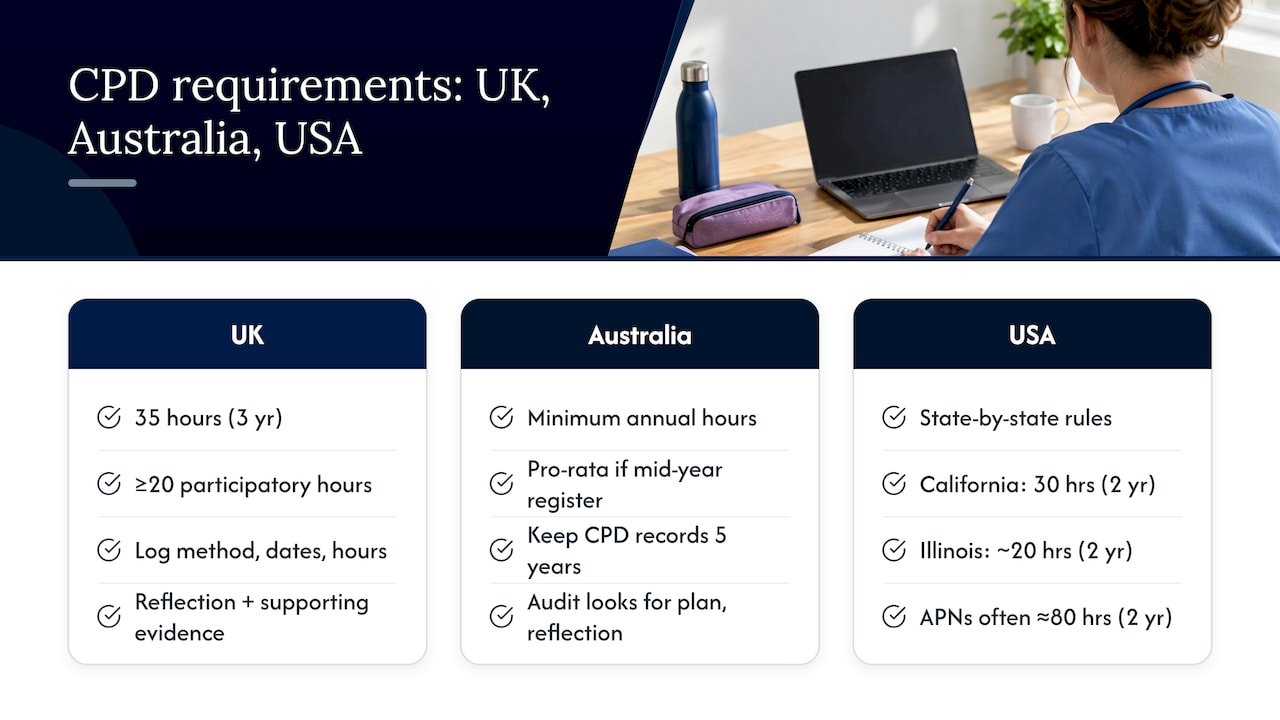
In Australia, the Nursing and Midwifery Board of Australia sets minimum annual CPD hours, with pro-rata adjustments for nurses registered partway through a year, and recommends keeping CPD records for five years. The NMBA’s guidance also sets out what an audit expects to see: planning evidence, participation records and a reflective note tying the learning to practice, since a certificate alone is often treated as insufficient.
US requirements are set state by state rather than nationally. In California, registered nurses must complete 30 contact hours of continuing education every two years, with contact-hour definitions and approved providers specified by the state board. Illinois takes a different structure again: many RNs and LPNs complete 20 hours over a two-year cycle, while advanced practice registered nurses face a substantially higher bar, often 80 hours over two years with a minimum number of pharmacotherapeutics hours built in. Massachusetts, like most states, sets its own separate figure and cycle length. The common thread across every jurisdiction is that advanced practice and specialist nurses generally carry heavier, more specific CPD obligations than general registration holders, particularly around pharmacology and diagnostics, so check the requirement tied to your exact registration type rather than a general nursing figure.
A practical framework to plan CPD that improves practice
Good CPD planning starts before you book a single course. It starts with an honest look at where your practice has gaps.
- Reflect against the Code or your competency framework to identify two or three real learning needs, not just convenient ones.
- Set measurable goals tied to your actual scope of practice, then spread activities across the full cycle instead of clustering them near renewal.
- Mix participatory learning (workshops, case discussions, supervised sessions) with self-directed study, and prioritise assessed courses when your specialty demands documented evidence of competence.
- Record the planned activity, the date, the outcome and a short reflective statement as soon as each item is complete, rather than reconstructing it months later.
Pro Tip: Book your participatory hours early in the cycle. Interactive sessions fill up and reschedule more often than self-directed reading, so leaving them for the final months is the most common cause of a late scramble.
Exactly what counts as participatory learning
Participatory learning means genuine interaction with others around a learning topic, not passive consumption. Workshops, facilitated case discussions, structured clinical supervision sessions and interactive webinars all count, provided you can show real engagement rather than a login record.
Virtual formats are explicitly accepted by regulators including the NMC, where online discussions and webinars with evidenced interaction satisfy the participatory requirement. The deciding factor is interaction, not physical presence, so Q&A sessions, breakout group work and recorded engagement in a virtual session all qualify.
- Keep attendance confirmation or a certificate naming the session and date.
- Ask for facilitator confirmation where the platform offers it, especially for smaller interactive groups.
- Write a short reflective note linking what you discussed to a specific part of your own practice.
How to build an audit-ready CPD portfolio
An audit rarely fails nurses on hours. It fails them on evidence that cannot show how the learning connected to practice.
- Record the activity title, date, hours split between participatory and non-participatory, the learning outcome, the relevant part of the Code or standards, and an evidence reference for each entry.
- Write a short reflective account for each significant activity, covering what you learned, why it matters to your practice, what you changed as a result, and how you can evidence that change.
- Store records securely for your regulator’s required retention period, commonly three to five years, and keep a backup copy separate from your workplace system.
Pro Tip: A certificate without a reflective note is the single most common reason CPD evidence gets queried at audit; always pair the two.
Practical places to earn accredited or free CPD hours
Finding CPD that actually counts matters as much as finding CPD that is convenient. Start with sources your regulator explicitly recognises.
- Professional bodies and regulator-accredited providers are the safest starting point, since their accreditation status is usually stated clearly on the course page.
- On-demand webinars and employer-provided courses can count, but check the stated learning objectives, the level of interaction, and whether you receive a certificate with facilitator details attached.
- Free CPD is widely available through professional associations and some employer portals, though informal training without clear learning outcomes or evidence may not satisfy an audit.
- University CPD and assessed modules suit specialist or advanced practice needs where your regulator expects documented, assessed competence rather than attendance alone.
If you are preparing for a specialist certification alongside routine CPD, a targeted learning approach built around your actual exam or practice gaps tends to use study time far more efficiently than generic revision.
Why accredited, customisable training matters for revalidation
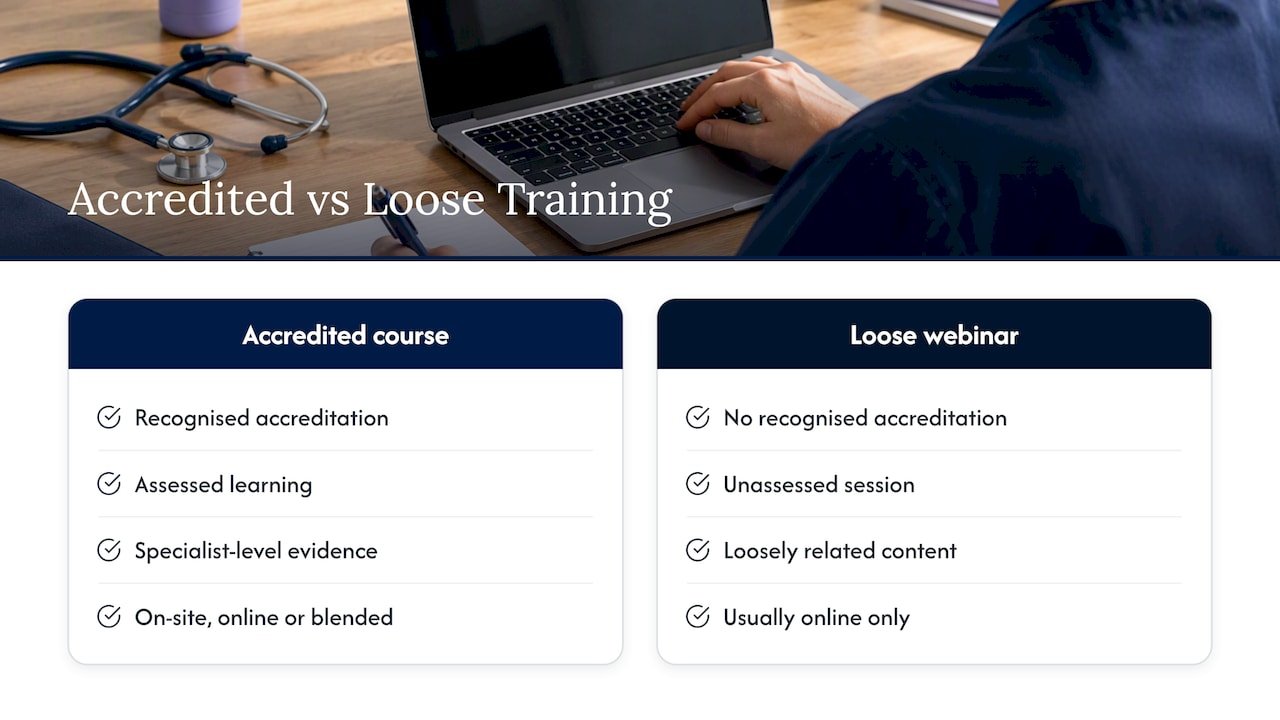
Not every course that claims CPD value will hold up under audit. We built our catalogue around accreditation that regulators recognise, because a certificate only helps you if it stands up to scrutiny. Our courses span professional training across sectors, including healthcare, and we deliver them on-site, online or blended so you can fit assessed learning around shift patterns rather than the other way around. For nurses who need documented, specialist-level evidence rather than a loosely related webinar, that structure tends to make the difference between a record that passes audit and one that invites questions.
Explore accredited CPD options with Oxford Centre
If you want CPD that is both regulator-ready and genuinely useful to your practice, customizable, accredited courses cover healthcare alongside management and leadership topics that suit nurses moving into senior or specialist roles. Courses are delivered on-site, online or blended, so individuals and whole departments can book learning that fits their cycle rather than disrupting it.

Browse our course catalogue or visit our training centre page to check course availability and enquire about dates that suit your revalidation timeline.
FAQ
How do I earn CPD points for nursing?
You earn CPD hours by completing a mix of participatory activities, such as workshops or interactive webinars, and self-directed study, then recording the date, hours, method and outcome for each one. The NMC requires at least 20 of your 35 total hours to be participatory within the three-year cycle, though other regulators set different figures.
How many hours of CPD do nurses need to complete?
The figure depends entirely on your regulator and registration type. UK nurses need 35 hours over three years under the NMC, while California requires 30 contact hours every two years, so always confirm the exact figure with your own board.
Where can nurses find free CPD hours?
Professional associations and some employer-provided portals offer free webinars and courses that count towards CPD, provided they have clear learning outcomes and a certificate you can evidence. Check that the provider states its accreditation or endorsement status before relying on the activity for revalidation.
What are the five principles of CPD?
Definitions vary by regulator, but a common version centres on identifying learning needs, planning activities around those needs, carrying out the learning, reflecting on what changed in practice, and recording evidence that an audit can verify. The ICN frames this cycle as an ethical professional obligation rather than a paperwork exercise.
Do virtual courses count towards participatory CPD hours?
Yes, provided you can evidence genuine interaction such as live Q&A, breakout discussion or facilitator confirmation. Regulators including the NMC accept virtual participatory learning where engagement is demonstrable rather than passive viewing.