
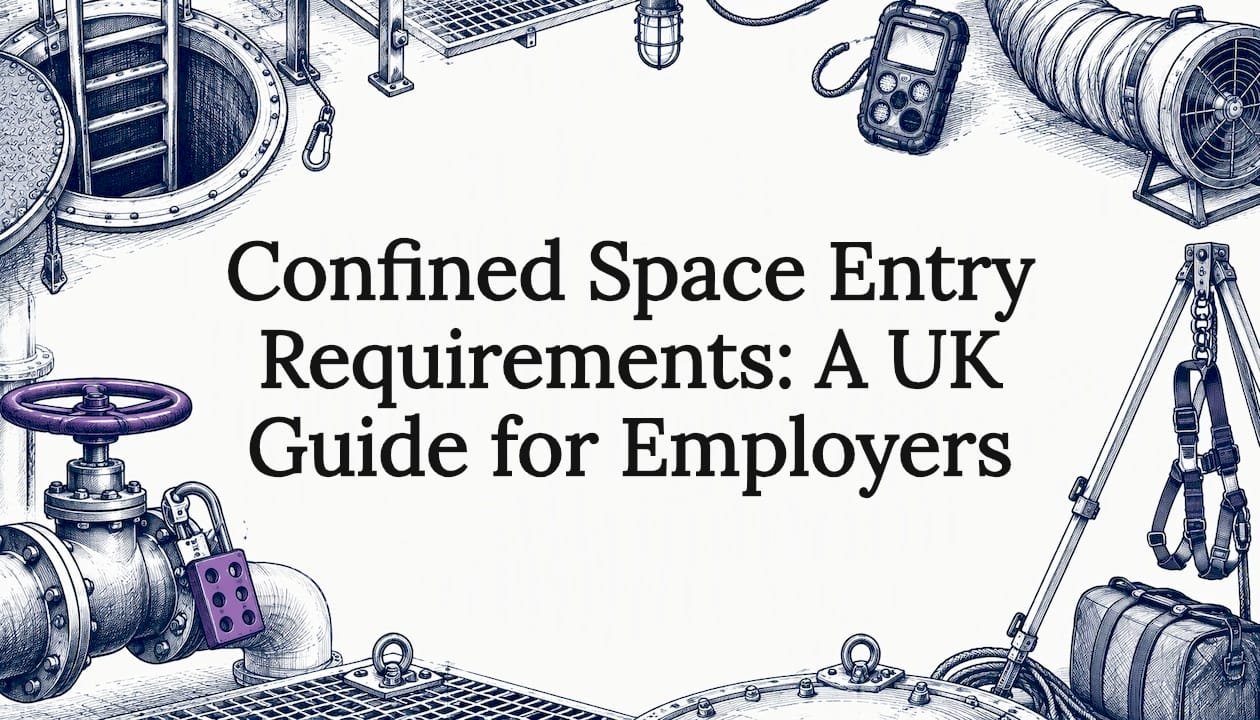
In Great Britain, the rule is simple to state. Do not enter a confined space if the work can be done from outside. If entry cannot be avoided, assess the risks, set up a safe system of work, and put emergency and rescue arrangements in place before anyone goes in. The Health and Safety Executive (HSE) sets out this approach under the Confined Spaces Regulations 1997. This guide turns it into a working checklist for employers, supervisors and the people who go in.
TL;DR
- A confined space is defined by enclosure plus a reasonably foreseeable specified risk, not by size alone.
- Avoid entry where you can. Where you cannot, you need a risk assessment, a safe system of work and rescue arrangements agreed in advance.
- A permit to work is the usual way of formalising the checks. It is a control, not a substitute for a competent person.
- Everyone involved, from entrants to attendants to rescuers, needs training that matches the actual task and place.
- Rescue must be planned before entry and must not depend on calling 999 once something goes wrong.
Table of Contents
- What counts as a confined space in the UK
- The legal duties in plain terms
- Step one: the risk assessment
- Step two: isolation, ventilation and atmospheric testing
- Step three: the permit to work
- Step four: roles and supervision
- Step five: emergency and rescue arrangements
- Training and competence
- A practical pre-entry checklist
- Common mistakes
- Building competence across your organisation
- FAQ
- Sources
What counts as a confined space in the UK
A confined space is not simply a small space. Under the Confined Spaces Regulations 1997 it is a place that is substantially enclosed, though not always entirely, and where there is a reasonably foreseeable risk of serious injury from hazardous substances or conditions within the space or nearby. Those hazards are called “specified risks”. HSE’s introduction to working in confined spaces is the starting point for the legal framework.
The specified risks include:
- fire or explosion
- loss of consciousness from gas, fume, vapour or a rise in body temperature
- drowning from a rise in liquid level
- asphyxiation from a free-flowing solid, or being trapped by one
- lack of oxygen
So a large tank with a toxic atmosphere is a confined space, while a small, well-ventilated cupboard with no foreseeable specified risk is not. Typical examples are storage tanks, silos, vats, sewers, manholes, culverts, trenches, ductwork and some ceiling or floor voids. A space can also become confined because of the work: welding or painting in a poorly ventilated room can create the atmosphere that makes it so.
The legal test therefore needs a judgement, and the judgement belongs in your risk assessment. If you are not sure, treat the space as confined until a competent person has decided otherwise.
How other countries define it
You will see different wording if you work internationally. In the United States, OSHA describes a confined space as one large enough for a worker to enter, with limited or restricted entry or exit, and not designed for continuous occupancy. A permit-required confined space is one with one or more of the serious hazards OSHA lists. Canadian definitions vary by jurisdiction. The British test is built around specified risks rather than a separate “permit-required” category, so do not assume a US or Canadian checklist maps cleanly onto a British site.
The legal duties in plain terms
The framework has three layers, and the order matters.
- Avoid entry. Ask whether the job can be done from outside, for example by using remote cameras, long-handled tools or equipment that can be cleaned or inspected without a person inside. HSE’s guidance puts this first. Safe Work Australia’s model code makes the same point, saying the need to enter should be eliminated so far as reasonably practicable (Safe Work Australia, 2024).
- Follow a safe system of work. If entry cannot be avoided, the work needs a risk assessment and a system of work that controls the hazards found.
- Have emergency arrangements in place. These must exist before anyone enters, and they must be workable in the space in question.
The duty sits with the employer, but contractors, clients and the person in charge on the day all share practical responsibility. If you hire a contractor to clean a tank on your site, you still need to share what you know about its previous contents, its connections to other pipework and its access points.
Step one: the risk assessment
The risk assessment is the document everything else hangs from. Write it for the specific space and the specific task, not for “tanks in general”. Safe Work Australia’s code lists the hazards a good assessment should cover: atmospheric contaminants, unsafe oxygen levels, engulfment, temperature, manual handling, and electrical and mechanical hazards (model code of practice). That list translates well to British workplaces.
A workable assessment answers these questions:
- What was last in the space, and what could remain: residues, sludge, rust that consumes oxygen, or gas released when deposits are disturbed?
- What could flow in from outside: liquids, gases, steam, or solids from a connected line or hopper?
- What will the work itself introduce: hot work, solvents, petrol-driven equipment, cleaning chemicals?
- How will people get in and out, and how quickly could an unconscious person be removed?
- How will people inside communicate with someone outside?
- Who is fit to work in the space, considering size, health and training?
The output is a short list of controls: isolation, cleaning, ventilation, gas testing, equipment choice, limits on the number of entrants, time limits, and the rescue method.
Step two: isolation, ventilation and atmospheric testing
Controls follow the hierarchy: remove the hazard first, then control it, then protect people from what remains.
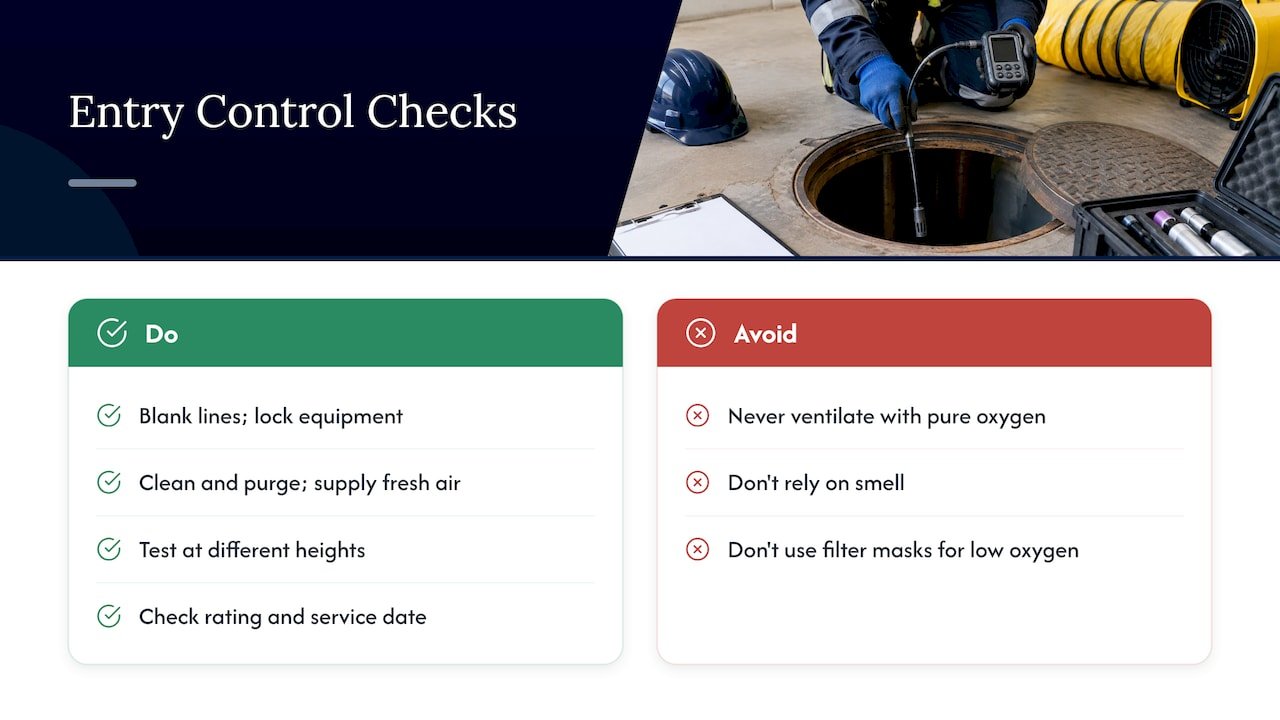
Isolation. Disconnect or blank off pipes, lines and feeds so nothing can enter. Lock off mechanical and electrical equipment, including agitators and conveyors. A valve closed is not the same as a line blanked.
Cleaning and purging. Empty and clean the space where practicable before entry, since residues are a common source of toxic gas.
Ventilation. Fresh air should be supplied, by natural ventilation where it can be shown to work or by mechanical means. Safe Work Australia’s code lists forced ventilation alongside atmospheric testing and supervision by an attendant at the entrance as core procedural controls. Never ventilate with pure oxygen, which creates a fire risk.
Gas testing. Test before entry and keep monitoring during the work where conditions can change. Typical checks cover oxygen, flammable gases and specific toxic gases such as hydrogen sulphide or carbon monoxide, depending on the assessment. Use a calibrated instrument, test at different heights in the space as gases layer differently, and make sure the person testing is trained to read the results. Do not rely on smell.
Equipment. Choose equipment suited to the atmosphere. If flammable gas or vapour could be present, electrical and other tools need to be rated for it. Check that equipment is fit for purpose and within its service date before use, as one of the pages ranking for this topic helpfully reminds teams.
Respiratory protection. Where the atmosphere cannot be made safe, breathing apparatus is a controlled, trained procedure. A filter mask does not protect against a lack of oxygen.
Step three: the permit to work
Many people searching for permit requirements want to know whether a permit is legally compulsory. Under the 1997 Regulations the legal requirement is a safe system of work, and a permit to work is one of the standard ways to deliver it. HSE guidance expects a permit where the risks are high enough that a formal check is needed, so most higher-risk entries in industry use one.
What a permit does is formalise the checks. Safe Work Australia describes an entry permit as a formal check that a safe system of work is in place, including the control measures from the risk assessment, before anyone goes in. In Australia a worker must not be directed to enter without one. Hong Kong’s code requires a competent person to prepare a risk assessment report, and the responsible proprietor or contractor must issue a permit-to-work certificate before entry (Labour Department). Germany’s DGUV Rule 113-004 requires a written permit issued by the employer or a delegate, specifying the protective measures based on the risk assessment (DGUV). Those are other countries’ rules, but the shape of a good permit is consistent.
A useful permit records:
- the location and description of the space, and the task
- the hazards identified and the controls applied
- isolation and lock-off confirmation
- gas test results, with who tested, when and with what instrument
- the names of authorised entrants and the attendant
- the communication method and the emergency and rescue arrangements
- start and expiry times, and a sign-off when the work is done
- the signature of the person authorising entry, and arrangements for handover if the job spans shifts
Two practices keep permits honest. First, the person who authorises entry should be someone who has actually looked at the space and the controls, not someone signing a stack of forms in an office. Second, the permit should be cancelled and the space returned to a safe state when work stops, so no one wanders in later on an expired permit. DGUV makes the point that a thoroughly completed permit effectively acts as the risk assessment for that task at that moment, which is a good reason to fill it in properly rather than tick boxes.
Step four: roles and supervision
A typical entry has at least three roles, and one person should never cover them all.
- Authoriser or supervisor: checks that controls are in place and signs the permit.
- Entrants: the people who go in. They know the hazards, the signals and the exit route.
- Attendant (top person): stays at or near the opening, keeps count of who is inside, maintains communication and raises the alarm. The ILO’s training material says entrants should be monitored by a fully trained attendant stationed at or near the opening (ILO).
The attendant must never enter to attempt a rescue. That is the most common way a single casualty becomes several. The attendant’s job is to raise the alarm and start the prepared rescue plan.
Step five: emergency and rescue arrangements
Rescue planning is where many sites fall down. The arrangements must be in place before entry and be suited to the space: a vertical tank with a small manhole needs a different plan from a long, horizontal culvert. Safe Work Australia’s code says emergency arrangements should include a communication system for those inside and a rescue plan that does not rely on external emergency services. Rescuers must be trained, equipped and readily available, and drills should be practised to confirm the procedures work.
What a sound rescue plan covers:
- Method: non-entry rescue (a tripod, winch and harness that retrieve a casualty without anyone entering) wherever the space allows it, with entry rescue by trained, equipped teams as the fallback.
- Equipment: breathing apparatus, harnesses, lifelines, stretchers suited to narrow access, resuscitation equipment, and a means of calling for help that works in the space.
- People: named rescuers who are trained, fit and on site while the work goes on, with first aid and CPR skills.
- Practice: scheduled drills. In the United States, OSHA requires employers to designate and evaluate rescue services and to run simulated rescues at least every 12 months (OSHA 1910.146). British law does not set that exact interval, but a yearly drill is a sensible benchmark.
If your organisation also plans for wider emergencies, such as a casualty needing paramedics at a remote site, it helps to connect the confined space plan with your broader emergency response planning. Agree in advance how an ambulance will be called, who meets it, and how crews are directed to the access point.
Training and competence
The regulations expect everyone involved to be competent for the task. There is no single national confined space certificate required by law in Great Britain, but employers must make sure people have the knowledge and skills for their role, and many clients and sites require evidence of recognised training before they let anyone near a tank.
Training should be proportionate to the role:
| Role | What they need to understand |
|---|---|
| Entrants | Hazard recognition, the permit, communication signals, personal gas monitors, escape routes, emergency procedure |
| Attendants | Head counts, communication, never entering, raising the alarm, starting the rescue plan |
| Supervisors and authorisers | Risk assessment, isolation, gas test interpretation, permit issue and cancellation |
| Rescue personnel | Rescue equipment, breathing apparatus where needed, casualty handling, first aid and CPR |
OSHA’s standard sets a useful benchmark on content: employers must give training so that employees acquire the understanding, knowledge and skills needed for their duties, before first assignment and whenever duties change (1910.146). The principle carries over: training is specific to the place and the work, repeated when things change, and refreshed periodically, particularly for rescuers.
Keep records of who was trained, when and on what, and review them when the space, the equipment or the process changes.
A practical pre-entry checklist
Use this as a prompt, not a replacement for your own assessment.
- Can the job be done without entering? If yes, stop here.
- Has a competent person completed a task-specific risk assessment?
- Is the space isolated, drained, cleaned and locked off?
- Has the atmosphere been tested with a calibrated meter, and is it being monitored?
- Is ventilation running and has it been shown to work?
- Is the permit complete, signed and displayed at the entrance?
- Are entrants, attendant and supervisor named, trained and fit for the task?
- Is communication tested between inside and outside?
- Is the rescue equipment at the entrance and the rescue team on site?
- Has everyone been briefed on the alarm and the evacuation signal?
If any answer is “no”, the entry waits.
Common mistakes
- Treating the permit as paperwork. A permit signed without a site check gives false confidence.
- Relying on the emergency services as the rescue plan. The fire and rescue service may be minutes away, and brain damage from lack of oxygen happens in that time.
- Testing once, then forgetting. Conditions change as work disturbs residues or hot work begins.
- Rescue by untrained colleagues. The instinct to dive in is natural and often fatal.
- Ignoring “ordinary” spaces. Trenches, ceiling voids and poorly ventilated rooms with solvents can meet the definition.
- No handover. Shift changes break the chain of information, so brief the incoming team in full.
Our perspective
We see the same pattern across the sectors we train: oil and gas, civil engineering, healthcare estates and facilities teams. The sites with the fewest near-misses are rarely the ones with the thickest procedures. They are the ones where every person in the chain, from the contractor’s operative to the manager who signs the permit, can explain why each control is there.
That is why we favour training built around your own spaces and your own permit system rather than a generic slide deck. A course delivered on site, online or in a blended format can use your real tanks, your real forms and your real rescue equipment, so what people learn is what they will do on the day.
Entry requirements work best as part of a wider safety management system. If your confined space procedures sit alongside a clear approach to hazard control, auditing and continual improvement, they are far more likely to hold up under pressure.
Sam
Building competence across your organisation
Confined space rules are one piece of a bigger health and safety picture. Oxfordcentre offers professional training with global accreditation that can be customised for corporate teams and delivered on site, online or blended. Two courses on our site are relevant if you are building the system around your entry procedures: Occupational Safety and Health Management Systems and ISO 45001 Occupational Health and Safety. To discuss a programme tailored to your teams, start from the Oxfordcentre home page.

FAQ
Is a permit to work legally required for confined space entry in the UK?
The Confined Spaces Regulations 1997 require a safe system of work rather than naming a permit by default. For higher-risk entries, a permit to work is the standard way to show that isolation, testing, supervision and rescue arrangements are checked before entry. Most industrial sites and clients require one.
What is classed as a confined space in the UK?
It is a place that is substantially enclosed and where there is a reasonably foreseeable risk of serious injury from specified risks such as toxic gas, lack of oxygen, fire, flooding or engulfment. Size alone does not decide it. Tanks, silos, sewers, manholes and some trenches commonly qualify.
Do confined space workers need a certificate?
No single certificate is demanded by law in Great Britain, but everyone involved must be competent for their role. In practice, employers and site operators usually ask for recognised training for entrants, attendants, supervisors and rescue personnel, matched to the specific space and task.
Can the fire service be my rescue plan?
No. Emergency arrangements should be in place before entry and should not rely solely on external emergency services. Plan for trained rescuers and suitable equipment on site, and use the emergency services as support alongside that plan.
Sources
- HSE: Introduction to working in confined spaces
- OSHA elaws: Confined Spaces Advisor, definitions
- Safe Work Australia: Confined spaces model code of practice, November 2024
- Hong Kong Labour Department: Code of Practice for Safety and Health at Work in Confined Spaces
- DGUV Rule 113-004: Vessels, silos and confined spaces
- OSHA 1910.146: Permit-required confined spaces
- ILO training programmes: confined spaces
- EMS response planning guide