
The right change management certification depends on where you are in your career, not on which badge is best known. A project lead who needs usable tools next month needs something different from an established change manager who wants to prove a track record. Below we set out the main routes, what each one asks of you, and how HR teams can decide for a group rather than a single person.
TL;DR
- There are three broad types of certification: a short, methodology-led course, a two-level Foundation and Practitioner qualification, and an experience-based professional credential.
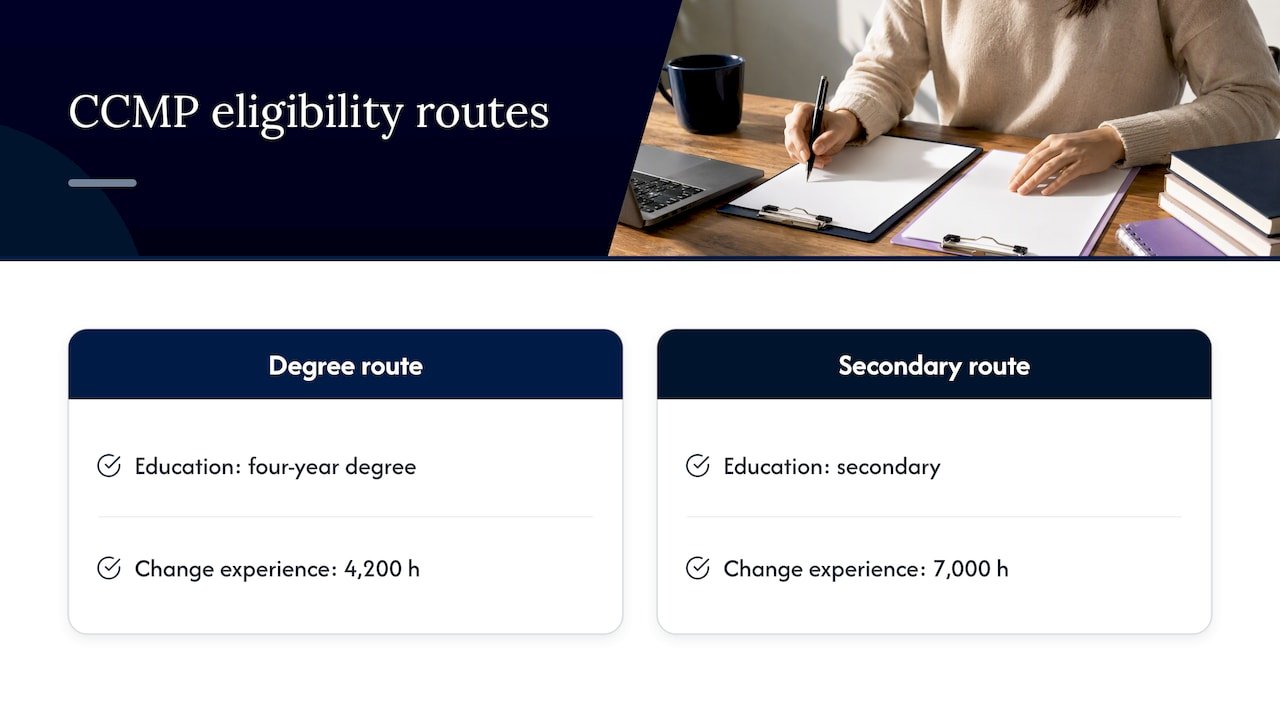
- The CCMP is aimed at experienced practitioners. Its eligibility rules ask for a degree plus 4,200 hours of change experience, or secondary education plus 7,000 hours.
- Most programmes are workshop-heavy. You will work on a live project or document your own history, so prepare before you book.
- For teams, certifying several people gives them a common language, which cuts friction during rollouts.
- Match the credential to your current role: tools now, or formal validation of what you have already done.
Table of Contents
- What a change management certification actually proves
- The three types of change management certification
- Is the CCMP worth it?
- Which certification is best for your role?
- What the courses really demand of you
- Why teams should certify together
- The “5 Cs” of change management
- What qualifications do you need to be a change manager?
- Our perspective
- How Oxfordcentre can help
- A practical way to decide
- FAQ
- Sources
What a change management certification actually proves
A certification does not make you a change manager. It shows an employer that you know a recognised framework, can use its vocabulary and, in the stronger schemes, have applied it to real work.
That last point matters. Practitioners often say that the credential is only the first step. APMG’s own exam guidance is written for the third edition of its qualification, launched in April 2024, and it is a useful reminder that frameworks get revised. Soft skills such as handling stakeholder resistance and facilitating conflict tend to decide whether a change succeeds, and no exam fully tests them.
So treat the certificate as a structured way to learn and to be recognised, not as a finish line.
The three types of change management certification
It helps to sort the market by type before you compare individual names.
| Type | Typical entry barrier | Format | Best for |
|---|---|---|---|
| Methodology-led course | Usually none | Short intensive, around three days, applied to a real project | Project leads and teams who need practical tools quickly |
| Foundation and Practitioner qualification | Foundation first, then Practitioner | Modular, exam-based | People moving into change roles who want a staged route |
| Experience-based professional credential | Years of documented change work | Application, essays and an exam | Established change managers validating their standing |
The research behind this article describes the same split: one route is widely seen as a practical “toolbelt” for project teams, while the experience-based credential is designed for people who already have a proven record and want to validate their global standing (source).
Methodology-led courses
These are short and practical. You learn a structured approach, then apply it to a live initiative during the course itself. The attraction is immediacy: you leave with templates and a method you can use on Monday. The trade-off is that the credential says less about how long you have practised.
Foundation and Practitioner qualifications
The APMG Change Management certification is the best-known example of a two-level scheme in the UK. Foundation covers principles and terminology. Practitioner builds on it, and you need Foundation first. This staged approach suits people who are new to formal change work and want to build up, or organisations that want a consistent baseline across many staff.
Experience-based professional credentials
The CCMP is the main example. The Association of Change Management Professionals describes it as a credential for experienced practitioners of change, whatever your job title. There is no shortcut through a course: you apply, document your experience and sit an exam.
Is the CCMP worth it?
It is worth it if you already do change work and need to prove it. It is the wrong first step if you are new to the field, because you will not meet the eligibility threshold.
According to the association, eligibility means a four-year degree plus 4,200 hours of change management experience, or secondary education plus 7,000 hours (eligibility page). Other sources quote different hour counts, so check the current figure with the issuing body before you plan around it.
The application process is also more demanding than many candidates expect. You need to document your experience and write responses that line up with the association’s Standard for Change Management. Set aside time for this before you pay for anything.
For most people the value is professional standing. If your employer cares about alignment with a global standard, or you work as a consultant and need credibility with new clients, that is a real benefit. If you simply need to run a restructure next quarter, a faster route will serve you better.
Which certification is best for your role?
There is no single winner. Industry commentary stresses that the choice depends on your organisation’s culture and the work you do: technical, project-driven environments often prefer a structured, tool-heavy approach, while organisations that want to signal maturity tend to value experience-based validation.
Use these questions to narrow it down.
- How many hours of change work can you already evidence? Thousands of hours points to the professional credential. Few or none points to a course or a Foundation qualification.
- Do you need tools or recognition? Tools favour the practical methodology route. Recognition favours the experience-based credential.
- Is it for you or for a team? Teams usually benefit from one shared method, so a single course delivered to a whole group is often more efficient than separate qualifications.
- What do employers in your sector ask for in job adverts? Read ten adverts for the roles you want and count the names that come up.
- How much preparation time do you have? Live-project and application-based schemes need your own data and your own history.
If you are a project manager
Change management and project management overlap constantly. If you already hold or are studying for a project qualification, a practical methodology course adds the people side of delivery. Our project management courses are a natural companion if you are building both skill sets.
If you want to become a change manager
A staged qualification gives you a clear path and a recognised vocabulary. Add real projects as early as you can, even small ones, because the experience hours will count later if you aim for a professional credential.
If you are already an experienced change manager
Go for the credential that validates experience. A short course will teach you little you do not already do, and it will not carry the same weight with a sceptical hiring panel.
What the courses really demand of you
Many people assume certification means sitting through lectures and taking a test. It does not.
The methodology-led courses expect you to arrive with a real, active project to work on. The professional credential expects you to arrive with a documented career. The staged qualification expects revision and exam technique. In every case, preparation is yours to do.
Before you book, gather three things:
- A short description of a live or recent change initiative, including who was affected and what resisted.
- A rough log of your change-related hours and roles.
- Your employer’s agreement on time off and, where relevant, funding.
That last item is where individuals and HR teams most often stall, so raise it early.
Why teams should certify together
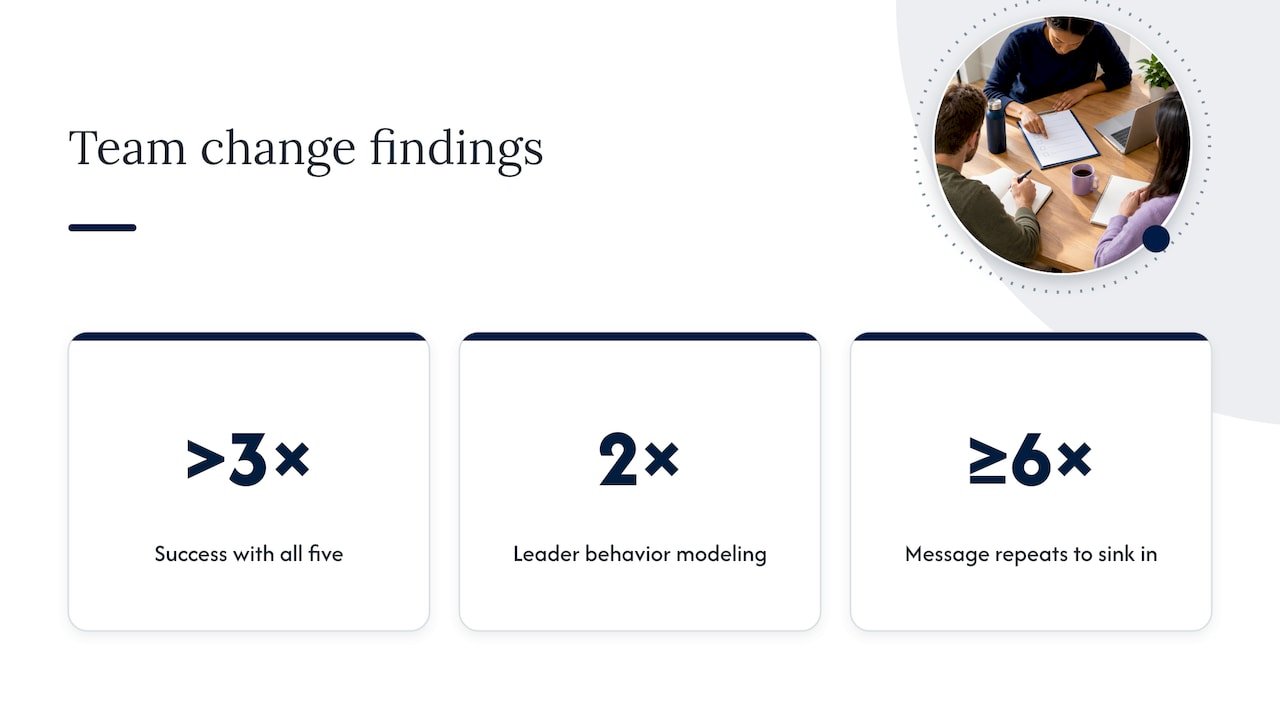
McKinsey’s study of government transformations found that the minority that succeed apply five disciplines: committed leadership, clear priorities, coordinated delivery, compelling communication and capability for change. Transformations applying all five were more than three times as likely to succeed. The same research notes that leaders of successful transformations were twice as likely to model the behaviours they expect from their teams.
For an HR manager, the practical lesson is that certification works best as a team investment. When several people share a method and a vocabulary, handovers are smoother and arguments about approach shrink. One certified person in a department of fifty is a useful resource. Ten certified people across functions are a shared way of working.
Communication deserves special attention. One change specialist argues that people often need to hear a message at least six times before it sinks in, and that resistance is rarely about the process and almost always about the impact on individuals. Good training builds that habit of repeating, listening and adapting.
Leadership behaviour is part of the same picture. If you are weighing how cohort-based training can build shared habits, a cohort-based leadership curriculum shows one way programmes structure leadership development over several stages.
The “5 Cs” of change management
People searching for certification often meet the “5 Cs” along the way. There is no single official list. One widely shared version is clarity, communication, collaboration, culture and commitment, as set out by a change consultancy. The McKinsey version above is different and focuses on delivery discipline.
Do not memorise one list and assume it is the answer in an exam. Check which framework your chosen qualification uses and learn that one.
What qualifications do you need to be a change manager?
There is no legal requirement. Employers usually look for demonstrated experience of leading people through change, plus a recognised qualification as supporting evidence. Many change roles sit inside project, HR or operations teams, so a background in any of those is a common route in.
If you come from a surveying or consulting path, change management can also appear as a competency in professional pathways. RICS’s management consultancy pathway guide lists change management among its optional competencies.
Our perspective
We train professionals and corporate teams across project management, healthcare, oil and gas, civil engineering, IT, leadership, compliance and safety, and one pattern repeats. Organisations ask for a certificate when what they need is a changed way of working.
A credential is easy to buy and hard to turn into results. The results come when the content is tied to the organisation’s own problems: its projects, its resistance points, its sign-off routes. That is why we put weight on customisable content, on expert trainers who have worked on real projects, and on delivery that fits the team, whether on-site, online or blended.
Our advice to HR managers is simple. Decide the behaviour you want to see six months after the course, then pick the certification and format that make it most likely. If several people need the same skill, train them together and use a live project as the case study.
Our advice to individuals is just as plain. Be honest about your experience. Choose the route that matches it today, and plan the next step for when you have the hours.
— Sam
How Oxfordcentre can help
If your change work sits inside a larger programme, our globally accredited training can support the project side of it. We deliver on-site, online or blended, and we can shape content around your organisation’s own challenges. Start with our project management courses, or browse the full course list and tell us what your team needs. Course prices are not published on these pages, so contact us for a quote.
A practical way to decide
Here is a short process you can run in an afternoon.
- Write down the single outcome you want: a promotion, a team method, or a validated credential.
- Count your documented change hours.
- Pick the type from the table above that matches both.
- Check the issuing body’s current requirements and fees on its own website, since these change.
- Agree time and budget with your manager or HR before you commit.
- Pick a live project to use as your case study.
If you cannot yet answer step 2, start with a staged qualification or a practical course and keep a log from today.
FAQ
Which certification is best for change management?
None is best for everyone. A practical methodology course suits project leads who need tools fast. A staged Foundation and Practitioner route suits people entering change roles, and the CCMP suits experienced practitioners who want formal validation.
Is the CCMP certification worth it?
It is worth it if you already have thousands of hours of change experience and need professional standing. The association requires either a degree plus 4,200 hours or secondary education plus 7,000 hours, so it is not an entry-level choice. Check the current rules on the eligibility page.
What are the 5 Cs of change management?
There is more than one version. A common consultancy list is clarity, communication, collaboration, culture and commitment. McKinsey’s government transformation research uses committed leadership, clear priorities, coordinated delivery, compelling communication and capability for change.
Do I need experience before getting certified?
It depends on the scheme. Some courses and Foundation qualifications have no formal prerequisites, while Practitioner level requires Foundation first and the CCMP requires documented experience.
Sources
- Eligibility: Who Can Apply? (ACMP)
- Apply and Prepare (ACMP)
- Change Management Exam Questions and Answer Guide (APMG International)
- Change Management Certification (APMG International)
- Elements of a successful government transformation (McKinsey)
- Navigating Change with Empathy and the Five C’s Framework (Adaptovate)
- Change Management Certification comparison (ClickUp)
- Prosci Certification guide (VerifyEd)
- Management Consultancy pathway guide (RICS)