
ISO 14001 and ISO 45001 are both management system standards, but they protect different things. ISO 14001 helps an organisation manage its effect on the environment. ISO 45001 helps it prevent injury and ill health among the people who work for it or on its sites. They share a structure, so most organisations that need both run them as one system.
This guide explains what each standard covers, where they differ, where they overlap in practice, and how to decide what to certify first. It is written for HR managers, health and safety leads, project managers and individual professionals who need to decide what to implement or train for.
TL;DR
- ISO 14001 is outward-facing: it manages how your operations affect the environment. ISO 45001 is inward-facing: it manages how your operations affect the health and safety of people.
- Both use the same High Level Structure, so clauses, terms and definitions line up and one integrated system can cover both.
- ISO 45001 demands more active worker participation than ISO 14001, which is the difference teams most often underestimate.
- Which comes first depends on your biggest exposure and on what customers, tenders or regulators ask for. Check the current edition of each standard before you plan.
- Training your internal team early usually matters more than the certificate itself.
Table of Contents
- What each standard is for
- The core difference: direction of impact
- Side-by-side comparison
- What they share
- Where the two overlap in real operations
- Where they genuinely differ
- How common are they?
- Which should you implement first?
- Certification: accredited or not
- A practical route to a combined system
- Our perspective
- Building the skills behind the standards
- FAQ
- Sources
What each standard is for
ISO 14001: environmental management
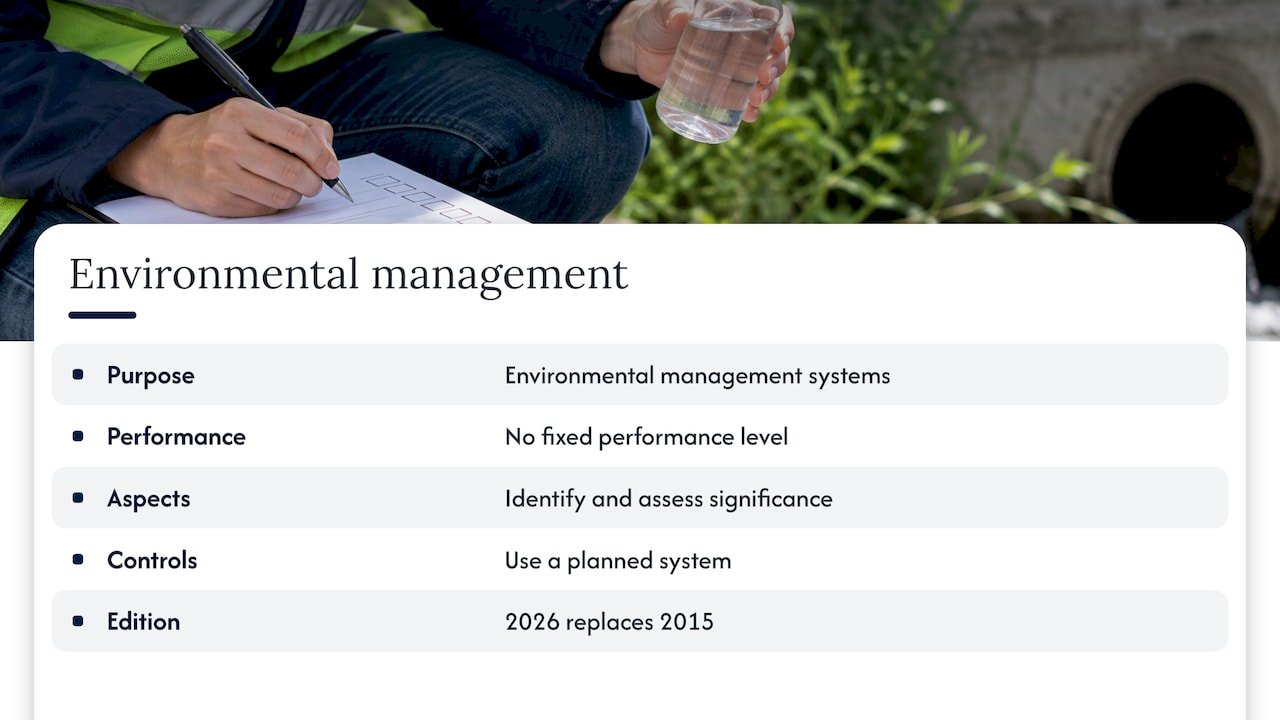
ISO 14001 is the international standard for environmental management systems. It helps an organisation manage its environmental impacts, meet its legal and other obligations, and improve over time. It does not set a fixed level of environmental performance. It asks you to identify your environmental aspects (for example emissions, waste, energy and water use, spills), decide which are significant, and control them through a planned system.
The standard has also moved on. According to ISO’s own page, ISO 14001:2026 is the current fourth edition, replacing ISO 14001:2015 with a clearer structure while keeping the same overall framework. If you are reading older comparisons that cite the 2015 version, treat the clause detail with caution and ask your certification body about transition arrangements for your existing certificate.
ISO 45001: occupational health and safety
ISO 45001:2018 is the international standard for occupational health and safety (OH&S) management systems. It helps organisations provide safe and healthy workplaces by preventing work-related injury and ill health, managing risks and continually improving performance. Where ISO 14001 looks at aspects and impacts, ISO 45001 looks at hazards and risks to people: workers, contractors and visitors.
A revision of ISO 45001 is under way. Until a new edition is published, the 2018 text (with any published amendments) is what auditors assess against, so confirm the current position with your certification body before you commit to a schedule.
The core difference: direction of impact
The simplest way to separate the two is the direction in which the risk travels. As one comparison of the two standards puts it, ISO 14001 centres on how an organisation affects the external environment, for example through pollution prevention, while ISO 45001 centres on preventing work-related injury and ill health through proactive risk management and workplace controls.
Think of a metal-finishing workshop:
- An environmental view asks what leaves the building: solvent vapour, contaminated wastewater, scrap, energy use.
- A health and safety view asks what happens to the person at the bench: exposure to fumes, manual handling, machine guarding, noise.
The same solvent appears in both analyses, but the questions, the controls and the evidence you keep are different.
Side-by-side comparison
| Criterion | ISO 14001 | ISO 45001 |
|---|---|---|
| Subject | Environmental management system | Occupational health and safety management system |
| Protects | The environment, and your compliance position | Workers, contractors, visitors |
| Risk concept | Environmental aspects and impacts, with a life cycle perspective | Hazards, risks and the hierarchy of controls |
| Worker role | Awareness, competence, consultation | Consultation and active participation at all levels |
| Typical triggers | Permits, waste and emissions rules, customer sustainability questionnaires | Injury rates, legal duties, insurance, tender requirements |
| Current edition | ISO 14001:2026 (fourth edition) | ISO 45001:2018, revision in progress |
| Structure | High Level Structure | High Level Structure |
The life cycle versus hierarchy-of-controls contrast, and the heavier worker participation requirement in ISO 45001, are both described in the normgrid comparison.
What they share
Both standards follow the High Level Structure, the common clause skeleton used across ISO management system standards. In practice that means the same sequence: context of the organisation, leadership, planning, support, operation, performance evaluation and improvement. ISO’s own explainer notes that aligned standards share core text, terms and definitions, which is what lets you run one system instead of two.
In day-to-day terms, you can share:
- One policy framework, with environmental and safety commitments side by side.
- One document and record control process.
- One internal audit programme, with auditors checking both topics in a single visit.
- One management review, so leadership sees environmental and safety performance together.
- One corrective action process, so incidents, near misses and non-conformities are handled the same way.
This is the same logic that makes integration attractive with other management systems. Frameworks for information security controls, for example, can also be mapped onto a shared system, which is why many organisations treat the standards as modules of one management system rather than separate projects.
Where the two overlap in real operations
Some events are simultaneously environmental and safety incidents. A chemical spill contaminates soil or drains and exposes workers to harm. A fire releases smoke and fire water and endangers people. Industry practitioners point out that these are the points where both standards apply at once, and where a single emergency preparedness procedure serves both.
Other common overlaps:
- Waste handling. Segregation, storage and disposal protect the environment and the people moving the waste. Our waste management course for facilities professionals is built around this kind of operational reality.
- Contractor control. Both systems require you to manage what external parties do on your sites or on your behalf.
- Change management. New equipment, materials or processes alter both environmental aspects and hazards.
- Legal compliance registers. Environmental permits and safety regulations can be tracked in one register with separate owners.
Where they genuinely differ
Worker participation
This is the difference teams most often miss. ISO 45001 expects workers to take part actively in hazard identification, incident investigation and decisions that affect them, at every level. ISO 14001 frames involvement more around awareness and consultation. If you are extending an environmental system to cover safety, plan time for worker representation and genuine consultation, not just a new set of procedures.
The risk method
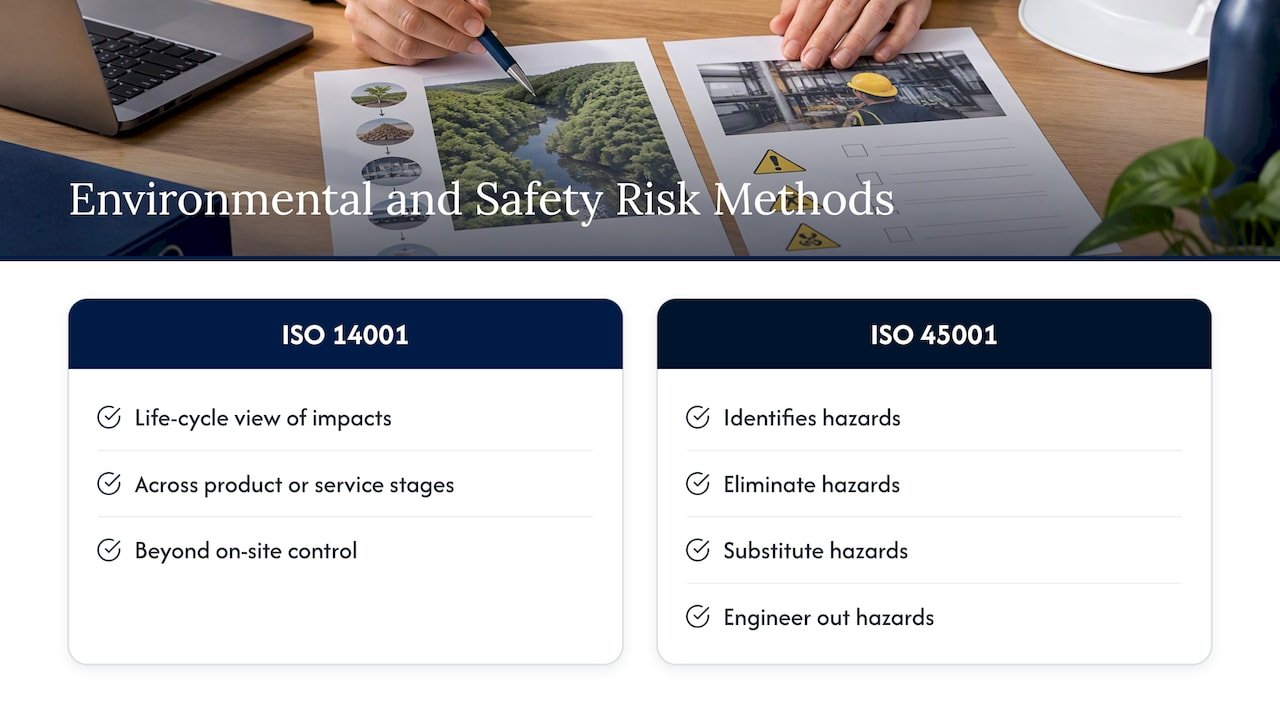
ISO 14001 uses a life cycle perspective: you consider environmental aspects across the stages of a product or service, not just the part you control on site. ISO 45001 is about identifying hazards and applying the hierarchy of controls: eliminate, substitute, engineer out, then administrative controls and personal protective equipment as the last resort. The first is a wide-angle view of impacts; the second is a close-up on exposure.
Who asks for it
Customers often ask for one or the other for different reasons. Environmental certification tends to appear in sustainability questionnaires and supply chain requirements. Safety certification tends to appear where contractors work on someone else’s site, such as construction, oil and gas, and facilities. Practitioners note that proactive risk management also supports employee engagement and morale and can be a supplier requirement in sectors such as automotive and electronics.
How common are they?
Both are widely used. In the 2022 ISO Survey of Certifications, ISO 14001 had 529,853 valid certificates and ISO 45001 had 397,339, behind only ISO 9001 at 1,265,216. Those figures are for 2022, so use them as a sense of scale rather than a current count.
Which should you implement first?
There is no universal answer, but a few questions usually settle it.
- Where is your largest exposure? A site with heavy machinery, working at height or hazardous substances points to ISO 45001. A business with permits, significant emissions or waste streams points to ISO 14001.
- What do your customers and tenders require? Read the last three tender documents or supplier questionnaires you received. They often answer the question for you.
- What already exists? If you run an ISO 9001 system, adding either standard is mostly extending something you know. If you already have a safety system that is not certified, formalising it may be quicker than starting an environmental system from scratch.
- What can your people absorb? Doing both at once is realistic only if someone owns the integrated system and has time for it.
- Is a full certificate the goal? Some organisations get most of the value by implementing the practices and delaying certification.
If your risk is genuinely mixed, an integrated approach is usually more efficient than two separate projects, because leadership commitment, audits and records are shared.
Certification: accredited or not
Certification to either standard is voluntary, and ISO does not carry it out itself. Independent certification bodies audit you, and the credibility of the certificate depends on whether that body is accredited. ISO’s survey commentary points out that organisations often confuse unaccredited certificates with accredited ones, and accredited certification is often what supply chains and public procurement expect. In the UK, check that the body is accredited by UKAS before you sign. Elsewhere, check the national accreditation body.
A practical route to a combined system
- Define the scope. Which sites, activities and contractors are in?
- Run a gap analysis against both standards together, using the shared clause structure to avoid duplicated effort.
- Build the shared core first: policy, roles, document control, internal audit, management review.
- Add the topic-specific parts: the environmental aspects register and the hazard and risk register.
- Train the people who run it. Internal auditors, line managers and worker representatives all need different depth.
- Run an internal audit and management review before the certification audit.
- Choose an accredited certification body and agree the audit plan, ideally covering both standards in one visit.
Common traps are writing procedures nobody uses, treating the system as the quality manager’s job alone, and leaving worker consultation until the end.
Our perspective
We train corporate teams across sectors where both topics bite: oil and gas, civil engineering, healthcare, facilities and project delivery. What we see is that the standards rarely fail on the clauses. They fail on ownership. A system written by one person for an auditor does not change how a site behaves.
So we start from the job, not the certificate. Who handles waste, who supervises contractors, who signs off a change? Training should be built around those people and their real decisions, and it should be customisable to the organisation’s own risks rather than a generic slide deck. Delivery can be on-site, online or blended, so shift workers and head-office teams are not forced into one pattern.
Our view on the comparison itself: do not treat it as a contest. If your operations can harm people and the environment, you need both disciplines. The standards’ shared structure is a gift, so use it to build one system, led visibly by senior management, with workers genuinely involved.
— Sam
Building the skills behind the standards
Certification gets the attention, but competence is what keeps the system alive. Our professional training covers compliance and safety alongside project management, facilities and engineering topics, and programmes can be tailored to your organisation, delivered on-site, online or blended.
Relevant starting points include workplace violence prevention and security training for the people-risk side, and project management courses for the teams who deliver the implementation. If you prefer training near you, see our London training centre page or browse the full list of locations. Tell us about your sector and risks, and we will shape the programme around them.
FAQ
Can I be certified to ISO 14001 without ISO 45001?
Yes. The two certificates are independent, and you can hold either on its own. Many organisations start with the one their customers ask for and add the other later, using the shared structure to reuse policies, audits and records.
Is ISO 45001 harder than ISO 14001?
Not in length, but ISO 45001 usually asks more of your culture. It expects active worker participation and a rigorous hazard and risk process, which takes time to embed. ISO 14001 can be easier to start but needs good data on aspects, legal duties and the wider life cycle.
Is ISO 14001 being updated?
It has been. ISO lists ISO 14001:2026 as the current fourth edition, replacing the 2015 version. If you hold a 2015 certificate, ask your certification body how and when you need to transition.
Can one audit cover both standards?
Yes, because the standards share the High Level Structure, certification bodies can usually audit them together. You still need separate evidence for environmental aspects and for hazards and risks, but leadership, internal audit and management review can be common.