
Waterfall plans the whole project upfront and delivers it in sequence. Agile plans in short cycles and delivers in increments. Choose Waterfall when requirements are stable, the scope is fixed and changes are costly. Choose Agile when requirements are likely to shift and you need feedback early. Choose a hybrid when your project has both kinds of work.
That is the short answer. The rest of this guide shows how each approach runs, what the professional bodies say about them, and how to decide for a real project.
TL;DR
- Waterfall is sequential: detailed requirements and planning come first, and the product is delivered at the end.
- Agile is iterative: planning is continuous, and working increments are delivered in short cycles with regular feedback.
- Waterfall suits stable, well-defined, regulated or high-risk work. Agile suits uncertain, fast-changing work where feedback shapes the result.
- Many organisations blend the two, keeping a Waterfall frame for budget and milestones and using Agile inside the teams.
- Choosing the wrong approach is expensive, so train the people who must decide and run it, not just the people who deliver.
Table of Contents
- What Agile and Waterfall actually mean
- The key differences at a glance
- Pros and cons of each approach
- When to use Waterfall
- When to use Agile
- The cost of choosing wrong
- A quick way to decide
- Hybrid: using both on purpose
- What this means for your team
- Our perspective
- Build the skills to run either approach
- FAQ
- Sources
What Agile and Waterfall actually mean
The Association for Project Management describes Agile project management as an iterative approach to delivering a project throughout its life cycle, made up of iterations or incremental steps towards completion. It describes Waterfall as a sequential approach that tries to capture detailed requirements upfront, the opposite of Agile.
Waterfall in plain terms
Waterfall moves through phases in order. Each phase finishes before the next begins, so requirements come before design, design before build, build before test. IBM’s overview credits Dr Winston W. Royce, whose 1970 paper on managing the development of large software systems documented the linear sequential model.
The Scottish Government’s service manual lists a similar Waterfall sequence: concept, definition, deployment and transition. The logic is simple. If you define everything well at the start, you can estimate, schedule and control the work.
Agile in plain terms
Agile breaks the product into features and tackles them one at a time under a fixed time limit. In Scrum, that limit is called a sprint. The same Scottish guidance says Agile splits a project into small units called sprints or iterations, typically two to four weeks long, and that Scrum and Kanban are the two most common frameworks.
The philosophy comes from the Agile Manifesto, published in February 2001. It values individuals and interactions over processes and tools, working software over comprehensive documentation, customer collaboration over contract negotiation, and responding to change over following a plan. The authors add that the items on the right still have value, but the items on the left are valued more.
The key differences at a glance
The two approaches differ in where they place certainty. Wrike’s guide puts it well: Waterfall tries to buy predictability early through upfront planning and staged approvals, while Agile accepts that uncertainty is part of the work and buys predictability over time through frequent delivery and feedback.
| Factor | Waterfall | Agile |
|---|---|---|
| Planning | Detailed, long-term, completed before execution | Continuous, based on iterations |
| Delivery | Product delivered at the end | Product delivered incrementally |
| Structure | Linear, phased | Short, repeating cycles |
| Stakeholder involvement | Mostly at the start and end | Throughout the project |
| Change | Handled through formal control, often costly | Expected and absorbed each cycle |
| Documentation | Comprehensive, a core output | Lighter, focused on working results |
| Scope, time, cost | Scope is the driver; time and cost follow | Time and resources are set; scope flexes |
The planning, delivery and stakeholder rows reflect the State of California’s project resources guide. It notes that Waterfall stakeholders are typically involved at the beginning and end, while Agile stakeholders are deeply involved throughout. The scope row follows the practical comparison from the UK’s Government Digital Service community of how each approach treats open and fixed variables.
Plans versus feedback
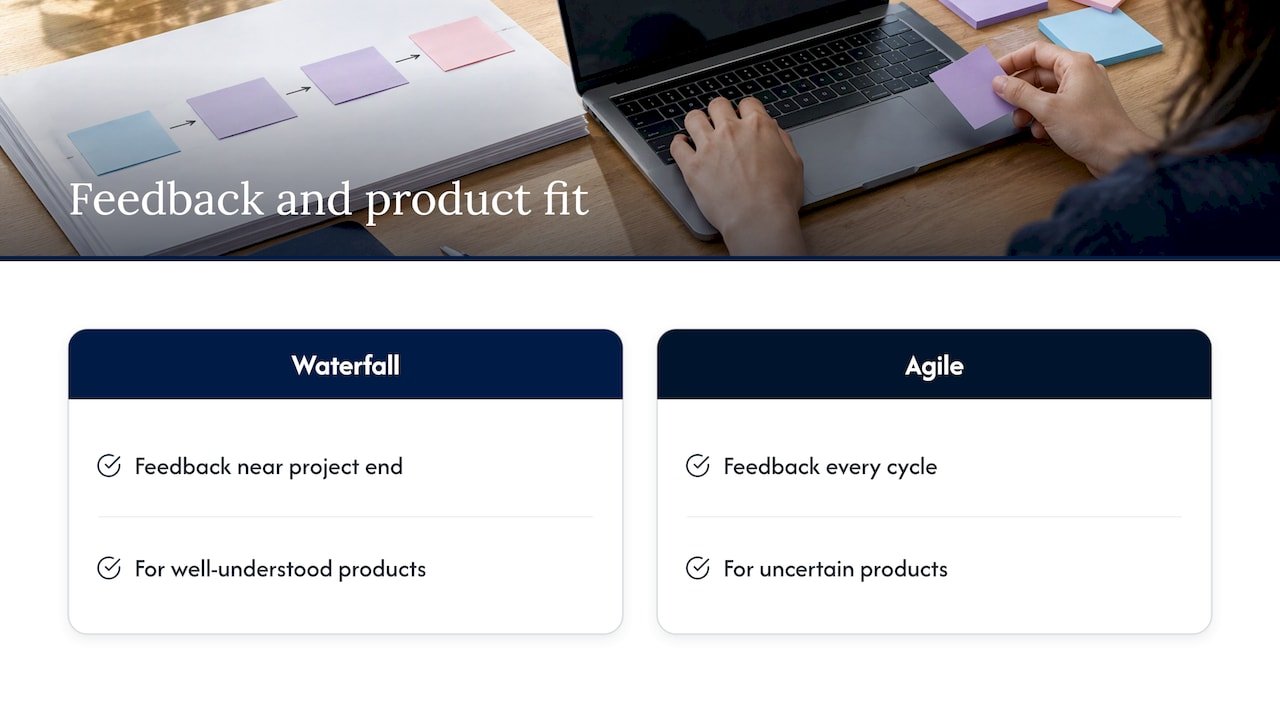
The sharpest difference is how you learn. In Waterfall, you learn whether the product works near the end. In Agile, you learn every cycle. That is why Agile is attractive when nobody can fully describe the finished product on day one, and why Waterfall is attractive when the finished product is already well understood.
Contracts and governance
The APM lists the same contrasts as the Manifesto: customer collaboration over contract negotiation, and responding to change over following a structured plan. In practice this affects procurement. Fixed-price contracts fit a defined scope. Agile work needs a way to fund capacity and prioritise value instead.
Pros and cons of each approach
Waterfall
Atlassian’s comparison lists these Waterfall strengths:
- Less coordination is needed during the build.
- Dependencies are clearer.
- Cost estimates are possible once requirements are defined.
- Documentation is better.
- The design phase is more methodical.
Its weaknesses include harder work-sharing, delays at phase transitions, specialised hiring needs, communication overhead at handoffs, and potentially weaker product ownership and engagement.
Agile
The same source lists these Agile strengths:
- Faster feedback cycles.
- Earlier problem identification.
- A higher potential for customer satisfaction.
- Better time to market.
- Better visibility and accountability.
- Flexible prioritisation focused on value.
The U.S. Air Force’s software resource adds adaptability to changing requirements, effective risk mitigation through iterative development, and better team motivation.
Agile also asks more of the organisation. Atlassian points to unclear critical paths and cross-project dependencies, the cost of the learning curve, and the engineering investment needed for continuous deployment. These are things to plan for, and training is the usual way to plan for them.
When to use Waterfall
Waterfall earns its place when certainty is high. Digital Public Services Wales says it is ideal where requirements are well defined and agreed, and where there is stability and minimal change.
The University of Waterloo’s project management office says Waterfall is typically used when scope is well defined, risk is small and few feedback cycles are needed. It may work for small, tried-and-true projects but does not typically work for larger ones.
The Project Management Institute goes further. It says infrastructure, high-risk or very technically complicated projects should adopt Waterfall. It also says Waterfall is the sensible route where the business cannot commit resources or where key departments hold radically conflicting views, because Agile would not be feasible there.
Typical fits include:
- Construction and civil engineering packages with fixed design and regulatory sign-off.
- Safety-critical systems such as medical software, aerospace and defence.
- Short, well-understood projects.
- Work with external vendors under fixed-price contracts.
The last two groups come from a software consultancy’s executive guide, which argues that Waterfall is not obsolete and is the responsible choice where deviation is costly or illegal.
When to use Agile
Agile earns its place when learning is the main task. Digital Public Services Wales says it is ideal where there is uncertainty, requirements may evolve and things are likely to change. PMI says web-based projects and stand-alone software development lean towards Agile. The Waterloo guidance calls Agile best for high-change projects.
Good signals that Agile fits:
- You cannot describe the finished product in detail yet.
- Users or customers can react to early versions.
- The market or the business context is moving.
- Stakeholders can commit time throughout, not just at sign-off.
- The team can deliver something usable every few weeks.
If stakeholders cannot give that time, Agile will stall. This is the most common reason Agile adoptions disappoint, and it is a people and governance problem rather than a tooling one.
The cost of choosing wrong
The Waterloo office warns that applying the wrong approach can be costly, can severely affect the timeline and the ability to deliver value, and can even lead to failure. Its example is Waterfall applied to a large, complex project with a lot of change: slow, difficult and frustrating.
The reverse mistake is just as real. An Agile label on a project with a fixed scope, fixed date and rigid regulatory sign-off produces constant replanning and no extra benefit. The method has to match the nature of the work.
A quick way to decide
Ask these five questions before you commit.
- How stable are the requirements? If they are nearly fixed, lean Waterfall. If they will evolve, lean Agile.
- What does a mistake cost? If errors are costly, dangerous or illegal, lean Waterfall for those parts.
- Can users give regular feedback? If yes, Agile pays off. If no, its main advantage disappears.
- How is the work funded and contracted? Fixed-price, fixed-scope contracts favour Waterfall. Capacity-based funding favours Agile.
- What can your people actually run? A method nobody on the team has practised will underperform on either side.
If your answers split, you probably need a hybrid.
Hybrid: using both on purpose
Most real programmes are not purely one or the other. Rework says hybrid is the right call when a project has both fixed and fluid elements. Its examples are compliance combined with uncertainty, hardware plus software, large programmes with a funding cycle, teams moving from Waterfall to Agile, and vendors and clients working at different rhythms. It reports PMI figures showing hybrid use rising from 20% in 2020 to 31% in 2023.
An academic history of the Waterfall model published in 2025 argues that Waterfall has moved from a standalone framework to a component of modern hybrid methods. The sequential logic is often kept at the macro level, with Agile applied at team or sprint level. It also argues that Waterfall remains relevant for stable requirements, clear scope and strong demands for traceability and documentation.
A common pattern looks like this:
- Programme level: phase gates, budget approvals, regulatory milestones and a baseline schedule.
- Team level: sprints, backlogs, regular reviews and demonstrations.
- Interface: each gate is passed by showing working increments rather than only documents.
One consultancy reports that aligning the method with requirements stability gave an average 15% reduction in scope creep and a 10% faster time to market in its own research. Treat that as the vendor’s finding rather than an industry benchmark. The direction is plausible, though: fit matters more than loyalty to a method.
What this means for your team
The method matters less than the people using it. Waterfall projects fail when planners treat early estimates as facts. Agile projects fail when teams treat flexibility as permission to skip planning. Hybrid projects fail when nobody owns the boundary between the two.
Three practical moves help in any case:
- Make the choice explicit. Write down why you chose the approach and which conditions would make you revisit it.
- Train managers, not only practitioners. Sponsors and project managers set the conditions Agile or Waterfall needs, such as stakeholder time, funding and governance.
- Use a shared vocabulary. When a sponsor says “sprint” and a contractor says “phase”, expectations drift quickly.
Our perspective
We see the same pattern in organisations of every size. The debate is framed as a choice between two camps, when the real question is whether the people running the project can use the right tool for the work in front of them.
Our view is that a team needs both vocabularies. A project manager who understands phase gates, baselines and documentation, and also understands iterations, backlogs and fast feedback, can pick the approach on evidence instead of habit. That is why we build project management training around practical choices and real workplace problems, led by industry experts.
It is also why we customise content to the organisation. A civil engineering contractor, a hospital group and an oil and gas operator face different constraints. They should not sit through the same generic slide deck. Our courses can be delivered on-site, online or blended, so a whole team learns the same method together.
Pick the method that matches your risk, then make sure your people are ready to run it.
Sam
Build the skills to run either approach
If your team is about to adopt or switch methods, start with the people. We offer professional training with global accreditation, customisable for corporate teams, and delivered on-site, online or blended. Our project management courses are a good starting point for project managers who want accredited certification and a practical grounding in structured and adaptive delivery.
If you are comparing options across disciplines, such as leadership, safety or compliance, you can also browse the full course catalogue or our top training courses. Managers who coordinate people across functions may find our matrix management and leadership course relevant, since hybrid delivery often runs across team boundaries.
FAQ
Is Waterfall still relevant today?
Yes. Research on the model’s history argues that it remains relevant in context-aware development strategies, especially where requirements are stable, scope is clear and traceability matters. Safety-critical, regulated and infrastructure work still commonly uses it, often inside a hybrid frame.
Is Scrum Agile or Waterfall?
Scrum is an Agile framework. The Scottish Government’s service manual names Scrum and Kanban as the two most common Agile frameworks, and Scrum organises work into sprints, typically two to four weeks long. It is not a Waterfall approach, although a Scrum team can work inside a larger Waterfall-governed programme.
Is Agile better than Waterfall?
Neither is better in general. Agile suits uncertain, changing work where early feedback matters. Waterfall suits stable, well-defined, regulated or high-risk work. The better method is the one that matches your requirements, your risk and your stakeholders’ availability.
Can you combine Agile and Waterfall?
Yes, and many organisations do. A common approach keeps Waterfall-style planning, budgeting and milestones at programme level while teams use Agile methods to deliver. Rework reports PMI data showing hybrid use rising from 20% to 31% between 2020 and 2023.
Sources
- APM: What is agile project management?
- IBM: Agile vs. Waterfall
- Scottish Government Service Manual: Comparing Agile and Waterfall
- Manifesto for Agile Software Development
- Wrike: Agile vs. Waterfall
- State of California: Waterfall and Agile
- Atlassian: Agile vs. Waterfall project management
- U.S. Air Force: Agile vs. Waterfall
- Digital Public Services Wales: Waterfall v Agile
- University of Waterloo: Methodologies
- PMI: Product methodologies
- CISIN: Agile, Waterfall or Hybrid
- Rework: Hybrid project management
- arXiv: A Brief History of the Waterfall Model