
An accredited course has been independently checked against external standards by a recognised body. A non-accredited course has not, though it can still teach you a great deal. Which one you need depends on what the certificate must do for you: open a regulated career door, satisfy an employer or insurer, or simply build a skill quickly and cheaply.
This guide explains what accreditation means in the UK, how to check a claim in a few minutes, where each type of training earns its place, and how to decide for yourself or for a whole team.
TL;DR
- Accredited training has been evaluated by an independent authority. Non-accredited training has not, but it is not automatically poor quality.
- Choose accredited when a regulator, licensing body, client or employer asks for a recognised credential. Choose non-accredited when speed, cost and tailoring matter more than a formal qualification.
- Never take “accredited” on trust. Check the awarding body and look the qualification up on the official register.
- Accredited and customised are not opposites: bespoke corporate programmes can be built around, or put forward for, external recognition.
- Check the status for your own start date. Accreditation can lapse or be withdrawn.
Table of Contents
- What accredited training actually means
- What non-accredited training is, and what it is not
- Accredited vs non-accredited: side by side
- When accredited training is the right call
- When non-accredited training is the better choice
- How to check whether a course is accredited in the UK
- Deciding for a team: a practical framework
- You can have customised and accredited
- Perspective: what we see when organisations choose
- Where Oxford Centre fits
- Red flags in any course listing
- FAQ
- Sources
What accredited training actually means
Accreditation is formal recognition that a provider or a course meets standards set by an outside body. NHS England’s guide to accreditation and qualifications describes it as certification that a school, college, university or course has met standards set by external regulators, and in England it points to Ofqual as the regulator concerned.
The practical value is trust without repeated auditing. An employer cannot inspect every training provider’s syllabus, trainers and assessment methods. When an independent body has done so, the employer can rely on the result. The same NHS guide frames accreditation as external validation that gives employers confidence in outcomes.
It helps to think of accreditation as a risk management tool rather than a gold star. You are delegating quality checks to a specialist that has no commercial interest in the course you are about to buy.
Accredited, regulated, endorsed: three words that get mixed up
Providers use these terms loosely, so separate them:
- Regulated qualification: one that appears on the official register of regulated qualifications and is overseen by a qualifications regulator. In England and Northern Ireland that register is run by Ofqual.
- Accredited course: a course or programme that an awarding body, professional institution or similar organisation has evaluated against set criteria. It may or may not be a regulated qualification.
- Endorsed programme: per NCFE’s explanation of accredited training, a distinction exists between qualifications that carry learning outcomes and are accredited by an awarding organisation, and programmes of activity such as workshops that receive a stamp of approval without formal assessment criteria. Both can be legitimate. They are not the same thing.
So when a course page says “accredited”, the useful follow-up questions are: by whom, at what level, and does it lead to a qualification or only to a certificate of attendance?
What non-accredited training is, and what it is not
Non-accredited training has not gone through that external assessment. It does not mean fake, and it does not mean weak. Many in-house programmes, vendor courses and specialist workshops are excellent. The point is that nobody independent has verified them, so you rely on the provider’s reputation, the trainer’s track record and the evidence you can gather yourself.
The US Department of Education’s guidance on diploma mills makes the same distinction from a different country’s angle: unaccredited institutions are not automatically of poor quality, but they lack the external benchmark that protects learners and employers from low-quality or bogus providers. The same page notes that whether a certificate carries weight often depends on whether the employers or licensing boards in your field recognise it.
That last point matters most. A certificate is only as useful as the person reading it.
Accredited vs non-accredited: side by side
| Question | Accredited | Non-accredited |
|---|---|---|
| Independent quality check | Yes, by an awarding body, regulator or professional institution | No external check |
| Where it appears | Often on official registers or the accrediting body’s list | Not on regulated registers |
| Curriculum | Usually fixed, with set learning outcomes and assessment | Flexible, can follow your exact needs |
| Cost and time | Typically higher, with assessment, registration and renewal costs | Typically lower, and quicker to set up |
| Portability | Recognised across employers and sometimes countries | Depends on the provider’s reputation |
| Best for | Regulated roles, formal career progression, compliance | Skills top-ups, niche tools, internal processes |
The trade-off between standardisation and customisation is the real heart of the decision. QAHE’s comparison notes that accredited programmes tend to follow pre-approved curricula, while non-accredited training can be tailored to niche industry needs or specific corporate objectives, and is often cheaper because the provider avoids the administrative burden of maintaining accreditation.
When accredited training is the right call
Regulated and safety-critical work
In healthcare, engineering, construction, oil and gas and similar sectors, a recognised credential is often a condition of practice, of a contract, or of professional registration. Universities describe the same logic for degrees: professional accreditation is an extra layer of recognition showing a course has been endorsed by an independent professional body.
Engineering is a clear example. The Engineering Council explains that recognised programmes have been approved or accredited by licensed professional engineering institutions as delivering some or all of the knowledge and competence needed for professional registration. If you want that registration, an unrecognised course may leave a gap you have to fill later.
Compliance and health and safety
If a client, insurer, regulator or tender document names a specific certificate, a non-accredited alternative will not satisfy it, however good the content. Always check the wording in the requirement: some ask for a named qualification, others only for “competent” staff, which leaves room for judgement.
Career mobility
If you may change employer, sector or country, a certificate from a known awarding body travels better. Hiring managers recognise it without needing to research the provider.
Project management certifications
Project management is a field where credentials are used as hiring filters. Many professionals look for certifications linked to a recognised professional body, and some such credentials require documented hours of formal instruction from an approved provider. Check the current prerequisites on the certifying body’s own site before you pay for any preparation course, as requirements change.
When non-accredited training is the better choice
- A narrow, practical skill. Learning a new software tool, a facilitation technique or an internal system rarely needs a formal qualification.
- A tight deadline. Setting up and assessing an accredited route takes time. A workshop can start next month.
- Company-specific content. Your own procedures, equipment, culture and client situations are not in any standard syllabus.
- Limited budget. Without registration and assessment fees, the same money can reach more people.
- Experienced staff who need a refresher, not a credential.
Specialist trades show the pattern well. A course that teaches a hands-on craft, such as online piano tuning and repair courses, may prepare you for an industry-run certification rather than a state-regulated qualification. What counts there is whether the trade’s own community recognises the credential, which is exactly the question to ask in any niche field.
How to check whether a course is accredited in the UK
These steps take about ten minutes and catch most problems.
- Find the named body. A genuinely accredited course states who accredited or awards it. A clear warning sign is a course page that names no awarding body anywhere in the details.
- Search the official register. The GOV.UK service for finding a regulated qualification lets you check whether a qualification is regulated in England and Northern Ireland. Qualifications in Wales and Scotland are listed by their own regulators, which the same page signposts.
- Check the awarding organisation too. The register also lets you search regulated awarding organisations, so you can confirm the body exists and is recognised.
- Ask the body directly. Professional institutions and awarding bodies will usually confirm in writing that a provider and a specific course are approved. Do not rely only on logos on the provider’s site.
- Confirm the status for your start date. The Engineering Council notes that accreditation status can change, and that learners generally keep the credential if the course was recognised when they started. If you enrol later, verify again for your intake year.
- Watch for lookalike names. If the provider’s name resembles a well-known institution or the awarding body is unfamiliar, be cautious. nidirect’s guidance on bogus degrees warns that not every advertised award is recognised by the UK government or employers, and shows how to find out which are genuine.
For courses that are not on a regulated register, the question shifts from “is it listed?” to “who recognises it?” Ask the provider which employers, professional bodies or clients accept the certificate, then ask one of those directly.
Deciding for a team: a practical framework
HR and learning managers rarely choose between the two in the abstract. A useful way through is to ask four questions in order.
- Does anything external require a named credential? A regulator, a client contract, an insurer, a licensing scheme. If yes, accredited is not optional.
- Will this person need the credential outside your company? Think promotion paths, mobility and professional registration. If yes, lean accredited.
- How specific is the content? If more than half of the value sits in your own processes, equipment or systems, a customised programme will serve better than a standard syllabus.
- What is the cost of being wrong? For safety, clinical or structural work, the cost of an unrecognised certificate is high. For soft-skill or tool training, it is low.
Most organisations end up with a blend: accredited routes for regulated and career-defining roles, tailored non-accredited sessions for everything else. That is a healthy mix, not a compromise.
A worked example
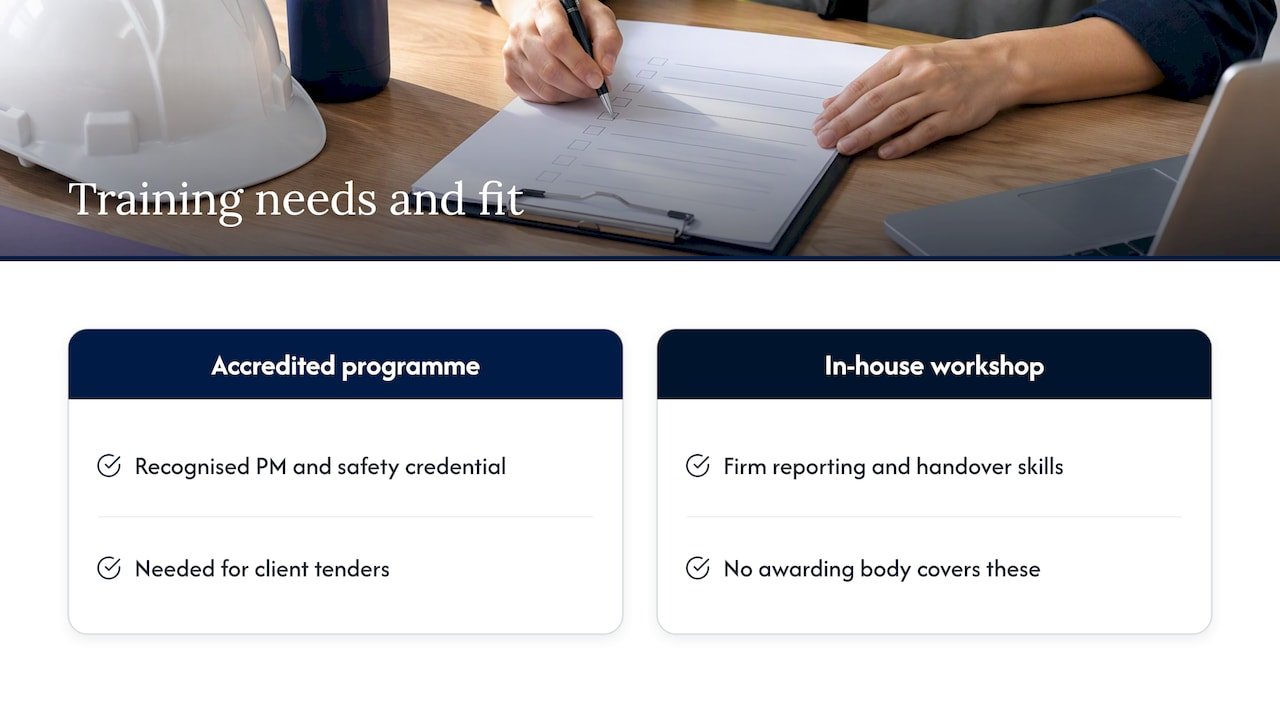
Imagine a mid-sized contractor that wants to develop a dozen site managers. Two things are needed. First, a recognised project management and safety credential, because clients ask for it in tenders. Second, training in the firm’s own reporting system and handover process, which no awarding body covers. The sensible plan is an accredited programme for the first and a short in-house or bespoke workshop for the second, delivered by trainers who know the sector. Treating them as one purchase would either overspend on the second or under-deliver on the first.
You can have customised and accredited
The usual assumption is that customisation costs you recognition. It does not have to. NHS England’s guide describes how organisations can have their own bespoke programmes evaluated by an awarding body or professional association against established benchmarks. That turns private training that nobody outside the company recognises into an externally validated asset, which can lift engagement and might even become a revenue stream if marketed externally.
NCFE’s description of its own accredited training service makes the same point: a programme of your own design can receive approval from a recognised awarding organisation, which signals that it is fit for purpose and rigorous. Note the distinction made earlier. Ask whether you are getting a qualification with assessed learning outcomes, or an endorsement of a programme of activities. Either may suit you, but they carry different weight with employers.
Perspective: what we see when organisations choose
We train corporate teams and individual professionals across project management, healthcare, oil and gas, civil engineering, IT, leadership, compliance and safety. The same mistake appears on both sides of the accredited debate.
Some buyers pick accreditation as a reflex, then discover that their staff sat through a generic syllabus that never touched the problems their business actually faces. Others pick the cheapest tailored option, then find that a client or regulator wants a recognised certificate they cannot show.
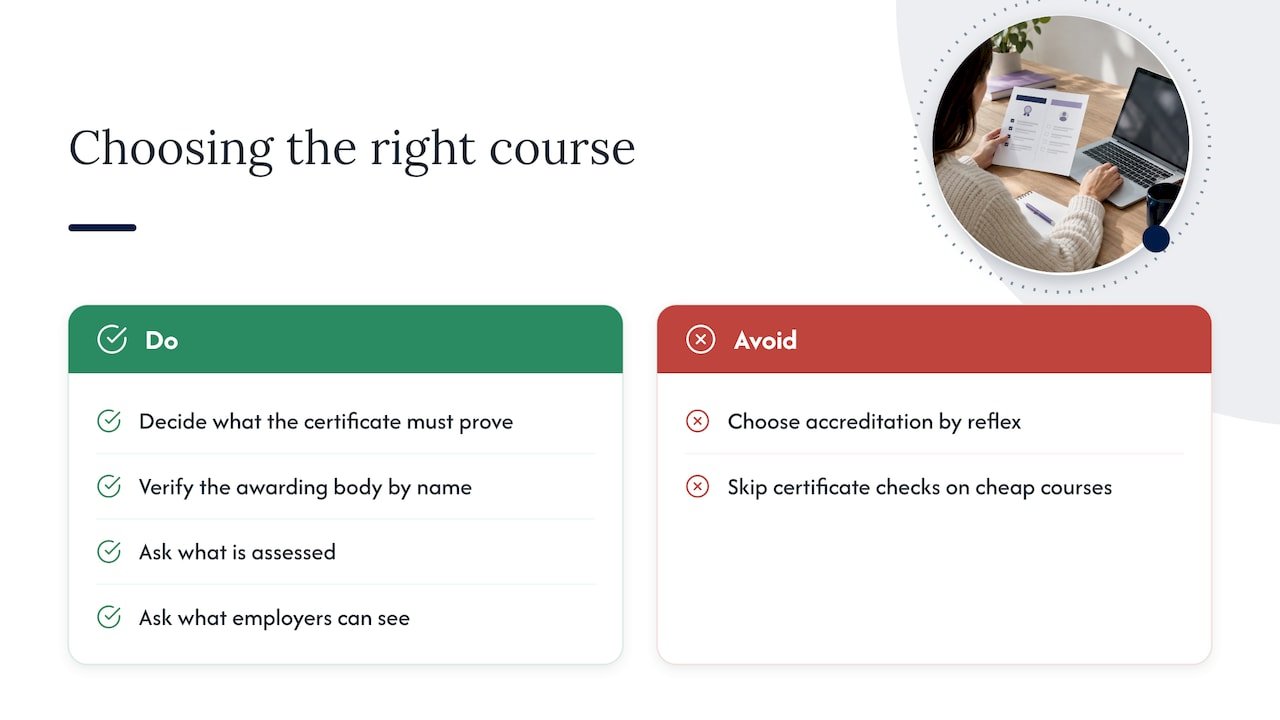
Our view is simple. Decide what the certificate has to prove and to whom, before you look at providers. If the answer is “to a regulator or a client”, ask for the awarding body by name and verify it. If the answer is “to ourselves, that the team can do the job better”, put the budget into content that fits your real work, with trainers who have done that work.
That is why we build courses to be customisable and deliver them on site, online or in a blended format: so a team does not have to choose between relevance and recognition. Whatever provider you use, ask for the same three things: who accredits it, what is assessed, and what you can show an employer afterwards.
— Sam
Where Oxford Centre fits
Oxford Centre offers professional training with global accreditation across project management, healthcare, oil and gas, civil engineering, IT, management, leadership, compliance and safety. Programmes can be customised for corporate teams and run on site, online or blended. If you are weighing a recognised project management route for yourself or your staff, start with our project management courses, or see the full range on the Oxford Centre homepage. Tell us what your team must be able to prove and to whom, and we will help you match the programme to it.
Red flags in any course listing
- No awarding body, regulator or professional institution named.
- A body name you cannot find on a register or its own website.
- Wording such as “fully recognised” with no detail on who recognises it.
- Guaranteed pass rates, or certificates issued without meaningful assessment.
- Pressure to pay quickly, or prices far below comparable courses.
- A provider who cannot say which employers accept the certificate.
One red flag is a reason to ask questions. Several together are a reason to walk away.
FAQ
What is an accredited course?
It is a course that an independent, recognised body has evaluated against set standards for quality and content. The body might be an awarding organisation, a regulator or a professional institution. Always ask who accredited it and how you can verify that.
Is a non-accredited course worth doing?
Often, yes, when your goal is a practical skill rather than a formal qualification. It will not usually satisfy a regulator, licensing body or contract that names a specific credential. Judge it on the trainer’s experience, the content and who in your field values the certificate.
How do I check if a course is accredited in the UK?
Find the awarding body named by the provider, then look the qualification up in the Register of Regulated Qualifications through GOV.UK. For Wales and Scotland, use their own regulators’ registers. For professional credentials, confirm directly with the professional body.
Can accreditation be withdrawn?
Yes. Status can be withdrawn or not renewed, and it is tied to the intake year in many cases. Check it for your own start date rather than relying on an old brochure.
Can a company’s own training be accredited?
Yes. An organisation can work with an awarding body or professional association to have a bespoke programme evaluated against recognised benchmarks. That gives in-house training external validation.
Sources
- NHS England: Accreditation and qualifications guide
- NCFE: What is accredited training?
- U.S. Department of Education: Diploma mills and accreditation
- QAHE: Accredited vs non-accredited training
- University of Brighton: Professional accreditation
- Engineering Council: What is an accredited course?
- GOV.UK: Find a regulated qualification
- nidirect: Avoiding bogus degrees