
A safety training matrix is a grid that lists your people (or roles) down one side and the safety training each of them needs across the top. Each cell records whether that training is required, whether it is done, when it was done and when it expires. Built properly, it tells you in seconds who is competent to do what, where the gaps are and what is about to lapse. Built badly, it is a spreadsheet of course names that nobody trusts.
This guide shows how to build one from your risk assessments, which columns to include, how to score competence rather than attendance, and where matrices usually fail.
TL;DR
- A safety training matrix maps roles to required training, status, dates, expiry and evidence. Its job is to show who is qualified now and who is not.
- Build it from your risk assessments and control decisions, not from a generic course list. It records training needed after other controls are chosen.
- Record competence, not only attendance: add a level scale, supervised sign-off for high-risk tasks and an evidence reference.
- Do not apply one refresher cycle to every topic. Set intervals by hazard, role, legal requirement and trigger events such as new equipment.
- Review it on a schedule and whenever work changes. A matrix that is not updated becomes a liability.
Table of Contents
- What a safety training matrix is for
- The legal backdrop in Great Britain
- Start from risk, not from a course catalogue
- The columns every matrix needs
- Score competence, not just completion
- Worked example: a small contractor’s matrix
- Setting refresher intervals sensibly
- For high-hazard industries: manage competence as a cycle
- Where matrices go wrong
- Our view on safety training matrices
- Closing gaps once the matrix shows them
- FAQ
- Sources
What a safety training matrix is for
The purpose is simple: to show who is qualified now, identify gaps, schedule renewals and provide auditable evidence of all three. It answers four questions a manager, auditor or inspector will ask:
- Who needs which training for the work they actually do?
- Who has it, and is it still valid?
- What is due in the next 30, 60 or 90 days?
- How do you know the person can do the task, not just that they sat a course?
The last question is the one most matrices cannot answer. We return to it below.
The legal backdrop in Great Britain
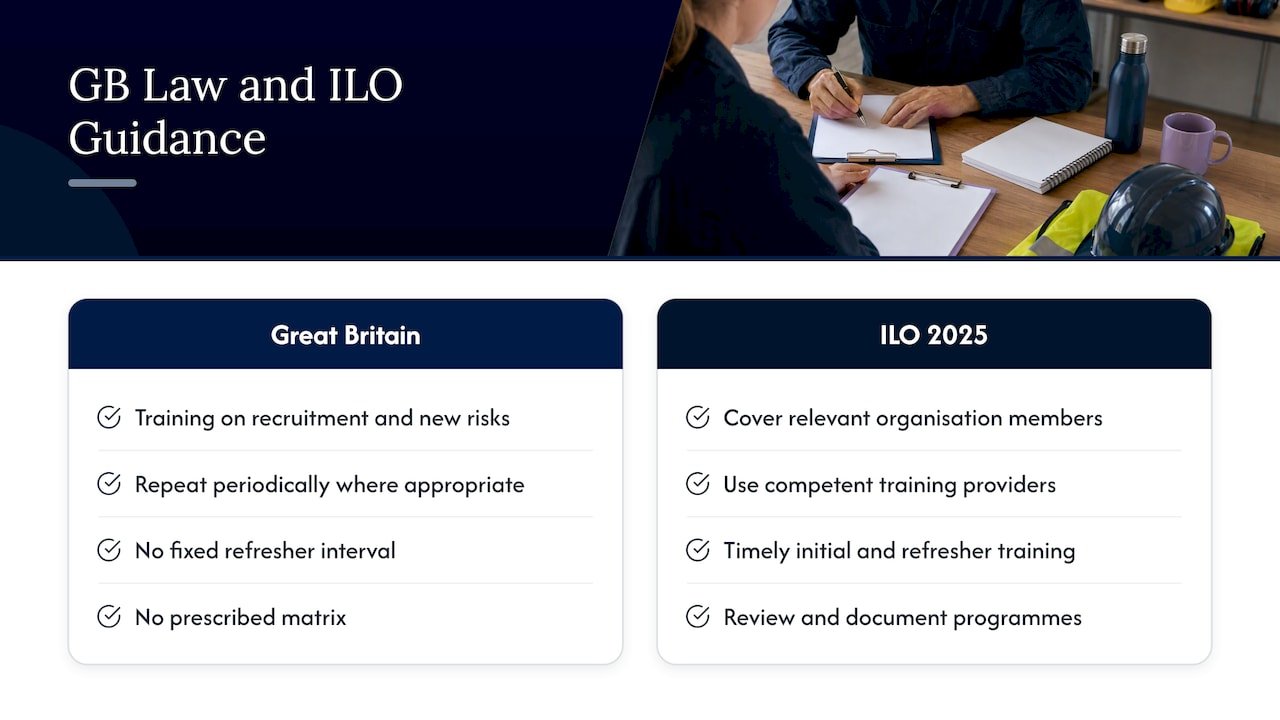
In Great Britain, the Management of Health and Safety at Work Regulations 1999 require employers to take employees’ capabilities into account when giving them tasks. They also require adequate health and safety training on recruitment and when people face new or increased risks, for example through a change of role, new equipment, new technology or a new system of work. The training must be repeated periodically where appropriate and adapted to new or changed risks.
Notice what the regulation does not do: it sets no single refresher interval and does not prescribe a matrix. The matrix is your tool for demonstrating that you meet the duty. Specific regulations and approved codes for particular hazards (work at height, asbestos, lifting, confined spaces and so on) add their own requirements, so check the ones that apply to your work.
If you operate outside Great Britain, the details change. The ILO’s 2025 guidance offers a globally framed baseline: programmes should cover relevant members of the organisation, be delivered by competent persons, provide timely initial and refresher training, evaluate comprehension and retention, be reviewed periodically and be documented. Training should be free to workers and, where possible, take place during working hours. Exact duties and intervals still depend on the jurisdiction, hazard and role.
Start from risk, not from a course catalogue
The most common mistake is to open a spreadsheet and list every course you can think of. A defensible matrix works the other way round.
HSE describes risk assessment as a five-part process: identify hazards, decide who may be harmed and how, evaluate the risks and decide on controls, record and implement the findings, then review and update. The matrix should be generated from those control decisions. It does not replace the assessment.
There is a second point here. HSE is clear that training should complement higher-order controls, not substitute for redesign, substitution, isolation or other measures. So the matrix records the training needed once you have chosen your controls. If a row says “manual handling” only because nobody removed the heavy lift, the problem is not training.
A practical sequence:
- List tasks and hazards from your current risk assessments, site by site.
- Group tasks into roles (or job families) so the matrix stays readable.
- For each role, note the controls that depend on people’s knowledge or skill: procedures, PPE, equipment use, emergency response, supervision.
- Translate each into a training or competence requirement.
- Add anything the law or your customers specifically require.
HSE’s example for work-related driving shows the kind of items that come out of this: induction, incident and near-miss reporting, PPE use and maintenance, manual handling, vehicle or equipment checks, safe loading, emergency arrangements and periodic refreshers. The approach generalises to any activity: awareness, procedures, practical skills, emergency response, supervision and verification, not just e-learning completion.
The columns every matrix needs
Keep the layout plain. Most workable matrices carry these fields, either as columns or as a detail record behind each cell:
| Field | Why it matters |
|---|---|
| Worker name or role | Shows whom the requirement applies to |
| Department or site | Lets you filter by location and manager |
| Required training or competency | The link back to the risk assessment |
| Status | Required, not required, in date, expired, in progress |
| Date completed and date verified | Separates attending from being checked |
| Expiry or refresher date | Drives your renewal schedule |
| Evidence reference | Certificate number, assessment record or sign-off form |
| Verifier and method | Who confirmed it and how: test, observation, practical |
| Action owner and due date | Turns a gap into a task someone owns |
These fields follow the typical structure of a training matrix template. Add one more if you work with contractors: the employer or agency that holds the training record.
Score competence, not just completion
A tick in a cell says someone attended. It does not say they can do the job safely. Two sources point the same way. The ILO says programmes should evaluate comprehension and retention. HSE’s competence guidance stresses that supervised practical experience turns course completion into dependable performance.
Use a level scale where roles differ in autonomy
IChemE’s process-safety guidance uses four competency levels: awareness, basic application, skilled or proficient application, and mastery or expert. It applies them across topics such as hazard identification and risk assessment, management of change, human factors, emergency preparedness, incident investigation and assurance. A four-level scale tells you far more than “done / not done” when roles need progressively more independence and decision-making.
A simple version for general industry:
- 0, not required for this role.
- 1, awareness: has been briefed and knows the hazard exists.
- 2, supervised: can do the task under supervision.
- 3, competent: can do it unsupervised, signed off by an assessor.
- 4, can train or assess others.
Pair high-risk entries with observation
For high-risk tasks, do not let a certificate alone move someone to level 3. Add an observed task, a workplace assessment, mentoring or a supervised sign-off, and record who signed and when.
Worked example: a small contractor’s matrix
Imagine a 40-person building services contractor with four roles. The entries below are illustrative and not a statement of what the law requires for your business.
| Training | Site operative | Supervisor | Electrician | Office staff |
|---|---|---|---|---|
| Induction and site rules | 3 | 3 | 3 | 1 |
| Manual handling | 3 | 3 | 3 | 1 |
| Work at height | 2 or 3 by task | 3 | 3 | 0 |
| Isolation and safe systems of work | 1 | 3 | 4 | 0 |
| Fire and emergency arrangements | 2 | 3 | 2 | 2 |
| Incident and near-miss reporting | 2 | 3 | 2 | 2 |
| Risk assessment review | 0 | 3 | 3 | 0 |
Three design choices make it work. First, it is by role with individual overrides, so a new joiner’s row is built in minutes. Second, scores carry a date and an evidence reference in the record behind each cell. Third, a supervisor scores 3 in more rows because they direct others, which is exactly the organisational point the ILO makes: safety competence is an employer responsibility that extends to managers, supervisors and, where relevant, contractors, and includes new and young workers, not only frontline employees.
Setting refresher intervals sensibly
Resist the urge to put “annual” on everything. Different topics call for different logic, and some are trigger-based rather than calendar-based.
US OSHA’s lockout/tagout training is a good illustration, used here as an example and not as a UK rule. Authorised employees need training on recognising hazardous energy, its magnitude and isolation methods; affected employees need the purpose and use of the procedure; other employees need instruction on the procedure and the ban on restarting locked or tagged equipment. OSHA also requires certification of completed and current training, with each employee’s name and training date. Retraining there is linked to changes or inadequacies, not simply to the date.
Hazard communication shows a related point. OSHA requires training at initial assignment and whenever a new hazard is introduced, and expects the written programme and chemical inventory to reflect the specific workplace. The same interpretation notes that this particular standard does not itself require training records. That is a useful reminder to separate what a regulation requires you to record from what good internal control requires you to record. Your matrix should usually go further than the legal minimum.
A workable approach for each row:
- Legal or standard-driven interval: use it, and cite it in the notes field.
- No fixed interval: set one from the hazard, how often the task is done and what has gone wrong before. Review it after incidents and near misses.
- Trigger events: add a rule for changes of role, new equipment, new technology, new procedures and returns from long absence. These echo the situations named in the 1999 Regulations.
For high-hazard industries: manage competence as a cycle
In oil and gas, chemicals and other major-hazard settings, a matrix on its own is not enough. CCPS frames process-safety competency management as a cycle: identify roles and competency needs, assess gaps, develop gap-closure plans and sustain competencies. Training may be internal, external or a mix. The matrix is the working record of that cycle, covering corporate as well as individual competencies.
Where matrices go wrong
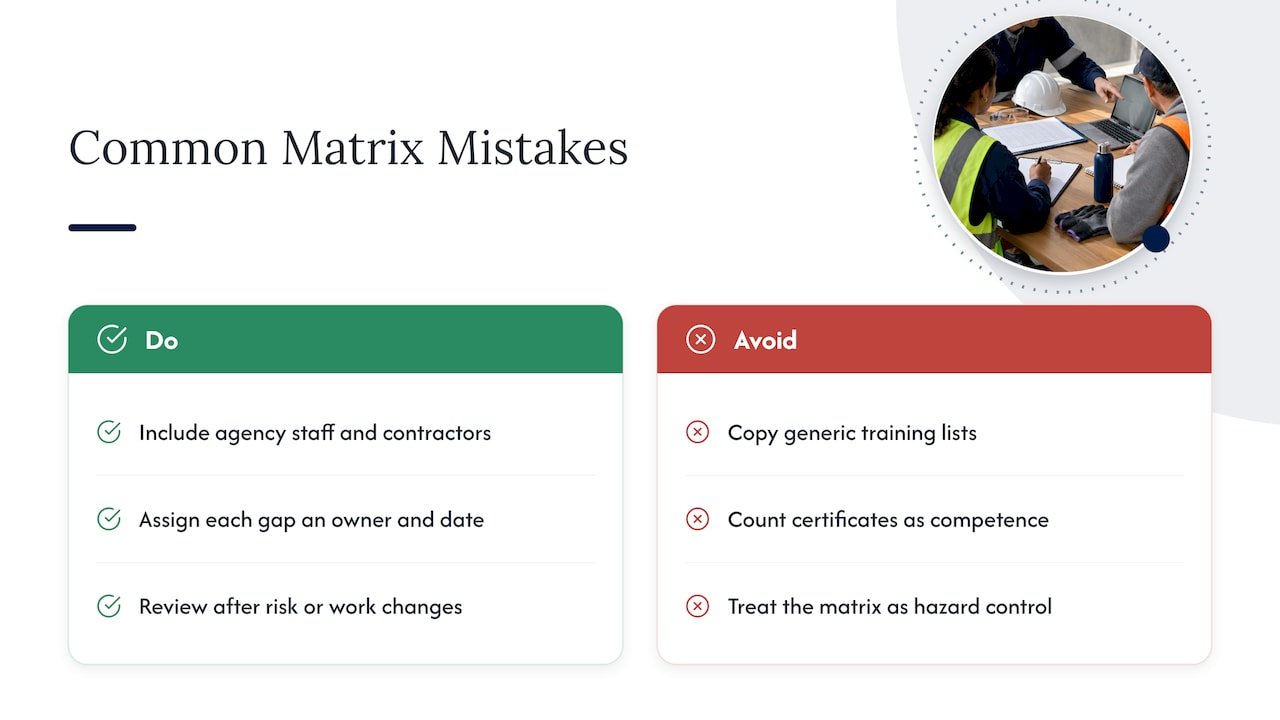
Copying a generic list. A template from another company reflects its hazards, not yours. OSHA’s point about workplace-specific chemical inventories and the ILO’s requirement that training be appropriate to the organisation and periodically reviewed both warn against this.
Counting attendance as competence. If the only evidence is a certificate, you cannot show the person can do the task.
Forgetting who is not on the payroll. Agency staff, contractors and visitors who do work on site belong in the scope, or in a clear rule about who holds their records.
No owner. Every gap needs a named person and a date. A red cell with no action is decoration.
Never reviewing. Tie a review to your risk-assessment review dates and to any change in work. HSE’s competence guidance supports updating development plans after assignments, assessments, reassessments and changes.
Using the matrix as the control. Training is the last line of a longer hierarchy. Do not let a full matrix lull you into thinking the hazard is managed.
Our view on safety training matrices
We deliver professional training across project management, healthcare, oil and gas, civil engineering, compliance and safety, and the same pattern turns up whichever sector a team comes from. The matrix is rarely the problem. The problem is the distance between the matrix and the work.
Our advice is to build the matrix first from real tasks, then buy or design training to fill the specific gaps it shows. That is why we favour customisable programmes over off-the-shelf lists: a course should map to the roles and risks on your sites, whether it is delivered on site, online or in a blended format. It also means asking of any course, internal or external, what the person will be able to do afterwards and how you will verify it.
For teams in high-consequence settings, treat the matrix as a living record. Review it with the people who do the work, not only with HR or the safety manager. They will spot the task nobody wrote down.
— Sam
Closing gaps once the matrix shows them
A good matrix quickly produces a list of gaps. Group them before you buy anything: gaps shared by a whole role suit a team course, ideally tailored to your procedures and equipment; single gaps suit individual places on an open course; and skills that need practice suit supervised sign-off at work.
If your gaps sit in project management, compliance, safety or industry-specific areas, Oxford Centre offers accredited professional courses that can be arranged on site, online or blended, and adapted to your organisation. Project leads can start with our project management courses. Tell us your roles and the gaps your matrix shows, and we can discuss what fits.
FAQ
What is the purpose of a training matrix?
It shows at a glance who needs which training, who has completed it and when it expires. That lets you plan renewals, spot gaps before they cause harm or a failed audit, and produce evidence on request. For safety, it should also show competence, not just attendance.
How often should safety training be refreshed?
There is no single answer. Some topics have a stated interval in regulations, standards or certification schemes. Others are set by your risk assessment, the frequency of the task and what has gone wrong before. In Great Britain, the 1999 Regulations require training to be repeated periodically where appropriate, and when risks change.
Is a safety training matrix a legal requirement in the UK?
The law requires adequate training and for employers to consider capability, but it does not name a matrix. In practice a matrix is the simplest way to show you are managing that duty. Check the regulations and guidance for your own hazards, and ask a qualified health and safety adviser if you are unsure.
What is the difference between a training matrix and a risk assessment?
A risk assessment identifies hazards, who could be harmed and the controls needed. The matrix is built from the outcome, recording the training and competence that people need for those controls to work. It cannot replace the assessment.
What should I include for contractors?
Include them where they do work under your control, or state who holds their records and how you check them. The ILO’s view that competence is an organisational responsibility supports covering managers, supervisors and contractors as well as frontline staff.
Sources
- The Management of Health and Safety at Work Regulations 1999, regulation 13
- ILO: organising occupational safety and health, competence and training
- HSE: Managing competence for safety-related systems, Part 2
- HSE: Managing health and safety (HSG60)
- HSE: Make sure drivers and riders are safe
- IChemE Safety Centre: competency guidance
- CCPS: Guidelines for Defining Process Safety Competency Requirements
- OSHA: Lockout/tagout, employee training and communication
- OSHA: Hazard Communication Standard interpretation
- MapTrack: training matrix template