
In the UK there is no such thing as a forklift licence. What the law requires is that every operator has been properly trained, and that the employer can prove it. HSE’s Approved Code of Practice for rider-operated lift trucks, known as L117, says there is no legal requirement to issue certificates of basic training and states plainly that there is no lift-truck licence. The certificate people ask for in job adverts is evidence that an operator received relevant training and reached an appropriate standard. For an employer, the duty is to provide that training, and to authorise and supervise each operator. For an individual, it is to hold evidence that a new employer will accept.
That distinction decides how you should approach certification, whether you are an HR manager planning for a warehouse team or a professional adding a credential to your CV. The rest of this guide sets out what is required, who is responsible, how to get certified, and when training needs refreshing.
TL;DR
- No state-issued forklift licence exists in the UK. The legal duty is on the employer to provide adequate training and evidence it.
- Operators should be over the minimum school-leaving age (16). In ports the minimum is 18 unless they are on a suitable, properly supervised training course.
- A good certificate covers basic training, specific type training and familiarisation on the employer’s own site. The certificate alone is not authorisation to drive.
- UK law sets no fixed refresher interval, but reassessment every three to five years is the widely recommended practice.
- Overseas rules differ sharply (the US, Hong Kong and Australia all have their own systems), so a certificate rarely travels unchanged.
Table of Contents
- Is there a forklift licence in the UK?
- Who can be trained: age and eligibility
- What proper training consists of
- How to get forklift certified in the UK
- What employers must record
- Does forklift certification expire?
- If you work abroad or hire from abroad
- Where forklift safety fits into wider workplace compliance
- Our view
- Plan your team’s training with Oxford Centre
- FAQ
- Sources
Is there a forklift licence in the UK?
No. Unlike driving on the public road, operating a lift truck at work is not controlled by a state licensing scheme. HSE’s position in L117 is that the legal responsibility sits with the employer, who must make sure operators are trained to an adequate standard. The “licence” mentioned in recruitment is really a Certificate of Basic Training, issued by a training provider or an accrediting body once you have completed a course and passed a practical test.
That is why the phrase “forklift certification requirements” has two different answers depending on who is asking:
- For the employer: the requirement is a legal duty to ensure operators are competent. Under L117, that means basic training, specific job training and familiarisation training, plus ongoing supervision.
- For the operator: the requirement is practical. You need a record of training that a new employer will recognise, because L117 notes that the employee needs that evidence when changing jobs.
A certificate from an accredited scheme is the easiest way to carry that evidence from one job to the next. It does not replace the employer’s own decision to let you drive a particular truck on a particular site.
Who can be trained: age and eligibility
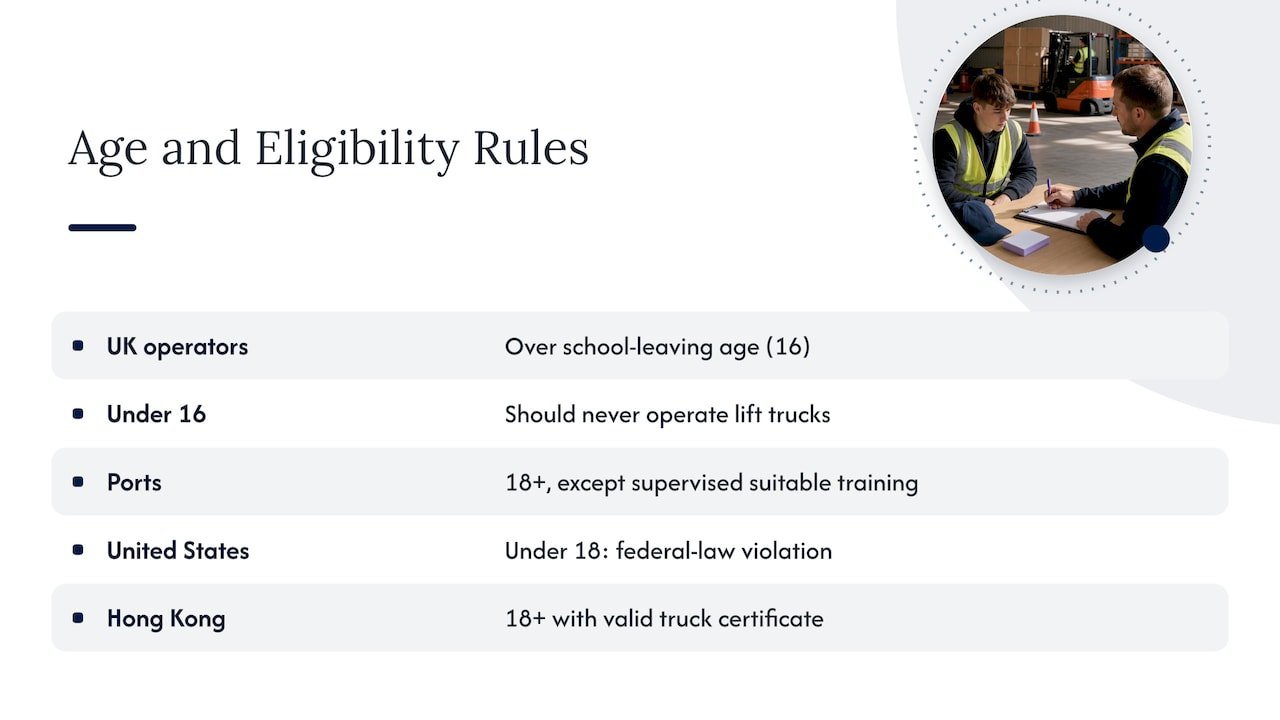
The age rules are short. According to L117, operators should be over the minimum school-leaving age, which is 16. Children under 16 should never operate lift trucks. Ports are the exception: there operators must be at least 18, unless they are on a suitable training course that is properly supervised by a competent person.
There is no requirement to hold a car driving licence. What matters is that the person is physically and mentally able to do the work, is selected with care and is given the right training for the truck and the site. Employers recruiting young or agency workers should expect to supervise them more closely during the early weeks.
If you recruit across borders, remember the minimum ages differ. In the United States, OSHA states that anyone under 18 operating a forklift in non-agricultural work is a violation of federal law. In Hong Kong, the Occupational Safety and Health Council explains that regulation requires an operator aged 18 or over holding a valid certificate for the type of truck.
What proper training consists of
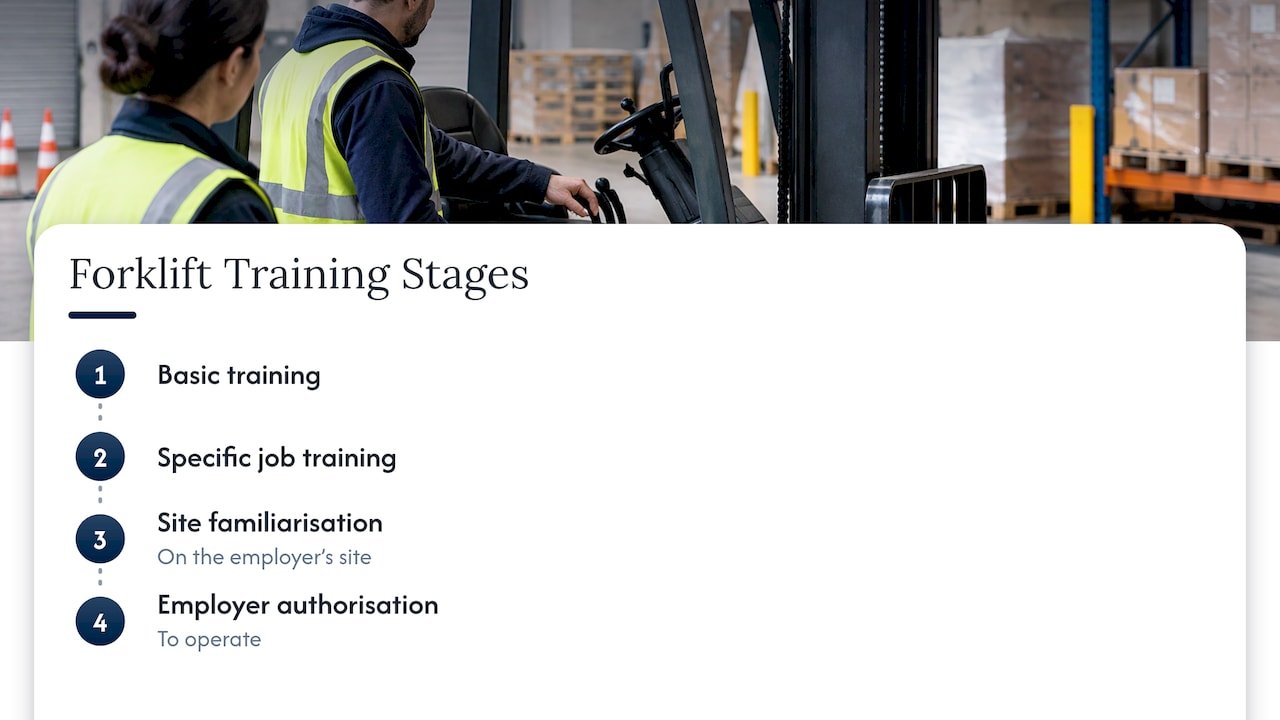
L117 breaks training into stages, and a certificate from a reputable course should reflect all of them.
Basic training
Basic training teaches the core skills and knowledge for the class of truck: controls, stability, load handling, pre-use checks and safe working rules. It ends with a practical test. This is the stage most people mean when they say “getting certified”, and it is usually a few days for a novice and shorter for someone with experience. Which course you need depends on the truck: counterbalance, reach, pallet stacker and so on. Training on one does not automatically cover another.
Specific job training
This covers the particular attachments, loads and tasks the operator will meet in their job, such as handling drums, long loads or working in narrow aisles. It is often delivered at the workplace.
Familiarisation training
Familiarisation takes place on the employer’s own site, on the actual trucks, in the actual conditions: ramps, pedestrian routes, racking, loading bays and the site’s rules. It is the stage employers most often skip, and it is the stage that turns a certificate into genuine competence.
Authorisation
Only when all stages are complete should the employer authorise the person to operate a truck. Many employers do this in writing. The authorisation belongs to the employer and is specific to the site, which is why a new starter with a certificate still needs familiarisation.
Other systems follow the same logic. In Australia, WorkSafe Victoria says licensed operators still need familiarisation training when a forklift differs from the one used in their licence assessment, because designs vary between manufacturers and models. In Germany, drivers are trained and then receive a written employer appointment before they may drive, according to the Listed Abroad guide.
How to get forklift certified in the UK
- Confirm the truck type. Identify the class you will actually use: counterbalance, reach truck, pallet truck or something else. Courses and certificates are type-specific.
- Check your eligibility. Make sure you meet the age rule above and can do the work safely.
- Choose accredited training. Look for a course from a provider working to a recognised accreditation scheme, covering theory, a supervised practical element and a final practical test. Employers should also ask whether the course content matches the L117 stages.
- Complete the course and test. A novice should expect a longer course; an experienced operator is usually assessed on a shorter one. Written elements often sit alongside the practical test.
- Keep your certificate safe. It is your portable proof. A new employer will usually want to see it, and may still need to add their own familiarisation.
- Get authorised on site. Your employer completes familiarisation and authorises you in writing before you drive unsupervised.
If you are an employer, treat this as a programme rather than a purchase. Map which employees drive which trucks, schedule basic training and familiarisation in the same plan, and keep a training record for each operator. Our own London training offer is built around that kind of planning for corporate teams: customisable content, delivered on-site, online or blended.
What employers must record
UK law does not prescribe a form, but good records show who was trained, on what truck type, when, by whom, and that the operator was authorised. Compare this with the United States, where OSHA’s training eTool requires the employer’s certification to state the operator’s name, the training date, the evaluation date and the name of the person who carried out the training or evaluation. That is a useful model for any UK employer building a defensible record, even though it is not a UK requirement.
A simple operator file might contain:
| Record | Why it matters |
|---|---|
| Name and date of birth | Confirms age eligibility |
| Truck classes trained on | Authorisation is type-specific |
| Basic training certificate and date | Evidence of competence |
| Site familiarisation date and trainer | Shows the site-specific stage was done |
| Written authorisation | Proves the employer permitted the operator to drive |
| Reassessment or refresher dates | Shows competence is being kept current |
Does forklift certification expire?
It depends on what you mean. UK law does not set a fixed refresher period. The UK Material Handling Association explains that, contrary to popular belief, there is no legal requirement for operators to receive refresher training at specific intervals, while recommending refresher training or a retest after a set period, for example three to five years.
So a certificate may show no expiry date, yet an employer who never reassesses operators will struggle to show they remain competent. Sensible triggers for retraining include:
- a set interval, such as every three years;
- an accident or near miss;
- observed poor operating habits;
- a new type of truck or attachment;
- a change to the layout or traffic routes of the site;
- a long absence from driving.
Other countries are more prescriptive. OSHA’s eTool requires each operator to be evaluated at least once every three years, with refresher training after an unsafe act, an accident or near miss, a failed evaluation, a change of truck type or relevant workplace changes. In Australia, the AFITA licence FAQ cites a standard under which refresher frequency is set by the user but should not exceed five years.
Refresher thinking applies beyond drivers. Teams that maintain trucks and equipment also need ongoing, practical assessment, as shown in this overview of maintenance technician training pathways.
If you work abroad or hire from abroad
Because the UK has no licence, UK certificates sit inside an employer-led system. Elsewhere, the regulator may be involved directly:
- United States: no licence, but the employer must train, evaluate and certify each operator. Washington State’s Labor and Industries form says there is no licence requirement but employers must document general training, workplace-specific hands-on training and a skills evaluation, with re-evaluation every three years.
- Hong Kong: an operator must be 18 or over and hold a valid certificate for the type of truck.
- Australia: a high risk work licence is needed, with two forklift classes. According to the Listed Abroad guide, it is valid for five years and an overseas certificate does not replace it.
- South Africa: a 2024 code of practice was incorporated into the Driven Machinery Regulations and requires operators of listed lifting machines to be trained regardless of capacity.
- Germany: the accident insurers’ draft principle dated 15 June 2026 would replace qualification levels with modules per truck type and an operator card. It is a draft, so check the final text.
For a multinational team, the safe approach is to meet the local rule where each person works and keep a consistent record across sites.
Where forklift safety fits into wider workplace compliance
Lift trucks rarely sit alone in a compliance plan. The same site often needs training for work at height, confined spaces, hazardous substances and site supervision. If you are building a wider programme, these guides cover neighbouring requirements: construction safety training on UK sites, confined space entry requirements and HGV driving training for the vehicles that deliver to your yard.
Our view
Most of the confusion about forklift “licences” comes from treating a certificate as the finish line. It is not. The law puts the responsibility on the employer, which means the real question for an HR manager is whether training, familiarisation, authorisation and reassessment form one joined-up plan.
We build compliance and safety training for corporate teams around that idea. Our programmes are customisable to the organisation’s own risks and environment, they are led by industry experts who address real-world challenges, and they can be delivered on-site, online or in a blended format. For a team that works across several locations, that flexibility means the same standard can be applied everywhere without pulling everyone away from the job.
Accreditation matters because a new employer, an insurer or an auditor will ask for it. Our qualifications are globally accredited, so the evidence people earn is portable. Our advice is to decide your standard first, then fit the training to it, rather than buying a course and hoping it covers your site.
Sam
Plan your team’s training with Oxford Centre
If you are responsible for compliance and safety training across a team, we can help you build it around your organisation. Our professional courses are globally accredited, customisable and delivered on-site, online or blended. Browse our courses or see how we work with teams in London.
FAQ
Do I need a licence to drive a forklift in the UK?
No. HSE’s L117 states that there is no such thing as a lift-truck licence. What you need is adequate training and evidence of it, plus authorisation from your employer for the trucks and site you will work on.
What is the youngest age to operate a forklift?
In the UK, operators should be over the minimum school-leaving age, which is 16, and children under 16 should never operate lift trucks. In ports the minimum is 18, unless the person is on a suitable, properly supervised training course.
How long does a forklift certificate last?
UK law sets no legal expiry or fixed refresher interval. Many certificates carry no expiry date, but refresher training or reassessment every three to five years is the widely recommended practice, and sooner after an incident or a change of truck or site.
Is a certificate enough to start work at a new employer?
Not on its own. A certificate evidences your training, but the new employer still needs to give you familiarisation on their trucks and site and authorise you before you drive unsupervised.
Sources
- HSE L117: Rider-operated lift trucks, operator training and safe use
- OSHA: Powered industrial trucks overview
- OSHA eTool: Powered industrial trucks training
- OSH Council Hong Kong: Fork-lift truck safe operation
- WorkSafe Victoria: Forklift training and competency
- Listed Abroad: Forklift licences abroad
- UKMHA: L117 introduction
- Washington State L&I: Forklift safety form F417-202-000
- AFITA: Forklift licence FAQ
- South Africa: Driven Machinery Regulations notice, 2024
- DGUV: Draft Grundsatz 308-001
- Maintenance technician training pathways