
A workable cloud security training roadmap has four stages: core IT and security foundations, one cloud platform learned properly, identity and data controls practised in labs, then a certification that matches your experience. Skip the order and you collect badges without being able to secure anything. Follow it and you, or the team you manage, can move from the basics to a recognised credential in a planned sequence. We run accredited courses for individuals and corporate teams at every stage of that sequence, with on-site, online or blended delivery, so the roadmap below ends with where our courses fit.
TL;DR
- Learn in this order: networking, Linux and security basics; one cloud platform; identity and access management (IAM); data protection and logging; then certification.
- Start with a vendor-neutral or foundational credential, then add a provider-specific one for the cloud you actually use.
- CCSP, the most widely recognised vendor-neutral cloud security credential, needs five years of experience, but ISC2 allows a route for people who are short of that.
- Teams get better results when training is matched to job role and protected in working hours, not left to evenings.
- Hands-on labs matter as much as the exam: each stage should end with something you have built and secured.
Table of Contents
- Why a roadmap beats a pile of courses
- Stage 0: the foundations you need before the cloud
- Stage 1: learn one cloud platform and the shared responsibility model
- Stage 2: the skills, in the order that works
- Stage 3: labs that prove you can do it
- Stage 4: choosing your certification path
- A realistic timeline
- How teams should adapt the roadmap
- Where our courses fit
- Our view: sequence beats speed
- FAQ
- Sources
Why a roadmap beats a pile of courses
Cloud security is not one skill. It combines networking, identity, encryption, monitoring and governance, applied to platforms that change constantly. Learners who jump straight to an advanced certification tend to stall because they lack the layer underneath.
Employers are investing in this gap. In ISC2’s 2026 Enterprise Training Trends report, a survey of 995 security leaders in Canada, Germany, India, Japan, the UK and the US, cloud computing security was among the top skills needs being addressed through training, cited by 44% of leaders. If you are an HR manager planning a programme or an individual planning a career move, a defined order saves months.
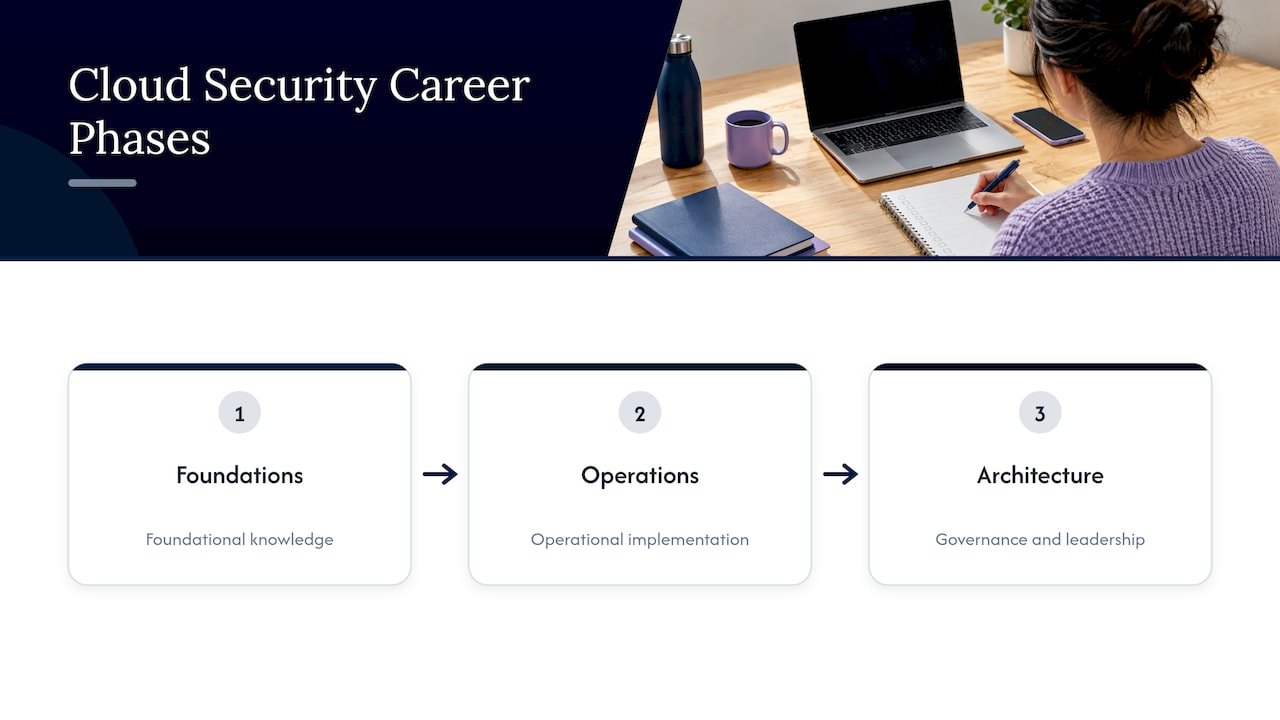
ISC2 describes the same shape in its cloud security certification roadmap: three career phases, from foundational knowledge through operational implementation to architecture, governance and leadership. The stages below follow that logic and add the practical detail.
Stage 0: the foundations you need before the cloud
Most people who struggle with cloud security are missing one of four basics. Check yourself against each.
- Networking. TCP/IP, DNS, HTTP and HTTPS, subnets, firewalls. Cloud networks are virtual versions of the real thing, so the concepts carry straight over.
- Linux command line. Most cloud workloads run on Linux, and most security tooling is driven from a shell.
- One scripting language. Python is the usual choice. The target is reading and modifying scripts, not building applications.
- Security fundamentals. The confidentiality, integrity and availability triad, common attack types, and the difference between authentication (proving who you are) and authorisation (what you are allowed to do).
The Cloud Security Office Hours learning path, a community-written guide, makes the same point and suggests skipping this stage if you already have all four. A recognised grounding in the fundamentals is the entry point for many learners; our CompTIA Security+ certification training course covers that ground in a structured, instructor-led format.
Stage 1: learn one cloud platform and the shared responsibility model
Pick one provider, not three. AWS, Microsoft Azure and Google Cloud all use different names for similar controls, and trying to learn them in parallel slows everyone down. Choose the one your employer uses or the one most common in the jobs you want.
Then learn the shared responsibility model before anything else. The provider secures the underlying infrastructure; you secure what you put on it, including configuration, identities and data. Microsoft’s cloud security benchmark makes this a governance point: it tells organisations to educate everyone on the shared responsibility model and to educate technical teams on the technology used to secure the cloud.
In practice, this stage means:
- understanding infrastructure, platform and software as a service (IaaS, PaaS, SaaS);
- creating an account structure with regions, billing controls and separate environments;
- launching a virtual machine, a storage bucket and a virtual network, and noting who is responsible for each setting.
If your goal is to build, not only to secure, our guide to learning cloud engineering with Azure and AWS platforms shows how the engineering and security tracks overlap.
Stage 2: the skills, in the order that works
The sequence matters because later skills depend on earlier ones. A widely shared 2026 roadmap from IT Knowledge Lab sets out the order below, and its rule is that identity comes before advanced tools, logging before incident response, and Kubernetes basics before cluster hardening.
| Order | Skill area | What you should be able to do |
|---|---|---|
| 1 | Identity and access management | Write a least-privilege role, enforce multi-factor authentication, review who has access to what |
| 2 | Network and perimeter controls | Design a virtual network with public and private subnets, use security groups, segment workloads |
| 3 | Data protection | Encrypt data at rest and in transit, manage keys and secrets, classify data, plan backup |
| 4 | Logging and monitoring | Turn on audit logging, read the logs, set alerts on risky changes |
| 5 | Detection and response | Use a SIEM (a tool that gathers and correlates security logs), follow playbooks, contain an incident |
| 6 | Containers and Kubernetes | Apply role-based access, image scanning and pod security standards |
| 7 | Automation and governance | Define infrastructure as code, enforce policy as code, track posture and compliance |
Identity comes first because most serious cloud incidents involve over-permissive access or exposed storage. If you only master one area early, make it IAM.
For the automation and pipeline end of the list, our SecDevOps: security in DevOps pipelines training course is the natural next step. For policy, risk and audit, see our security governance and compliance training course and the security policy development and implementation training course.
Stage 3: labs that prove you can do it
Certifications show you know the material. Labs show you can apply it, and interviewers and managers ask about them. Four projects cover the core:
- Design and test a least-privilege IAM policy. Write the policy, then try to misuse it and document the gaps.
- Build a virtual network from scratch. Use public and private subnets and a NAT gateway, then restrict traffic with security groups.
- Classify and encrypt a dataset. Decide which tier each data type belongs to and apply the matching encryption and key management.
- Harden a deployment pipeline. Plant a deliberate vulnerability, then configure scanning that catches it.
Two habits make these labs worth more. First, deliberately misconfigure something, such as a publicly readable storage bucket, then find it and fix it. Second, write up what you did in a short README. A reviewer can read that in two minutes.
Reviewing real security documentation is also practice. Reading how a vendor describes its platform security and audit logging teaches you what controls a business expects to see, and a chatbot security checklist is a good model for turning a list of good practices into evidence you can check.
Stage 4: choosing your certification path
Two families of credential exist: vendor-neutral and provider-specific. A sensible path uses one of each.
| Credential | Type | Experience | Fee (US pricing) |
|---|---|---|---|
| CompTIA Security+ | Vendor-neutral foundation | None formally required | See the exam provider |
| CCSP (ISC2) | Vendor-neutral, advanced | Five years, see below | $599 exam, about $135 annual maintenance, three-year renewal cycle |
| Google Professional Cloud Security Engineer | Provider-specific | No prerequisites; 3+ years’ experience recommended | $200 registration fee |
| AWS Certified Security Specialty | Provider-specific | Hands-on AWS experience recommended | See the provider |
Fees are the published US figures for 2026 and can change, so check the certification body’s page when you book.
Which provider-specific credential?
Follow the platform you work on. CertSelect’s April 2026 analysis found AWS Security Specialty in roughly 38% of the US cloud security job postings in its sample, ahead of any single Microsoft or Google credential. That is a US sample, so look at adverts in your own market. If you are working towards AWS, our AWS Certified Solutions Architect training course builds the platform knowledge that security specialisation rests on. For Google Cloud, see our Google Cloud Platform professional training course. The Google security engineer exam is two hours long with 50 to 60 questions and can be taken online or at a test centre.
CCSP: the experience requirement explained
The Certified Cloud Security Professional is the credential most often named as the senior vendor-neutral goal. ISC2 requires a minimum of five years of cumulative full-time IT experience, three of them in cybersecurity and one in one or more of the six CCSP domains.
There are ways to meet it:
- A degree in computer science, IT or a related field can cover up to one year.
- The Cloud Security Alliance’s CCSK certificate can cover one year.
- An active CISSP covers the whole requirement.
- If you lack the experience, you can pass the exam, become an Associate of ISC2, and then have six years to earn the experience.
That last route makes CCSP realistic for ambitious people who are earlier in their career. Our Certified Cloud Security Professional (CCSP) training course is the course to look at once you have chosen it.
A realistic timeline
Timelines depend on where you start and how many hours you can give. The community learning path mentioned earlier suggests roughly this shape:
| Stage | Typical duration | Focus |
|---|---|---|
| Beginner | Months 0 to 3 | One cloud, IAM and networking basics, free labs |
| Intermediate | Months 3 to 9 | Breach case studies, first certification |
| Advanced | Month 9 onwards | Production work, a second cloud, a public portfolio |
| Specialise | After that | Incident response, detection engineering, application security, governance |
Treat these as a guide, not a promise. Someone studying around a full-time job in an unrelated field may need around 18 months rather than 12, and someone who already has networking, Linux and security basics can start at Stage 1.
How teams should adapt the roadmap
For an HR manager or learning lead, the roadmap is a framework to adjust by role, not a single course for everyone. ISC2’s 2026 report found that 70% of organisations customise training by job role or function, and 98% allow professional development during work hours. The most common delivery format was hybrid in-person and virtual, at 54%.
A simple way to map roles:
- Developers and engineers: Stage 0 gaps, then IAM, pipelines and infrastructure as code.
- Operations and security analysts: logging, detection and response, then a provider certification.
- Compliance and risk staff: shared responsibility, data classification, policy and governance.
- Managers and leaders: shared responsibility, accountability and the governance phase, so they can make informed decisions.
The same report advises mixing methods, because most learning happens on the job, with coaching and formal training making up the rest, and protecting dedicated training time by adjusting workloads. Courses work best when they are paired with real tasks that use the new skills within weeks.
For a practical view of the controls your organisation should already have, our article on cloud security best practices for businesses is a good companion to the training plan.
Where our courses fit
We provide professional training with global accreditation across IT, compliance and safety, and the cloud security stages above map onto courses we run: Security+ for foundations, Google Cloud and AWS for the platform layer, SecDevOps for pipelines, governance and policy courses for compliance, and CCSP for the senior vendor-neutral credential. Course content can be customised for corporate teams, and delivery is available on-site, online or blended, led by industry expert trainers.
If you are planning a programme for a team or choosing your own next step, start from our training courses homepage and tell us your starting point and target role.
Our view: sequence beats speed
We see the same pattern in cloud security training again and again: people want the certification first and the foundations later. We think that is backwards. A learner who understands identity, networking and the shared responsibility model finds any exam easier and, more importantly, can use what they learn on Monday morning.
That is why we build programmes around the learner’s or the team’s starting point. A network engineer, a compliance officer and a developer need different routes to the same destination, and our customisable course content, accredited qualifications and flexible on-site, online or blended delivery exist so each of them gets the right one.
Our advice to HR and learning leaders: choose the roles first, map the stages to them, then pick the accredited courses. Do it in that order and the training budget turns into capability you can measure.
Sam
FAQ
How do I learn cloud security from scratch?
Start with networking, Linux, basic scripting and security fundamentals. Then pick one cloud provider, learn the shared responsibility model, and practise identity, network and data controls in a free-tier account. Finish each stage with a lab you can show someone.
What is the cloud security certification path?
A common path starts with a foundation such as Security+, then a provider-specific credential for your main platform, then CCSP once you meet its experience requirement. ISC2 frames this as foundational, operational and architecture-or-leadership phases.
Do I need experience before taking CCSP?
To be fully certified, ISC2 requires five years of IT experience including three in cybersecurity and one in a CCSP domain. A relevant degree, the CCSK or an active CISSP can reduce or replace this, and you can sit the exam first and become an Associate of ISC2 while you build the experience.
How long does it take to become job-ready?
Roughly 9 to 12 months of steady study and lab work is a common plan for someone starting with some IT background. It can stretch to 18 months if you study around an unrelated full-time job, and shorten if you already have the foundations.
Sources
- ISC2: Cloud Security Certification Roadmap
- ISC2: CCSP experience requirements
- ISC2: Enterprise Training Trends Research Report 2026
- Google Cloud: Professional Cloud Security Engineer certification
- Microsoft cloud security benchmark: Governance and strategy
- CertSelect: Best Cloud Security Certifications 2026
- IT Knowledge Lab: Cloud Security Roadmap 2026
- Cloud Security Office Hours: Learning Path