
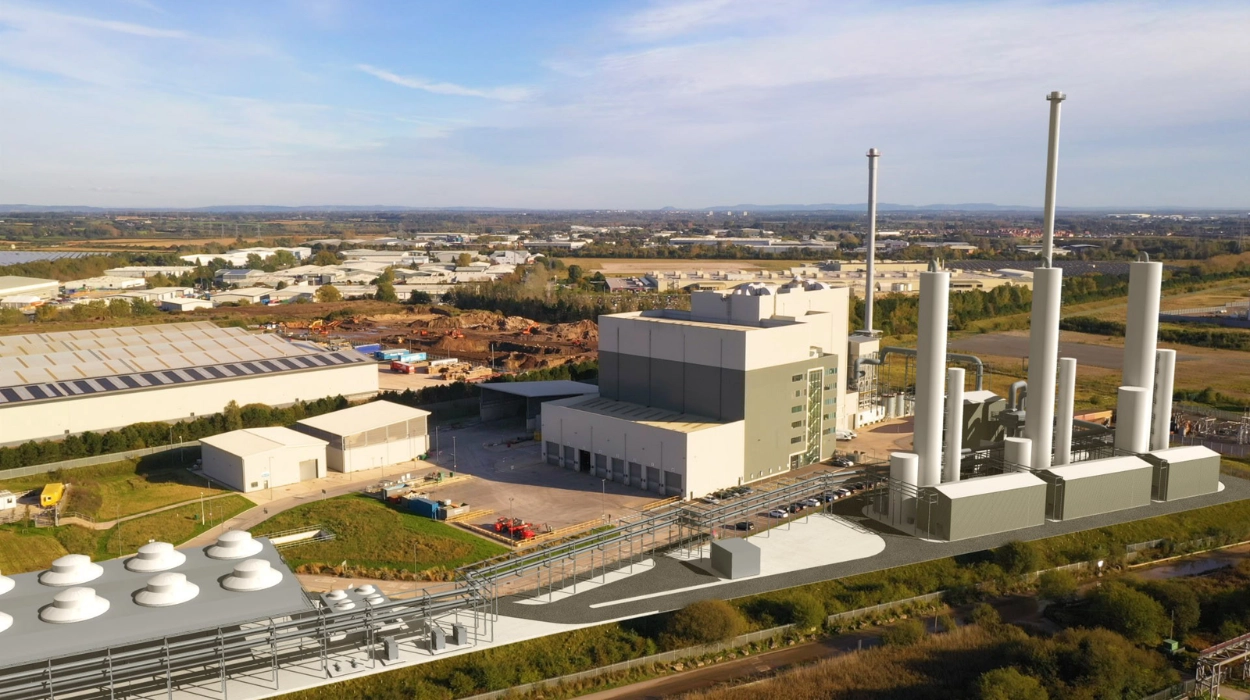
Key Points
- Flintshire County Council has granted planning permission for full-scale carbon capture technology at Enfinium’s Parc Adfer Energy from Waste (EfW) facility in Deeside, North Wales.
- The approval was granted by the council’s Planning Committee on 4 November 2026, marking a significant milestone for the proposed carbon capture and storage (CCS) development.
- Enfinium submitted its planning application on 24 October 2025, following public consultation with residents and regional stakeholders.
- The proposed development is expected to become Wales’s largest carbon removals project once operational.
- The carbon capture installation will collect carbon dioxide (CO2) from the facility’s exhaust gases, enabling it to be transported through the HyNet North West carbon transport and storage network.
- The captured CO2 is intended for permanent storage in depleted gas reservoirs beneath Liverpool Bay.
- The project has been shortlisted by the UK Government for connection to the HyNet North West network, which is currently under construction.
- Parc Adfer opened in 2019 through a partnership involving the five local authorities that make up the North Wales Residual Waste Treatment Partnership (NWRWTP).
- The existing facility has the capacity to process up to 232,000 tonnes of unrecyclable waste annually.
- Enfinium first announced its plans for full-scale carbon capture at Parc Adfer in April 2024, including a proposed investment of approximately £200 million.
- A carbon capture and storage pilot plant has been operating at Parc Adfer since April 2025, following its transfer from Enfinium’s Ferrybridge-1 facility in West Yorkshire.
- Mike Maudsley, Chief Executive of Enfinium, described the planning approval as an important milestone towards delivering Wales’s largest carbon removals project.
- Ben Burggraaf, Chief Executive of Net Zero Industry Wales, said the development could support industrial decarbonisation, low-carbon energy generation and the future competitiveness of Welsh manufacturing.
- The planning decision follows an earlier deferral in October 2026, when concerns were raised about consultation with communities and authorities across the border in England.
- The project is expected to support regional economic development, skilled employment and Wales’s wider clean energy transition.
Flintshire County Council has granted planning permission for Enfinium to install full-scale carbon capture technology at its Parc Adfer Energy from Waste facility in Deeside, North Wales, advancing a proposed development that aims to make the site Wales’s largest carbon removals project. Approved by the council’s Planning Committee on 4 November 2026, the decision allows the operator to progress plans to capture carbon dioxide from waste treatment operations and prepare it for permanent storage through the HyNet North West carbon transport and storage network. The project, which follows a planning application submitted in October 2025 and an earlier investment proposal of approximately £200 million, represents a significant development in the region’s industrial decarbonisation ambitions.
Why Has Parc Adfer Received Planning Permission for Carbon Capture?
The planning approval concerns the installation of full-scale carbon capture technology at Enfinium’s existing Parc Adfer Energy from Waste facility on Deeside Industrial Park in Flintshire.
According to the report published by letsrecycle.com on 6 November 2026, Flintshire County Council has approved the proposed installation following a planning application submitted by Enfinium on 24 October 2025. The application followed a public consultation involving residents and regional stakeholders.
The development is intended to capture carbon dioxide produced during the facility’s waste treatment operations rather than allowing all the relevant emissions to be released through the existing exhaust system.
As reported by Neil Tague of Place North West on 5 November 2026, the application involves constructing and operating a post-combustion carbon capture plant, alongside associated works, at the existing energy recovery facility. Tague also reported that the proposed installation would add approximately 21,600 square feet of plant infrastructure to the Parc Adfer site.
The proposed system would separate carbon dioxide from other gases in the facility’s exhaust emissions. The captured CO2 would then be compressed to prepare it for transportation through the proposed carbon transport infrastructure.
The approval is an important step for Enfinium because it moves the project beyond its initial planning and development stages towards the delivery of a full-scale industrial carbon capture installation.
However, planning permission for the carbon capture plant should be distinguished from approval and completion of the wider transportation and storage infrastructure. The project still depends on the development of the necessary network connection and the relevant arrangements for transporting and permanently storing the captured emissions.
How Will the Carbon Capture Technology Work at Parc Adfer?
The proposed carbon capture installation will be integrated into the existing Energy from Waste operation.
Energy from Waste facilities process residual waste that cannot be recycled through conventional recycling systems. During the treatment process, waste is combusted to generate energy, but the operation also produces exhaust gases containing carbon dioxide.
At Parc Adfer, the proposed technology is designed to separate carbon dioxide from the exhaust gases before the captured emissions are compressed and transported away from the site.
As explained in Place North West by Neil Tague, the development will involve a post-combustion carbon capture plant that separates CO2 from other exhaust gases. The captured material will then be compressed so that it can be transported through pipeline infrastructure.
The technology is intended to address emissions associated with the existing waste treatment operation without requiring the facility to abandon its energy recovery function.
An important element of the proposal is the connection with the HyNet North West carbon transport and storage network. This infrastructure is being developed to support the transportation and permanent storage of carbon dioxide generated by industrial facilities across the region.
The approach would allow Parc Adfer to continue treating residual waste while adding an emissions management system designed to capture carbon dioxide for geological storage.
The development is therefore relevant to the wider transition towards lower-carbon industrial operations, particularly where existing infrastructure continues to provide essential waste treatment and energy generation services.
Where Will the Captured Carbon Dioxide Be Transported and Stored?
The proposed destination for the captured carbon dioxide is Liverpool Bay, where depleted gas reservoirs are intended to provide permanent geological storage.
According to letsrecycle.com, the captured CO2 will be transported through the HyNet North West carbon transport and storage network, which is currently under construction in the region.
The project has also been shortlisted by the UK Government for connection to the network.
Once the necessary connection and transportation arrangements are established, the carbon dioxide captured at Parc Adfer will be moved through the network for permanent storage in depleted gas reservoirs beneath Liverpool Bay.
This connection is central to the project’s wider purpose. Capturing carbon dioxide at an industrial facility is only one stage of the process. The emissions must also be transported and stored securely if the development is to deliver the intended carbon removal benefits.
Enfinium’s proposal is therefore linked to the development of a wider regional carbon management infrastructure rather than being an isolated installation at a single waste treatment site.
The HyNet network is expected to provide a transportation and storage route for industrial carbon dioxide emissions in North West England and North Wales. Its development could support other industrial facilities seeking to reduce their carbon emissions through carbon capture and storage.
The UK Government’s shortlisting of the Parc Adfer project for a potential network connection is an important part of its development. Nevertheless, shortlisting should not be interpreted as confirmation that the network connection is already operational or that all the project’s remaining delivery arrangements have been completed.
What Is the Significance of Parc Adfer’s Existing Waste Treatment Operations?
Parc Adfer has been operating since 2019 and was developed through a partnership involving the five local authorities that make up the North Wales Residual Waste Treatment Partnership (NWRWTP).
According to letsrecycle.com, the facility has the capacity to process up to 232,000 tonnes of waste annually.
The facility was established to manage residual waste generated across the participating local authority areas. By processing waste that cannot be recycled through conventional systems, it provides an alternative to sending this material to landfill.
The development of carbon capture technology represents an additional stage in the site’s operational evolution.
Rather than replacing the existing waste treatment infrastructure, the proposed installation is intended to work alongside it. The objective is to address the carbon dioxide emissions associated with the facility while maintaining its role in the region’s waste management arrangements.
This distinction is important because the project combines two infrastructure functions: the treatment of residual waste and the management of carbon dioxide generated during that treatment.
In its 4 November 2026 announcement, Enfinium also highlighted the facility’s long-term role in serving communities across North Wales.
Mike Maudsley, Chief Executive of Enfinium, said that Parc Adfer was a state-of-the-art facility that would serve North Wales communities for decades. He also described its location and infrastructure as particularly suitable for supporting the successful operation of the HyNet carbon capture network.
The existing facility’s operational capacity and its proximity to the developing regional carbon network are therefore important considerations in the proposed expansion.
How Long Has Enfinium Been Developing the Parc Adfer Carbon Capture Project?
The carbon capture proposal has been under development for several years, with the latest planning approval representing a significant stage in a process that began before the submission of the formal application.
Enfinium first publicly announced its plans for a major carbon capture and storage investment at Parc Adfer in April 2024.
In an announcement dated 11 April 2024, Enfinium said it was progressing plans to invest approximately £200 million in carbon capture and storage technology at the Deeside facility.
The company stated that the proposed installation could capture up to 235,000 tonnes of CO2 annually. The investment proposal was presented as part of its efforts to develop carbon removal infrastructure and support the UK’s transition towards net zero.
Enfinium also explained that more than half of the waste processed at Parc Adfer was organic. The company said that capturing carbon dioxide from the facility could enable it to remove more CO2 from the atmosphere than it produced, subject to the project’s eventual performance and carbon accounting.
The company subsequently progressed its technical and planning preparations.
Following consultation with residents and regional stakeholders, Enfinium submitted its planning application to Flintshire County Council on 24 October 2025.
A carbon capture and storage pilot plant has also been operating at Parc Adfer since April 2025, following its transfer from Enfinium’s Ferrybridge-1 facility in West Yorkshire, as reported by letsrecycle.com.
The pilot operation has provided a basis for developing experience with carbon capture technology at the site before the proposed full-scale installation.
The planning application was therefore supported by an earlier investment proposal, consultation activity and pilot-stage development.
The approval granted in November 2026 advances the project into its next phase, although construction, network connection and the eventual commencement of full-scale operations remain separate delivery milestones.
Why Was the Parc Adfer Planning Decision Delayed in October 2026?
The planning approval followed an earlier delay involving consultation with communities and authorities across the border in England.
In its report published on 5 November 2026, Nation. Cymru reported that Flintshire’s planning committee had previously deferred consideration of the application after councillors raised questions about whether neighbouring communities in England had been directly consulted.
The communities mentioned included Burton, Shotwick and Puddington.
According to Nation. Cymru staff, senior planning officer Robin Wynne Williams told committee members at the earlier meeting: “We haven’t consulted directly with neighbouring communities or parish councils over the border.”
The concerns related to the cross-border implications of a major infrastructure development in North Wales, particularly given the geographical proximity of communities in England.
The application was subsequently reconsidered, with Flintshire County Council’s Planning Committee granting permission on 4 November 2026.
The sequence of events demonstrates the importance of consultation in major infrastructure planning, especially when proposed developments may have implications beyond the local authority area in which they are situated.
The eventual approval represents a planning milestone for Enfinium, although it does not remove the need to address the remaining technical, regulatory and infrastructure requirements associated with delivering the project.
What Have Enfinium and Net Zero Industry Wales Said About the Approval?
Enfinium and Net Zero Industry Wales have both described the planning decision as an important development for industrial decarbonisation in the region.
Mike Maudsley, Chief Executive of Enfinium, welcomed the council’s decision and described it as a significant milestone for the project.
As reported by letsrecycle.com on 6 November 2026, Maudsley said:
“We welcome Flintshire County Council’s decision to approve our plans to develop carbon capture at Parc Adfer. This is an important milestone for the project and demonstrates that we are making progress towards delivering Wales’s largest carbon removals project.”
Maudsley also highlighted the site’s existing infrastructure and its potential contribution to the HyNet network.
He said:
“As a state-of-the-art facility that will serve the communities of North Wales for decades to come, Parc Adfer is exceptionally well positioned to support the successful operation of the HyNet carbon capture network.”
He added that Enfinium remained committed to working with the UK and Welsh Governments and its partners to deliver the development and unlock its potential economic and environmental benefits for North Wales.
His comments underline the company’s intention to position Parc Adfer as part of the wider industrial carbon management infrastructure being developed in the region.
Ben Burggraaf, Chief Executive of Net Zero Industry Wales, also welcomed the approval.
According to letsrecycle.com, Burggraaf said:
“I’m delighted that Flintshire’s planning committee has approved the Parc Adfer CCS project planning application.”
He described the decarbonisation of the Energy from Waste industry in Wales as an important component of the country’s ambition to become a leading clean energy transition hub.
Burggraaf further said:
“This project will not only remove emissions from the atmosphere, but also produce low-carbon energy, to power our manufacturing industries in Wales and allow them to remain a cornerstone of the UK industrial base.”
His comments highlight the potential relationship between carbon capture infrastructure, low-carbon energy generation and the long-term competitiveness of Welsh manufacturing.
The statements from both executives reflect the project’s wider industrial significance, extending beyond the immediate operations of the Parc Adfer waste treatment facility.
What Could the Project Mean for Wales’s Clean Energy and Industrial Development?
The Parc Adfer development is intended to contribute to Wales’s broader efforts to reduce industrial emissions and expand its clean energy infrastructure.
Energy from Waste facilities have a role in managing residual waste, but their operations also present carbon management challenges. Installing carbon capture technology could provide an additional method of addressing emissions from facilities that continue to perform an essential waste treatment function.
The connection with HyNet North West is particularly relevant because the network is intended to provide the infrastructure required to transport and store carbon dioxide from industrial sites.
For North Wales, the project could help strengthen the region’s position within the developing carbon capture and storage industry.
It could also create opportunities for specialist engineering, construction, installation, maintenance and technical services as the development moves through its delivery stages.
The economic implications highlighted by Enfinium and Net Zero Industry Wales include the potential support of skilled employment, regional growth and industrial competitiveness.
In its 4 November announcement, Enfinium stated that the project could support skilled jobs and economic growth in the region while contributing to Wales’s efforts to develop a sustainable and circular economy.
The company’s longer-term ambition is to transform its Energy from Waste facilities into local decarbonisation hubs. Such facilities could potentially combine waste treatment, energy generation and carbon capture with other emerging low-carbon technologies.
However, the full extent of the project’s contribution will depend on its eventual construction, operational performance, access to transportation and storage infrastructure, and the wider development of the HyNet network.
The planning approval is an important step, but the environmental and economic benefits will ultimately need to be assessed against the project’s actual delivery and performance.
For organisations involved in industrial infrastructure, the development also illustrates the increasing importance of Environmental and Agriculture expertise, particularly in emissions management, environmental planning, sustainable waste treatment and industrial decarbonisation. The delivery of projects of this scale also requires coordination across Project Management, Construction and Civil Engineering, and Power Systems and Maintenance, as developers integrate new technology into existing operational facilities.
What Happens Next for the Parc Adfer Carbon Capture Development?
With planning permission granted, Enfinium can progress the development towards its next delivery stages.
The proposed carbon capture installation will need to move through the relevant engineering, construction, regulatory and commissioning processes before full-scale operations can begin.
The connection to the HyNet North West network will also remain a significant consideration. Although the Parc Adfer project has been shortlisted by the UK Government for connection, the wider network is still under construction.
The transportation and permanent storage arrangements must therefore progress alongside the development of the capture installation.
The project also forms part of a wider national effort to establish carbon capture and storage infrastructure capable of supporting industrial decarbonisation.
For Enfinium, the immediate significance of the November 2026 decision is that a major planning milestone has been achieved after the project underwent consultation and application procedures.
For Flintshire and the wider North Wales region, the proposal represents a potential addition to the area’s industrial and environmental infrastructure.
The project’s eventual success will depend on how effectively the carbon capture installation is integrated with Parc Adfer’s existing waste treatment operations and how quickly the supporting transportation and storage network becomes available.
The approval nevertheless places the proposed development in a stronger position as Enfinium continues working with the UK and Welsh Governments and its regional partners.
If delivered as intended, the project could establish Parc Adfer as a major centre for carbon removal in Wales while supporting the development of the region’s low-carbon industrial economy.