
Good onboarding training for new hires starts before day one, runs through the first 90 days and is built around the role, not a one-off welcome session. It combines a short induction (the practical and legal basics), role-specific training with a named person supporting it, and regular check-ins that show whether the new starter is becoming productive. This guide sets out what to include, in what order, and how to tell whether it is working.
TL;DR
- Treat induction as the first part of onboarding, not the whole of it. Induction covers the first days; onboarding runs from the offer through the first months.
- Plan in stages: before the start date, week one, days 30 to 60, days 60 to 90. Give each stage clear learning objectives and an owner.
- Structured, supported on-the-job training has the strongest research backing of the onboarding strategies reviewed so far.
- Deliver health, safety and compliance training early and in several short sessions, then refresh it.
- Measure time to productivity, retention and new-hire feedback, then change the programme based on what you find.
Table of Contents
- Onboarding, induction and orientation: what is the difference?
- Why a structured programme is worth the effort
- An onboarding training plan from offer to day 90
- What kind of training works best?
- In-person, remote or blended onboarding
- Health, safety and compliance training for new starters
- Keep learning going after induction
- How to evaluate onboarding training
- Where Oxford Centre fits
- FAQ
- Sources
Onboarding, induction and orientation: what is the difference?
The terms overlap, and in the UK they are often used interchangeably. The Chartered Institute of Personnel and Development describes induction as helping people learn about their new role and employer, including the organisation, the team and their responsibilities, and it notes that induction is sometimes called onboarding or orientation. So do not worry about the label your colleagues use. Worry about what the programme actually covers and how long it lasts.
The useful distinction is one of scope and time:
- Induction or orientation is the event-based part: introductions, workplace information, equipment, paperwork, employment conditions and essential training. In Queensland, for example, the state government’s guidance says induction begins when the employee starts.
- Onboarding is the longer process. The same guidance says it starts when the job is offered and covers cultural, role and social integration. The Association for Talent Development says onboarding should begin with the first contact with a new hire and continue through the first year, unlike orientation, which is usually an isolated single-day event.
The same ATD page breaks onboarding into three strands that make a handy checklist for your programme:
- Organisational: history, culture, policies and procedures.
- Social: team dynamics, key relationships, who to ask for what.
- Technical: how to perform the job tasks, with the tools and systems used.
Most weak programmes cover the first strand thoroughly (a stack of policies) and neglect the other two. A new starter who has signed every form but does not know who to ask about a customer problem is not onboarded.
Why a structured programme is worth the effort
The case rests on retention, speed to productivity and engagement.
- In a survey by the Society for Human Resource Management, organisations perceived effective onboarding as improving retention (52%), time to productivity (60%) and customer satisfaction (53%). These are perceptions from a 2010 US survey, so treat them as a direction rather than a promise.
- A 2024 meta-analysis of 83 field experiments found that newcomers who took part in a socialisation programme had 1.46 times higher odds of being retained than those in a control group. The authors argue the benefit is greatest when programmes address psychological needs: showing what effective task behaviour looks like, encouraging proactivity and helping social integration.
- APQC’s 2025 work found that a documented learning path is associated with less time to full productivity and higher employee satisfaction than spontaneous, unstructured learning.
The practical message: write the learning path down. If it lives in one manager’s head, it will vary from hire to hire, and the quality of someone’s first month will depend on luck.
An onboarding training plan from offer to day 90
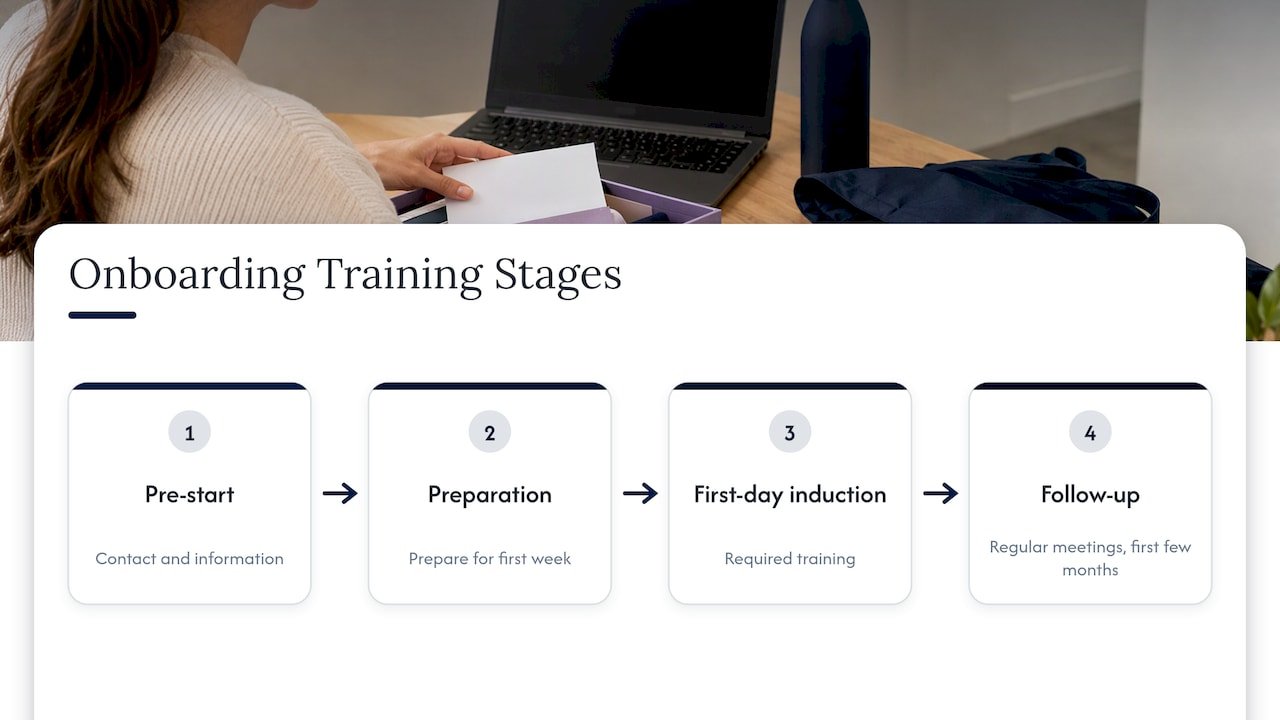
The Queensland guidance suggests a practical plan has four elements: contact and information before the start, preparation for the first week or two, first-day induction with required training, and regular follow-up meetings over the first few months. The University of California, Davis uses a 90-day framework with a similar logic. Combined, they give a plan you can adapt to any UK employer.
Before day one: offer to start date
This stage is cheap and often skipped. Use it to remove first-day friction and keep the new hire engaged.
- Send a short welcome pack: start time, location or login details, who they will meet, and what to wear or bring.
- Complete right-to-work checks and contract paperwork in advance, so day one is not spent on forms.
- Order equipment and set up accounts and access before they arrive.
- Name a line manager and a buddy, and tell the new hire who they are.
- Share a draft of their first-week timetable.
Week one to day 30: required training, purpose and relationships
UC Davis emphasises required training, role purpose and relationships for the first stage. In practice:
- Day one: welcome, tour, introductions, equipment, health and safety basics (fire exits, first aid, reporting an accident), and a conversation about what success looks like in the role.
- Week one: mandatory training that applies to everyone, such as data protection, information security, equality and conduct policies, plus the systems they will use daily.
- By day 30: a first review. Ask what is unclear, what they have learned, and what they still cannot do without help.
Give each module a learning objective phrased as something the person can do afterwards: “report a near miss using our form”, “log a customer complaint in the system”. Objectives like these are easy to check and easy to improve.
Days 30 to 60: applying knowledge
This stage moves from knowing to doing. UC Davis emphasises role-specific training, shadowing and feedback.
- Schedule role-specific technical training, ideally close to when the person will first use the skill.
- Arrange shadowing with experienced colleagues and then reverse it, with the new hire doing the task while someone observes.
- Hold fortnightly one-to-ones with specific feedback against the objectives you set.
Days 60 to 90: independence and review
The final stage emphasises increasingly independent work and a performance review.
- Hand over a real piece of work with a clear outcome.
- Review progress against the objectives set at the start, with the new hire’s own assessment first.
- Agree a development plan for the next six to twelve months, including any accredited or professional training.
Here is the whole plan on one page:
| Stage | Focus | Typical training | Owner |
|---|---|---|---|
| Before day one | Information and preparation | Welcome pack, access, schedule | HR and line manager |
| Week 1 to day 30 | Required training, purpose, relationships | Induction, compliance, systems | HR, manager, buddy |
| Days 30 to 60 | Applying knowledge | Role-specific training, shadowing, feedback | Manager and experienced colleagues |
| Days 60 to 90 | Independent work | Stretch tasks, review, development plan | Manager |
What kind of training works best?
A systematic review by Frögéli and colleagues found that structured and supported on-the-job training was the onboarding strategy with the strongest support to date, and the authors advise organisations to prioritise it and implement it well. That has practical consequences:
- Structure it. “Sit with Priya for a week” is not a training plan. Specify which tasks, in what order, with what checks.
- Support it. The person training the new hire needs time in their own workload, a short guide on how to coach, and recognition for doing it.
- Pair it with classroom or online learning for content that has to be consistent: regulations, safety procedures, technical standards and methods.
- Tailor it. ATD’s view is that onboarding should fit the employee’s role, responsibilities and learning needs rather than being a one-size-fits-all event. A site engineer, a nurse manager and a finance analyst need different technical strands, even if the organisational strand is shared.
In-person, remote or blended onboarding
In a 2023 survey of 730 respondents across 12 sectors, Shanker Menon found hybrid onboarding rated most effective, followed by virtual and then face-to-face. It is a single study, but it matches a common-sense pattern: put what benefits from presence (relationships, hands-on demonstrations, site walkthroughs) in person, and what benefits from flexibility (policy modules, system tutorials, knowledge checks) online.
For remote and hybrid teams, APQC suggests a structured plan is a necessary safeguard because the casual learning that happens when people sit near each other does not occur by itself. Make up for it deliberately:
- Book short daily check-ins in week one, then weekly.
- Schedule introductions with colleagues in other teams, not just their own.
- Record walkthroughs of key systems so new starters can replay them.
- Send equipment early and test the connection on a call before day one.
Health, safety and compliance training for new starters
Safety and compliance content cannot be optional or left until “things calm down”. The International Labour Organization says employers should give workers clear, easy-to-understand information on hazards, risks, control measures and emergency procedures, plus adequate safety and health training during work hours, free of charge. The same page stresses that new, inexperienced and young workers need an appropriate level of supervision, and that workers are at particular risk of injury in their first six months.
What to build in:
- Before exposure to hazards. US OSHA’s 2026 Safety Champions guide recommends training new hires before they are exposed to hazards, or within 30 days, whichever comes first. That is a US recommendation; for a UK workplace, confirm your own legal duties with the Health and Safety Executive or your competent safety adviser. A safe rule in any country is to train before the person does the risky task.
- Spread it out. ILO guidelines advise against cramming safety training into a single session and suggest several sessions to improve understanding and retention. The same document recommends site-specific induction before work starts and refreshers at least every six months for contractors’ workers.
- Buddy system for young or inexperienced workers. OSHA recommends a mentor or buddy so new young workers can learn the ropes and feel free to ask about unclear tasks.
- Record it. Keep a signed record that each item was explained, as in the orientation checklist that OSHA-funded work produced for young employees. It protects both parties and shows gaps.
If you employ people in security-sensitive, facilities or healthcare environments, add role-specific compliance. Topics such as workplace violence prevention and security awareness and threat prevention belong in the first weeks for staff who work with the public or on sensitive sites.
Keep learning going after induction
The knowledge from week one fades if nothing reinforces it. Plan refreshers at 30, 60 and 90 days: short quizzes, scenario discussions, or a manager asking “what would you do if…?” Give people access to material they can revisit. Ideas for building ongoing learning habits are covered in these professional development strategies, which suit the follow-up phase when spaced practice matters more than another orientation session.
How to evaluate onboarding training
A programme you never measure will drift. SHRM recommends evaluating onboarding with measures that suit your organisation: time to productivity, turnover and retention, retention thresholds, new-hire surveys, satisfaction and engagement, performance measures and informal feedback.
A simple evaluation routine:
- Set targets in advance. For example, “independently handling standard cases by day 60”.
- Collect evidence at 30, 60 and 90 days: manager assessment, new-hire survey, and performance data.
- Diagnose gaps. The US Office of Personnel Management’s evaluation guide advises comparing results with target standards, finding the causes when results fall short, then acting and communicating changes.
- Watch for known barriers. The same guide lists wrong participants, poor preparation, faulty methodology, low engagement and low relevance.
- Do not stop at smiles. Satisfaction scores matter, but they are not evidence of learning. Link feedback to the objectives you set.
Common mistakes to avoid
- Cramming everything into day one.
- Treating compliance content as the whole programme.
- Leaving the buddy or trainer unprepared and with no time.
- Using the same plan for every role.
- Never asking new hires what was missing.
Our view: build the plan around the work
We design training for organisations in project management, healthcare, oil and gas, civil engineering, IT, leadership, compliance and safety, and the pattern we see is consistent. Onboarding fails when it is generic. A new project coordinator and a new site supervisor need different technical content, different safety content and different milestones, yet many induction packs are identical.
That is why we build customisable programmes. We start with the tasks the new hire must perform, the standards that apply and the risks of the workplace, then choose the delivery format: on-site where hands-on practice matters, online where flexibility helps, or a blend of both. Our courses are globally accredited and led by expert trainers, so the technical strand of onboarding can be consistent across sites and countries.
We would also say this plainly: do not leave role training to chance. Structured, supported learning is what gets people productive, and external training is the quickest way to give a new starter a recognised foundation while your own experts focus on coaching.
Sam
Where Oxford Centre fits
If your onboarding plan needs accredited, role-specific training that your team does not have time to build, we can help. Oxford Centre provides professional training courses with global accreditation, customisable for corporate teams and delivered on-site, online or blended.
Browse our project management training, explore the full course catalogue, or see our top training courses. For facilities and healthcare environments, look at facilities management for healthcare environments. To talk through a tailored programme for your new starters, start from our homepage.
FAQ
How long should onboarding training for new hires last?
Plan for at least the first 90 days, with structured contact continuing through the first year. ATD says onboarding should continue through the first year, and frameworks such as the one from UC Davis break the first 90 days into three stages. The formal induction itself may take days, but the follow-up is where much of the learning happens.
What should a new hire training programme include?
Cover the organisational, social and technical strands: policies and culture, team relationships, and the skills and systems needed for the job. Add health, safety and any compliance training that applies to the role. Set a learning objective and an owner for each item.
Is induction the same as onboarding?
Not quite, though people often use the words interchangeably. CIPD notes the terms are not universal. A helpful working rule is that induction is the early, event-based introduction to the job and workplace, while onboarding is the longer process that starts at the offer and continues through the first months.
Can we onboard remote staff effectively?
Yes, with more structure. Menon’s study rated hybrid onboarding highest, and APQC argues that a documented plan makes up for the missing casual learning of a shared office. Use scheduled check-ins, recorded walkthroughs and named contacts in other teams.
How do we know if onboarding is working?
Track time to productivity, retention, new-hire feedback and performance against targets you set in advance. SHRM lists these among its recommended measures. Then act on gaps, rather than only collecting opinions.
Sources
- Employee induction, CIPD
- Staff onboarding and inductions, Business Queensland
- What Is Onboarding? ATD
- Maximizing Success, SHRM
- Unpacking the Effects of Socialization Programs on Newcomer Retention
- What Makes a Good Onboarding Experience? APQC
- The First 90 Days, UC Davis
- Effectiveness of formal onboarding for facilitating newcomer socialization
- Effectiveness of Virtual Onboarding
- Workers, ILO
- Safety Champions Step Guide, OSHA
- Safety and health guidelines, ILO
- Young Workers: Employer Responsibilities, OSHA
- Young Employee Safety Orientation Checklist, OSHA
- How to Measure Onboarding Success, SHRM
- Training Evaluation Field Guide, OPM