
Complete conflict management training gives managers the skills to spot escalation early, de-escalate difficult conversations and mediate disputes toward a fair outcome. First-line managers, HR practitioners and team leads benefit most, since they handle the bulk of day-to-day friction. Courses are available as accredited on-site, online or blended programmes, so organisations can match delivery to team size and schedule.
TL;DR:
- Effective training emphasizes role-play and simulation, with research showing skills improvement lasting over three years when practice is prioritized.
- Courses should cover negotiation, mediation, and dispute resolution, with assessment including observed exercises rather than solely lecture-based learning.
- Smaller cohorts and in-house delivery allow more personalized practice, which significantly increases skill transfer and retention.
- Trainers with real workplace experience and recognized certifications deliver better outcomes by providing practical feedback during simulated scenarios.
- Supplementary resources like workbooks, scripts, and follow-up coaching are crucial for embedding conflict management skills into daily work practice.
Table of Contents
- Course overview: aims, outcomes and typical syllabus
- Who should attend and how different roles benefit
- Syllabus, learning methods and assessment
- Delivery formats and typical duration, costing cues
- Evidence and outcomes: what research shows about training effectiveness
- How to choose a conflict management course (practical checklist)
- Case studies: what successful conflict resolution looks like after training
- Trainer qualifications and expertise
- Tools and resources provided during or after training
- Publisher perspective: how we frame conflict management training
- Oxford Centre training: next step and how to book
- FAQ
- Sources
Course overview: aims, outcomes and typical syllabus
A conflict management course aims to turn abstract advice like “stay calm” into a repeatable set of actions a manager can use under pressure. By the end of a structured programme, participants should be able to diagnose the root cause of a dispute rather than just react to its symptoms, apply de-escalation language in a tense conversation and run a basic mediation session between two colleagues.
Most syllabuses build toward these outcomes through a consistent set of modules:
- Conflict dynamics and the typical stages a disagreement passes through before it escalates.
- Communication techniques for de-escalation, including tone, listening and framing.
- Negotiation fundamentals for reaching workable compromises.
- Mediation skills for facilitating a conversation between two other people.
- Alternative dispute resolution (ADR) approaches used when formal mediation stalls.
- Practical scenarios that mix these skills together, mirroring real workplace friction.
On the job, this translates into fewer disputes reaching formal grievance stages, calmer one-to-ones and managers who address tension before it affects a whole team, demonstrating how konfliktlösning i arbetsmiljö positively impacts the workplace climate.
Who should attend and how different roles benefit
Conflict management training suits anyone whose role involves managing people, mediating between colleagues or absorbing customer frustration. The specific gains differ by function, which is worth raising early in any internal business case.
- Line managers gain de-escalation techniques for day-to-day friction within their own teams.
- HR professionals gain structured mediation skills for formal disputes and grievance conversations.
- Team leads gain the confidence to intervene before a disagreement affects wider team morale.
- Client-facing staff gain scripts and techniques for defusing frustrated customers or stakeholders.
Where several people from the same department need the same skills, bespoke in-house delivery is usually more cost-effective than booking individual places on a public course, and it lets the trainer use examples drawn from the organisation’s own situations.
Syllabus, learning methods and assessment
Effective conflict management training rarely relies on lecture-style delivery alone. The syllabus typically covers negotiation, mediation, ADR, techniques for managing anger and the phases of escalation, from early tension through to open conflict and eventual resolution or breakdown.
What distinguishes a strong course is how that content is taught:
- Role-play, where participants act out a disputed scenario rather than just discuss it.
- Simulation, placing a small group inside a realistic, higher-stakes conflict situation.
- Peer feedback, where colleagues observe and comment on each other’s handling of a scenario.
- Self-reflection, where participants review their own performance against specific behavioural criteria.
Assessment commonly combines a practical observed exercise, such as running a short mediation, with a written or verbal reflection on what worked and what did not. Accredited awards usually require both elements before certification is issued, rather than attendance alone.
Pro Tip: Ask a prospective provider how much of the course is role-play versus lecture before booking: a ratio weighted toward practice is a reliable sign of a well-designed programme.
Delivery formats and typical duration, costing cues
Conflict management training is offered in several shapes, and the right one depends on how many people need training and how quickly.
- One-day workshops suit teams wanting a fast introduction to de-escalation and communication basics.
- Level 2 or Level 3 awards suit managers wanting a recognised, assessed qualification.
- Online modules suit individuals or distributed teams who need flexible, self-paced study.
- Blended programmes combine online theory with in-person or live virtual practice sessions.
Cohort size matters: smaller groups allow more role-play time per person, while larger public courses are usually cheaper per delegate. Bespoke in-house delivery costs more upfront but can be tailored to an organisation’s own disputes and often includes follow-up coaching. Pricing is generally structured either per delegate for open courses or as a fixed corporate booking fee for in-house sessions, with the path to a full certification typically running from a single day to several weeks depending on the award level.
Evidence and outcomes: what research shows about training effectiveness
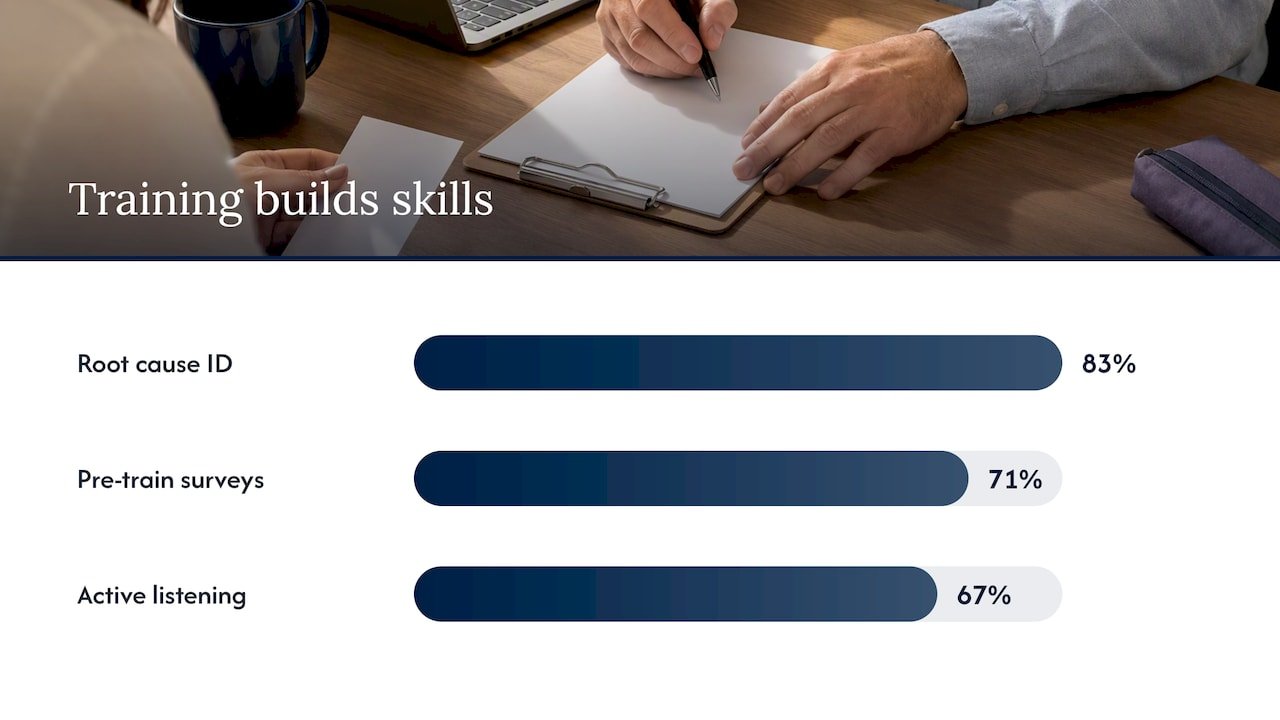
A 2026 mixed-methods evaluation of a structured conflict management programme found statistically significant improvements across measured skills, with change sustained over three years. The evaluation covered several hundred participants across multiple sites, with 71% completing pre-training questionnaires, and reported improvements at p < 0.004 across measured domains, alongside a note that tiered programmes in high-stakes sectors need senior sponsorship and integration into HR processes to hold.
A separate university-based multidisciplinary protocol using immersive role-play and structured reflection produced significant gains across assessed skills with strong statistical support, with immediate post-training scores rising across all measured items, a result the researchers describe as generalisable to other high-stress professional contexts.
A 2024 study of a LEARN, PRACTICE, REFLECT training sequence reported that a substantial portion of participants showed a significant increase in confidence after practice, with the most common strategies used afterward being:
- Identifying the root cause of the disagreement (83% of participants).
- Actively listening to the other party (67% of participants).
- Making specific, objective statements rather than generalised accusations.
Across all three findings, the pattern is consistent: training built around immersive practice and structured reflection correlates with better observed performance than content delivered through lecture alone.
How to choose a conflict management course (practical checklist)
Shortlisting providers is faster with a fixed checklist rather than comparing marketing pages against each other.
- Confirm the course carries recognised accreditation, not just an internal certificate.
- Check the syllabus covers negotiation, mediation and ADR, not communication skills alone.
- Ask what proportion of the course is experiential practice versus lecture.
- Review trainer credentials and relevant sector experience.
- Ask about typical cohort size and how much individual role-play time that allows.
- Confirm how assessment works and what happens after the course ends.
Questions worth putting to a supplier directly include how realistic their practical scenarios are, whether assessment is observed or self-reported, and how much content can be customised to the organisation’s own disputes.
Pro Tip: Treat a course with no practical assessment and vague learning outcomes as a red flag, since it usually signals lecture-only delivery rather than skills that transfer to real conversations.
Case studies: what successful conflict resolution looks like after training
The clearest evidence of a course working is behaviour that holds months later, not just confidence on the final day. In the 2026 structured programme evaluation, researchers tracked participants for three years and found the improvements measured immediately after training were still present, which is a stronger result than most short post-course surveys can show.
The pattern repeats in the practice-led multidisciplinary protocol study: participants who rehearsed a disputed scenario through role-play, then reflected on their own performance with structured prompts, scored significantly higher immediately afterward than they had before training. The mechanism researchers point to is not the information delivered but the rehearsal itself: practising a difficult conversation in a low-stakes setting before facing the real one.
For managers, the practical takeaway is that a course succeeds when a participant can later recall a specific technique, such as naming the other person’s underlying concern before responding, and use it in an actual disagreement rather than only in the training room. Courses that build in follow-up coaching or refresher sessions tend to protect that transfer better than a single standalone workshop, since skills learned under role-play conditions can fade without a chance to apply them soon after.
Trainer qualifications and expertise
The quality of a conflict management course depends heavily on who delivers it, since facilitating role-play and giving useful feedback on a mediation attempt requires different skills from presenting slides. Strong trainers typically combine a recognised teaching or coaching qualification with direct experience applying mediation or negotiation in a real workplace setting, rather than purely academic exposure to the theory.
SHRM guidance treats conflict management as a core competency area and notes that training built around it can count toward professional development credits for ongoing certification, which gives HR buyers a useful reference point when assessing whether a trainer’s background meets a recognised standard. Asking a provider directly about a trainer’s sector experience, their approach to giving feedback during role-play and how many groups they have facilitated is a reasonable way to judge quality before booking, since a glossy course outline says little about how well a trainer manages the room during a difficult simulated scenario.
Tools and resources provided during or after training
A well-structured course rarely ends when the session does. Many programmes provide a syllabus or workbook covering the core frameworks used, such as the phases of escalation and the negotiation and mediation techniques practised during role-play, so participants have a reference to revisit after returning to work.
Some providers also issue practical templates: scripts for opening a difficult conversation, checklists for running a basic mediation session, or frameworks for identifying the root cause of a dispute before responding. SHRM’s own teaching materials illustrate this approach, combining negotiation exercises, mediation checklists and ADR guidance that scale from short sessions to multi-day workshops.
Where a course includes follow-up coaching or refresher access, that resource matters more than any workbook, since a single rehearsal rarely embeds a new habit on its own. When comparing providers, it is worth asking specifically what participants take away beyond a certificate: a workbook they can reference in the moment is more useful than a slide deck filed away and never opened again.

Publisher perspective: how we frame conflict management training
We offer professional training courses across sectors including project management, healthcare, oil and gas and civil engineering, and conflict management sits alongside that work as a skill every manager eventually needs. Our focus stays on customisable content and flexible, accredited delivery formats that fit how a specific team actually operates, rather than a fixed script applied to every organisation.
— Sam
Oxford Centre training: next step and how to book
We build our courses around customisable modules, expert-led delivery and accredited formats that flex between on-site, online and blended learning, so a conflict management programme can sit inside a wider leadership or compliance curriculum rather than standing apart from it. Where your organisation already has one of our courses in mind, our project management training page is a practical starting point for booking and scoping a cohort.
If you are not yet sure which course fits your team, our full course catalogue sets out the sectors and delivery formats we cover, so you can check availability and get a quote tailored to your group size and timeline.
FAQ
What are the 5 C’s of conflict management?
Definitions vary across providers, but a common version covers Communication, Collaboration, Compromise, Control and Commitment, five behaviours trainers encourage when a dispute is unfolding. Courses generally teach these as practical habits through role-play rather than as a memorised list.
What are 5 conflict management techniques?
Commonly taught techniques include active listening, identifying the root cause of a disagreement, using specific and objective statements rather than generalised accusations, structured negotiation and formal mediation. A 2024 study found that after practice-based training, 83% of participants tried identifying root causes and 67% actively listened as their go-to strategies.
What are the 5 steps of conflict management?
A typical sequence runs: recognise the early signs of tension, understand each side’s underlying concern, communicate using de-escalation language, negotiate toward a workable compromise and follow up to confirm the resolution holds. Training usually rehearses each step through a realistic scenario rather than teaching it as theory alone.
What are the 7 strategies for managing conflict?
Common strategies taught across courses include active listening, identifying root causes, using objective language, negotiation, mediation, alternative dispute resolution and structured reflection after a difficult conversation. The exact list varies by provider, but these seven appear consistently across the syllabuses and studies referenced in this guide.
How much does conflict management training typically cost?
Pricing depends on delivery format and whether a course is booked per delegate or as a fixed in-house session for a whole team. We do not publish a fixed price for our own conflict management content, so cost is available on request through our course page.