
Key Points
- The UK Government is expected to approve the Jackdaw gas field for production on 15 September 2026, according to reporting by The Times, citing government sources.
- Energy Secretary Miatta Fahnbulleh is expected to give the formal approval, with Prime Minister Andy Burnham expected to address the decision during a visit to Aberdeen.
- Jackdaw is operated by Adura, the joint venture formed by Shell and Equinor for their UK offshore oil and gas operations.
- The field could begin producing gas as early as this winter because much of the required infrastructure has already been constructed.
- Adura says Jackdaw could reach peak production of approximately 40,000 barrels of oil equivalent per day and contribute about 6% of UK gas supply.
- The project has faced years of legal and regulatory delays after environmental campaigners challenged the original approval.
- A 2025 legal ruling required fresh government consent before production could proceed.
- Rising energy prices and concerns about UK energy security have increased the political significance of the decision.
- US President Donald Trump has publicly urged Prime Minister Andy Burnham to increase North Sea drilling to help reduce energy costs.
- The UK Government has stressed that the North Sea remains an important national asset while maintaining its commitment to the transition towards cleaner energy.
- Environmental campaigners, including Friends of the Earth, have criticised the expected approval, while Conservative politicians and trade unions have backed further North Sea development.
- The decision on the Rosebank oil field is expected separately, with The Times reporting that approval is considered unlikely at this stage.
- Adura has said Jackdaw and Rosebank together could generate £1.4 billion in tax revenues by 2029, while its wider estimates put combined economic value at billions of pounds.
UK Set to Clear Jackdaw Gas Field for Production
Britain is expected to approve the development of the Jackdaw gas field in the North Sea on 15 September, potentially clearing the way for production to begin this winter after years of legal disputes, environmental scrutiny and regulatory delays.
The expected decision was first reported by The Times, which cited government sources. Political editor Steven Swinford reported that Energy Secretary Miatta Fahnbulleh is expected to give the green light to the gas project. In contrast, Prime Minister Andy Burnham is expected to discuss the decision during a visit to Aberdeen.
The development would represent an important test of Burnham’s approach to the UK’s energy policy. The Prime Minister has sought to present his position as pragmatic, arguing that oil and gas will remain part of the UK’s energy mix for years while the country moves towards cleaner sources of energy.
Offshore Engineer, in its report published on 7 September and based on Reuters reporting, also said Britain was expected to approve Jackdaw on 15 September. Reuters reporters Sam Tabahriti and Shadia Nasralla, with additional reporting by Stephanie Kelly, wrote the report, while Sarah Young and William James handled the writing and Barbara Lewis edited it.
The expected approval comes as Britain faces continuing concerns over energy prices and domestic supply. The government has not formally confirmed the decision, and an energy department spokesperson told Reuters that officials would not comment on speculation, while describing the North Sea as a “vital national asset”.
Why is the UK expected to approve the Jackdaw gas field?
The Jackdaw decision has become closely linked to Britain’s energy-security debate.
According to Offshore Engineer‘s Reuters report, rising energy prices are affecting households and businesses and have been placing pressure on the British economy. The report also noted that US President Donald Trump has publicly encouraged Burnham to increase drilling in the North Sea, arguing that greater domestic production could help reduce costs.
The expected approval would also fit with Burnham’s stated intention to adopt a pragmatic position on energy. Rather than immediately ending Britain’s reliance on hydrocarbons, the Prime Minister has indicated that oil and gas will remain part of the energy system while the country continues its transition towards cleaner energy.
The Times, in reporting by Steven Swinford, said the Government is expected to frame Jackdaw as part of a broader approach to balancing energy security, employment and the transition towards net zero. The expected announcement is also likely to be accompanied by new renewable-energy investment, potentially including funding for wind power and activity associated with GB Energy in Aberdeen.
The timing is particularly significant because Jackdaw is much further advanced than many proposed offshore developments.
What is the Jackdaw gas field and who operates it?
Jackdaw is a gas and condensate development in the Central North Sea, approximately 250 kilometres east of Aberdeen and close to the UK-Norway median line.
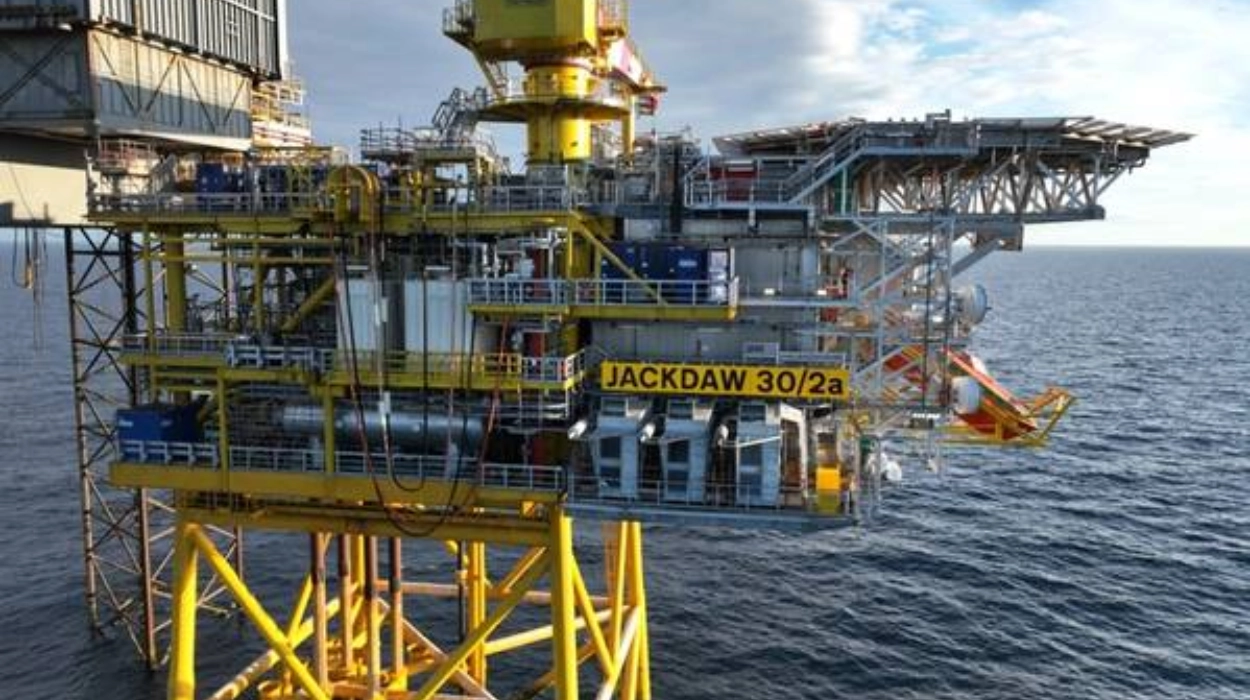
The project is now operated by Adura, the offshore joint venture created by Shell and Equinor. Shell’s own project documentation says the field covers UK Continental Shelf blocks 30/02a, 30/03a and 30/02d, with the development located in water approximately 78 metres deep.
The development consists of a normally unattended wellhead platform containing four wells. The platform is connected to the existing Shearwater hub through a 31-kilometre pipeline.
According to Shell, the steel jacket was installed in August 2023, and the topsides were installed in October 2025. The pipeline was laid in July 2024, while the wells have reached an advanced stage of drilling.
That level of construction means the project is not starting from scratch. Much of the infrastructure required to bring Jackdaw into production is already in place.
Shell said in its 2025 annual report that Jackdaw was expected to become operational in the fourth quarter of 2026, subject to regulatory approval. It also said work had continued after a Scottish court allowed the project to progress while new consents were sought.
How much gas could Jackdaw produce?
Adura has said Jackdaw could reach peak production of around 40,000 barrels of oil equivalent per day, with the output consisting primarily of natural gas.
An offshore engineer, citing Reuters and Adura, reported that the field could contribute approximately 6% of Britain’s gas supply. The field is located around 150 miles, or 241 kilometres, off Aberdeen.
The scale of Jackdaw has also been placed in context with other North Sea developments. Reuters reported that the Rosebank field, if approved, could produce around 70,000 barrels of oil equivalent per day, predominantly oil. By comparison, Norway’s much larger Johan Sverdrup field produces more than ten times Rosebank’s projected daily output.
The figures illustrate that Jackdaw is not a major field by global standards, but its potential contribution is significant in the context of Britain’s declining domestic gas production.
North Sea fossil-fuel production has fallen substantially from its peak in the late 1990s, making individual new developments more politically significant as the UK continues to consume natural gas while reducing domestic production.
Why has Jackdaw faced legal delays?
Jackdaw was originally approved by the previous Conservative government in 2022. Environmental campaigners subsequently challenged the approval process alongside the challenge against Rosebank.
The legal disputes centred on how the environmental consequences of producing and subsequently burning the oil and gas should be assessed.
A subsequent court ruling meant the projects could not proceed to production under their existing approvals without further government consent and updated environmental assessments.
The legal process has consequently added years to the development timeline.
In January 2025, Shell said the Scottish Court had ruled that work on Jackdaw could continue while new consents were being sought. Shell said it had already spent more than £800 million on the project at that stage and argued that swift government action was required.
The UK Government’s official Jackdaw records show that the regulatory process has continued through 2026, with additional information and public representations being incorporated into the assessment. The Government updated its Jackdaw development records as recently as 2 September 2026.
The current decision therefore concerns whether the revised environmental and regulatory requirements have been sufficiently addressed to permit production.
When could Jackdaw start producing gas?
If approval is granted, Jackdaw could begin production during the coming winter.
The project’s advanced construction status is central to that timetable. According to Reuters’ report published by Offshore Engineer, much of the infrastructure required for production has already been built.
Earlier in July, Neil McCulloch, chief executive of Adura, told BBC News that the project was in its final stages and could provide around 6% of UK gas demand from 1 October.
In reporting by James Cook, BBC Scotland’s environment and energy coverage said McCulloch described government approval as “hyper critical” in the context of potential winter supply risks. McCulloch warned that Britain could have limited options during a serious gas-supply emergency.
McCulloch’s comments were made while the regulatory review of Jackdaw and Rosebank was continuing. Environmental campaigners, however, disputed the argument that additional fossil-fuel production was the appropriate response to Britain’s energy challenges.
What does Adura say about Jackdaw’s economic benefits?
Adura has consistently argued that Jackdaw and Rosebank would provide significant economic and energy-security benefits.
In August, Adura said the public consultation on Jackdaw had closed after stakeholders were allowed to submit representations. The company said the two projects represented a combined anticipated investment of £10.8 billion and could generate £28.7 billion in gross value added over their producing lifespans.
Adura chief executive Neil McCulloch said the projects could strengthen energy security, sustain skilled jobs and apprenticeships, support businesses and generate economic activity and tax revenues.
The company also argued that domestic production could have lower associated carbon emissions than alternatives such as imported liquefied natural gas.
In the latest Reuters report, Adura estimated that developing Jackdaw and Rosebank together could generate approximately £1.4 billion in tax revenues by 2029.
Adura’s position has therefore focused on three main arguments: domestic energy supply, economic activity and employment.
What are environmental campaigners saying about Jackdaw?
Environmental groups have strongly opposed further North Sea fossil-fuel development.
Friends of the Earth described the expected Jackdaw approval as “a staggering step backwards”, according to Offshore Engineer‘s Reuters report.
Other environmental campaigners have argued that approving new oil and gas projects conflicts with the UK’s climate commitments.
BBC reporting by Kevin Keane, Scotland environment, energy and rural affairs correspondent, has also highlighted opposition from groups including Uplift. Uplift’s Isobel Reid argued that new drilling would contribute to climate change and pointed to extreme heat and wildfires as evidence of the consequences of continued fossil-fuel use.
The dispute therefore remains centred on whether domestic gas production should be expanded during the energy transition or whether investment and policy should move more rapidly towards renewable energy and reduced fossil-fuel consumption.
What will happen to the Rosebank oil field?
Jackdaw and Rosebank have frequently been discussed together because both developments are being advanced by Adura and both have been affected by the legal challenges over their original approvals.
However, the two projects are now expected to receive different treatment.
According to The Times and Steven Swinford’s reporting, the Government is expected to approve Jackdaw while delaying the decision on Rosebank. Government sources cited by the newspaper reportedly consider Rosebank’s approval much less likely, partly because Rosebank is predominantly an oil project whereas Jackdaw is focused on gas.
Reuters also reported that Rosebank could reach peak production of around 70,000 barrels per day, mainly oil, if approved.
The distinction is politically important because the Government can argue that domestic gas production has a more direct role in meeting Britain’s energy needs than new oil production, while still facing opposition from environmental groups over both developments.
Why is the Jackdaw decision important for UK energy policy?
The expected decision places the Burnham Government at the centre of a difficult debate between energy security, economic considerations and climate policy.
The Conservative opposition has supported further development of Britain’s North Sea resources on energy-security grounds. Trade unions have also called for approval of the projects, pointing to the importance of offshore oil and gas activity for employment and industrial supply chains.
At the same time, the Government remains committed to expanding cleaner energy sources.
The Times reported that Burnham’s expected Jackdaw announcement could be accompanied by new renewable-energy commitments, including possible investment in wind generation and the development of GB Energy’s Aberdeen headquarters.
That combination reflects the Government’s attempt to position the decision not as a rejection of the energy transition, but as part of a broader strategy in which existing fossil-fuel infrastructure continues tooperate while renewable capacity expands.
For professionals working across offshore exploration, production, energy infrastructure, regulation and operational risk, the development also demonstrates how energy projects increasingly require expertise spanning Oil and Gas, environmental assessment, project governance, regulatory compliance and energy transition.
What happens next for Jackdaw?
The immediate next step is the expected ministerial decision on 15 September 2026.
If the approval is granted, Adura will be able to move towards bringing Jackdaw into production, with the field potentially supplying gas during the coming winter.
The regulatory process is not simply a matter of political approval. Official Government documentation confirms that the project has been subject to environmental assessment and public consultation, with the Secretary of State’s agreement required before the relevant regulator can grant consent.
The decision will therefore have implications beyond the Jackdaw field itself. It will indicate how the Burnham Government intends to balance domestic oil and gas production with its clean-energy commitments, particularly after the legal challenges that overturned earlier approvals.
For the North Sea industry, Jackdaw is also significant because its infrastructure is already substantially developed. For consumers and policymakers, its importance will be judged against the wider questions of domestic supply, energy prices and the UK’s dependence on imported gas.
The field is not large by international standards, but its potential contribution of around 6% of British gas supply gives the decision significance at a time when the Government is attempting to address both energy security and the long-term transition away from fossil fuels.
s Britain moves towards the expected September decision, the Jackdaw case is likely to remain a focal point in the wider debate over the future of the North Sea, the country’s energy security and the practical pace of the UK’s transition to cleaner energy.