
A training needs analysis is a structured process that identifies the gap between required and current performance, and whether training is the right way to close it. It produces a training brief: who needs development, what they need to learn, and under what constraints, following the distinction the CDC’s needs analysis guidance draws between a broader needs assessment and a focused TNA, a framing CIPD also uses.
TL;DR:
- A training needs analysis must confirm that the performance gap is caused by a capability issue, not systemic, policy, or resourcing problems.
- Conducting organizational, task, and individual analyses ensures the identified training needs are accurate and prevent misleading recommendations.
- The process should produce a decision record documenting the gap, evidence, cause, and targeted intervention to avoid unnecessary or ineffective courses.
- Using multiple evidence collection methods and piloting tools increase data reliability and reduce bias in identifying actual performance gaps.
- Prioritizing needs based on impact, urgency, and feasibility helps allocate resources to the most significant and actionable training opportunities.
Table of Contents
- What a training needs analysis is, and how it differs from a learning needs analysis
- The three levels of a training needs analysis and why each matters
- A practical five-step TNA process HR can follow today
- Methods and instruments for collecting evidence
- Analysing gaps and deciding when training is (and isn’t) the answer
- Prioritisation and planning: turning findings into a roadmap
- From analysis to design: outcomes, delivery and evaluation
- A worked example and a compact template
- Common pitfalls and quick wins for busy L&D teams
- How we turn a training needs analysis into accredited, measurable training
- FAQ
- Sources
What a training needs analysis is, and how it differs from a learning needs analysis
A needs assessment asks a broad question: is there a performance problem, and why? A training needs analysis answers a narrower one, assuming training might help: who needs it, what they need to learn, and when and where delivery should happen. The CDC’s guidance on assessing training needs draws this line deliberately, because skipping the first question leads teams to build courses for problems that training cannot fix, such as a broken process or an unclear policy.
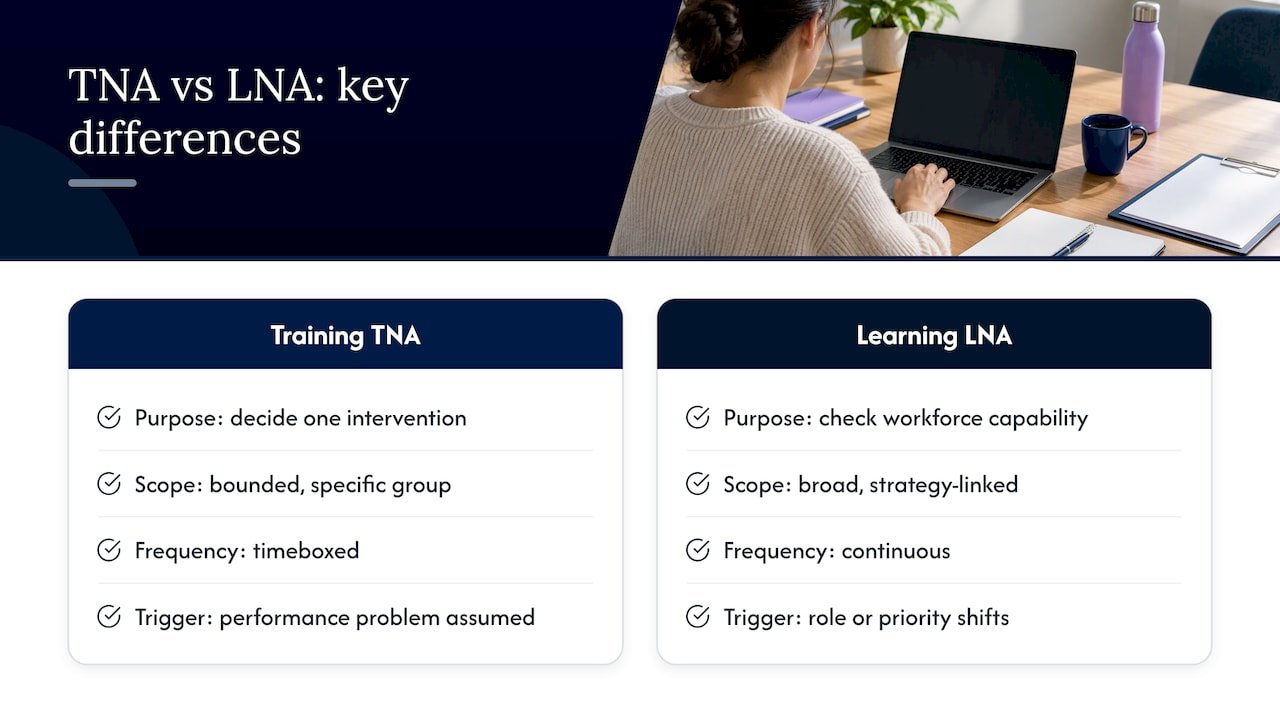
CIPD’s factsheet on learning needs analysis adds a second useful distinction. A learning needs analysis (LNA) is ongoing: a continuing check on workforce capability tied to strategy, refreshed as roles and priorities shift. A training needs analysis is bounded: it exists to decide on one intervention, for one group, within one timeframe. Treating the two as interchangeable is a common source of scope creep, where a single course request turns into an open-ended capability review with no clear end point.
A well-run TNA produces four concrete outputs: a set of learning outcomes stated as observable behaviour, a learner profile describing who needs the training and their starting point, a list of constraints (budget, time, delivery format, regulatory requirements), and a decision record that states why training was chosen over any alternative. Without these four, even thorough data collection rarely converts into a usable brief for whoever designs or commissions the course.
The three levels of a training needs analysis and why each matters
Every TNA worth doing works at three levels, and skipping one is the most common reason recommendations miss the mark.
Organisational analysis looks at where the business is heading and what capability that requires. It draws on strategy documents, workforce plans and resourcing data, and the relevant stakeholders are usually senior leaders and workforce planners. Task or job analysis breaks a role down into its component tasks and maps each to the knowledge, skills and attitudes (KSAs) it demands, drawing on job descriptions, competency frameworks and input from supervisors who know the work in detail. Individual analysis compares specific people or teams against the standard the task analysis has set, using performance records, assessments and manager observation to find who meets the bar and who does not.
Aligning the three levels matters because a gap visible at one level can be invisible, or misleading, at another. A team might show strong individual competence while the organisational analysis reveals the whole function is being asked to do something it was never resourced for, in which case the right fix is staffing or tooling, not a course. Running all three, even briefly, keeps a TNA from producing a training plan that treats a structural problem as a skills problem.
A practical five-step TNA process HR can follow today
The sequence below mirrors the structure both the EUAA’s training needs analysis manual and the CDC’s needs assessment checklist recommend: plan and define, collect evidence, analyse and test the cause, prioritise, then specify and act.
- Define required performance and scope. State the standard people are expected to meet, for which role or team, and over what timeframe, using job descriptions, strategy documents and KPIs as your baseline.
- Assess current competence and collect evidence. Gather data on how people are actually performing against that standard, using a mix of methods rather than a single survey.
- Analyse the gap and test whether training is the right remedy. Ask what people must do, what they are doing now, why the gap exists, and whether the cause is a capability issue or something else, following the diagnostic approach the CDC sets out.
- Prioritise using impact, urgency and feasibility. Not every confirmed gap deserves equal resource; rank them so budget and attention go to the needs that matter most.
- Specify, approve, implement and review. Write the training brief, get sign-off, commission or deliver the intervention, and set a review point to check whether it actually closed the gap.
The CDC checklist is explicit that step three is not optional: a TNA checklist exists partly to stop teams from commissioning training before confirming training can address the root cause. The EUAA manual’s five-phase methodology follows a similar arc and is built around producing a prioritised training plan as the end deliverable, not a list of raised requests.
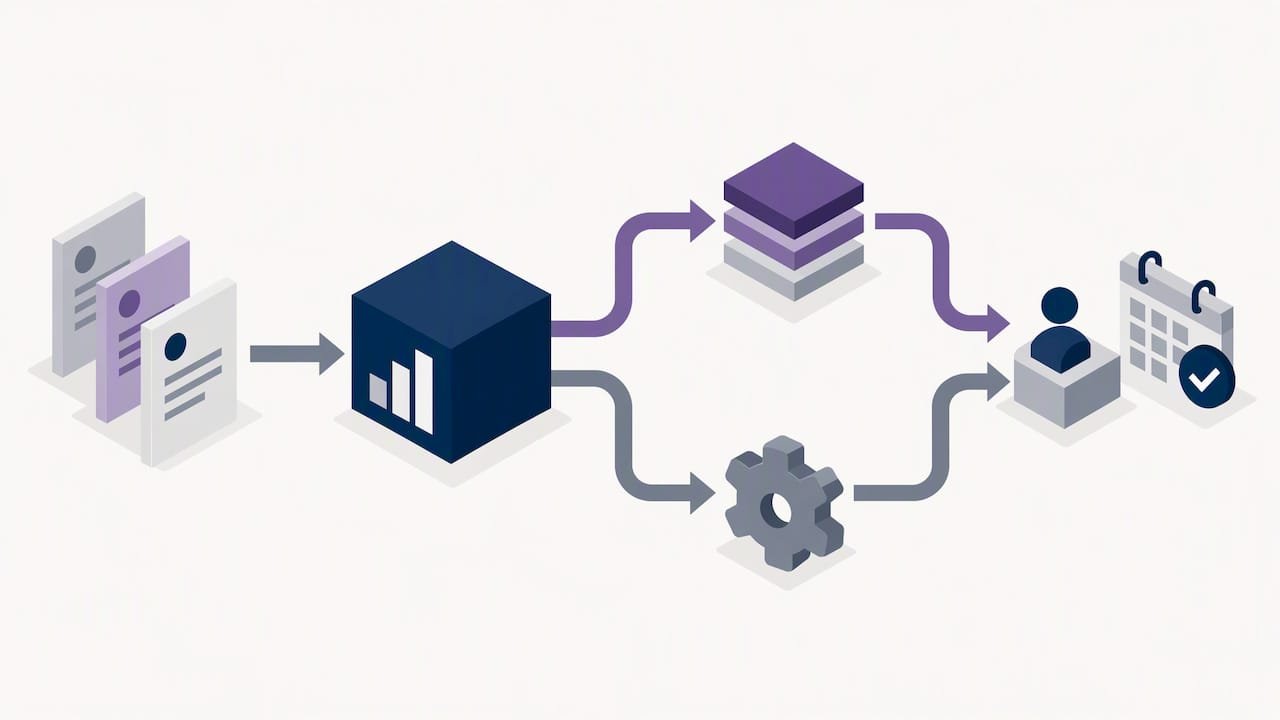
The output that ties this process together is a decision record, a short document, often a single table, with one row per identified need. Useful fields include the gap description, the evidence behind it, the level it sits at (organisational, task or individual), whether training is confirmed as the right fix, the proposed intervention, an owner, a target date and a review date. The EUAA guidance treats this record, rather than the raw survey data, as the most useful output of the whole exercise, because it is what gets acted on.
Skipping straight from data collection to course design is the single most common failure mode in a TNA. Teams that build the decision record first tend to commission fewer courses overall, and the ones they do commission map more precisely to a confirmed gap.
Methods and instruments for collecting evidence
No single method gives a reliable picture on its own, and the CDC’s guidance on conducting a needs analysis is explicit that triangulating several sources protects against the bias any one method introduces.
- Surveys suit large groups and self-reported confidence gaps, but response rates drop fast if the survey is long or poorly targeted.
- Interviews surface context and nuance that a survey cannot, particularly around why a gap exists, though they take more time per respondent.
- Focus groups are efficient for exploring shared experiences across a team, but can be dominated by one or two voices if not facilitated carefully.
- Direct observation shows what people actually do on the job, which often differs from what they report doing.
- Performance data and document review (error rates, complaint logs, audit findings, policy documents) ground the analysis in evidence that is not self-reported.
- Assessments and skills tests give a defensible measure of current competence against a defined standard.
Before rolling any instrument out widely, pilot it with a small group to catch confusing questions or technical issues, and keep response confidential wherever possible, since people are more candid about gaps when they are not worried about being singled out. Low response rates are usually a design problem rather than a motivation problem: a ten-minute survey sent with no context from a manager will underperform a five-minute one introduced by a trusted supervisor.
LMS and HRIS data, such as completion rates, assessment scores and absence patterns, are useful supporting evidence precisely because they exist already and are not subject to recall bias. Cross-referencing them against interview or survey findings is a quick way to confirm, or challenge, what people say about their own capability.
Pro Tip: Run your instrument on five people before sending it to five hundred: a short pilot catches ambiguous questions that would otherwise quietly skew every later result.
Analysing gaps and deciding when training is (and isn’t) the answer
Not every performance gap is a training problem, and the CDC’s guidance is built around testing that assumption before committing resource. The diagnostic question is simple: do people lack the knowledge, skill or behaviour to meet the standard, or is something else getting in the way?
- Capability gap: people have not been taught the skill, or have not practised it enough to apply it reliably.
- System or tooling gap: the process, software or equipment makes the right behaviour difficult even for a competent person.
- Policy or expectation gap: the standard was never clearly communicated, or conflicting priorities make it impractical to meet.
- Resourcing gap: there are not enough people, or enough time, to do the task to standard regardless of skill.
Training programmes designed from a careful needs analysis show improved transfer and learner motivation, according to CIPD’s evidence review on leadership development, which points to the value of confirming the cause before designing the fix rather than treating training as a default response.
When the cause is not capability, document the alternative fix, whether that is a process change, a tooling request or a clarified policy, and route it to the right owner rather than quietly dropping it. A minimal decision record needs just a handful of fields: the gap, the evidence, the confirmed cause, the recommended action, an owner and a review date. Recording a “not training” decision is as valuable as recording a “yes, train” one, since it stops the same request resurfacing as a course brief six months later.
Prioritisation and planning: turning findings into a roadmap
Once a list of confirmed training needs exists, the next job is ranking them, because budget and facilitator time are always finite. A simple scoring approach multiplies three factors: impact (how much performance improves if the gap closes), urgency (how soon the gap causes harm) and feasibility (how realistic the fix is given current resource). Scoring each from one to five and multiplying gives a rough but workable priority order.
- High impact, high urgency, high feasibility needs go first, since they are the clearest wins for the resource required.
- High impact but low feasibility needs may require phased delivery or a business case for extra budget before they can move.
- Low impact, low urgency needs can sit on a backlog and be revisited at the next review point rather than consuming current capacity.
Effort estimates should account for delivery format as well as content, since on-site, online and blended options carry different cost and time profiles; a blended approach often suits dispersed teams better than a single all-day workshop. Once needs are scored, assign an owner to each one, a target delivery window, and a review milestone, so the output of the TNA is a working plan rather than a static report that nobody revisits.
From analysis to design: outcomes, delivery and evaluation
A confirmed training need only becomes useful once it is translated into a design brief: what learners should be able to do afterwards, how the intervention will be delivered, and how success will be measured.
- Write outcomes as observable behaviour, not topics: “can complete a risk assessment unsupervised” rather than “understands risk assessment”.
- Match delivery to the transfer challenge: a skill that needs repetition benefits from practice and coaching, while a knowledge gap may need only a job aid or short reference guide.
- Build in spaced practice where the skill is complex, since a single session rarely produces lasting change on its own.
CIPD’s evidence review points to tailored content, opportunities for practice and manager support as the design features most associated with stronger transfer, which is a useful checklist when reviewing a proposed course outline against the gap it is meant to close. The same logic applies outside formal corporate training: guidance on structuring workplace language lessons for measurable results follows a comparable pattern of defined outcomes, practice built into sessions, and a way to check progress against the original goal.
Evaluation should work across three levels: an immediate check (did people engage with and understand the material), a transfer measure (are they applying it on the job weeks later), and a business KPI tied back to the original gap (has the error rate, complaint volume or output measure actually moved). Skipping straight to a satisfaction survey after the session answers the easiest question, not the one that matters.
Pro Tip: Pick the business KPI before the course is designed, not after it is delivered: it is the only way to know whether the training, rather than something else entirely, moved the number.
A worked example and a compact template
A regional service team shows a rising rate of customer complaints about incorrect quotes. Evidence collected: quote error logs, a short survey of the team, and three observation sessions.
- Diagnosis: observation shows most errors trace to a recently updated pricing system, not to staff misunderstanding pricing rules, so this is partly a tooling issue.
- Mixed finding: a smaller group of newer starters also misapply the discount policy regardless of the system, confirming a genuine capability gap for that subgroup.
- Decision record: train the newer starters on discount policy application (high impact, high urgency, high feasibility); log a separate ticket for the pricing system issue, owned by operations, with a review in eight weeks.
- Training brief: a two-hour session plus a one-page job aid on discount rules, delivered to new starters within two weeks, evaluated by re-checking the error rate at the next monthly review.
The same template scales down for a five-person team, where the “survey” might be a quick conversation, and scales up for a multi-site organisation, where each level of analysis gets its own evidence set before the records are consolidated.
Common pitfalls and quick wins for busy L&D teams
The biggest pitfall is treating a TNA as a wish-list exercise: asking people what training they would like, rather than testing what performance actually requires. A small pilot with one team, before a full rollout, catches design problems cheaply. Document every decision, including the ones that reject training as the fix, and check transfer weeks later rather than relying on same-day feedback. For small teams, a short micro-assessment plus manager coaching and a reusable job aid often does more than a full course.
— Sam
How we turn a training needs analysis into accredited, measurable training
Once the decision record names a confirmed gap, the harder question is often who builds and delivers the course. We design customisable, globally accredited training across project management, healthcare, oil and gas, civil engineering, IT, management, leadership, compliance and safety, and we deliver it on-site, online or blended depending on how your teams are spread.
We use the outputs of your training needs analysis directly: the learner profile, the gap description and the constraints you have already documented become the brief for a tailored course rather than a generic off-the-shelf module. That means less time translating your decision record into something a provider can act on, and a programme built to close the specific gap you identified rather than a broad topic area.
If your decision record points to a project management gap, our project management courses are built to be adapted to the task-level competencies your analysis surfaced. For any other area your TNA has flagged, our full course catalogue covers the other sectors we train across. Get in touch to talk through what your analysis found and how a tailored programme could be scoped around it.
FAQ
What are the 5 steps of training needs analysis?
The five steps are defining required performance, assessing current competence, analysing the gap to confirm training is the right remedy, prioritising confirmed needs, and specifying, approving, implementing and reviewing the chosen intervention. This sequence follows the structure both the CDC’s needs analysis checklist and the EUAA’s training needs analysis manual recommend.
Can you provide an example of a training needs analysis?
A typical example starts with a performance problem, such as rising quote errors, then collects evidence through error logs, a short survey and observation sessions. The analysis separates a system-level cause from a genuine skills gap among a subgroup of staff, and the decision record recommends training only for that subgroup while routing the system issue elsewhere.
What are the three key levels of training needs analysis?
The three levels are organisational analysis, which links capability needs to strategy and resources, task or job analysis, which maps tasks to the knowledge, skills and attitudes they require, and individual analysis, which identifies who meets or falls short of the standard. Covering all three prevents a recommendation that is accurate at one level but misleading overall.
What is the difference between a learning needs analysis and a training needs analysis?
A learning needs analysis is an ongoing, broader review of workforce capability tied to organisational strategy, while a training needs analysis is bounded and focused on deciding a single intervention for a defined group, as CIPD’s learning needs factsheet distinguishes. Confusing the two tends to turn a simple course request into an open-ended capability review.
Does our training catalogue cover project management needs identified in a TNA?
Yes, our project management courses are built to be customised against the specific task-level gaps a training needs analysis identifies. Pricing for these programmes is available on request through our course pages.