
These courses train electrical engineers, maintenance technicians and energy professionals in power system operation, protection and maintenance, covering fault analysis, switchgear, protection relays and testing procedures. Delivery ranges from in-person labs to online and blended formats, with accreditation typically tied to bodies such as NCCER, NICET or City & Guilds and mapped to CPD hours.
TL;DR:
- Power system training courses vary by focus, with high-voltage authorization for technicians and protection relay courses for engineers responsible for fault clearance.
- Practical skills are best developed through live-equipment labs and fault simulation, not just classroom theory, with emphasis on unsupervised task performance.
- Accreditation from bodies like NCCER, NICET, or City & Guilds is crucial, but the quality depends on the proportion of hands-on training and real equipment use.
- Course costs range widely depending on length, accreditation, and delivery format, making it important to clarify assessment and certification inclusion upfront.
- Customized, on-site courses with equipment-specific modules offered by providers like Oxford Center can narrow skill gaps and improve on-the-job performance.
Table of Contents
- What types of power systems and maintenance training courses exist?
- Core modules and the practical skills you actually walk away with
- Accreditation, certification and CPD recognition explained
- Delivery formats, duration and how courses are assessed
- How to choose the right course for your role and employer
- Why the Oxford Center is a direct option for accredited training
- Who should attend, and what do you need before you start?
- Registration, pricing and how to enquire
- Career paths that open up after certification
- Industry standards and compliance built into the courses
- Tools, equipment and software you’ll actually train on
- What happens after the course ends
- The gap between what training promises and what actually sticks
- Book a course or request a bespoke training proposal
- Where these standards and curricula come from
- Sources
- FAQ
What types of power systems and maintenance training courses exist?
Not every course suits every job title, and picking the wrong one wastes a training budget faster than anything else. High-voltage authorisation programmes sit at one end of the spectrum, built for technicians who need formal sign-off before they can safely isolate, switch or work near HV equipment. At the other end, renewables and power-quality modules cover PV arrays, wind turbine electrics, inverter faults and grid-connection issues, aimed at engineers moving into distributed generation work.
Protection engineers have their own track entirely. Relay testing, coordination studies and fault-current analysis dominate these courses because a misconfigured protection scheme can take down half a substation.
The main course families you’ll encounter:
- High-voltage authorisation and safe-operation courses for technicians handling isolation, switching and permit-to-work procedures
- Protection and relay testing programmes for engineers responsible for coordination studies and fault clearance
- Plant and power-generation maintenance curricula for site technicians maintaining generators, switchgear and rotating plant
- Renewables and power-quality specialisms covering PV, wind and inverter-based systems
Most working professionals need more than one strand eventually. A maintenance technician who starts on plant curricula often adds protection testing within a few years as their role expands.
Core modules and the practical skills you actually walk away with
Classroom theory only gets a technician halfway there. The modules that matter most combine fault analysis, protection coordination, switchgear maintenance, transformer and motor upkeep, and PLC troubleshooting, and each one is judged by whether a delegate can perform the task unsupervised afterwards.
Industrial electrical courses commonly structure these as module-based agendas with labs covering three-phase devices, motor control, schematic reading and lock-out/tag-out procedures, following a pattern used across industrial electrical systems training. Instructor-led programmes from equipment vendors often run this over multi-day agendas that blend safety fundamentals with structured hands-on labs.
A typical module sequence looks like this:
- Safety, isolation and permit-to-work procedures
- Fault analysis and diagnostic reasoning
- Protection coordination and relay settings
- Switchgear inspection and maintenance routines
- Transformer and motor condition monitoring
- PLC troubleshooting and control-system fault-finding
The strongest programmes replace static diagrams with live-equipment labs and simulated fault kits, often delivered from mobile training trailers that let delegates safely reproduce real faults without risking site plant, an approach backed by Eaton’s electrical worker training facilities. Assessment then follows through skill demonstrations, practical tests and written exams, giving employers documented proof of competence rather than a certificate of attendance.
Pro Tip: Ask any shortlisted provider how many hours of the course are spent on live or simulated equipment versus slides. If they can’t give you a number quickly, assume it’s low.
Accreditation, certification and CPD recognition explained
Recognised accreditation is what turns a training certificate into something an employer actually trusts. Industry courses commonly reference bodies such as NCCER, NICET and City & Guilds, alongside CPD schemes that log hours against professional development requirements.
NICET’s Electrical Power Testing certification covers technicians who inspect, test and maintain equipment used in power production, transmission and distribution, with a heavy focus on test procedures and documentation. Senior-level certification through NICET often requires documented work history and project descriptions, and candidates regularly underestimate how long it takes to compile that evidence properly.
Certification mechanics vary by scheme. Some require periodic re-examination, others accept recertification through logged CPD hours instead. Before enrolling, check three things:
- Whether the accrediting body is named explicitly on the certificate, not just referenced in marketing copy
- Whether your employer’s HR or engineering department already recognises that specific credential
- Whether recertification runs on a fixed cycle or a rolling CPD-hour basis
Delivery formats, duration and how courses are assessed
In-person labs win for practical skill transfer, full stop. You cannot learn to trace a fault on a live switchboard through a video call. Online theory modules earn their place elsewhere, mainly around scheduling flexibility for technicians who cannot get released from shift work for a full week.
Duration varies with depth. Expect half-day modules for narrow topics like relay settings, multi-day intensive courses for broader plant maintenance skills, and multi-week curricula where modular assessments are spread across several weeks so competence builds progressively rather than getting crammed into one exam.
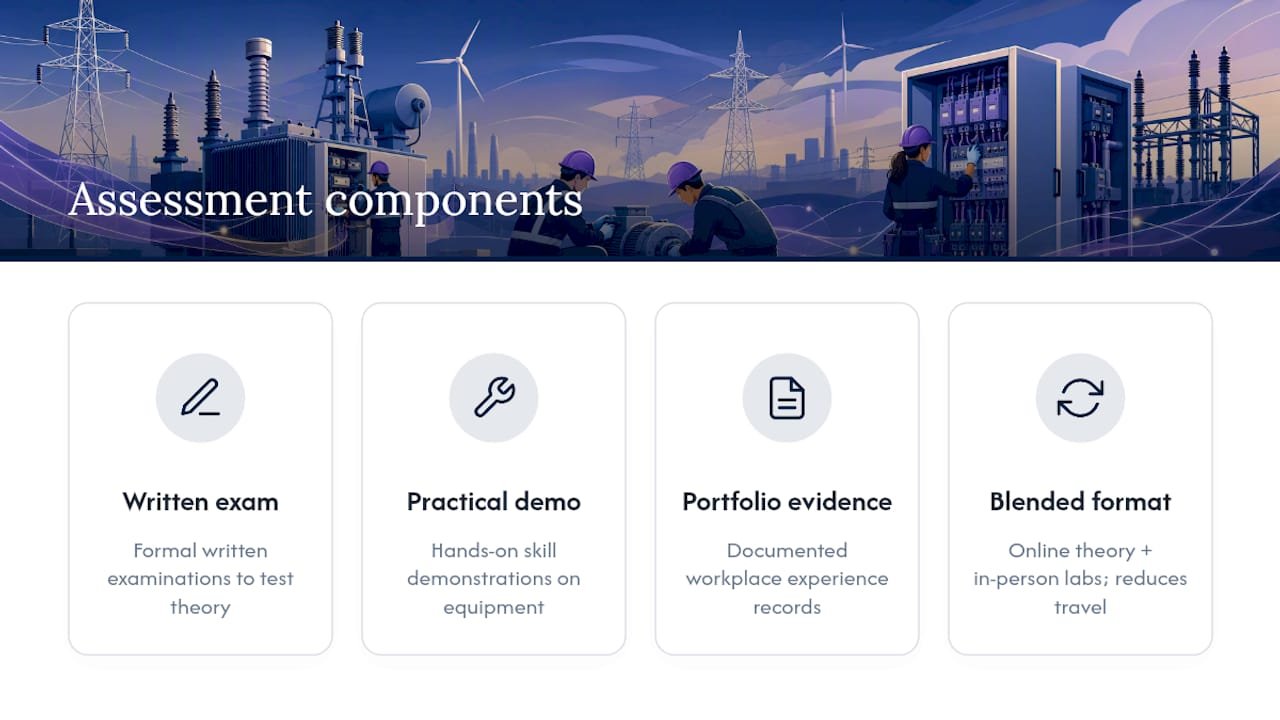
Assessment formats typically combine written examinations, practical skill demonstrations and, for some accreditations, portfolio evidence built from documented workplace experience. Blended formats, running theory online and labs in person, are increasingly common because they cut travel costs without sacrificing the hands-on component that actually builds competence.
How to choose the right course for your role and employer
Match the course to your equipment, not to a generic title. A protection engineer working on distribution switchgear needs relay coordination content; a plant technician maintaining generators needs rotating-machine diagnostics. Reading a course outline against your actual job list before booking saves both money and time.
Run through this checklist before contacting a provider:
- Does the syllabus name the specific equipment types you work on (switchgear, generators, protection relays, PLCs)?
- Is the accreditation one your employer already recognises, and does it carry CPD credit?
- How many hours are instructor-led hands-on labs versus lecture time?
- What is typical class size, and does that match your preferred learning pace?
- Is post-course support included, or does it stop the day the certificate is issued?
Ask providers directly whether courses can be customised for your site’s equipment and whether on-site delivery is available for group bookings. A provider that hesitates on customisation usually runs a fixed curriculum regardless of what they advertise.
Why the Oxford Center is a direct option for accredited training
Some training providers deliver globally accredited, expert-led courses that adapt to on-site, online or blended delivery, so an engineering team doesn’t have to choose between practical labs and scheduling flexibility. Courses can be customisable for corporate teams, with content aimed at workforce-ready skills rather than generic theory.
That configurability matters for employers running mixed-experience teams: a plant maintenance department can request modules aligned to its own switchgear and protection equipment rather than accepting a one-size curriculum…
Who should attend, and what do you need before you start?
These courses target electrical engineers, maintenance technicians, protection engineers and energy professionals already working in or moving into power systems roles. They are not introductory electrical courses. Most assume the delegate already understands basic circuit theory, three-phase supply principles and workplace electrical safety.
Prerequisites vary by course level. Entry-level plant maintenance modules often accept technicians with an electrical apprenticeship or equivalent trade qualification and limited site experience. Higher-level protection and testing certifications, particularly those aligned to NICET or NCCER pathways, typically expect documented on-the-job hours before a candidate can sit the assessment.
A useful way to self-check readiness:
- If you can already isolate equipment safely and read a single-line diagram, you’re ready for most plant maintenance courses.
- If you’re being asked to interpret relay settings or size protection schemes, you need the protection-specific track, not a general maintenance course.
- If your role is shifting toward renewables, confirm the course covers inverter and grid-connection faults specifically, not just generic PV installation.
Site supervisors and HR training leads also attend, usually to assess whether a course maps to internal competency frameworks before booking a cohort. That’s a sensible step, and most credible providers will walk a training manager through the syllabus before any commitment is made.
Registration, pricing and how to enquire
Pricing for power systems training varies substantially by course length, accreditation level and whether delivery is public, in-house or bespoke. A half-day relay-testing refresher costs far less than a multi-week protection engineering programme with formal certification attached, so treat any headline price with scepticism until you know exactly what’s included.
Registration typically follows one of two routes. Individual professionals book directly onto scheduled public courses, usually through an online enquiry form specifying preferred dates and location. Corporate teams generally request a tailored quote instead, particularly when the course needs adapting to specific site equipment or delivered on-site for a group.
Before registering, get clear answers on:
- Whether the quoted fee includes assessment and certification costs, or whether those are billed separately
- Whether group bookings attract a lower per-head rate
- What the cancellation or rescheduling policy looks like if a shift pattern changes
Current course fees, schedules and enquiry details are best confirmed directly with the provider rather than relied on from older listings, since accreditation costs and course lengths shift as curricula get updated.
Career paths that open up after certification
A recognised power systems certification changes what roles you’re eligible for, often immediately. Protection and relay testing certification typically opens doors to protection engineer, substation technician and commissioning engineer roles, particularly on transmission and distribution projects.
Plant maintenance certification tends to lead toward site maintenance engineer, reliability technician or plant electrical supervisor positions, especially in generation, oil and gas, or heavy industrial settings where unplanned downtime carries a direct cost. Renewables-focused certification increasingly leads to roles as solar or wind maintenance technician, or grid-integration engineer, as more employers build dedicated teams around distributed generation assets.
Modular curricula, of the kind NCCER uses across its levels, make internal promotion pathways easier for employers to map, letting a technician progress from entry-level maintenance into more specialised roles as they complete each certification tier. That’s a genuinely practical benefit for anyone trying to plan a five-year career move rather than just ticking a training box this quarter.
Industry standards and compliance built into the courses
Compliance content isn’t an add-on bolted onto these courses. It’s usually the backbone. Courses covering high-voltage work and isolation procedures build directly around national electrical safety codes and permit-to-work systems, since getting these wrong carries both legal and physical risk.
Protection and testing courses lean heavily on documentation standards. NICET’s testing certification, for instance, emphasises the test procedures and record-keeping technicians must follow when inspecting equipment used in power production and distribution, because inadequate documentation is often what fails an audit, not the test result itself.
Plant maintenance courses typically fold in lock-out/tag-out procedures, arc-flash risk assessment and manufacturer-specific compliance requirements for the equipment being maintained. A course that skips manufacturer documentation and schematic interpretation is missing something practitioners consistently flag as essential, since fluency with a specific manufacturer’s tooling and paperwork often accelerates real competence faster than generic theory does.
Tools, equipment and software you’ll actually train on
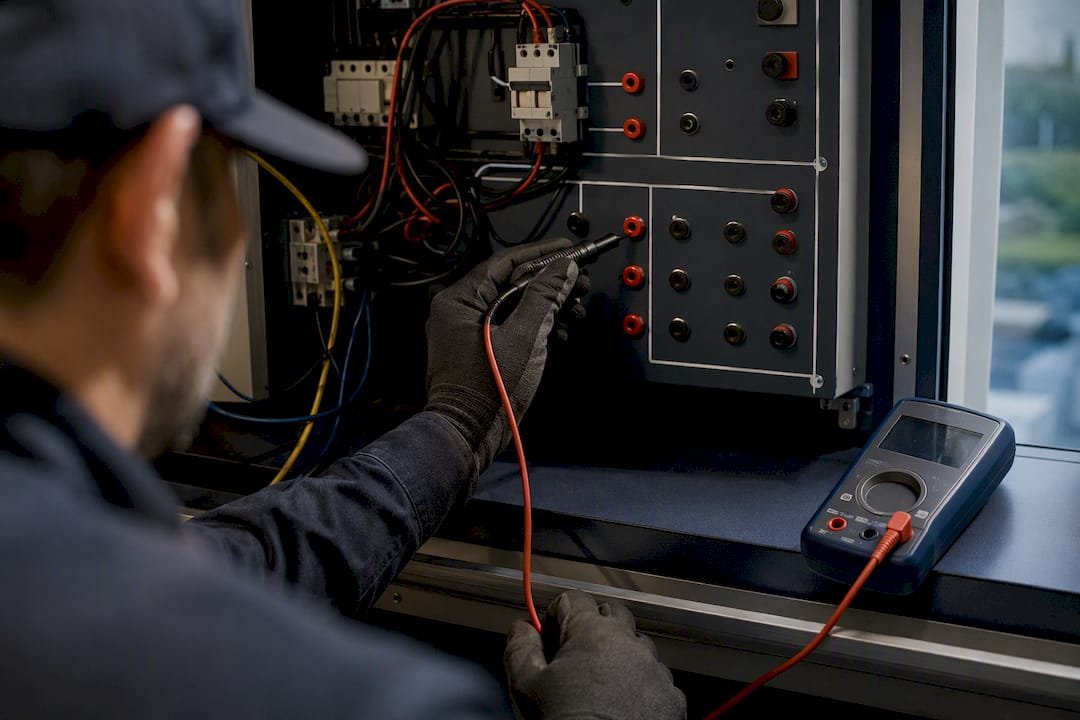
Hands-on training only works if the equipment matches what delegates use back on site. Expect training on protection relays, digital multimeters, insulation testers, thermal imaging cameras and, for plant maintenance tracks, motor and transformer diagnostic tools.
Simulated fault kits and mobile training trailers feature heavily in the better programmes, letting delegates safely reproduce faults that would be too dangerous or disruptive to stage on live plant. This approach, used in Eaton’s electrical worker training, lets a technician practise fault-finding under realistic pressure without any risk to actual equipment or personnel.
Software training increasingly covers protection relay configuration tools, SCADA interfaces for monitoring and, on renewables tracks, inverter monitoring platforms. PLC programming software also appears on maintenance-focused courses where control-system troubleshooting is part of the syllabus. A course that only covers hardware and skips the software side of modern protection and control systems is teaching half the job.
What happens after the course ends
The best programmes don’t stop supporting delegates the moment a certificate is issued. NCCER’s assessment structure, for example, gives candidates an online score report with recommended training prescriptions, flagging specific knowledge gaps rather than a blunt pass or fail result.
Many programmes also provide instructor toolkits, downloadable lab scenarios and assessments mapped to real workplace tasks, which helps employers build onboarding around the training rather than treating the course as a one-off event. That matters more than it sounds. A technician who finishes a course with a clear list of what to revisit is far more likely to retain the skill than one who simply banks a certificate and moves on.
Access to refresher materials, alumni support or a named contact for follow-up questions varies significantly between providers, so it’s worth asking directly what post-course access looks like before you commit a training budget.
The gap between what training promises and what actually sticks
Most course marketing focuses on the certificate. That’s backwards. The research behind this guide points to something more useful: best practice combines theory with realistic fault simulation and instructor feedback, and that combination is what actually reduces unplanned downtime on site, not the credential itself.
Here’s where conventional advice falls short. Buyers are told to check accreditation first, and that’s not wrong, but it’s incomplete. A NICET or NCCER credential tells you a technician passed an assessment; it doesn’t tell you whether they’ve spent real hours on live-equipment labs versus watching someone else demonstrate a fault. Employers who only screen for the certificate name are missing the more important question: how many hours were hands-on, and against what equipment?
If you’re choosing a course for yourself or your team, prioritise the lab-to-lecture ratio before you prioritise the accreditation logo. A course that’s flexible enough to adapt its modules to your actual switchgear and protection relays, rather than generic kit, will teach faster and stick longer. That flexibility, more than any single accreditation, is what separates training that changes on-the-job performance from training that just fills a CPD quota.
— Sam
Book a course or request a bespoke training proposal
Some providers work differently from fixed public course calendars. Instead of forcing teams into generic curricula, they can create accredited power systems and maintenance courses around actual equipment, such as protection relays, switchgear, generators or PLCs, and deliver them on-site, online or blended depending on scheduling needs.
That configurability is the real advantage here. A protection engineering team and a plant maintenance crew have very different equipment lists, and a single fixed syllabus rarely serves both well. Some corporate delivery models let clients specify equipment, accreditation alignment and group size upfront, so training maps to actual competency gaps rather than generic outlines.
If you’re ready to move forward, visit the Oxford Training Centre course page to request a course outline or a corporate training proposal tailored to your team’s equipment and schedule.
Where these standards and curricula come from
Several primary sources back the claims in this guide. Eaton’s electrical worker training programmes detail how simulation and live-equipment labs are used to build operational reliability. NCCER’s Power Generation Maintenance Electrician assessment specifications show the module-level structure behind a widely recognised curriculum. NICET’s Electrical Power Testing certification page lays out the technical scope and documentation standards testing technicians are assessed against.
Sources
- Eaton electrical worker training programmes and hands-on facilities
- Power Generation Maintenance Electrician assessment specifications (NCCER, 2023)
- Electrical power testing certification programme (NICET)
FAQ
How much does a power systems training course cost?
Fees vary widely by course length, accreditation level and whether delivery is public or bespoke corporate training. Contact Oxfordcentre directly through its course enquiry page for current pricing on specific modules.
What are some good courses for power system studies?
Look for programmes covering fault analysis, protection coordination, switchgear maintenance and relay testing, ideally accredited through bodies like NCCER or NICET with hands-on lab components rather than theory-only formats.
What degree do you need to be a power systems engineer?
Most power systems engineering roles require an electrical or electronic engineering degree, though many technicians enter through apprenticeships and build toward engineering-level roles via accredited certifications and documented site experience.
What is the average salary for a power systems engineer in the UK?
Salary data varies by region, experience and sector, and no single figure applies across the industry. Checking current job listings and recruitment sites for your specific region and specialism gives a more accurate picture than a generic average.
What is power system maintenance?
Power system maintenance covers the inspection, testing and upkeep of equipment such as switchgear, transformers, generators and protection relays, aimed at preventing unplanned outages and keeping systems compliant with safety standards.