
Manager communication training improves how you listen, give feedback, run meetings and influence people who do not report to you. It suits new managers finding their feet, line managers who inherited a team, and hybrid leads juggling remote and in-person staff. Courses run as workshops, online modules or blended cohorts, and the strongest ones build in practice and follow-up, which the rest of this article breaks down.
TL;DR:
- Most effective courses incorporate ongoing practice, feedback, and follow-up to ensure behavioral changes in managers, not just content delivery.
- Training outcomes are more likely to stick when managers apply new skills immediately through small tasks and reflection, with reinforcement sessions around six weeks later.
- Customisable content that reflects specific industries and management levels improves relevance, especially for senior managers or specialized sectors like healthcare or civil engineering.
- Digital tools such as recorded practice sessions, asynchronous reflection, and remote meeting guidance complement facilitated practice but do not replace active coaching.
- The success of communication training depends on post-course support and measurement, as habits erode quickly without deliberate reinforcement and organizational backing.
Table of Contents
- What a manager communication curriculum actually covers
- Formats, duration and who each one suits
- A sample syllabus and the exercises that make it stick
- How to choose the right manager communication course
- Designing training for transfer: what the research says about follow-up
- Customising training across management levels and industries
- Common communication problems managers run into
- Fitting communication training into leadership development
- Digital tools that support communication skills practice
- What impact looks like when training works
- Budgeting for manager communication training
- The part of manager training that gets skipped
- Taking the next step with Oxford Centre
- Sources
- FAQ
What a manager communication curriculum actually covers
A serious course goes well beyond public speaking tips. It should build verbal, written and non-verbal communication together, because managers switch between all three within a single day: a one-to-one, a status email, a difficult conversation in a corridor.
The MIT Sloan interpersonal communication course frames active listening and humble inquiry, the practice of asking genuine questions rather than leading ones, as central skills for managers rather than optional extras. Leadership narrative and cross-cultural communication sit alongside feedback and difficult conversations in that framework, and the pattern shows up across most credible manager programmes.
Each capability maps to something you already do:
- Active listening and humble inquiry sharpen one-to-ones and reduce the number of problems you hear about too late.
- Feedback and difficult conversations make performance discussions less dreaded and more useful for both sides.
- Influencing and stakeholder messaging help when you need buy-in from peers or senior leaders who do not report to you.
- Leadership narrative gives you a consistent way to explain change, direction and setbacks to your team.
- Non-verbal and written communication cover the tone of your emails and the signals you send in meetings, which people read closely.
For hybrid teams, add meeting design, bias awareness and rules for asynchronous channels, since a manager running a mixed room and remote screen needs different habits from someone managing everyone in person.
Formats, duration and who each one suits
The right format depends on your schedule, your team’s spread and how much practice you want built in.
- One-day workshops suit managers who need a concentrated refresh on a single skill, such as feedback conversations, and can clear a full day.
- Multi-week online courses work for people who want to spread learning around a busy diary and revisit material between sessions.
- Micro-learning modules fit managers who need short, specific input, like running a hybrid meeting, without a large time commitment.
- Learning paths suit anyone building capability over months, often combining several shorter courses into a progression.
- Blended cohorts, mixing live facilitation with online pre-work, suit organisations training several managers together and wanting consistent outcomes across the group.
New managers often benefit most from a structured path with built-in practice, since they are forming habits for the first time. Experienced line managers moving into hybrid leadership may only need a targeted module on meeting design and remote connection. HR cohorts commissioning training for a group should look at cohort size, facilitator experience, whether the course carries formal accreditation or CPD recognition, and whether the provider can adapt delivery for a specific industry or a bespoke corporate group rather than offering a fixed public course.
A sample syllabus and the exercises that make it stick
A realistic manager communication course might run across six modules, whether compressed into two days or spread over six weeks:
- Listening and humble inquiry, covering question technique and how to stop planning your response while someone is still talking.
- Feedback conversations, practising structure and tone for both praise and correction.
- Influence and stakeholder messaging, working on how to frame a request to someone outside your reporting line.
- Hybrid meeting design, covering agenda structure, turn-taking rules and keeping remote attendees genuinely involved.
- Difficult conversations, rehearsing conflict, underperformance and change conversations with a coach observing.
- Practice clinic and action plan, where participants bring a real upcoming conversation and leave with a written plan for it.
The exercises matter more than the slides. Look for role-play with facilitator coaching, simulated hybrid meetings that mix in-room and remote actors, recorded practice sessions with feedback, and peer coaching pairs who check in after the course ends. Some course outlines lean on practical exercises, real-world scenarios and personalised action plans rather than lecture-only delivery, which is the model worth asking any provider to match.
Pro Tip: Ask a provider for one example of a recorded practice session and the feedback a participant received on it. A course that cannot show this probably does not run one.
Strong learning outcomes are behavioural, not just a certificate. Ask what a manager should be able to do differently by week four: run a shorter, better-structured meeting, give one piece of specific feedback a week, or open a difficult conversation without stalling.
How to choose the right manager communication course
Work through a short checklist before committing budget or time.
- Does the provider state clear behavioural outcomes, not just topics covered?
- How many hours of observed or coached practice does the course include, not just content delivery?
- Is there a transfer plan after the course: self-coaching prompts, a follow-up session, or upward feedback from direct reports?
- Who facilitates, and what is their experience with managers specifically rather than general audiences?
- Is the course accredited or CPD-recognised, and does that matter for your organisation’s own development framework?
- Does the provider offer any baseline and follow-up measurement, even something simple like a before-and-after self-assessment?
Ask providers directly:
- What does a participant do differently in week one after the course?
- How is practice observed and coached during the sessions?
- What follow-up happens after the course ends?
Treat a few things as red flags: a course that hands out a certificate with no observed practice, a syllabus that is entirely lecture and slides, or a provider with no answer when you ask about follow-up support. Communication skills do not stick from a single afternoon of content.
Designing training for transfer: what the research says about follow-up
Training does not change behaviour by itself. A dynamic training transfer study from 2026 found that managers who felt early success with small practice attempts were more likely to keep practising afterwards, and that short weekly experiments sustained the change better than a single intensive burst. The CIPD’s evidence review of people managers points the same way: manager capability and the support their organisation gives them both shape whether training actually lands.
A practical recipe follows from this:
- Set one small, achievable practice task straight after the course, not weeks later.
- Add a weekly reflection checklist so managers notice what worked.
- Build in a short reinforcement session, even 30 minutes, around six weeks out.
- Collect upward feedback from direct reports as a simple measure of change.
Pro Tip: Agree the baseline measure before the course starts, even something as simple as “how often do you currently give specific feedback”, so the follow-up comparison means something.
A pilot feasibility trial of a web-based manager training programme, Managing Minds at Work, found improved manager confidence at three months but weaker retention by six months, with workload and time pressure the main barriers. Protect practice time and secure senior sponsorship before you enrol a cohort, or the early gains fade.
Customising training across management levels and industries
A course written for a first-time supervisor rarely fits a director managing other managers, and a script built for a call centre rarely transfers cleanly to a hospital ward or an oil rig. Scalable training separates a common core, listening, feedback, influence, from an industry layer that changes the examples and scenarios used in practice.
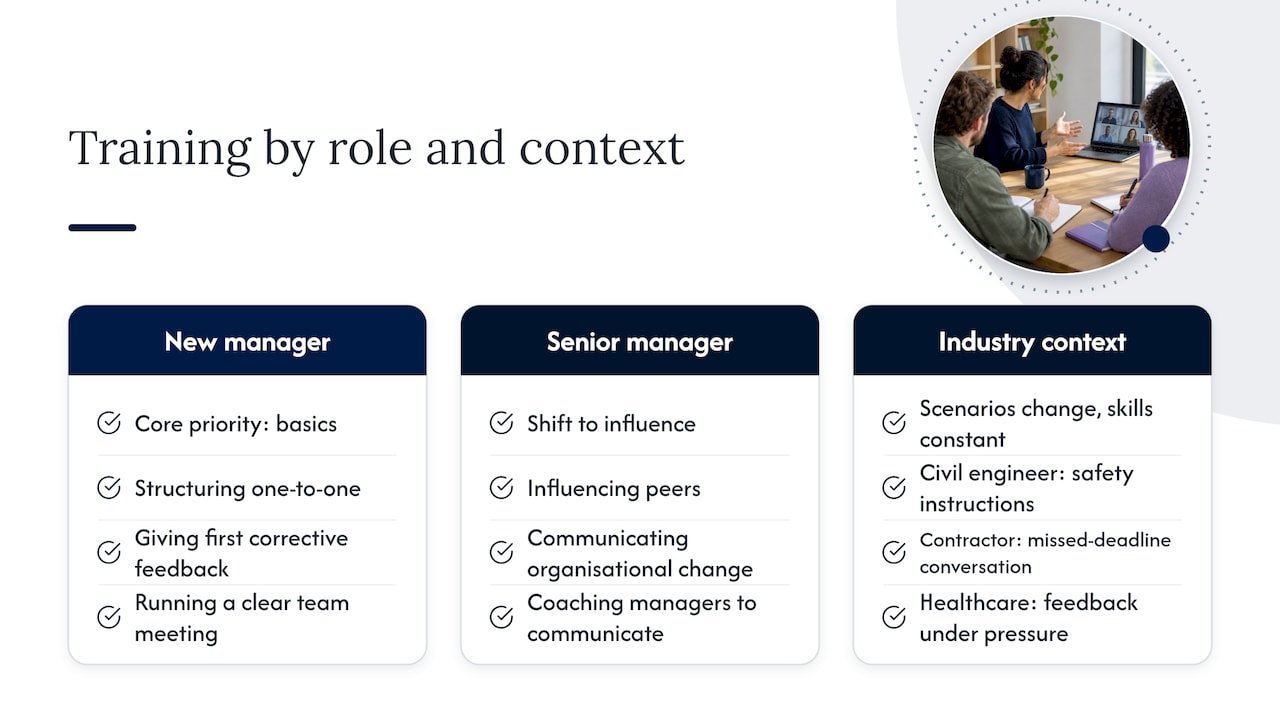
For a new manager, the priority is usually the basics: structuring a one-to-one, giving a first piece of corrective feedback, running a clear team meeting. For a senior manager overseeing other managers, the content shifts towards influencing peers, communicating organisational change and coaching others to communicate better themselves.
Industry context changes the scenarios used, not the underlying skill. A civil engineering site manager needs practice communicating safety instructions clearly and handling a difficult conversation about a missed deadline with a contractor. A healthcare team lead needs practice giving feedback under time pressure and communicating change to a rota. Some providers position themselves around customisable content for different sectors, reflecting the logic that core skills stay constant, but the scenarios and case material should match the room.
Scalability also means being honest about group size. A course built for a cohort of eight managers with individual coaching does not scale to eighty without losing the practice element that makes it work, so a provider offering both should be clear about what changes between the two.
Common communication problems managers run into
A handful of problems come up repeatedly across teams and industries, and each has a fairly specific fix rather than a generic “communicate more” answer.
Vague instructions cause rework. The fix is a habit of checking understanding before ending a conversation, asking the other person to repeat back what they will do rather than simply asking “does that make sense”.
Feedback either never happens or only happens as an annual review. Building a weekly rhythm of small, specific feedback, even two sentences, normalises the conversation so it stops feeling like an event.
Meetings run long and lose remote participants. Hybrid meeting design, covered in most current manager courses, tackles this directly through agenda structure and explicit turn-taking rather than leaving it to chance.
Difficult conversations get avoided or delayed. Structured rehearsal, the kind built into role-play exercises with facilitator coaching, is what actually reduces avoidance, since managers who have practised the opening lines are far more likely to start the conversation at all.
Influence without authority frustrates managers who need cooperation from peers or other departments. Training that treats stakeholder messaging as a specific skill, distinct from managing direct reports, gives managers language and structure for those conversations rather than leaving it to personality.
Fitting communication training into leadership development
Communication training works better as part of a broader leadership development path than as a standalone event. A manager who learns feedback technique in isolation, without any wider context on team dynamics or organisational change, often struggles to apply it consistently.
The CIPD evidence review frames this directly: training transfers better when it connects to a manager’s actual responsibilities and receives organisational support, rather than sitting as a one-off course disconnected from day-to-day expectations. A communication module that sits inside a longer leadership programme, alongside content on decision-making, delegation or change management, gives managers more chances to practise the same skills in different contexts.
For organisations building a leadership pipeline, sequencing matters. Communication fundamentals, listening, feedback, clear instructions, work best early, before a manager takes on more complex responsibilities like leading through organisational change or managing other managers. Later stages can then layer in influencing skills and leadership narrative once the basics are automatic.
This also affects how training gets measured. A standalone communication course might be judged on a satisfaction score. Embedded within a leadership programme, it can be judged against the same behavioural measures used for the rest of the pathway, such as direct-report feedback or manager confidence ratings, giving a clearer signal of whether the investment is paying off.
Digital tools that support communication skills practice
Technology has changed what “practice” can mean in a manager communication course. Recorded video practice, where a manager rehearses a feedback conversation on camera and reviews it with a coach, gives a kind of self-awareness that a live-only session cannot replicate as easily.
Asynchronous platforms let managers complete reflection exercises between live sessions, which suits the weekly-practice model that transfer research favours. A short prompt landing in a manager’s inbox each week, asking them to note one feedback conversation they had, keeps the skill active between formal sessions rather than letting months pass before the next check-in.
For hybrid teams specifically, the daily tools managers already use, chat platforms, shared documents, video calls, are also where communication habits need to change. Practical guidance on remote daily huddles shows how a short, structured daily check-in can replace the informal corridor conversations that in-person teams take for granted, and training that ignores these existing tools misses where most hybrid communication actually happens.
None of this replaces coached practice with a real facilitator. Digital tools extend the reach of a course between sessions, but the CMI and Timewise hybrid working research still points to structured, facilitated practice as the element that produces measurable gains in areas like meeting design and bias awareness, not the technology alone.
What impact looks like when training works
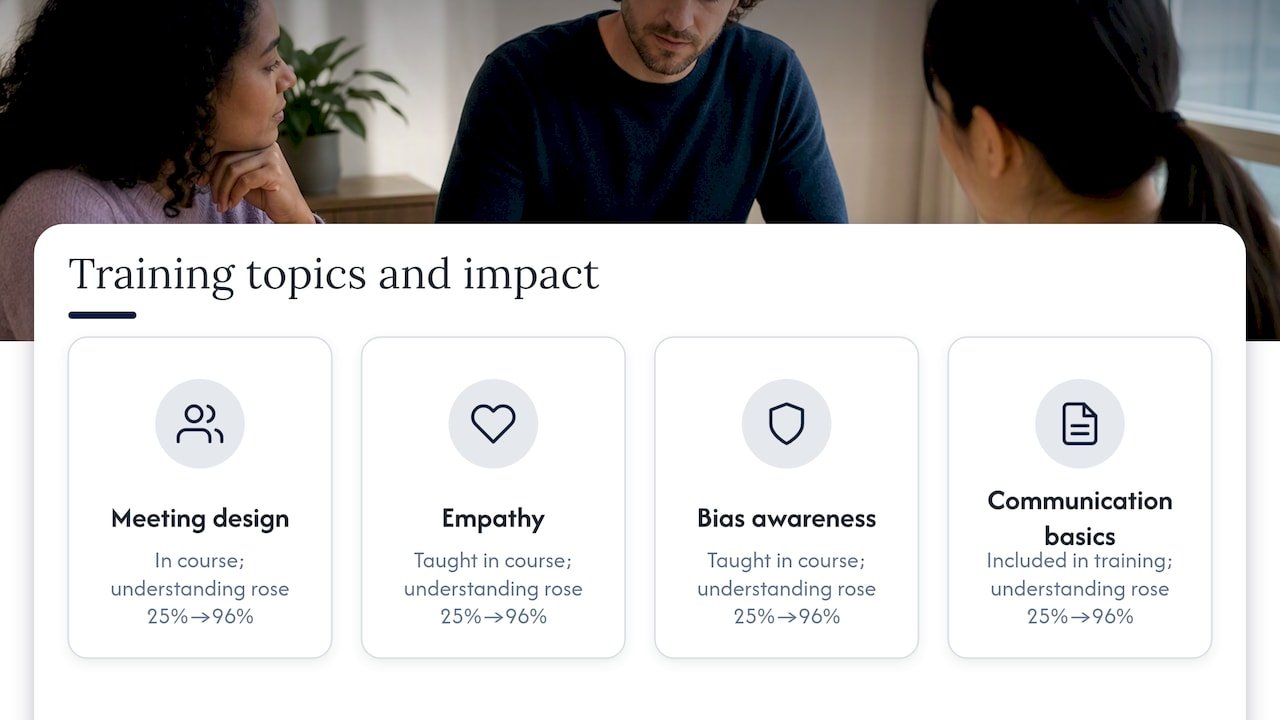
The clearest evidence for impact comes from programmes that measured behaviour, not satisfaction. A CMI and Timewise hybrid working report recorded a pilot in which participants’ understanding of hybrid meeting design and bias awareness rose from 25% to 96% after training that specifically taught meeting design, empathy and bias alongside communication basics. That scale of change came from a course built around practical modules on hybrid-specific challenges, not a generic communication refresher.
The pattern in the Managing Minds at Work pilot trial tells a more mixed story worth taking seriously: manager confidence and competence improved at three months, but fewer managers had sustained that engagement by six months, largely due to workload. The lesson from both is consistent. Training can produce large, measurable shifts in specific skills, but sustaining them past the course needs deliberate follow-up, not just a well-designed initial session.
Corporate training guidance on supporting employee growth remotely makes a similar point about remote-specific programmes: impact holds up better when organisations build in ongoing support rather than treating a single course as the finish line.
Budgeting for manager communication training
Cost varies widely depending on format, group size, accreditation and whether the course is bespoke or off-the-shelf. A short public workshop for one manager costs far less than a multi-week blended programme built specifically around an organisation’s own scenarios and delivered to a cohort of thirty.
The budgeting decision usually comes down to trade-offs rather than a single number. Group training spreads facilitator cost across more people but can dilute individual coaching time. Bespoke, sector-specific content costs more to develop but tends to transfer better because managers recognise their own situations in the exercises. Accreditation or CPD recognition can add cost but matters where an organisation needs training to count towards a formal development framework.
Before setting a budget, decide what you are actually buying: a single workshop, a full learning path, or an ongoing capability-building relationship with follow-up sessions built in. Providers that offer customisable, industry-specific programmes for corporate teams, delivered on-site, online or blended, typically price on request rather than publishing a fixed rate, since group size and content customisation both move the cost. Some providers list professional training courses without a published price, with cost available on request based on delivery format and group needs, which reflects how most bespoke corporate training in this space is actually priced.
The part of manager training that gets skipped
Most manager communication training gets the content right and the follow-up wrong. Courses teach feedback structure, listening technique and meeting design well, largely because the curriculum research on this is solid and consistent across providers. Where things fall apart is afterwards: a manager leaves a well-designed workshop with genuine intent to change, and six weeks of ordinary workload erodes it before any new habit forms.
The evidence on this is fairly blunt. Early, small wins predict whether a manager keeps practising, and organisations that skip baseline measurement have no way of knowing whether anything changed at all. Conventional advice treats a certificate or a satisfaction score as proof of success, when neither tells you whether a manager gives better feedback three months later.
If you take one thing from this, prioritise the follow-up plan over the syllabus. Ask what happens in week two, not just what happens in the room. A course with a mediocre agenda and a strong follow-up structure will likely outperform an excellent agenda with no support afterwards, because behaviour change happens in the gaps between sessions, not during them.
— Sam
Taking the next step with Oxford Centre
Some training providers offer models where customisation and flexible delivery are built into how courses run rather than added as an afterthought. Programmes may adapt to on-site, online or blended formats and to different sectors, including project management, healthcare, oil and gas and civil engineering, with expert-led sessions built around real-world scenarios rather than generic slides.
For a manager or HR team working through the checklist in this article, that translates into practical options:
- Request a bespoke cohort design that reflects your industry and management level rather than a fixed public course.
- Browse the project management training courses as one example of how Oxford Centre structures a specialised programme.
- Visit the Oxford Centre site to see the full range of formats and request pricing based on your group size and delivery needs.
If you are ready to move past comparing options and want a course built around your team’s actual situation, get in touch with Oxford Centre to discuss a bespoke communication programme for your managers.
Sources
- MIT Sloan: Interpersonal communication course
- CIPD: People managers evidence review
- CMI/Timewise hybrid working report
- Dynamic training transfer in leadership development (2026)
- Managing Minds at Work pilot trial
FAQ
What are the 5 C’s of communication?
Definitions vary across sources, but a common version covers being clear, concise, concrete, correct and complete in what you say or write. Manager training often builds these into feedback and instruction exercises rather than teaching them as an abstract list.
How do I improve my communication skills as a manager?
Practise specific behaviours regularly rather than studying theory alone: give one piece of specific feedback each week, check understanding after giving instructions, and rehearse difficult conversations before having them. Research on training transfer suggests small, early practice wins matter more for lasting change than a single intensive session.
What are the 7 C’s of communication?
This model typically extends the five C’s above with courtesy and completeness, though exact lists vary by source. The underlying goal across versions is the same: messages that are clear, accurate and considerate of the audience receiving them.
What are the five C’s of management?
There is no single agreed definition, since different management frameworks list different core principles. If you encounter this term from a specific course or textbook, check that source directly rather than assuming a universal list, since usage is not standardised.
How long does manager communication training usually take?
Formats range from single-day workshops to multi-week online courses and longer blended learning paths, depending on how much practice and follow-up is built in. Choosing the right length depends on whether you need a focused skill refresh or a fuller behaviour-change programme with coached practice and follow-up sessions.