

For HR and L&D teams sourcing hospitality and tourism training courses for corporate upskilling, the safest route is a customised, globally accredited blended programme, tested through a short pilot before wider rollout. Shortlist a small number of providers, demand evidence of measurable outcomes, and build KPI tracking and LMS certification records into the contract from day one.
TL;DR:
- Customized, accredited blended courses with measurable outcomes help ensure return on investment and support staff retention in high-turnover sectors.
- Blended learning, mixing synchronous and asynchronous elements for 30% to 69% online contact time, outperforms fully online approaches in cognitive and satisfaction metrics.
- Shortlisting three to five providers and validating through pilot testing with real assessments reduces the risk of poor fit and unmeasured quality in training programs.
- Effective rollout requires role-specific LMS setup, manager reinforcement, and KPI tracking over multiple time horizons to measure sustained behaviour change.
- Choosing providers who can demonstrate genuine content customisation, industry-specific instructor expertise, and impact measurement beyond satisfaction scores ensures quality delivery.
Table of Contents
- Why accreditation and customisation deliver business value
- Which delivery format works best: blended, online, or on-site?
- How do you evaluate and shortlist training providers?
- Getting programmes live and measuring impact
- Key global accreditation bodies and standards for corporate hospitality training
- Cost considerations: what should you budget for training formats?
- How long does it take to select, pilot, and roll out training?
- Common challenges in commissioning training and how to avoid them
- What should you ask providers beyond accreditation status?
- Author view: what to expect from reputable providers
- How Oxford Center supports accredited, customised training
- Sources
- FAQ
Why accreditation and customisation deliver business value
Accreditation is not a badge for the wall. It signals to staff, regulators, and clients that a programme has been checked against external standards, and that matters when you are trying to hold onto good people in a sector with famously high turnover. Accreditation bodies frame it plainly: recognised credentials function as a strategic investment that strengthens employer brand and supports retention, because staff read accredited training as proof the organisation is willing to spend on their development rather than just their output.
Customisation does the other half of the job. Generic courses waste contact hours explaining scenarios your teams never encounter, while a programme built around your actual booking systems, guest complaint patterns, or safety protocols gets people back to productive work faster.
Before signing anything, push for contract language that pins down what “success” looks like:
- Accreditation body and certificate format, stated explicitly, not implied.
- Baseline and target scores for the specific KPIs you care about (service scores, error rates, compliance pass rates).
- A defined timeframe for measuring behaviour change after training, not just a post-course quiz.
- Named instructor credentials and substitution rights if that instructor becomes unavailable.
Pro Tip: Ask providers to show you a sample certificate and LMS audit report before you sign, not after. If they cannot produce one on request, that tells you something about how audit-ready their back office actually is.
Which delivery format works best: blended, online, or on-site?
Blended delivery beats fully online training on most measures that matter to a business commissioning corporate education. A meta-analysis of learner performance found blended learning produces an upper-medium positive effect on outcomes compared with purely online approaches (SMD = 0.611), with especially strong cognitive gains (SMD = 0.698). Workplace-specific research backs this up: an industrial training comparison found blended groups scored higher on both learning outcomes and course satisfaction than either e-learning or face-to-face groups alone, at a strong significance level (P < 0.001).
The effect is not automatic. It depends on how the blend is built. Research on moderating factors points to two design levers worth getting right: a mix of synchronous and asynchronous interaction, and an online proportion typically between 30% and 69% of total contact time. Push too far past that upper bound and you start losing the face-to-face practice that drives the cognitive gains in the first place.
| Format | Best suited to | Typical trade-off |
|---|---|---|
| On-site | Practical skills, compliance drills, teams in one location | Highest cost per head, hardest to scale across sites |
| Fully online | Large distributed workforces, low-stakes refreshers | Weaker cognitive outcomes, higher drop-off |
| Blended | Most corporate upskilling and certification needs | Needs more design effort upfront, strongest overall results |
Practical guidance for HR teams:
- Choose on-site when the skill is physical or safety-critical and cannot be practised through a screen.
- Choose fully online only for low-stakes awareness content or geographically scattered teams with tight budgets.
- Default to blended for anything involving judgement, customer interaction, or certification, and design the asynchronous portion for theory, saving synchronous time for practice and feedback.
How do you evaluate and shortlist training providers?
Start with objectives, not vendor brochures. Before you contact a single provider, agree internally on the roles the training targets, the specific outcomes you need (fewer complaints, faster onboarding, a compliance pass rate above a set threshold), and the KPIs you will use to judge success.
- Write a targeted RFP. A vague brief produces vague proposals. Training industry guidance is direct on this: a targeted RFP that demands proof of customisation and measurement produces higher-quality proposals than a broad, generic one. Include sample scenario tasks and ask providers to respond to them directly.
- Research the landscape first. Map the field before you issue the RFP so you know roughly what “good” looks like on price and content depth.
- Shortlist three to five providers. Best practice recommends narrowing to this range after the landscape review, validating each finalist through a pilot or codesign workshop rather than a slide deck pitch.
- Run the pilot with real assessment. Include pre and post testing plus manager feedback, so you catch pedagogical mismatches early rather than after a full rollout.
- Decide on scale-up using the pilot data, not on the strength of the sales relationship.
Pro Tip: Watch for RFPs that come back generic within 48 hours. A provider that can genuinely customise content usually needs time to ask clarifying questions about your operations first.
Getting programmes live and measuring impact
Selecting a provider is the easy half. Making the training stick inside your organisation is where most programmes quietly underdeliver.
Set your learning management system up properly before launch: assignment by role, automated recertification reminders for compliance modules, and audit-ready reporting are the features that separate training you can defend to a regulator from training you can only describe from memory. Guidance on compliance training is clear that effective programmes are role-specific, scenario-based, tracked in an LMS with audit-ready reports, and reinforced by line managers.
Practical steps for the rollout:
- Assign modules by job role rather than blanket-assigning everyone the same course.
- Automate recertification windows for anything safety or compliance related, so nobody’s certificate quietly lapses.
- Brief managers before launch so they reinforce the training in one-to-ones, not just in a launch email.
- Set KPIs across more than one time horizon, not just a post-course survey.
This structure follows the Kirkpatrick model, which links reaction and knowledge measures in the short term to behaviour and business results over a longer horizon. Skip the later levels and you will never know whether the training actually changed anything.
Key global accreditation bodies and standards for corporate hospitality training
Accreditation in this space is not one single stamp. Buyers typically encounter a mix of quality-assurance bodies, sector-specific certification frameworks, and general professional-development standards, and the right one depends on what the course is meant to prove.
International adult-education accreditation bodies, such as those that certify continuing-education units, focus on verifying that a course meets defined instructional design and assessment standards rather than certifying industry-specific competence. That distinction matters when you are comparing two providers: one accreditation might confirm the teaching method is sound, while another confirms the content meets a recognised occupational standard.
For hospitality and tourism specifically, look for three things on a provider’s credentials page: a named accrediting body you can independently verify, a stated syllabus or competency framework the course maps to, and a certificate format that includes a verifiable ID or registry entry, not just a PDF with a logo. If a provider cannot point to an external body checking its content, treat any “certified” language on its marketing as a claim, not a fact, until you have seen supporting documentation.
Ask directly which standard a course maps against and request the accreditation reference number. A provider confident in its credentials will hand this over without hesitation; one that hedges is worth a harder look before you commit budget.
Cost considerations: what should you budget for training formats?
Price ranges in corporate training vary enormously by delivery format, group size, and depth of customisation, and providers rarely publish flat rate cards because the real cost depends on how much bespoke design work is involved.
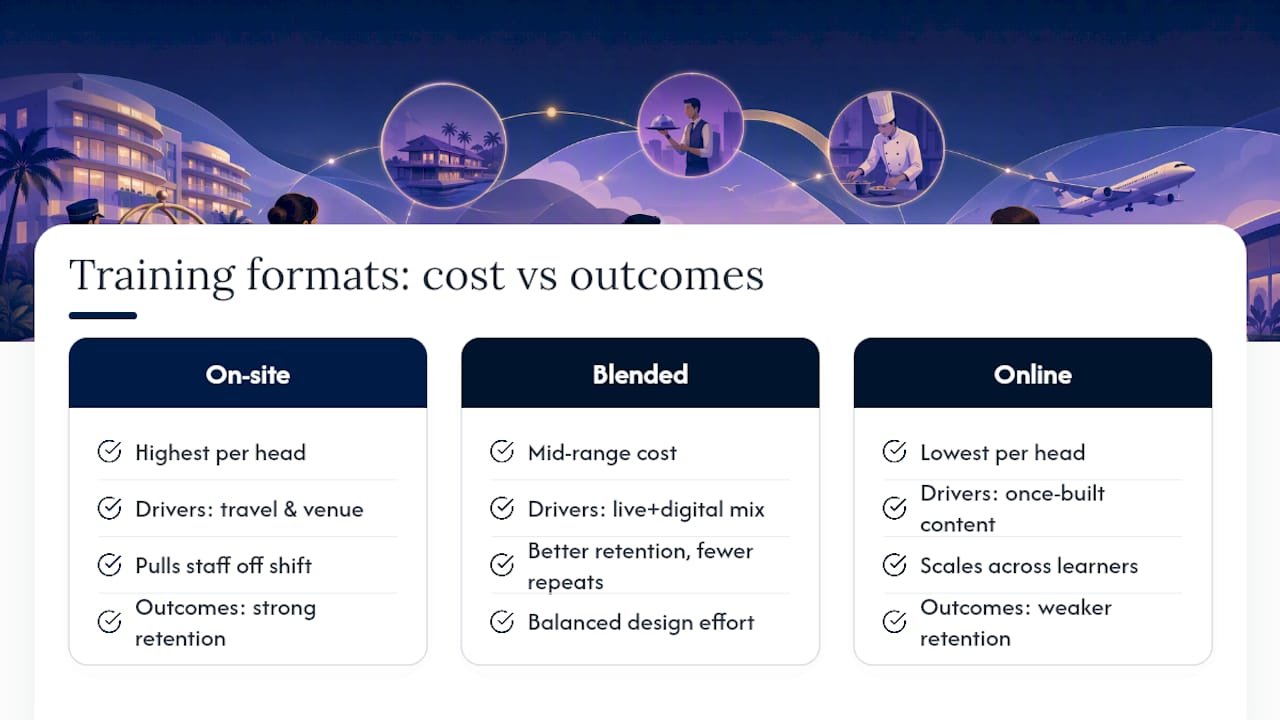
On-site programmes carry the highest per-head cost once you factor in trainer travel, venue hire, and the opportunity cost of pulling staff off shift for a full day. Fully online, self-paced courses sit at the lower end because content is built once and reused across many learners, but that lower price tag comes with the weaker outcomes discussed earlier. Blended programmes typically land in the middle on direct cost, and the total investment case improves once you weigh in the stronger retention of skills and lower need for repeat training.
Beyond the headline course fee, budget for the costs that rarely make it into a first quote: LMS licensing or integration, instructor customisation time for building scenario content around your operations, manager time spent reinforcing learning post-course, and recertification cycles for any compliance-linked modules. A programme that looks cheaper on the invoice can end up costing more once you add the hidden expense of repeating training because the first pass didn’t stick.
Ask every shortlisted provider for a cost breakdown that separates design, delivery, and measurement, rather than one bundled figure. That breakdown is often the fastest way to spot which providers have actually built a measurement layer into their offering and which are treating it as an afterthought.
How long does it take to select, pilot, and roll out training?
Most organisations underestimate the selection phase and overestimate how fast full rollout can happen. A realistic timeline runs in three distinct phases.
Selection, from writing objectives to signing a shortlisted provider, typically takes four to eight weeks if you move with intent: a week or two to define KPIs and roles internally, two to three weeks to issue the RFP and receive proposals, and a further one to two weeks to shortlist and negotiate.
The pilot phase is where the evidence base is most useful. Industrial training research on blended methods suggests designing pilots with measurable pre and post tests and manager-observed behaviour checks within a six to twelve-week window, long enough to capture both knowledge gain and early signs of behaviour change on the job. Rushing a pilot to under a month rarely gives you enough signal to justify a scale-up decision either way.
Full implementation, once a pilot has validated the approach, usually spans a further two to four months for a mid-sized organisation, depending on how many roles and sites are involved and how much LMS configuration is needed for recertification tracking. Altogether, a realistic path from first objective-setting meeting to organisation-wide rollout runs somewhere between four and seven months. Providers who promise full deployment inside a few weeks are usually skipping the pilot, which is exactly the step most likely to save you money later.
Common challenges in commissioning training and how to avoid them
The most common failure point is not the training content. It is misalignment between what the business actually needs and what gets written into the brief. A generic RFP produces generic proposals, and poor scoping is one of the most reliable predictors of a weak vendor response. The fix is spending real time defining roles, outcomes, and sample scenarios before you contact a single provider.
A second recurring risk is treating accreditation as the only quality signal and skipping the pilot. Accreditation tells you a provider meets an external standard. It says nothing about whether their delivery style suits your team, your shift patterns, or your operational quirks. Running a short pilot with genuine assessment is the fastest way to catch a pedagogical mismatch before you have committed a full budget to a provider that looks good on paper but delivers poorly in practice.
A third risk sits with managers, not vendors. Training that isn’t reinforced on the floor tends to fade within weeks, regardless of how well it was delivered. Brief managers before launch and build a short check-in into their calendar for the first month after training finishes.
Finally, watch for scope creep on customisation requests without a matching change in fee or timeline. Agree upfront how many rounds of content revision are included, so a reasonable ask for tailoring doesn’t quietly turn into an unbudgeted redesign.
What should you ask providers beyond accreditation status?
Accreditation confirms a floor, not a ceiling. Once you have verified it, the real differentiation between shortlisted providers comes down to questions accreditation certificates never answer.
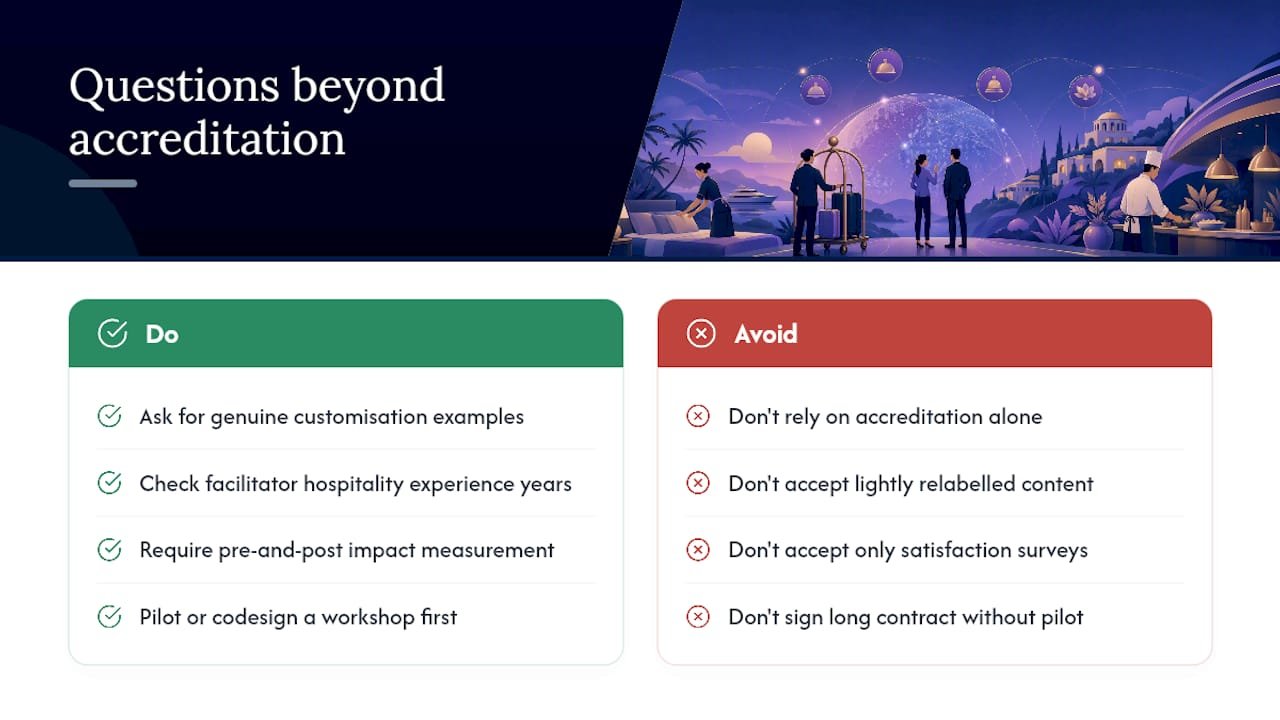
Ask how much of the content is genuinely rebuilt for your organisation versus lightly relabelled from an existing course. A provider offering real customisation should be able to describe specific changes made for a previous client in a comparable sector, without breaching that client’s confidentiality.
Ask about instructor expertise directly: how many years of operational experience the facilitator has in hospitality or tourism specifically, not just in training delivery generally, and whether the same instructor stays with you for the full engagement or gets swapped mid-programme.
Ask how they measure impact beyond an end-of-course survey. A provider who can describe a specific pre and post assessment method, and who talks comfortably about behaviour-level measurement rather than just satisfaction scores, is operating at a different level of rigour than one who cannot.
Finally, ask what a codesign session looks like in practice. Validating a provider’s approach through a pilot or codesign workshop before signing a long-term contract remains one of the clearest ways to see how a vendor actually works, rather than how they say they work. Providers who build in project-based or self-paced components as part of that codesign, similar to the portfolio-building approach used in adult education, tend to give teams something concrete to assess beyond a quiz score.
Author view: what to expect from reputable providers
Most vendor pitches promise transformation inside a fortnight. Realistic timelines run longer, and any provider who skips straight past the pilot stage is usually hiding a weak measurement process, not a strong one. A successful pilot shows three things: genuine engagement from staff who did not want to be there, a measurable lift between pre and post assessment, and managers reporting a visible change on the floor, not just a certificate on file. Once you have that evidence, scaling up is a budgeting decision, not a leap of faith.
— Sam
How Oxford Center supports accredited, customised training
Training providers build accredited, customisable programmes across on-site, online, and blended formats, designed specifically so HR teams can pilot before committing to a full rollout rather than gambling budget on an untested vendor relationship.
That means you get a defined KPI framework, LMS-ready certification records, and instructor-led design work built around your actual operations rather than a generic syllabus. If you are weighing up providers for hospitality or tourism upskilling, the practical next step is a short pilot or codesign workshop rather than a long procurement cycle. Visit the Oxford Training Centre to request a pilot session or discuss a customised blended programme for your teams, and get a clear view of how the design and measurement process would work for your specific roles before you sign anything longer term.
Sources
- Unraveling the impact of blended learning vs. online learning on learners’ performance: perspective of self-determination theory
- How to select a training vendor: a step-by-step guide
- Who needs accreditation?
- Compliance training: what it is, types & best practices (2026)
FAQ
What are hospitality and tourism training courses?
They are accredited, often customisable corporate programmes covering management, leadership, compliance, and technical upskilling for hospitality and tourism businesses, delivered on-site, online, or in blended formats such as those offered through Oxford Center.
Is blended learning really better than fully online training?
Evidence points that way for most corporate upskilling needs. A meta-analysis found blended learning produces an upper-medium positive effect on learning outcomes compared with purely online delivery, with the strongest gains on cognitive measures.
How many providers should we shortlist before piloting?
Best practice guidance recommends narrowing to three to five providers after a landscape review, then validating the strongest candidates through a pilot or codesign workshop.
How long should a training pilot run?
A window long enough to capture both knowledge gain and early behaviour change through pre and post assessment plus manager observation.
What should be tracked in the LMS for compliance modules?
Role-based assignment, automated recertification reminders, and audit-ready completion and assessment reports are the minimum for any compliance-linked hospitality or tourism training.