
Healthcare leadership training builds the management, strategic and systems skills clinicians and managers need to run teams, services and organisations well. Three formats cover most needs: short executive courses for senior leaders setting strategy, month-long professional courses for mid-level managers building practical skills, and masters-level study for those heading into system-wide roles. Whichever you choose, accreditation and recognised CPD credit should be the first filter, not an afterthought.
TL;DR:
- Most healthcare leadership courses focus on practical, measurable skills like stakeholder analysis, governance, and data use, rather than just theory.
- Accreditation and recognized CPD hours are essential filters to ensure the course’s quality and its contribution to professional revalidation requirements.
- Workplace practice elements such as projects, coaching, and real-world tasks greatly enhance skill transfer and lasting behavior change.
- The choice between short executive, month-long, or masters-level programmes depends on your current role, career goals, and the depth of learning required.
- Courses should be tailored to your specific clinical setting, whether hospital, primary care, or public health, for maximum relevance and impact.
Table of Contents
- Course types and what they actually teach
- Who these courses suit and what you need to enrol
- What you’ll actually be able to do afterwards
- Why accreditation and CPD recognition matter
- Delivery formats and why workplace practice matters most
- Duration, assessment and what it costs to enrol
- How to choose the right healthcare leadership programme for your role
- Executive short courses vs month-long professional courses vs masters
- What employers and appraisal panels actually look for
- Why choose Oxford Centre: training built around real roles
- How training turns into practice on the ward or in the boardroom
- The recurring pressures healthcare leaders face, and how training responds
- Who teaches these courses and why that matters
- What to study before or alongside a leadership course
- Hospital, public health and primary care: different leadership demands
- Editorial perspective: real-world readiness beats certificates alone
- Oxford Centre training: built around your role, not a template
- Sources
- FAQ
Course types and what they actually teach
Most healthcare leadership training sits in one of three formats. The World Health Organization’s prototype curricula describe a one week executive short course with optional self-study, as designed by WHO, a one-month professional course of around 160 hours, and a full year masters programme, each built for a different stage of a leader’s career and a different depth of learning.
The executive short course condenses strategic thinking into an intensive week, designed for senior leaders who need a sharp refresh rather than a full qualification. The month-long professional course goes deeper into applied skills over several weeks of part-time or block study, suited to managers who need to build capability while still running a service. The masters sits at the far end: a year or more of academic and practical work aimed at those moving into system-level leadership.
Across all three formats, certain themes recur because they reflect what health systems actually need from their leaders:
- Strategic leadership and decision-making under uncertainty.
- Systems thinking and understanding how parts of a health service interact.
- Human resources for health (HRH) policy and workforce planning.
- Quality improvement methods and patient safety practice.
- Digital transformation and the use of data in service design.
- Governance, accountability and regulatory compliance.
Programmes typically organise this material into modules, each paired with a case study or workplace task rather than delivered as abstract theory. A module on stakeholder analysis, for instance, commonly asks participants to map stakeholders for a live project in their own organisation rather than a hypothetical one, which keeps the learning tied to something they can act on immediately.
Who these courses suit and what you need to enrol
Healthcare leadership training is not a single audience product. Providers design different levels for different points in a career, and matching yourself to the right one saves both time and money.
Typical participants include:
- Clinicians moving into their first formal management responsibilities.
- Nurse managers and ward or service leads overseeing teams and budgets.
- Senior technical staff (pharmacy, allied health, diagnostics) stepping into cross-functional leadership.
- HR leads and workforce planners working within health organisations.
- Executives and directors preparing for or already holding system-level roles.
Entry requirements vary by level but follow a predictable pattern. Short executive courses often ask only for current seniority or relevant role responsibility. Month-long professional courses may require a few years of managerial experience or a demonstrated need, such as a recent promotion into a leadership post. Masters programmes usually expect a first degree, a minimum number of years in a relevant role, and sometimes a portfolio or reference demonstrating management experience.
Cohort mix matters more than it might seem. Courses that bring together clinicians, managers and policy staff in one room, physical or virtual, tend to produce richer peer learning, because participants bring different operational pressures to the same problems.
What you’ll actually be able to do afterwards
A good healthcare leadership programme should leave you with measurable capability, not just a certificate. The clearest way to judge this is to look at what outcomes a provider publishes before you enrol.
Common measurable outcomes include:
- Applying systems thinking to diagnose where a service is underperforming.
- Running a structured stakeholder analysis before launching a change.
- Engaging in policy dialogue and translating policy into operational decisions.
- Exercising governance and accountability within a defined scope of authority.
- Applying HRH-specific skills such as workforce planning and retention strategy.
- Interpreting operational and clinical data to support decisions.
These outcomes are not arbitrary. WHO’s Global Competency and Outcomes Framework for Universal Health Coverage recommends competency-based education as the benchmark for health worker training, meaning curricula should be built around what a learner can actually do afterwards rather than how many hours they sat in a room. A programme that lists specific, observable competencies against each module is following this benchmark; one that lists only topic headings generally is not.
Competency-based education organises curricula around performance outcomes and practice activities rather than duration alone, which the Global Competency and Outcomes Framework credits with improving preparedness for real-world practice. In practice, this means a module on quality improvement should end with you running an actual improvement cycle in your own workplace, not just describing one in an exam answer.
Assessment evidence in well-designed programmes tends to include:
- Workplace projects tied to a real operational problem.
- Portfolios collecting evidence of applied skills over the course.
- Formative feedback from tutors or peers during the programme, not only a final grade.
The WHO prototype curricula build this pairing directly into their design: each module links to a workplace practice task and a summative assessment, so a module on stakeholder analysis is assessed by submitting an actual stakeholder analysis from a current project, complete with reflection on what it revealed. That structure is worth looking for when you compare providers, because it is the difference between a course that teaches a concept and one that embeds it in your daily work.
Why accreditation and CPD recognition matter
Accreditation is the single most useful filter when comparing healthcare leadership courses, because it tells you whether an external body has checked the course content, assessment and outcomes against a recognised standard.
CPD recognition matters for a related but distinct reason: many professional bodies require a minimum number of CPD hours or points for revalidation, and only accredited or formally recognised courses count towards that requirement. A course without clear CPD credit may still teach useful content, but it will not help you meet a formal revalidation obligation.
When comparing providers, check for:
- A named accrediting body or professional association tied to the course, not just a general claim of “accreditation”.
- A published statement of CPD hours or credit points, ideally broken down by module.
- Whether your employer or professional body explicitly recognises the credits for progression or revalidation.
Pro Tip: Ask the provider for the exact wording they use on your certificate and check that wording against your professional body’s CPD guidance before you pay, not after.
Courses tied to recognised professional bodies, such as the staged programmes and fellowships published by AONL, tend to carry more weight with employers precisely because the contact hours and competencies are externally validated rather than self-described.
Delivery formats and why workplace practice matters most
Healthcare leadership courses are delivered online, in blended formats, or fully on-site, and each has trade-offs worth weighing against your schedule and learning style.
- Synchronous online sessions suit learners who want live interaction and immediate feedback but need to work around shift patterns.
- Asynchronous online modules offer the most flexibility for busy clinicians, though they require more self-discipline to complete.
- Blended formats combine online study with in-person workshops, giving some face-to-face networking without a full-time commitment.
- Fully on-site programmes offer the most immersive peer learning but demand the most time away from the workplace.
None of these formats matters as much as what happens after the formal sessions end. The 70:20:10 model, widely applied in healthcare leadership development, holds that roughly 70% of learning happens through workplace experience, 20% through coaching and mentoring, and only 10% through formal classroom or online training. That ratio is a strong argument for choosing a course that builds in workplace projects and coaching cycles rather than one that treats the classroom sessions as the whole programme.
Practical elements worth looking for include:
- Action learning sets, where small groups work through real problems together over several sessions.
- One-to-one or group coaching alongside the taught content.
- Workplace projects assessed as part of the course, not as an optional extra.
Formal learning alone rarely produces durable change in leadership behaviour, which is why the strongest programmes treat the classroom as a starting point rather than the destination.
Duration, assessment and what it costs to enrol
Time commitment varies sharply by level, and planning around it matters as much as choosing the right content. Executive short courses typically run for about a week, sometimes with optional self-study either side. Month-long professional courses, as described in the WHO prototype curricula, run to roughly 160 hours of study as per WHO design, often spread across several weeks part-time. Masters programmes run for a full academic year or more, usually part-time alongside a working role.
Assessment formats generally include:
- Written assignments applying course concepts to the learner’s own workplace.
- Quizzes or short tests checking understanding of core material.
- Portfolios collecting evidence built up across the course.
- Workplace project reports assessed as a capstone piece of work.
Pricing shapes differ by provider and format. Corporate bookings, where an employer enrols several staff at once, often attract different terms to individual enrolments, and some providers offer payment plans for longer programmes. Course landing pages typically list entry requirements, duration options, assessment modes and fee information directly, so it is worth checking a provider’s own course page rather than relying on general estimates before you commit.
How to choose the right healthcare leadership programme for your role
Choosing well comes down to matching your current role and near-term goals to the right level of programme, then checking that the provider can prove what it claims.
- Identify your target outcome. Decide whether you need a strategic refresh, a practical skills upgrade, or a full qualification for a system-level role, since this points you straight at short, month-long or masters formats respectively.
- Match the format to your schedule. A clinician working full shifts will struggle with a fully on-site month-long course, while a director with protected study time may get more from immersive, in-person formats.
- Check accreditation and CPD credit in writing. Ask for the named accrediting body and the exact CPD hours before enrolling, not after.
- Ask about cohort composition. Find out whether you will be learning alongside peers at a similar level, or a mixed group, and decide which suits your learning style.
- Ask how workplace practice is built in. Confirm whether the course includes coaching, action learning sets or assessed workplace projects, given how much of real learning happens on the job rather than in class.
- Ask about post-course support. Some providers offer follow-up coaching or alumni access; others end contact the day the course finishes.
- Request sample assessment evidence. A provider that can show you an example portfolio or project brief is generally more transparent about what you will actually produce.
Pro Tip: Write down your target outcome in one sentence before contacting any provider, then test every course against that sentence rather than against a generic prospectus.
Watch for red flags during this process. Vague outcome statements such as “develop your leadership potential” with no named competencies suggest the course has not been designed around specific skills. A complete absence of workplace practice, with every assessment confined to written exams, suggests the course will struggle to produce lasting behaviour change. And any provider unwilling to name their accrediting body or state CPD hours clearly should be treated with caution, since this is the easiest claim to verify and the easiest one to overstate.
Executive short courses vs month-long professional courses vs masters
These three formats are not interchangeable, and picking the wrong one wastes both time and budget.
Executive short courses concentrate on strategic focus and peer learning over a short, intense period, generally one week according to WHO’s prototype design. They suit senior leaders who already have management experience and need to sharpen strategic thinking or address a specific challenge, rather than build foundational skills from scratch.
Month-long professional courses, running to roughly 160 hours, are built for practical skill development among mid-level managers. They go deeper than a short course into applied technique, covering things like quality improvement methods or HRH workforce planning in enough detail to apply directly, without the full academic weight of a masters.
Masters-level study, typically a full year, is aimed at senior system roles that require not just applied skill but a genuine grounding in policy, research methods and systems leadership. This is the format for someone heading towards a director-level or system-wide position where decisions need to be grounded in evidence and policy understanding, not just operational competence.
The practical difference comes down to depth versus speed:
- Executive short courses trade depth for speed, ideal when time away from the role is limited.
- Month-long courses balance depth and time, suited to managers with a defined skills gap.
- Masters programmes trade speed for depth, suited to those building a long-term leadership career.
What employers and appraisal panels actually look for
Completing a leadership course only helps your career if you can show what it changed. Employers and appraisal panels generally care less about the certificate itself and more about what you did with the learning.
What tends to carry weight:
- A completed workplace project with a measurable before-and-after outcome.
- Evidence of leadership behaviours changing, such as how you now run team meetings or handle conflict.
- CPD hours that count formally towards revalidation or a professional qualification.
- Feedback from colleagues or line managers reflecting a visible change in approach.
When presenting course impact in a CV, appraisal or professional portfolio, be specific rather than listing the course title alone. State the problem you worked on, the action you took as a direct result of the training, and the measurable outcome, however modest. A line such as “redesigned the discharge planning stakeholder map, reducing delays in handover communication” demonstrates far more than simply naming the course you attended.
Why choose Oxford Centre: training built around real roles
Some professional training spans healthcare alongside sectors such as project management, oil and gas and civil engineering, with courses designed to be customised to an organisation’s specific challenges rather than delivered as a fixed, generic programme.
A few features of how Oxford Centre operates are worth knowing if you are comparing providers against the framework above:
- Some courses carry globally accredited qualifications, which matters given how much accreditation determines whether training counts for CPD or revalidation.
- Delivery formats may include on-site, online and blended formats, potentially allowing matching the course to different schedules and working patterns.
- Content may be customisable to an organisation’s specific needs, rather than being a one-size-fits-all curriculum.
- Some courses may be led by trainers addressing real-world challenges rather than abstract theory alone.
This maps directly onto the decision framework above: when you ask a provider about accreditation, cohort fit and delivery mode, these are the exact questions Oxford Centre’s model is built to answer. You can review the current course structure directly on the Oxford Training Centre site before deciding whether it fits your goals.
How training turns into practice on the ward or in the boardroom
Good healthcare leadership training does not stop at theory. Programmes built around the WHO prototype curricula pair each taught module with a live workplace task, so a session on stakeholder analysis ends with participants mapping stakeholders for an actual project they are running, not a textbook scenario.
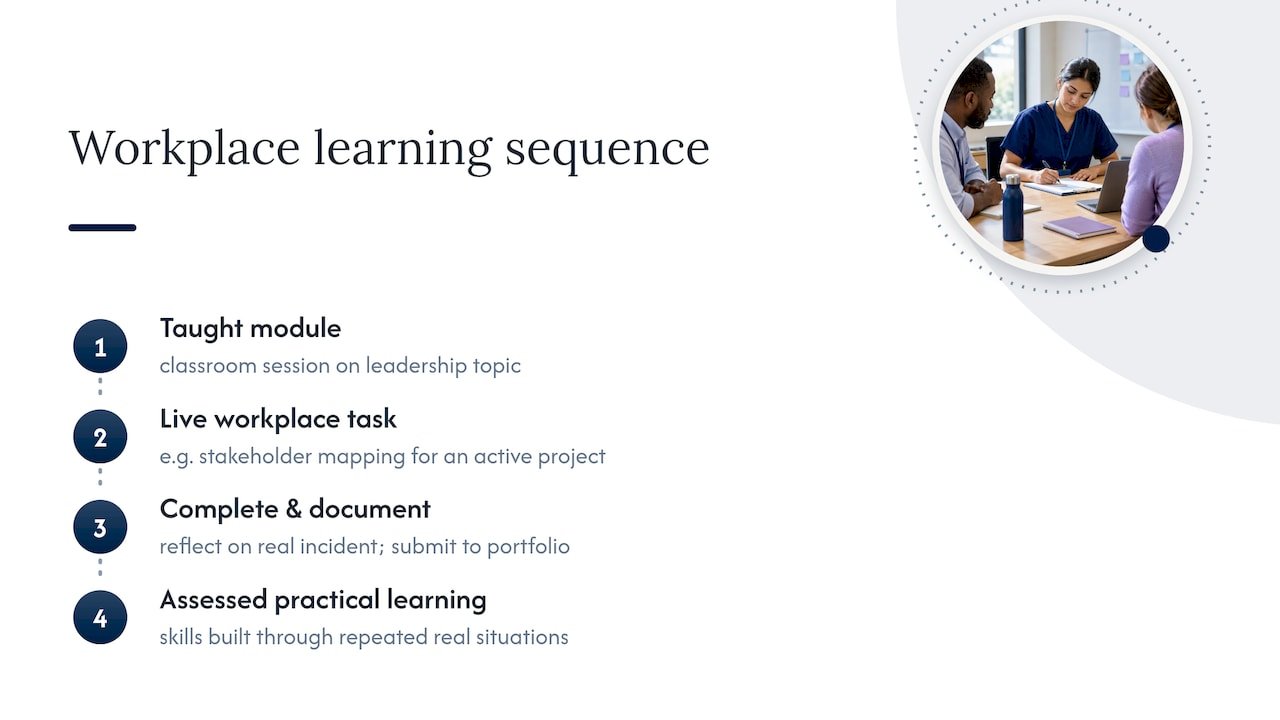
This matters because leadership skill rarely transfers cleanly from a classroom exercise to a real service under pressure. A nurse manager working through a module on conflict resolution, for example, might be asked to document and reflect on a real disagreement they handled between shifts, submitting that reflection as part of their assessed portfolio. The curriculum guide covering leadership in critical care nursing makes a similar point about ICU settings: leadership capability there is built through handling real, high-stakes situations repeatedly, not through abstract principles alone.
Case-based learning also gives cohorts a shared reference point. When a mixed group of clinicians and managers works through the same real-world scenario, such as redesigning a discharge pathway or responding to a staffing shortfall, the discussion surfaces different perspectives that a single-discipline group would miss entirely.
The recurring pressures healthcare leaders face, and how training responds
Certain challenges show up again and again across healthcare leadership roles, regardless of setting. Staff shortages force managers to balance competing priorities with fewer resources. Rapid policy change, particularly around digital systems and data reporting, demands leaders who can adapt quickly rather than rely on fixed procedures. And the tension between clinical priorities and administrative or financial constraints creates near-constant friction for anyone managing a service.
Well-designed training addresses these directly rather than treating them as background noise. Modules on HRH policy and workforce planning give leaders frameworks for making difficult staffing trade-offs defensibly rather than reactively. Digital transformation content equips leaders to interpret and act on new reporting requirements instead of simply complying with them. And governance modules give leaders a structured way to balance clinical and financial priorities, rather than treating every decision as a fresh negotiation.
Distributed leadership, where authority and decision-making are shared across a team rather than concentrated at the top, is increasingly emphasised in this context. Health systems are complex enough that command-and-control approaches from a single leader struggle to keep pace, and training that builds skills in delegation, stakeholder engagement and coaching others reflects that reality rather than training leaders to be the sole decision-maker in every situation.
Who teaches these courses and why that matters
Faculty quality is one of the harder things to judge from a course prospectus, but it is worth pushing providers on directly. Strong healthcare leadership programmes tend to draw on trainers with direct experience in health system operations, policy or clinical management, rather than generalist business trainers applying a template from another sector.
Staged programmes and fellowships published by AONL combine experiential learning with coaching and measurable contact hours, an approach that depends heavily on faculty who can run realistic simulations and give meaningful, specific feedback rather than generic encouragement. Ask any provider you are considering how their trainers maintain current industry involvement, whether through ongoing clinical or management roles, advisory work, or active research, since trainers who have stepped away from the sector entirely tend to teach a dated version of its problems.
Industry involvement also shows up in how current the case material is. A course still using examples from a decade-old reorganisation is a weaker signal than one built around challenges your organisation is facing this year, such as digital transformation pressures or recent workforce policy shifts.
What to study before or alongside a leadership course
Leadership training works best when it sits on top of some existing foundation, rather than being the first formal learning a manager encounters. If you are moving into management for the first time, a short course in basic people management or performance appraisal before tackling a full healthcare leadership programme can make the strategic content land better.
Complementary training worth considering alongside or before a leadership course includes:
- Quality improvement methodology, which underpins much of the systems thinking content in leadership courses.
- Project management fundamentals, useful for anyone who will be running workplace projects as part of their assessment.
- Data interpretation or basic analytics, given how much modern healthcare leadership depends on reading operational and clinical data correctly.
None of these are strict prerequisites for most programmes, but they make the leadership content considerably easier to apply once you are in the course, since you spend less time learning the supporting skill and more time applying it to the leadership problem at hand.
Hospital, public health and primary care: different leadership demands
Leadership training that works well for a hospital setting does not always transfer cleanly to public health or primary care, because the operational pressures differ sharply.
Hospital-based leadership tends to emphasise managing large, multidisciplinary teams, patient flow and acute resource allocation, often under immediate time pressure. Training for this setting leans heavily on governance, quality improvement and crisis decision-making.
Public health leadership operates on a longer time horizon and a wider population scale, dealing more with policy dialogue, data-driven planning and coordination across multiple organisations rather than a single site. Training here draws more heavily on the policy and HRH workforce planning content described in the WHO prototype curricula, reflecting the system-wide scope of the role.
Primary care leadership sits somewhere between the two: smaller teams than a hospital, but direct, ongoing relationships with patients and communities that shape decisions in a way hospital leadership rarely experiences. Leaders here often need strong stakeholder engagement skills, since much of their influence depends on relationships with patients, local authorities and other primary care providers rather than formal authority within a large institution.
Choosing a course that reflects your actual setting, rather than a generic leadership curriculum, makes the case studies and workplace tasks far more relevant to what you do day to day.
Editorial perspective: real-world readiness beats certificates alone
The healthcare leadership training market sells a lot of certificates and not nearly enough changed behaviour. A course can tick every accreditation box and still leave a manager no better at handling a difficult staffing negotiation or a genuine conflict between clinical and financial priorities, because classroom content alone rarely produces that kind of durable skill.
The providers doing this well tend to share one trait: they treat the taught sessions as a trigger for workplace practice, not the whole product. The gap shows up in programmes that stop at the certificate and never ask what the learner actually did differently afterwards. Distributed leadership, where authority is shared rather than hoarded at the top, is a harder sell than a tidy diploma, but it is what complex health systems actually need.
If you take one thing from any course you choose, make it a habit rather than a credential: find one real workplace problem each month and apply what you learned to it deliberately, then write down what changed.
— Sam
Oxford Centre training: built around your role, not a template
Picking a course from the framework above still leaves one practical question: who delivers training flexible enough to match your actual schedule and organisation, rather than forcing you into a fixed format. Oxford Centre’s healthcare courses are built to be customised, delivered on-site, online or blended, and led by trainers working from real-world challenges rather than a generic template.
Before you enquire, it helps to have three things ready: your current role and the leadership gap you are trying to close, your preferred delivery mode given your working pattern, and a rough timeline for when you need the training completed. That turns a generic enquiry into a conversation about the specific programme shape that fits you.
A few things worth knowing before you reach out:
- Delivery formats include on-site, online and blended options, so shift patterns do not have to rule out a course outright.
- Course content can be tailored to your organisation’s specific operational challenges rather than delivered as a fixed curriculum.
- Courses carry global accreditation, addressing the CPD and recognition questions covered earlier in this guide.
You can view course structure and start an enquiry on the project management course page or get in touch directly through Oxford Training Centre to discuss a bespoke healthcare leadership programme.
Sources
- Human Resources for Health leadership and management: a prototype curricula package
- AONL education programmes overview
- Workplace leadership development for doctors (70:20:10 model)
FAQ
Is there a free leadership course offered by the NHS?
Workforce development bodies connected to the NHS, such as Health Education England, have published free workplace leadership resources, including guidance on the 70:20:10 model for doctors. Availability and scope of any free course changes over time, so check the current NHS workforce development pages directly for what is on offer now.
What are the four leadership styles in healthcare?
Healthcare leadership literature describes several recognised styles, commonly including transformational, transactional, situational and servant leadership, though definitions and groupings vary between sources. Most accredited training programmes cover these styles as a foundation before moving into applied skills like stakeholder engagement and governance.
Is there an MSc in healthcare leadership available in the UK?
Several UK universities offer MSc programmes in healthcare leadership or management, typically run part-time over a year or more alongside a working role. These sit at the masters level described in this guide, aimed at leaders moving into system-wide or policy-facing positions.
What are some good leadership courses available in the UK?
Strong options in the UK span accredited fellowships, university masters programmes and professional short courses, and the right one depends on your current role and target outcome. Oxford Centre offers customisable, globally accredited leadership training delivered on-site, online or blended, which you can review on the project management course page.
What should I check before paying for a healthcare leadership course?
Confirm the named accrediting body, the exact CPD hours offered, and whether the course includes workplace projects or coaching rather than classroom content alone. Course landing pages typically list entry requirements, duration and fees directly, so checking the provider’s own page before enrolling is the most reliable way to avoid surprises.