
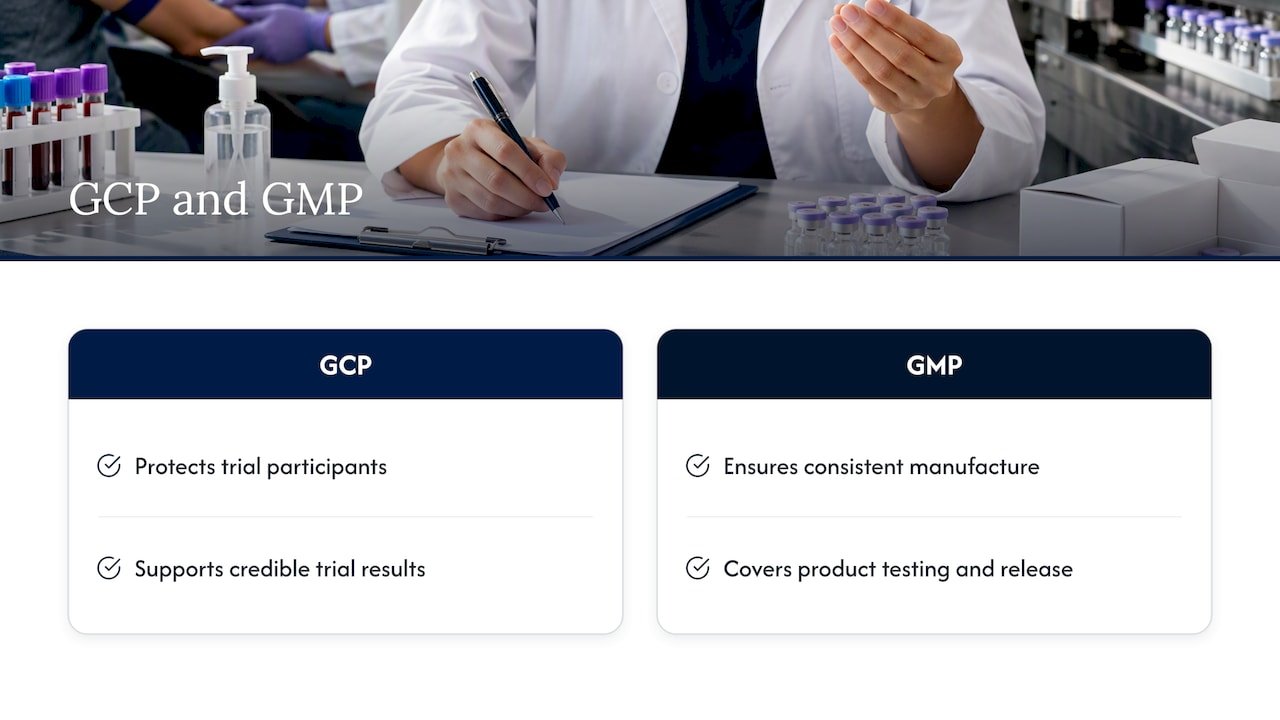
GCP and GMP are two different quality standards for two different stages of a medicine’s life. Good Clinical Practice (GCP) governs clinical trials on human participants: how they are designed, run, recorded and reported. Good Manufacturing Practice (GMP) governs how a medicine is made, tested, packaged and released, so that every batch is consistent and fit for its purpose. They meet at one point, the manufacture of investigational medicines used in trials, but they are not interchangeable and they are not enforced in the same way.
This guide sets the two side by side, explains where they overlap, and helps you decide which one your team needs training in.
TL;DR
- GCP protects trial participants and makes sure trial data is credible. It applies to anyone designing, running, monitoring or reporting a clinical trial.
- GMP makes sure medicines are produced to a consistent quality. It applies to manufacturers, their quality units and the people who handle, test and release product.
- The two overlap for investigational medicinal products: the medicine given in a trial must be made under GMP, and the trial itself must follow GCP.
- Rules differ by country. The UK, EU and US each have their own legal route, though all lean on shared international principles.
- Choose training by your role: trial staff need GCP, production and quality staff need GMP, and some roles need both.
Table of Contents
- The short answer: trials versus production
- What GCP means
- What GMP means
- GCP vs GMP side by side
- Where GCP and GMP meet
- Consequences of getting it wrong
- How the rules differ by country
- What about GLP and GDP?
- Which one does your team need?
- A worked example
- Our perspective
- Training for your team
- Common misunderstandings
- FAQ
- Sources
The short answer: trials versus production
Think of a new medicine’s journey. It is made in a facility, then given to volunteers or patients in a trial, then, if it works, made again at scale and sold. GMP sits over the making. GCP sits over the trial.
The question GCP asks is: were the people in this trial protected, and can we trust the results? The question GMP asks is: was this product made, tested and released in a way that guarantees it is what it says it is, every time?
A clinical research associate and a production supervisor can both work for the same pharmaceutical company and never use the same standard in a working day. That is why mixing the two up in a job description, a tender or a training budget causes real problems.
What GCP means
GCP stands for Good Clinical Practice. The international guideline that defines it, ICH E6, describes it as an international, ethical, scientific and quality standard for the conduct of trials involving human participants. Its purpose is to protect participants’ rights, safety and well-being and to make sure results are credible.
The guideline covers the whole lifecycle of a trial. According to the 2025 revision (E6(R3)), that means planning, initiating, performing, recording, oversight, evaluation, analysis and reporting. It applies to interventional trials of investigational products intended to support a regulatory submission.
Who works under GCP
- Sponsors and the clinical research organisations that act for them
- Principal investigators and site staff, including research nurses and study coordinators
- Monitors and clinical research associates
- Data managers, statisticians and medical writers on trial data
- Auditors and quality assurance staff for clinical studies
- Ethics committee and regulatory affairs staff
What GCP looks like in practice
Day to day, GCP shows up as informed consent that is properly obtained and documented, a protocol that is followed or any deviation recorded, safety events reported on time, data that can be traced back to its source, and oversight that is proportionate to the risk of the trial.
The 2025 revision leans further into proportionality. It incorporates flexible, risk-based approaches and embraces innovation in trial design, conduct and technology, while keeping the focus on quality by design, participant protection and reliable results. The principles are meant to hold as methods change, and can be met through different approaches suited to a trial’s purpose.
What GMP means
GMP stands for Good Manufacturing Practice. In the words of the European regulator, it is the minimum standard a medicines manufacturer must meet in its production processes so that medicines are of consistently high quality, appropriate for their intended use and in line with the terms of their authorisation. The UK’s guidance on good manufacturing practice and good distribution practice uses essentially the same definition.
The detail lives in rulebooks. In the EU, EudraLex Volume 4 provides GMP guidance for human and veterinary medicines, with chapters on quality systems, personnel, premises and equipment, documentation, production and quality control.
Who works under GMP
- Production operators and supervisors
- Quality control analysts and quality assurance staff
- Qualified persons and those who release batches
- Engineering, maintenance and validation teams
- Warehouse and logistics staff who store and move materials and product
- Supplier quality and auditing teams
What GMP looks like in practice
In a plant, GMP means documented procedures that people actually follow, trained and qualified staff, clean and maintained premises, validated equipment and processes, controlled raw materials, batch records, deviation and change control, and a quality unit with the authority to stop a batch.
One point surprises newcomers. As the pharmaceutical engineering body ISPE notes, most GMP requirements are general and open-ended, leaving each manufacturer to decide how best to implement the controls. That flexibility is why two compliant sites can look quite different, and why judgement matters as much as memorising clauses.
GCP vs GMP side by side
| GCP (Good Clinical Practice) | GMP (Good Manufacturing Practice) | |
|---|---|---|
| Governs | Design, conduct, recording and reporting of clinical trials | Production, testing, packaging, storage and release of medicines |
| Main aim | Protect participants and ensure credible data | Ensure consistent product quality and fitness for use |
| Core question | Is the person protected and is the data trustworthy? | Is every batch what it claims to be? |
| Where it applies | Trial sites, sponsors, research organisations | Manufacturing and testing sites, importers, packagers |
| Key records | Consent forms, protocols, case report forms, safety reports | Batch records, specifications, deviations, validation files |
| Typical roles | Investigators, monitors, coordinators, data managers | Operators, quality control, quality assurance, qualified persons |
| International reference | ICH E6 guideline | National and regional rulebooks such as EudraLex Volume 4 |
| Style of rule | Principles that can be met by different approaches | Minimum standards, often open-ended, applied to each site |
Where GCP and GMP meet
The overlap is the investigational medicinal product, the experimental drug or comparator given to participants in a trial. It has to be manufactured to a suitable standard, and then used in a trial that follows GCP.
The EU has a dedicated instrument for this. Commission Delegated Regulation (EU) 2017/1569 sets out principles and guidelines of good manufacturing practice for investigational medicinal products for human use, and it is listed alongside the main GMP volume.
In practical terms, the hand-off looks like this:
- The manufacturer makes and releases the trial supply under GMP.
- The sponsor arranges labelling, shipping and storage conditions that protect that quality.
- The trial site stores, dispenses and accounts for the product under GCP, recording who received what.
- If a quality defect is found, both worlds are involved: the manufacturer investigates under GMP, and the sponsor and investigators manage participant safety and data impact under GCP.
Staff on either side benefit from understanding the other’s expectations. A monitor who knows what a GMP release certificate means, or a quality assurance specialist who understands why a missed consent form is a serious finding, communicates better and spots problems earlier.
Consequences of getting it wrong
The stakes are different too. For GMP, ISPE points out that failing to comply can lead to recalls, seizures, fines and even jail time in the US context. A GMP failure is typically a product problem: contaminated, mislabelled or out-of-specification medicine reaching patients.
A GCP failure is typically a people and data problem: participants who were not properly informed or protected, or results that regulators cannot rely on. In the worst case, a trial’s data is rejected and the work has to be repeated.
The details of enforcement depend on the country, so check the regulator for your own jurisdiction rather than assuming one rule applies everywhere.
How the rules differ by country
GCP and GMP are global ideas with local legal clothing. Our readers work in many countries, so here is the pattern for three major regions.
United Kingdom
The Medicines and Healthcare products Regulatory Agency (MHRA) inspects manufacturing and distribution sites against GMP or GDP. According to GOV.UK guidance, you are inspected when you apply for a manufacturer’s or wholesale dealer’s licence and then periodically, based on risk, and overseas sites are inspected too.
On the clinical side, the MHRA announced that the most significant update to UK clinical trials regulations in two decades would come into force on 28 April 2026, alongside implementation of the latest international GCP guidelines. If your team’s GCP training predates that change, it is worth checking it still matches current requirements.
European Union
EU GMP is binding on anyone who wants to supply the EU market. The EMA states that manufacturers of medicines for the EU must comply with EU GMP wherever in the world they are located. Importers carry a duty too: according to EudraLex Volume 4, EU importers are responsible for ensuring the third-country manufacturers they buy from comply with GMP.
For trials, the EMA describes Good Clinical Practice as an international ethical and scientific quality standard, and lists guidance on trials run both inside and outside the EU.
United States
The FDA enforces Current Good Manufacturing Practice (CGMP) regulations, which require manufacturers to control operations so that drug identity, strength, quality and purity are assured. The “C” for current signals that manufacturers are expected to use up-to-date technologies and systems, not just meet a fixed historical checklist.
What about GLP and GDP?
Search results for this topic often drag in two more acronyms, so here is where they fit.
- GLP (Good Laboratory Practice) covers non-clinical laboratory studies, the safety testing done before a medicine is ever given to people. It sits earlier in the timeline than GCP.
- GDP (Good Distribution Practice) covers the supply chain after manufacture: obtaining medicines from the licensed chain and keeping them stored, transported and handled properly. GOV.UK treats it alongside GMP in the same guidance.
A rough order of the lifecycle is GLP in the lab, GMP in the factory, GCP in the trial, then GMP and GDP again as the approved product is made and delivered.
Which one does your team need?
Start from the job, not the acronym.
| Your role or team | Primary standard | Also useful |
|---|---|---|
| Clinical research associate, monitor, study coordinator | GCP | Basic GMP awareness for trial supply |
| Principal investigator and site staff | GCP | None required for most |
| Clinical data manager or trial statistician | GCP | Data integrity principles shared with GMP |
| Production operator or supervisor | GMP | None required for most |
| Quality control or quality assurance in a plant | GMP | GCP if you support trial supplies |
| Clinical supply chain or trial packaging team | GMP and GCP | GDP |
| Regulatory affairs | Both, at overview level | Local legislation |
| Auditor or inspector | Both, depending on scope | Risk-based audit methods |
Questions to ask before you book
- Which regulator will judge us? Training should reflect the rules that apply in your country or the market you supply.
- How current is the content? GCP guidance was revised in 2025 and UK trial regulations changed in 2026, so older material may be out of date.
- Is it role-specific? A coordinator and a qualified person need very different depth.
- How will it be delivered? On-site delivery suits a whole team with shared procedures, online suits dispersed staff, and blended suits a mix.
- Can the content use your own procedures? People retain more when examples come from their own deviation reports and protocols than from generic case studies.
A worked example
Imagine a mid-sized company running a phase II trial of a new tablet across six sites in the UK and the Netherlands.
The contract manufacturer making the tablets needs GMP for investigational products: its quality unit certifies each batch before it ships. The sponsor’s clinical operations team needs GCP: monitors visit sites, check consent and source data, and follow up on deviations. The clinical supply manager sits between the two, so needs to understand both what the release documentation says and how sites will store and dispense the product.
When a temperature excursion happens during transport, the supply manager asks the manufacturer for stability data (a GMP-side document), and the monitor confirms with the site which participants received product from the affected lot (a GCP-side activity). One incident, two standards, two sets of people who need to talk the same language.
Our perspective
We see the same mistake in training plans again and again: organisations buy one “compliance course” and expect it to cover every regulated role. GCP and GMP look alike because both stress documentation, training and traceability, but a person who has learned one has not learned the other.
Our approach is to start with the role and the regulator, then build the course around it. Our training is customisable, so content can be shaped around your organisation’s own procedures and real-world challenges rather than a generic slide deck. It can be delivered on-site, online or in a blended format, so a quality team in one country and a trial team in another can train in the way that suits them.
Our advice to HR and learning managers: map roles to standards first, check how recent your last training was against the latest guidance, and train people in the depth their job demands. A short awareness session is right for regulatory staff who touch both worlds. A full programme is right for the people whose daily work is judged against the standard.
— Sam
Training for your team
If you are building a compliance and upskilling plan, we run professional training with global accreditation across healthcare, management, compliance and safety, customisable for corporate groups and open to individual professionals. You can browse the full course catalogue or see how our programmes are organised for project managers, whose trial and manufacturing projects depend on teams that understand these standards. Tell us your roles, your regulator and your preferred format, and we will advise on what fits.

If you would like to talk through a team plan, start from our main site or the page for your nearest city, such as London or Bristol.
Common misunderstandings
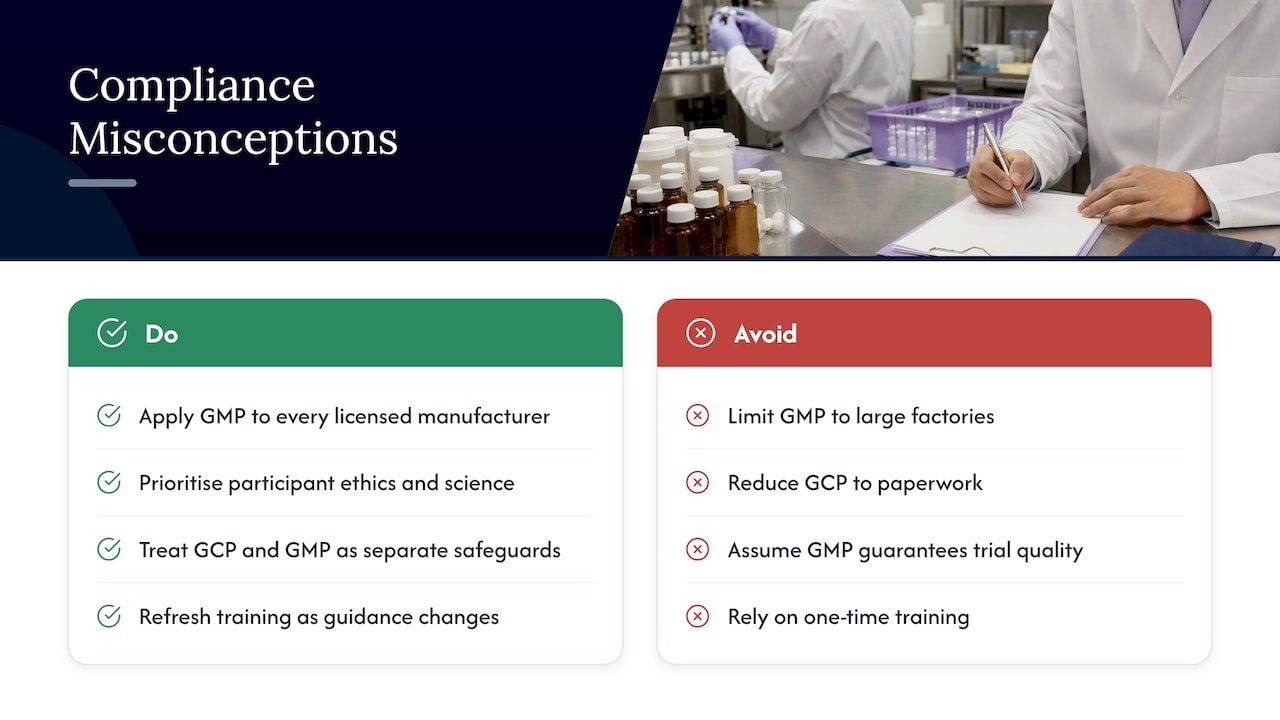
“GMP is only for big factories.” It applies to any licensed manufacturer, including small sites and those making trial supplies. Scale changes the systems, not the principle.
“GCP is only about paperwork.” Documentation matters because it proves participants were protected and data is reliable, but the standard is about ethics and science first.
“If we are GMP compliant, our trial is fine.” A perfectly made product can still be used in a trial with poor consent processes or unreliable data. Each standard guards a different risk.
“These are the same everywhere.” The principles travel, the legal detail does not. A site supplying several markets needs to know which rulebook each regulator applies.
“Training once is enough.” Guidance evolves, as the 2025 GCP revision and the 2026 UK trial regulation changes show. Refresher training and a record of who was trained on what version are part of staying compliant.
FAQ
What is the main difference between GCP and GMP?
GCP governs clinical trials on human participants, protecting them and ensuring reliable data. GMP governs the manufacture of medicines, ensuring each batch is consistent and fit for its intended use. One is about how research on people is done, the other about how a product is made.
Do GCP and GMP ever apply together?
Yes, for investigational medicines used in trials. The product must be manufactured under GMP, and the trial that uses it must follow GCP. In the EU, a dedicated regulation sets GMP principles specifically for investigational medicinal products.
Is GMP the same as cGMP?
Not exactly. In the US the regulations are called Current Good Manufacturing Practice, where “current” means manufacturers are expected to use up-to-date systems and technologies. In everyday use, the terms are often used interchangeably, but check which regulator’s wording applies to you.
Which training should I take first, GCP or GMP?
Choose by your job. If you work with trial participants, trial data or monitoring, take GCP. If you work in production, quality control or batch release, take GMP. People in clinical supply or regulatory roles often need both at different depths.
Where do GLP and GDP fit in?
GLP covers non-clinical laboratory studies carried out before human trials. GDP covers the storage, transport and handling of medicines through the licensed supply chain after manufacture. Together with GCP and GMP they form the family of “good practice” standards across a medicine’s life.
Sources
- ICH E6(R3) Guideline for Good Clinical Practice, 2025
- ICH E6(R3) Guideline for Good Clinical Practice, error-corrected version
- European Medicines Agency: Good manufacturing practice
- European Medicines Agency: Good clinical practice
- European Commission: EudraLex Volume 4
- ISPE: What is GMP
- FDA: Facts about Current Good Manufacturing Practice
- GOV.UK: Medicines, good manufacturing practice and good distribution practice
- MHRA Inspectorate: Clinical trials regulations, six-month countdown begins