
CPR is a single emergency skill: chest compressions, with rescue breaths where appropriate, to keep blood moving after a cardiac arrest. BLS, or Basic Life Support, is the wider package built around that skill. It adds recognising the emergency, calling for help, using a defibrillator (AED), managing the airway and ventilations, responding to choking, and working as part of a team. So BLS contains CPR, but a CPR certificate is not automatically a BLS provider credential. Which one you need depends on your role and on what your employer, regulator or professional body specifies.
This guide explains the difference in plain terms, shows who usually needs which course, and gives HR managers a way to choose for a whole workforce.
TL;DR
- CPR is a technique. BLS is the organised set of early actions around it, including AED use, airway skills, choking response and team coordination.
- Clinical staff, paramedics and other first responders are generally steered towards BLS. Non-clinical employees, teachers, parents and fitness professionals are usually well served by CPR with AED training.
- There is no worldwide ranking called “CPR Level C”. Labels differ between countries and employers, so follow the credential named in your job requirements.
- BLS is not just a longer CPR class. The real difference is whether learners can coordinate roles and use equipment under pressure.
- If you are buying for a team, start from the risk and the roles, then ask the provider to match the course to both.
Table of Contents
- What CPR actually is
- What BLS covers that CPR alone does not
- BLS vs CPR side by side
- Is BLS harder than CPR?
- Can BLS be used for CPR, and is it “higher” than CPR Level C?
- Which one do you need?
- How to choose for a team: a practical framework for HR managers
- Our perspective: match the course to the job, not the other way round
- Training your team with Oxford Centre
- FAQ
- Sources
What CPR actually is
CPR stands for cardiopulmonary resuscitation. Resuscitation Council UK describes the term as covering everything from basic first aid through to the most advanced medical interventions used to restore breathing and circulation in someone whose heart has stopped. In everyday speech, though, CPR means the first-aid version: pushing hard and fast on the centre of the chest and, if you are trained and willing, giving breaths.
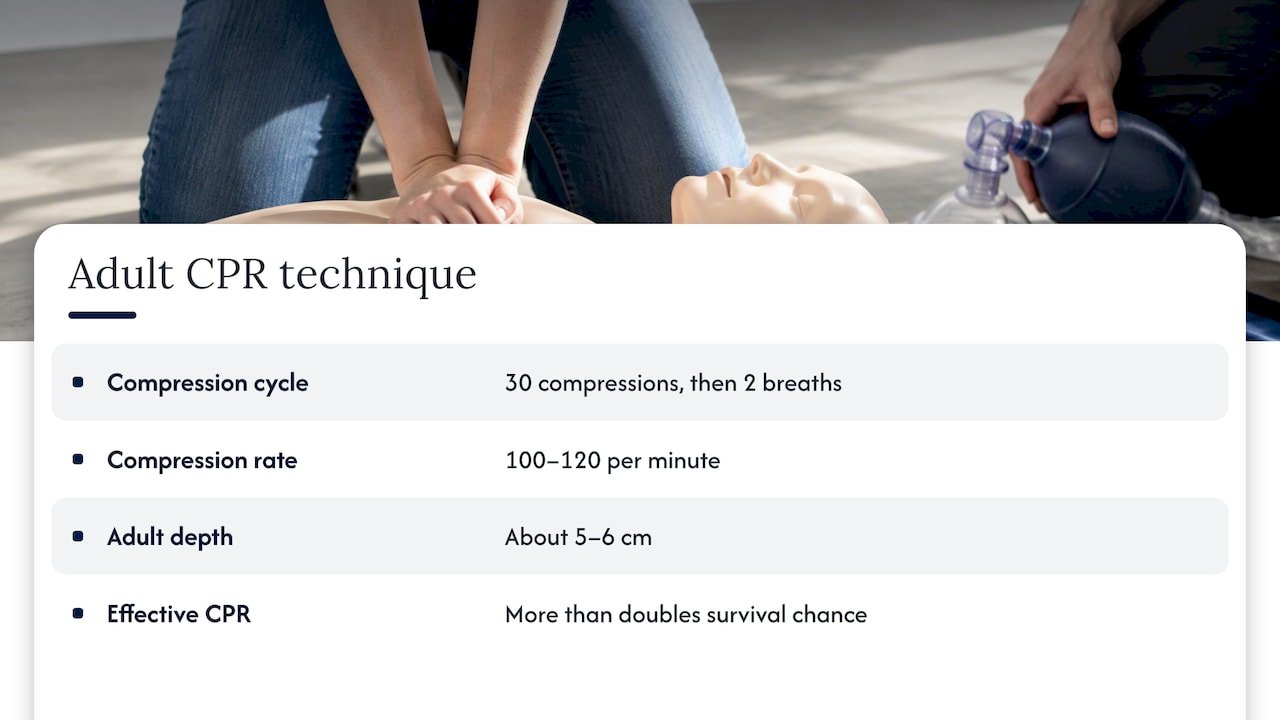
The technique itself is specific. The European Resuscitation Council’s 2025 adult basic life support guidelines set out the standard approach for trained rescuers: 30 compressions followed by 2 breaths, with compressions delivered at 100 to 120 a minute and to a depth of about 5 to 6 cm in an adult. If you are untrained or unwilling to give breaths, compression-only CPR is a useful alternative, and Resuscitation Council UK says so directly.
The important point is what CPR can and cannot do. It buys time. It rarely restarts a heart by itself. Resuscitation Council UK stresses that bystander CPR gives the ambulance service time to arrive, and that effective CPR more than doubles the chance of survival. The thing that usually ends the arrest is a shock from a defibrillator and then advanced care, and CPR keeps the brain and heart supplied with oxygenated blood until both are available.
Who CPR training is designed for
A standard CPR or CPR/AED course is aimed at people who are not working as clinicians: office staff, teachers, childcare workers, fitness instructors, security teams, volunteers, parents and anyone in a workplace first-aid rota. The course is shorter and focuses on the single-rescuer situation: you find someone collapsed, you call for help, you start compressions, and you use an AED if one is nearby.
That is not a lesser skill. For a workforce of non-clinicians, it is exactly the right one, because the first action has to be obvious and achievable by someone who has never done it for real.
What BLS covers that CPR alone does not
BLS takes the same compressions and builds the surrounding chain of actions. The ERC guidance frames it as a chain-of-survival package: early recognition and calling for help, high-quality compressions, effective ventilation, and early defibrillation. In a healthcare or first-responder setting, the course typically goes further in these areas:
- Recognition and assessment. Checking responsiveness and breathing quickly and accurately, so that no time is lost and nobody is given compressions unnecessarily.
- High-quality compressions as a team. Swapping compressors on a schedule so quality does not drop as people tire.
- Airway and ventilation skills. Using a bag-valve-mask and basic airway adjuncts, which lay courses generally do not cover in depth.
- AED use in a clinical setting. Not only switching it on and following the prompts, but fitting it into the flow of a resuscitation with minimal pauses in compressions.
- Choking response. Recognising an obstructed airway and acting on it.
- Two-rescuer and team scenarios. Clear roles, closed-loop communication and handover to an advanced team.
The American Heart Association’s provider course description, which is widely used as a reference point for what healthcare BLS should include, lists the same core elements: recognising several life-threatening emergencies, giving high-quality CPR, delivering appropriate ventilations and using an AED early. The international consensus on BLS science published in Circulation is the evidence base that guideline bodies on both sides of the Atlantic draw on.
Why a CPR course can leave a clinical team underprepared
The ERC and ILCOR framework explains why BLS and CPR should not be seen as rival techniques. CPR is a component. BLS is the organised set of early actions that preserves circulation and oxygen delivery until defibrillation and advanced care arrive. A course can therefore teach compressions very well and still fail to prepare a ward team, an ambulance crew or a dental practice to resuscitate together. The difference shows up in the practical assessment: can the learner take a role, hand over, use the equipment, and keep pauses short?
BLS vs CPR side by side
| CPR (or CPR/AED) | BLS (provider level) | |
|---|---|---|
| What it is | One core emergency technique | A broader framework of early resuscitation actions |
| Typical learner | General public, workplace responders, parents, teachers | Nurses, doctors, paramedics, dental and allied health staff, other first responders |
| Compressions | Yes | Yes, with emphasis on quality and rotation |
| Rescue breaths | Often taught, sometimes optional | Taught with equipment such as a bag-valve-mask |
| AED | Usually basic use | Integrated into the resuscitation sequence |
| Choking | Sometimes included | Included |
| Team roles | Rarely | Central |
| Assessment | Practical skills check | Practical skills and scenario-based team performance |
| Who sets the requirement | Employer or workplace risk assessment | Employer, regulator or professional body |
Treat the table as a guide, not a rule. Course content varies between providers, and the same label can mean different things in different organisations. Always check the syllabus.
Is BLS harder than CPR?
Yes, in the sense that it asks more of you. A CPR course asks you to perform one skill well. A BLS provider course asks you to perform that skill, use equipment, communicate with colleagues and manage a scenario. Most learners find the practical scenarios more demanding than any written element, but with proper tuition the course is entirely achievable for anyone whose job calls for it. Both are practical courses: nobody passes either one by memorising a sheet.
Can BLS be used for CPR, and is it “higher” than CPR Level C?
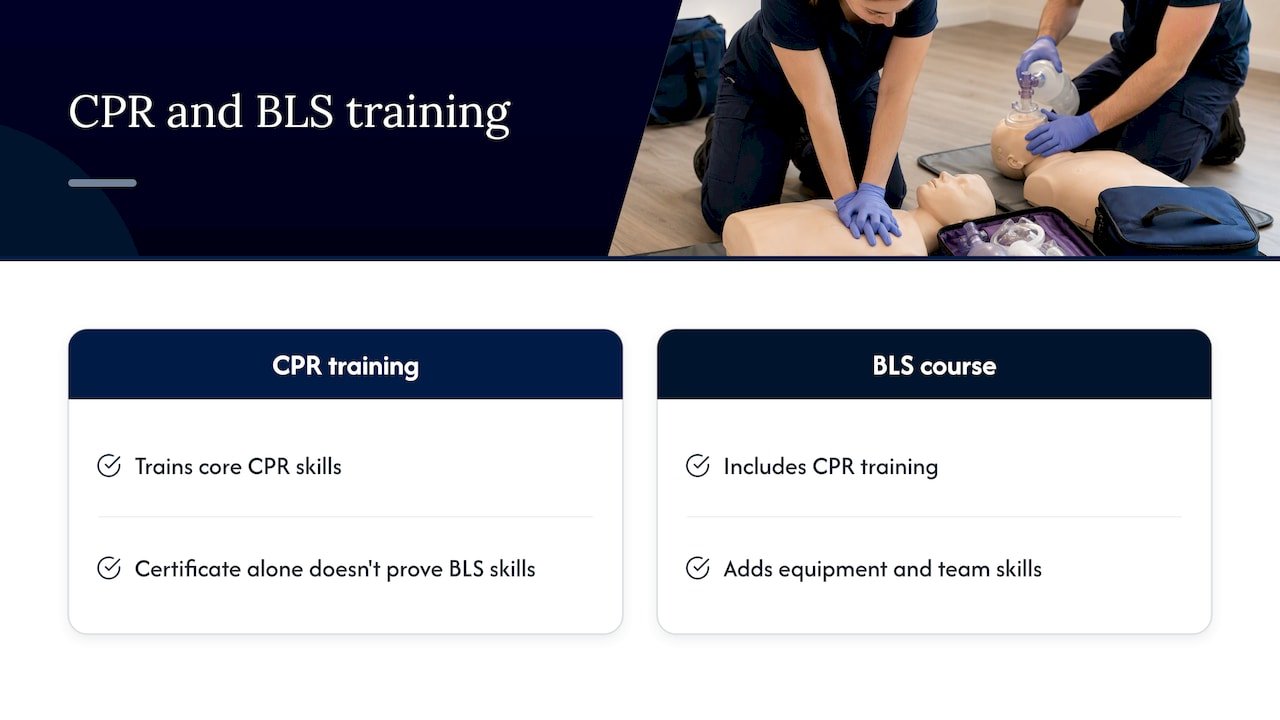
BLS includes CPR, so anyone who has completed a BLS course has been trained to do CPR. The reverse does not hold: a CPR certificate does not on its own show the equipment and team skills of a BLS provider.
The “Level C” question comes up because some national or workplace systems use letter levels. There is no globally standardised ranking called “CPR Level C”. In some systems it describes a specific lay-responder or workplace course, while BLS describes a provider-oriented course. Those labels are not safely comparable across borders, and neither the Red Cross nor the AHA publishes an international equivalence table. The practical rule is simple: choose the credential your employer, regulator, school or licensing authority names, not the one that looks highest on a ladder.
Which one do you need?
Start with your role, then check what your organisation accepts.
You probably need BLS if you are
- a nurse, midwife, doctor or other clinician;
- a paramedic, ambulance crew member or emergency responder;
- a dental, physiotherapy, pharmacy or care-home professional whose employer requires provider-level resuscitation training;
- a student on a clinical placement, where the placement provider asks for it.
For these roles, BLS is generally the safer enrolment choice because it is designed around them and includes team-based and equipment skills.
CPR with AED training is probably enough if you are
- an office or site employee named as a first responder;
- a teacher, nursery worker, coach or fitness professional;
- a parent or carer who wants to be ready;
- a volunteer at events or community venues.
For non-clinical roles, CPR with AED is generally the proportionate choice when nobody has asked for a provider-level credential. If your workplace risk assessment is more complex, for example a site with machinery, remote working or high-risk processes, ask whether a broader first-aid qualification should sit alongside it.
When the job description decides for you
If a job advert, contract, regulator or placement provider names a specific course, take that. Acceptance policies differ, and a card that one organisation takes happily can be refused by another. Ask before you book, not after. Also ask how long the certificate is valid for. Many providers issue certificates that last around two years, but your employer may want refreshers sooner, particularly after changes to guidelines.
How to choose for a team: a practical framework for HR managers
Choosing for a whole workforce is different from choosing for yourself. Three questions get you most of the way.
- What is the realistic emergency? A cardiac arrest in an office looks different from one on a hospital ward, a construction site or an offshore platform. Who is likely to be nearby, how far is the nearest AED and how long would an ambulance take?
- Who will actually respond? Designate named responders in each area and train them properly, rather than thinly training everyone. Add a short awareness session for the rest of the workforce so they know how to raise the alarm and fetch the AED.
- What does your sector require? Clinical, care and emergency roles tend to carry provider-level expectations. Other sectors are guided by risk assessments and by what insurers, clients or regulators ask for.
Drills that match the evidence
Because CPR buys time rather than reliably restarting the heart, corporate drills should concentrate on the first minutes: recognising the collapse, activating the emergency response, starting uninterrupted compressions and fetching the AED. They should not wait for a trained clinician to arrive. Run the scenario in your own building, with your own AED location and your own phone procedure. A well-run 20-minute drill often reveals more problems, such as a locked cabinet or nobody knowing the site address to give the call handler, than a certificate ever will.
Common mistakes to avoid
- Treating BLS as merely a longer CPR class. The differentiator is whether learners can coordinate roles and use equipment, not just recite compression steps.
- Buying one course for everyone. A single generic session either overtrains office staff or undertrains clinicians.
- Forgetting refreshers. Skills fade. Schedule renewals at the point you book the first course.
- Not checking acceptance. Confirm that the certificate will be recognised by whoever needs to see it.
Our perspective: match the course to the job, not the other way round
We train organisations across healthcare, oil and gas, civil engineering, project management, compliance and safety, and the same pattern comes up whenever resuscitation training is on the list. Teams are asked to pick between “CPR” and “BLS” as if one were simply the bigger version of the other. Then the booking goes through with whichever name the buyer recognised, and a gap appears later: a clinical team without scenario practice, or an office team paying for provider-level content that nobody on the site will ever use.
Our view is that the question to ask first is what the learner must be able to do, and where. That is why we build courses around the organisation’s real working environment, with on-site, online or blended delivery depending on what suits the team. For a safety-critical site, we would rather talk through the realistic emergency with you than sell a name off a shelf. For a healthcare team, we would want the scenario practice and equipment handling to be as close to the real workplace as possible.
One piece of advice we repeat often: write the requirement down before you book. Who needs it, which body or employer set it, how often it must be renewed, and what proof they will accept. It takes ten minutes and prevents most of the expensive mistakes.
— Sam
Training your team with Oxford Centre
If you are planning resuscitation, safety or compliance training for a group, we can help you work out the right level for each role and build the delivery around your shifts and sites. Our courses are globally accredited, customisable and available on-site, online or blended, and our trainers are industry experts who work from real-world problems. Tell us about your roles and your setting through our training courses page and we will talk you through the options.
FAQ
Is BLS the same as CPR?
No. CPR is the core emergency technique of compressions, with breaths where appropriate. BLS is the broader framework that includes CPR plus early AED use, airway and ventilation skills, choking response and team coordination. That is why a BLS course usually takes longer and is aimed at healthcare professionals and first responders.
Do I need BLS if I already have a CPR certificate?
It depends on who is asking. If your employer, regulator or placement provider requires a BLS provider credential, a general CPR certificate may not be accepted. If your role is non-clinical and nobody has specified BLS, CPR with AED training is generally proportionate. Check the wording in your job requirements before you book.
Can anyone do compression-only CPR?
Resuscitation Council UK describes compression-only CPR as a useful alternative for people who are untrained or unwilling to give rescue breaths. It is intended for bystanders who witness a sudden collapse in an adult. Even so, a trained rescuer who is willing to give breaths should follow the standard 30:2 approach.
How long does a BLS or CPR certificate last?
It varies by provider and by employer. Many provider-level cards are valid for around two years, but your organisation may set a shorter renewal cycle. Ask the training provider and your employer before you book, and diarise the renewal date.
Which should HR managers choose for a mixed workforce?
Use both, in proportion. Give clinical or emergency-facing staff BLS if their role calls for it, and give designated workplace responders CPR with AED training. Add short awareness sessions for everyone else so they know how to call for help and where the AED is.