
Apprenticeships suit anyone building administrative skills while working, CPD and Level 4-7 courses suit experienced staff moving into PA or executive support, sector-specific diplomas suit legal and medical administration, and short retraining courses suit anyone needing a fast skills top-up. Duration, assessment style and funding differ sharply across these routes, so the right pick depends on where you stand now and the job you want next.
TL;DR:
- Apprenticeships typically last 12 to 18 months, combining practical experience with off-the-job training, and require Level 2 English and math before final assessment.
- Advanced CPD courses for experienced staff focus on stakeholder management, project coordination, and strategic support, with flexible online or blended delivery modes.
- Sector-specific training in medical or legal administration adds industry terminology and compliance skills, often requiring several months of extra formal or on-the-job learning.
- Choosing the right course depends on your current experience, career goals, and whether you need quick skills updates or longer, specialized training.
- Funding options like employer-sponsored apprenticeships, T Levels, or free open-access courses can reduce costs and open pathways to career advancement.
Table of Contents
- What administration and secretarial training actually covers
- Apprenticeships: structure, duration and what to expect
- Advanced and CPD courses for experienced administrators
- Sector-specific routes: medical, legal and executive PA training
- How to choose the right course: a practical decision framework
- Funding, free training and qualification pathways
- Course formats and typical lengths compared
- Oxford Centre: how our courses map to learners’ needs
- Author’s recommended next steps
- How the Oxford Centre can help with your next course
- Sources
- FAQ
What administration and secretarial training actually covers
Whatever route you choose, most courses build the same core toolkit before branching into specialisms. You will typically cover office software, correspondence, diary management and records handling alongside softer professional skills that determine how well you function in a real office.
- Technical skills: Microsoft Office (Word, Excel, Outlook), email etiquette, diary coordination and digital record-keeping.
- Professional competencies: clear communication, confidentiality, and managing relationships with colleagues, clients and senior stakeholders.
- Applied outcomes: these skills translate directly into daily duties such as scheduling, correspondence drafting, minute-taking and document control, and they form the base from which progression into PA, office manager or executive support roles becomes possible.
Employers increasingly want administrative staff who can work independently and improve processes, not just complete tasks on request, according to guidance from Skills England’s business administrator standard. That shift in expectation is why most training routes now blend software proficiency with judgement and communication training rather than teaching typing and filing alone.
Apprenticeships: structure, duration and what to expect
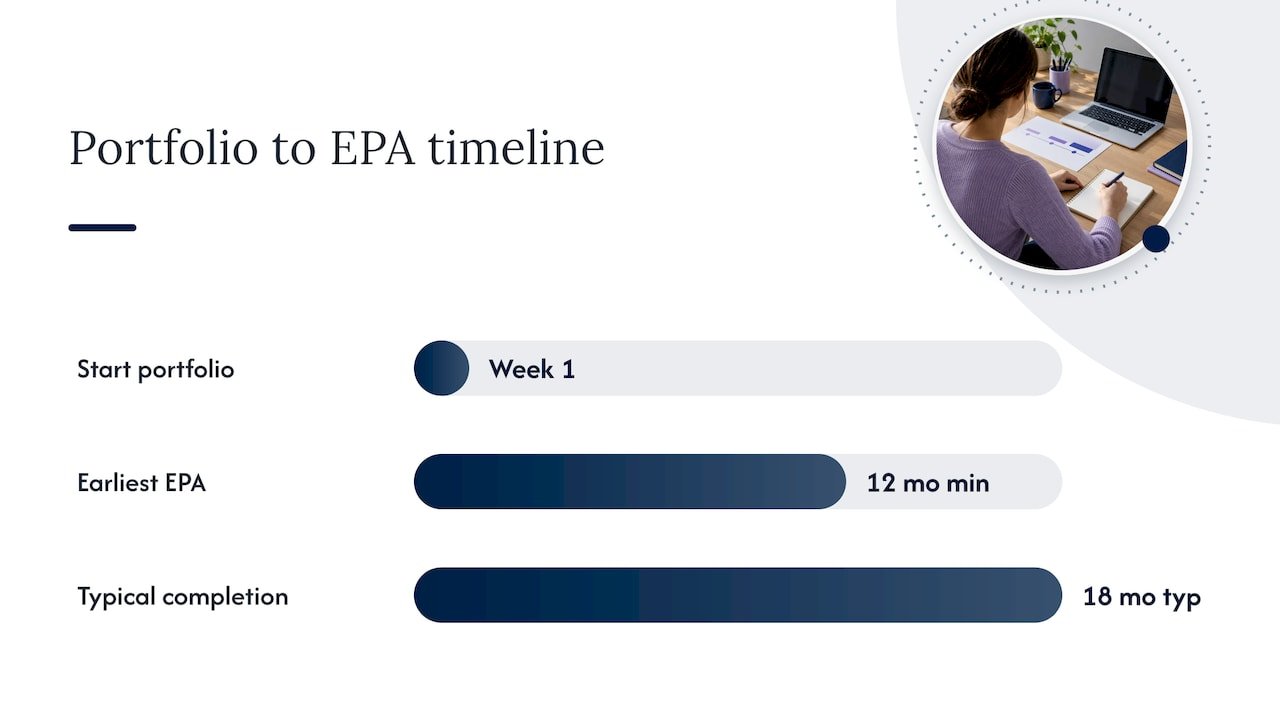
Business administration apprenticeships run for a minimum of 12 months and are typically completed within 18 months, combining on-the-job learning with structured off-the-job training, according to Skills England’s apprenticeship standard. The End Point Assessment (EPA) cannot be triggered before the 12-month mark, which keeps the apprenticeship anchored to genuine workplace experience rather than a rushed qualification.
- On-programme learning: apprentices build knowledge, skills and behaviours (KSBs) through structured training alongside their day-to-day role.
- Portfolio of evidence: apprentices compile examples of real workplace tasks that demonstrate competence ahead of the EPA.
- Employer and provider roles: the employer manages day-to-day supervision and signs off the EPA gateway decision, while the training provider delivers the formal teaching and reviews progress periodically.
- English and maths requirement: apprentices generally need Level 2 English and maths before progressing to final assessment if they have not already achieved this, per the apprenticeship standard’s assessment plan.
Apprenticeships suit school leavers, career changers and anyone who learns best through paid, on-the-job practice rather than classroom-only study. They also build transferable evidence: the portfolio you compile can support later job applications even outside the sponsoring employer.
Pro Tip: Start your portfolio from week one rather than retrofitting evidence near the EPA gateway, it saves weeks of backtracking through old emails and files.
Advanced and CPD courses for experienced administrators
Once you have a few years of office experience, Level 4-7 diplomas and CPD-accredited certificates open the door to PA and executive support roles. These courses generally assume existing workplace competence and focus on strategic responsibilities: managing multiple stakeholders, running projects, and supporting senior leadership rather than routine correspondence.
- Content focus: stakeholder management, project coordination, advanced business writing and, at the higher levels, elements of governance and decision support.
- Delivery modes: most are offered online and self-paced, though tutor-supported and blended formats are common for learners who want structured feedback.
- Assessment: expect assignments, occasional exams and a certificate of completion rather than a single high-stakes test.
- Who they suit: administrators with a few years’ experience aiming for PA, office manager or executive assistant roles, rather than newcomers to office work.
These courses work well alongside a full-time job because most providers design them for evening or weekend study, and the CPD label signals to employers that the qualification is recognised and current.
Sector-specific routes: medical, legal and executive PA training
Some administrative roles need more than general office skills. Medical and legal secretaries frequently require additional training to learn specialised terminology and compliance requirements specific to those industries, and this can take several months of extra formal or on-the-job learning beyond a general administration qualification, according to the US Bureau of Labor Statistics.
- Medical administration: covers clinical terminology, patient confidentiality rules and health records handling, on top of standard office skills.
- Legal administration: covers case management systems, court procedure basics and legal terminology alongside document precision.
- Executive PA training: emphasises credibility with senior stakeholders, discretion around confidential information and the ability to anticipate a principal’s needs before being asked, a skillset that the Bureau of Labor Statistics’ factsheet on executive support roles ties closely to judgement and interpersonal skill rather than technical training alone.
Sector-specific certificates tend to sit alongside a general administration qualification rather than replace it, so they work best as an add-on once you know which industry you want to specialise in. Employers in healthcare and legal settings often view this additional certification as a baseline requirement rather than a bonus, particularly where compliance and confidentiality carry regulatory weight.
How to choose the right course: a practical decision framework
Matching a course to your actual goal matters more than chasing the most advanced-sounding qualification. Someone entering their first office job needs a very different course from someone already working who wants a PA title within two years.
- Define your goal first: entry-level job, sector specialism, promotion to PA or executive support, or a fast retrain after a career break.
- Compare duration and structure: apprenticeships run 12-18 months with workplace integration, while CPD courses and short courses can run from a few days to several months.
- Check accreditation and assessment type: ask whether the qualification is recognised industry-wide, and whether assessment is by exam, assignment or workplace portfolio.
- Weigh cost against funding options: some routes carry employer or government funding, others are fully self-funded.
Before committing, ask any provider directly about their accreditation body, how EPA or final assessment is arranged, what tutor support looks like, typical cohort size and whether they have employer links that could lead to placements or job introductions.
Pro Tip: A provider that cannot clearly explain its EPA or certification process on the first call is a warning sign, ask again before you enrol.
Funding, free training and qualification pathways
Cost stops many people from training, but several routes reduce or remove that barrier entirely.
- Apprenticeship funding: employers typically sponsor apprenticeship training costs and pay a wage throughout, making this one of the few routes where you earn while qualifying.
- T Levels: school leavers can take a T Level in management and administration, which includes an industry placement lasting a minimum number of days alongside classroom study, according to Skills England’s qualifications finder.
- Free open-access courses: UNESCO and the University of Oxford’s Saïd Business School launched a free, global open-access course to help public-sector workers use AI and digital tools for service delivery, covering digital planning, data governance and digital management, a useful option for administrators wanting digital skills without course fees, according to UNESCO’s announcement.
- Prior qualifications: apprentices generally need Level 2 English and maths before progressing to EPA if they have not already achieved this, which can affect timelines for anyone starting without those qualifications.
Course formats and typical lengths compared
Delivery format shapes how a course fits around your existing job and life. On-site training gives structured contact time, online self-paced study offers flexibility, blended formats mix both, and workplace-based learning (as in apprenticeships) ties study directly to a real job.
- Short courses: typically run from a few days to several months, suited to fast reskilling or adding a specific skill.
- Apprenticeships: run a minimum of 12 months and typically complete within 18 months, per the apprenticeship standard.
- Workload and tutor access: check whether tutor support is scheduled or on-demand, and whether assessment happens continuously or in a single end-point test.
- Practical fit: match the format to your working pattern rather than assuming online always means easier, self-paced study still demands consistent time.
Oxford Centre: how our courses map to learners’ needs
The Oxford Center provides an extensive range of professional training courses across sectors including project management, healthcare, oil and gas, and civil engineering, giving learners a broad catalogue to draw from when building administrative or sector-specific skills, as described on Oxford Center’s site.
- Courses can be tailored to an organisation’s specific administrative or operational needs rather than following a fixed syllabus.
- Training is available on-site, online or blended, letting learners and employers choose the format that fits their schedule.
- Programmes are accredited, giving qualifications recognised value beyond a single employer or region.
Author’s recommended next steps
Start by naming the exact job or skill gap you want to close this year, then check funding eligibility and accreditation before you enquire. Contact a provider or your employer to sketch a realistic plan, and build a portfolio of real work as you go rather than waiting until assessment time. For organisations wanting a course shaped around their own processes, Oxford Centre’s bespoke training options are worth a direct conversation.
— Sam
How the Oxford Centre can help with your next course
Accredited administrative and professional training is available without piecing together separate providers for each skill gap you want to close. Whichever route this article pointed you towards, apprenticeship-style workplace learning, CPD progression or a sector specialism, customisable programmes let you build a course around your actual role rather than a generic syllabus.
- Choose on-site, online or blended formats to fit around work commitments.
- Courses span project management, healthcare, oil and gas, civil engineering and more, useful if your administrative role sits inside a specialist industry.
- Organisations can request tailored programmes built around their own processes and teams.
Browse the project management course category for a sense of the catalogue’s depth, or visit the Oxford Centre homepage to enquire about course details or request a bespoke corporate training proposal.
Sources
For details on apprenticeship standards and EPA arrangements, consult the business administrator apprenticeship standard and its assessment plan annex. For occupational outlook data, see the Bureau of Labor Statistics handbook. Always verify a provider’s accreditation and EPA registration status directly before enrolling.
- Secretaries and administrative assistants | Occupational Outlook Handbook | U.S. Bureau of Labor Statistics
- Business administrator / Skills England (apprenticeship standard)
FAQ
Where can I find free administrative training?
Free administrative and digital skills training exists through open-access initiatives, including a global course launched by UNESCO and the University of Oxford’s Saïd Business School for public-sector digital and AI skills, covering digital planning, data governance and digital management, according to UNESCO’s announcement. Government-backed apprenticeship routes are also effectively free to the apprentice since employers typically cover training costs.
What qualifications do I need to be an admin assistant?
Entry-level administrative roles typically require a high school diploma or equivalent along with proficiency in common office software, and many employers provide several weeks of on-the-job training to close any remaining gaps, according to the Bureau of Labor Statistics. A Level 2 or Level 3 business administration apprenticeship is a common formal route into the role.
What courses can I take to become a secretary?
Routes range from business administration apprenticeships, which run a minimum of 12 months and typically complete within 18 months, to CPD-accredited certificates and sector-specific diplomas for legal or medical secretarial work, per Skills England’s apprenticeship standard. Short retraining courses are also available for those wanting a faster route into general office administration.
What qualifications do I need to be a secretary?
General secretarial roles usually expect solid office software skills and clear written communication, often gained through on-the-job training or a Level 2/3 apprenticeship. Medical and legal secretarial roles typically need additional sector-specific training in terminology and compliance, which can take several months beyond general administration training, according to the Bureau of Labor Statistics.