
The best construction contract management training is built around the contract your team actually works under, the stage of the project where money and time are at risk, and the roles of the people attending. A generic one-day overview suits site staff who need contractual awareness. Commercial managers, contract administrators and quantity surveyors need a programme that goes further into notices, variations, delay and disputes, and that can be shaped around their own forms of contract. At Oxford Centre we build corporate training around that principle: customisable content, delivered on site, online or blended, by expert trainers.
This guide explains what the training covers, how FIDIC-specific and claims-specific courses differ from general ones, and how to judge whether a course fits your people.
TL;DR
- Contract management training ranges from a one-day introduction to multi-day programmes on claims, delay and procurement. Pick the depth that matches the role, not the job title.
- Choose by contract family first: NEC, JCT and FIDIC each put the risk in different places, and their notice rules differ.
- Claims skills come down to three habits: serve notices on time, keep contemporaneous records, and link every delay to a contract clause.
- Customised, in-house delivery lets a team practise on its own contract documents and live project problems.
- Assess needs from real project pain points (late notices, unpriced variations, disputed extensions of time) before you book anything.
Table of Contents
- What construction contract management training covers
- NEC, JCT or FIDIC: choose the course by contract family
- Claims training: notices, records, delay and disputes
- Formats, duration and recognition
- How to assess whether a course fits your team
- Making the training stick
- Our perspective
- Talk to us about a programme for your team
- FAQ
- Sources
What construction contract management training covers
Contract management in construction is the work that happens after signature: administering the contract, controlling change, protecting entitlement to time and money, and resolving disagreements before they become disputes. Training courses cover the same ground in a more or less compressed form.
The UK’s CITB sets out a useful baseline in its Commercial Management of Construction Contracts standard. It is a one-day introduction to the commercial side of a civil engineering contract. Its content covers contract documents, the main forms (NEC, JCT and FIDIC and variants), managing commercial risk, contract processes, roles and responsibilities, record-keeping, the basis of claims and the main methods of dispute resolution. CITB lists agents, works managers, site engineers, site planners, quantity surveyors and specialist sub-contractors as the audience.
That list is worth reading closely. It shows that contract training is not only for lawyers and commercial directors. The person who instructs a variation on site, or who fails to log a delay, shapes the contract position as much as the person who later writes the claim.
The project stages training should address
Good programmes follow the life of the contract rather than a list of clauses:
- Procurement and tendering. Choosing the procurement route, writing the tender documents, evaluating bids and allocating risk. Mistakes here are expensive to fix later.
- Contract formation. Understanding which documents form the contract, the order of precedence, and amendments that shift risk.
- Mobilisation and administration. Programmes, instructions, payment cycles, insurances, and who is authorised to do what.
- Change control. Valuing and agreeing variations or compensation events before the work is done, not after.
- Delay and disruption. Notices, records, extension of time and cost recovery.
- Completion and close-out. Defects, final accounts and any remaining disputes.
Most one-day courses touch every stage lightly. Longer or customised programmes choose the two or three stages where your organisation loses most.
Contract administration skills worth building
The skills that matter in practice are less about legal theory than about discipline:
- Reading a contract for its notice and time-limit provisions, and diarising them.
- Writing clear, contract-referenced correspondence.
- Keeping a change and early-warning register that others can follow.
- Valuing changes against rates, and separating cost from time.
- Running meetings so that decisions are recorded and acted on.
Under NEC4, for instance, early warning is a formal process: the parties notify each other of matters that could increase cost, delay completion or impair performance, and keep a register. A team trained to use it well spots problems while they can still be resolved by resequencing or a change in supply. A team that treats it as paperwork misses the point.
NEC, JCT or FIDIC: choose the course by contract family
The single most useful filter is the form of contract your projects use. The principles of contract management carry across, but the mechanics do not.
| Contract family | Typical setting | What training should focus on |
|---|---|---|
| NEC (NEC3, NEC4) | UK public works, infrastructure, many international projects | Early warnings, compensation events, programme acceptance, collaborative working |
| JCT | UK building projects, private and public sector | Instructions and variations, extensions of time, payment notices, practical completion |
| FIDIC | International infrastructure and building, often funded by development banks | Engineer’s role, claims procedure, time bars, dispute avoidance and resolution |
CITB’s overview names NEC, JCT and FIDIC together as the main forms a civil engineering team will meet, so a general course often introduces all three. If your organisation works under one family nearly all the time, a form-specific programme gives a better return.
What FIDIC training covers and how it differs
FIDIC training differs from general contract management training in three ways. First, it teaches a defined set of conditions rather than principles. Second, it puts heavy weight on the claims procedure, because FIDIC contracts impose strict time limits. Third, it is usually aimed at international projects, where the engineer, employer and contractor each have a distinct role.
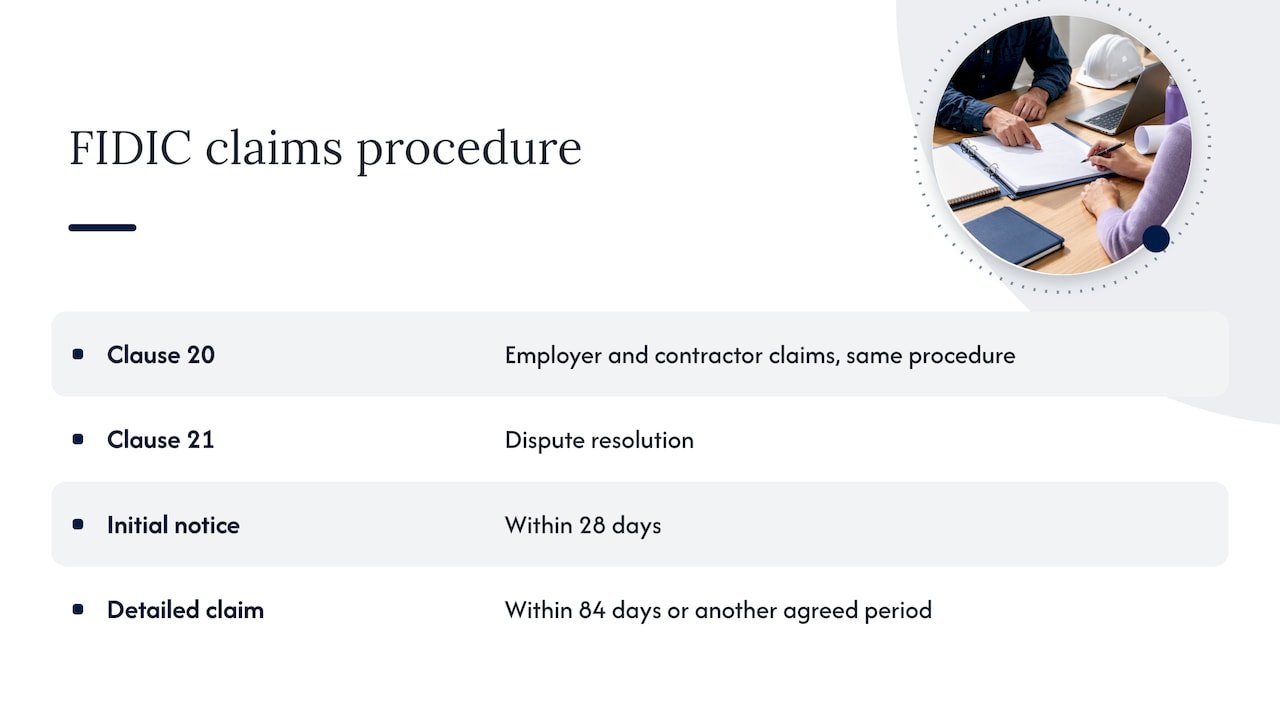
The 2017 edition of the Red Book shows why. A Fenwick Elliott analysis of the 2017 claims provisions explains that employer and contractor claims now sit together in Clause 20, under the same procedure, with dispute resolution moved to a new Clause 21. It also notes two obligations that can cost a claiming party its right to claim if missed: an initial notice of claim within 28 days, and a fully detailed claim within 84 days, or another agreed period.
A team that has not been trained on those clauses can lose entitlement through a missed date, however strong the underlying facts are. Whichever edition your project uses, read the actual conditions and particular conditions, because amendments often change these periods.
Claims training: notices, records, delay and disputes
Searches for construction claims training are usually about one anxiety: how to avoid losing money for a reason that was preventable. The content of a good claims course is consistent across jurisdictions, even where the law differs.
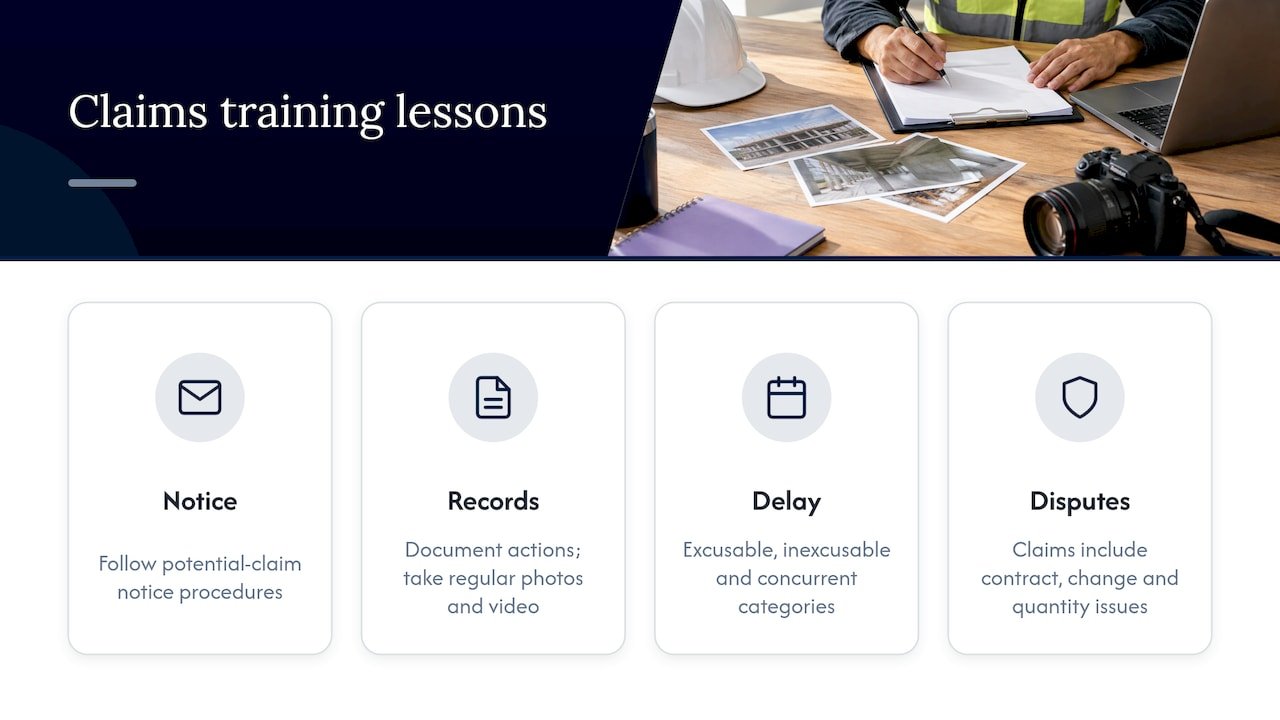
The California Department of Transportation’s Construction Claims and Disputes training is an official example of the syllabus, written for the US but recognisable anywhere. It covers the types of claim (contract interpretation, changes in work or materials, schedule, administrative deductions and quantities), delay categories (excusable, inexcusable and concurrent), notice of potential claim procedures, and record-keeping habits such as documenting actions and taking regular photographs and video.
Translate that into a UK or international team’s daily routine and you get four lessons.
1. Notice is the first deliverable
Most forms of contract make notice a condition, or at least a strong prerequisite, of recovery. Training should make every attendee able to say, for their own contract, what triggers a notice, who gives it, to whom, in what form and within what time. Put those answers on one page and keep it on site.
2. Records beat recollection
Contemporaneous records, such as daily diaries, progress photographs, resource records, instructions and meeting minutes, are what turn an assertion into a claim that can be assessed. The practical test is simple: could someone who was not on site reconstruct what happened from the files alone?
3. Delay must be tied to the programme and the clause
A late completion is not a claim. A claim shows which event, under which clause, delayed which activity on the critical path, by how long, and what it cost. Delay analysis methods are a specialist subject in their own right. Our Construction Delay Analysis and Claims Management Training Course is the relevant starting point for teams that need to go beyond the basics.
4. Disputes are managed from day one
In the UK, the Housing Grants, Construction and Regeneration Act 1996 gave parties to a construction contract the right to refer a dispute to adjudication, with a decision normally due within 28 days of the referral process unless the parties agree to extend. Knowing that adjudication can arrive quickly is a reason to train commercial and site staff together: the evidence is gathered on site, months before anyone drafts a referral.
Formats, duration and recognition
How long should training last?
CITB’s standard allows delivery on or off the job using classroom methods, with a minimum of one day of six learning hours. That is a floor for an introduction, not a ceiling for competence. Commercial teams commonly need a sequence: an overview for everyone, then deeper modules for the people who price, administer and defend change.
The ranking pages for this topic show the spread: one-day courses on dealing with construction contracts, two-day principles courses, form-specific days on a single JCT contract, and week-long intensives. Pick by the gap you want to close.
What recognition can training give you?
Recognition depends on the country and the sector. In UK central government, for example, the Foundation accreditation and development programme, updated on 13 August 2026, leads to a nationally recognised, CPD-endorsed accreditation aligned with the Contract Management Professional Standards. It is focused on public sector contracts, so it is a different route from construction-specific training for a contractor or consultant.
For private-sector construction teams, the useful questions are whether the course carries recognised accreditation, whether the content maps to the forms of contract you use, and whether it counts towards the CPD your professional body expects. Oxford Centre courses are globally accredited, which matters for organisations with staff or projects in more than one country.
How to assess whether a course fits your team
A training needs assessment does not need to be elaborate. Run it in four steps.
- List the last five contract problems. Late notices, unagreed variations, disputed extensions of time, payment disputes, unclear instructions. Patterns show the topics to train.
- Map each problem to a role. A late notice is usually a site or project manager issue. An unpriced variation is a commercial or QS issue. A badly drafted tender is a procurement issue.
- Match the contract family. Count the projects by NEC, JCT, FIDIC or bespoke. Weight the training towards the forms with the most live exposure.
- Set a measurable outcome. For example: every notice served within contract time, a live change register on every project, or fewer variations settled after completion.
Compare any course against those outcomes rather than against its brochure. A one-day introduction can meet the first outcome for site teams. It will not meet the second for a commercial team.
Building a training path by role
| Role | Starting point | Next step |
|---|---|---|
| Site engineers, supervisors, planners | Contractual awareness: documents, notices, records | Delay and programme basics |
| Quantity surveyors, commercial managers | Form-specific administration (NEC, JCT or FIDIC) | Claims, delay analysis and valuation |
| Procurement and tendering staff | Procurement and tendering strategies | Risk allocation, warranties and indemnities |
| Project and programme managers | Project management with contractual awareness | Dispute avoidance and resolution |
Two of our courses cover the ends of this path. The Construction Procurement and Tendering Strategies Training Course addresses the front end, where risk is set. The Warranty and Indemnity in Commercial Contracts Training Course covers the protections that sit around the contract. For HR buyers weighing several procurement and contract options against risk, our guide to accredited procurement courses matched to risk sets out how to compare them.
Making the training stick
The weak point of most training is the week after. Four habits help.
- Use your own documents. Teach from the contract and the notices your team actually has to serve. In-house delivery makes this possible, which is why customisable content matters.
- Train in cohorts that cross roles. Site, commercial and project staff on the same course agree on one version of the process.
- Create one-page tools. A notice calendar, a records checklist and a change-register template turn the course into routine.
- Review after the first live event. The first notice or variation after the course is the real assessment. Look at how it was handled and fix gaps.
If your teams also manage the wider delivery, our resource on construction project management training shows how the contract side fits with site safety and sustainability.
Our perspective
Contract problems rarely start with a bad contract. They start with a good contract that nobody on site has read closely enough to follow.
That is why we do not think of contract management as a topic for the commercial department alone. The engineer who gives an instruction, the planner who updates the programme and the manager who signs off a variation all make contractual decisions, usually without being told so.
Our approach is to customise the content to the organisation’s own contracts and project problems, and to deliver it in the format that suits the team: on site, online or blended. Courses are led by expert trainers and are globally accredited, so the learning applies to real projects and is recognised across borders.
Start from the five contract problems that cost you most, and build the training around them.
Sam
Talk to us about a programme for your team
If you are an HR manager or learning lead looking to train a project team, or a professional planning your own development, our project management and contract-related courses are the place to begin. We can adapt content to your forms of contract and deliver on site, online or blended.
Tell us the contract forms you use and the problems you want to fix, and we will shape the programme around them. You can also browse the full course list.
FAQ
Who should attend construction contract management training?
Anyone whose decisions affect time, cost or change on a project. CITB’s standard names agents, works managers, site engineers, site planners, quantity surveyors and specialist sub-contractors. Commercial managers, contract administrators and project managers also benefit, usually from deeper, form-specific modules.
Is FIDIC training different from general contract management training?
Yes. General training teaches principles across forms. FIDIC training teaches a specific set of conditions, with close attention to the claims procedure and its time limits. In the 2017 Red Book, for example, a notice of claim is due within 28 days and a detailed claim within 84 days, unless another period is agreed.
How long does a construction contract management course take?
Introductions run from one day upwards. CITB’s standard sets a minimum of one day of six learning hours. Form-specific, claims and delay courses typically run longer, and a customised programme can be spread over several sessions to fit project workloads.
What should a claims course teach?
It should cover types of claim, delay categories, notice procedures and record-keeping. Official training such as Caltrans’ claims course includes excusable, inexcusable and concurrent delay, notice of potential claim, and the habit of documenting actions with regular photographs and video.
How do we know which course suits our team?
List your last five contract problems, map each to a role, count projects by contract family, and set a measurable outcome. The course that closes those gaps for those roles is the right one, whatever its length.
Sources
- Construction Claims and Disputes, California Department of Transportation
- Adjudication and the Construction Act 1996
- Foundation accreditation and development programme, UK Government