
ITIL and COBIT answer different questions. ITIL helps you run IT services well day to day. COBIT helps the board and senior management govern IT so it supports the business, stays within risk appetite and meets compliance duties. If your main problem is service quality, start with ITIL. If it is oversight, audit or risk, start with COBIT. Most larger organisations end up using both.
This guide sets out what each framework covers, where they overlap, how to choose, and how to combine them without doubling your workload.
TL;DR
- COBIT is a governance and management framework for enterprise information and technology. ITIL is a service management framework built around co-creating value with customers.
- Pick COBIT first when the pressure comes from auditors, regulators or the board. Pick ITIL first when the pressure comes from incidents, slow delivery or unhappy users.
- They are not rivals. ISACA, which publishes COBIT, and Axelos, the then owner of ITIL, have jointly described how they work together.
- COBIT 2019 is the current COBIT version. ITIL 4 is established, and ITIL 5 was announced in January 2026, so check the official pages before booking certification.
- Teams with no formal service processes usually get the fastest return from ITIL practices first, then add COBIT governance on top.
Table of Contents
- ITIL and COBIT at a glance
- What ITIL is
- What COBIT is
- The real differences between ITIL and COBIT
- Governance, risk, security and compliance
- Current versions: what to know in 2026
- How to choose: five practical questions
- Using ITIL and COBIT together
- Our perspective
- Building the skills behind the framework
- Which should an individual professional learn first?
- Common mistakes to avoid
- FAQ
- Sources
ITIL and COBIT at a glance
| Question | ITIL | COBIT |
|---|---|---|
| Main purpose | Managing and delivering IT services | Governing and managing enterprise IT |
| Typical question | Are we doing things right? | Are we doing the right things? |
| Main audience | Service desk, operations, service owners | Board, CIO, risk, audit, compliance |
| Style | Narrative, detailed guidance | Structured, concise objectives |
| Strongest at | Service quality, consistency, continual improvement | Oversight, risk, assurance, alignment |
| Current version | ITIL 4 (ITIL 5 announced 2026) | COBIT 2019 |
The table is a simplification. The sections below explain each row.
What ITIL is
ITIL stands for Information Technology Infrastructure Library. It is a collection of good practice for managing IT services. According to Wikipedia’s ITIL entry, it was first released in 1989 by the UK’s Central Computer and Telecommunications Agency, grew into a series of 30 books, and passed to AXELOS in 2013. That British origin is one reason ITIL is so widely recognised in UK public and private sector IT.
ITIL 4, released in February 2019, moved away from a narrow IT focus towards end-to-end service management. It also drew on Agile, DevOps and Lean thinking, as the same Wikipedia article explains. Its core idea is value co-creation: the provider and the consumer create value together through services.
The ITIL 4 Service Value System has five elements: guiding principles, governance, the service value chain, management practices and continual improvement. The practices people recognise most, such as incident, change, problem and service level management, sit within it. Because ITIL describes how to do the work, it is often the framework a service desk manager recognises on first reading.
What COBIT is
COBIT is published by ISACA. ISACA’s own white paper describes it as offering effective enterprise governance of information and technology, including information security and risk management functions. It is not limited to the IT department. It covers how the whole enterprise directs and controls its use of technology.
COBIT 2019 has 40 governance and management objectives, up from 37 processes in COBIT 5, and six governance principles, up from five. It also introduced 11 design factors, which help you tailor the governance system to your own organisation, as ISACA’s COBIT 2019 and COBIT 5 comparison sets out.
The objectives sit in five domains. According to the COBIT 2019 objectives publication, one domain covers governance: Evaluate, Direct and Monitor. The other four cover management:
- Align, Plan and Organise
- Build, Acquire and Implement
- Deliver, Service and Support
- Monitor, Evaluate and Assess
The distinction matters. In COBIT, governance evaluates stakeholder needs, sets direction and monitors performance and compliance. Management plans, builds, runs and monitors activities in line with that direction.
The real differences between ITIL and COBIT
Scope
COBIT is broader. The Open Group’s framework summary notes that COBIT has a wider scope than ITIL because it includes areas such as architecture and project management. TechTarget makes a similar point: ITIL is a more focused service management approach, while COBIT applies to almost any area of the business, including service management. The same article estimates that ITIL covers about a quarter of the practices found in COBIT, mostly the service management ones.
Style and depth
The Open Group describes COBIT as terse and structured, while ITIL contains lengthy, detailed narrative. In practice, COBIT gives you objectives, goals and metrics to assess against. ITIL gives you explanation and guidance on how to build the practice.
Audience and purpose
ITIL is built around services and the people who use them. ISACA’s 2021 blog on using both frameworks puts it this way: ITIL focuses on value co-creation through service management, while COBIT focuses on governing and managing enterprise information and technology to create value for stakeholders. A service manager reads ITIL to improve a process. A board or audit committee uses COBIT to decide what it should expect from IT and how to check it.
Auditability
TechTarget also points out that COBIT’s structure makes it easier to audit, which can simplify compliance work involving certified information systems auditors. If an external reviewer will test your controls, COBIT gives you a common language for the conversation.
Governance, risk, security and compliance
This is where COBIT is strongest. Its objectives explicitly cover security, risk, and compliance, alongside service requests and incidents. Its components go beyond processes to include organisational structures, principles, policies, information, culture and behaviour, skills, and services and infrastructure. That makes it suited to questions such as who is accountable, which risks the board accepts, and how the organisation proves it is meeting its obligations.
ITIL touches security and risk through practices such as information security management and change enablement, but its centre of gravity is service delivery. It tells you how to handle an incident quickly and consistently. It does not tell the board how much technology risk to accept.
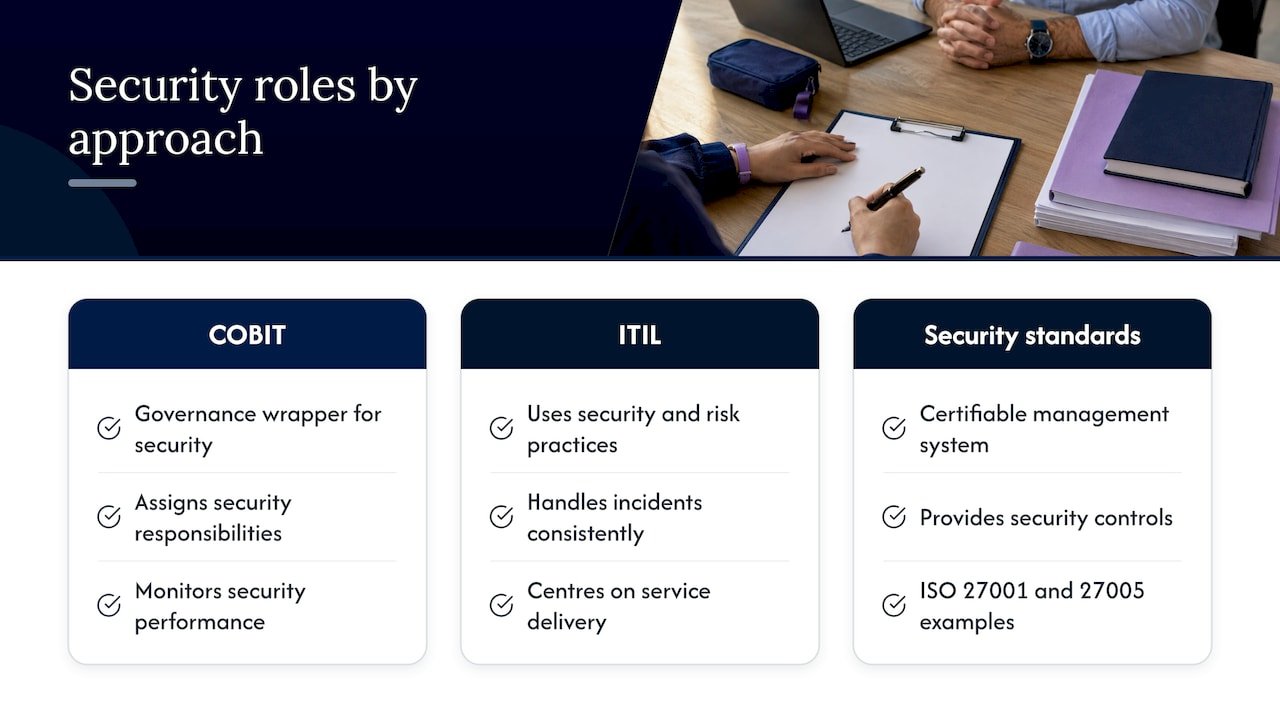
For cybersecurity, neither framework replaces a dedicated security standard. COBIT provides the governance wrapper, deciding who is responsible for what and how security performance is monitored. A certifiable management system standard then provides the controls. Readers building that layer often pair governance work with training in ISO 27001 information security management and ISO 27005 information security risk management.
Current versions: what to know in 2026
COBIT 2019 replaced COBIT 5 and remains the current core COBIT version. ISACA has added focus area guidance for topics such as cybersecurity, privacy, cloud and DevOps, which is how COBIT stays open-ended without rewriting the core model.
ITIL 4 has been the reference version since 2019. In January 2026, PeopleCert announced ITIL 5, according to the Wikipedia ITIL article. If you are planning certification or a training budget, check the official ITIL pages for the current certification path and transition arrangements rather than relying on any article, including this one. The underlying concepts, such as value, practices, continual improvement and the link to governance, carry across versions, so the choice between ITIL and COBIT does not change.
How to choose: five practical questions
There is no universal winner. These five questions, drawn from common decision approaches, help you find the right starting point.
- Who is sponsoring the work? If the push comes from the board, audit committee or external auditors, COBIT fits. If it comes from IT leadership and service managers, ITIL fits.
- What regulation applies? Financial reporting, data protection and sector rules create a demand for demonstrable governance and control. That points towards COBIT. Internal quality targets point towards ITIL.
- How mature are your IT processes? If incidents, changes and requests are handled informally, build those foundations with ITIL practices first. Governance on top of chaos produces policies nobody can follow.
- How big is the organisation? COBIT is designed to be tailored, and its design factors help, but a full implementation can be heavy for a small IT team. A small team often gets more from a pragmatic ITIL start.
- Where does it hurt most? Audit findings and weak risk assessment indicate a governance gap. High incident volumes, slow delivery and unhappy users indicate an operations gap.
The pattern is consistent: identify the primary problem, start with the framework aimed at it, and plan the second one rather than adopting everything at once.
Quick scenarios
- A mid-sized hospital group faces audit questions about patient data and system availability. It needs clear accountability for technology risk first, so COBIT leads, with ITIL practices for incident and change management added to meet availability targets.
- A growing engineering consultancy has an overloaded service desk and no consistent change process. ITIL practices give quick relief. COBIT can follow when clients start asking for assurance.
- A regulated energy company has both: strict oversight and a large operational estate. It needs both from the start, with governance defined first and service practices mapped beneath it.
Using ITIL and COBIT together
The either-or framing is largely a search habit. ISACA’s white paper states that the two have a high degree of compatibility and can be adopted in a single integrated environment. A joint ISACA and Axelos resource released in June 2021 says enterprises gain the most value by balancing performance and conformance and by using multiple frameworks within their governance structure.
A useful way to think about it: COBIT governs, ITIL operates. COBIT without ITIL can leave you with policies that nobody in operations turns into routine. ITIL without COBIT can leave you with well-run services that drift from the organisation’s risk appetite and strategy.
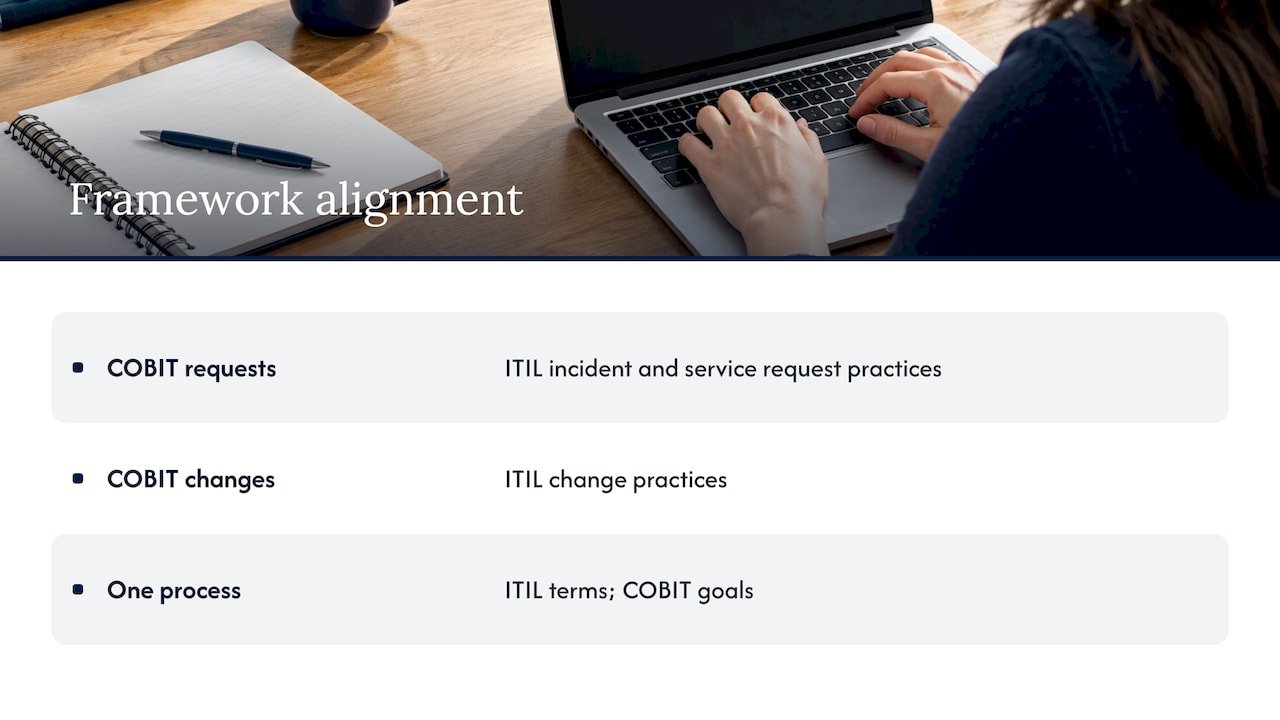
The mapping is concrete. COBIT’s objective for managed service requests and incidents lines up with ITIL’s incident and service request practices. Its managed IT changes objective corresponds to ITIL’s change practices. You do not need two parallel processes. You need one process, described in ITIL terms, measured against COBIT goals.
A sensible sequence
- Start with the pain point. Choose one framework for the biggest problem and set a measurable target.
- Stabilise the core practices. Incident, change and problem management are the usual first ITIL candidates.
- Set governance direction. Define who decides, who is accountable and which metrics the board sees, using COBIT’s governance objectives.
- Link the metrics. Connect operational indicators from ITIL practices to COBIT goals so that reporting upwards is consistent.
- Add practices gradually. Extend to service level management and continual improvement once the basics hold, and review the design factors as the organisation changes.
This typically plays out over several years, not a single project. Trying to adopt every framework at once is the commonest way to stall.
Our perspective
We train teams in many sectors, from project management and healthcare to oil and gas and civil engineering, and the same pattern repeats. Organisations ask us which framework to pick, when the better question is who needs to be able to do what.
The board needs to understand risk, accountability and compliance. Managers and specialists need dependable ways of working. Governance without capable people produces documents. Process without governance produces activity nobody can steer. The frameworks only work when the people applying them have the skills and judgement to adapt them to the organisation in front of them.
That is why we build programmes around the organisation’s real challenges rather than a fixed syllabus. Our courses are designed to be customised, and they can be delivered on site, online or blended, so a governance group and an operations team can each get what they need. If you are building governance and security capability alongside your service practices, start with the people who will own it.
Sam
Building the skills behind the framework
Frameworks do not implement themselves. Whichever you choose, the result depends on whether managers understand governance duties, whether security and risk owners can assess and treat risk, and whether leaders can work with the board.
We offer professional training courses that support this. Our Security Governance and Compliance training course suits teams who need to put governance and compliance into practice. Our Board and Executive Relationship Management course helps managers present technology risk and performance in terms the board acts on. For delivery leads, our project management courses cover accredited certification routes.
If you want a programme shaped around your own team, browse the full course list or contact us through our website to discuss on-site, online or blended delivery. For leadership development, our Management Capability Development course is another option.
Which should an individual professional learn first?
If your role is on the service desk, in operations or in service ownership, ITIL is the more natural first step because it speaks directly to daily work. If you are moving into risk, audit, security management or IT leadership, COBIT gives you the governance vocabulary that senior stakeholders use.
Careers rarely stay in one lane. A service manager who understands COBIT’s goals can show how operational metrics matter to the board. A governance specialist who understands ITIL practices can judge whether controls are realistic. Either way, check the current certification routes on the official ITIL and ISACA pages before committing, given the version changes above.
Common mistakes to avoid
- Treating the choice as permanent. Starting with one framework does not rule out the other.
- Copying the framework wholesale. Both are meant to be adapted. COBIT’s design factors and ITIL’s guiding principle of keeping things simple and practical exist for this reason.
- Skipping the people side. A new process with no trained owner reverts to old habits within months.
- Measuring activity, not outcomes. Tie each practice to a goal someone senior cares about.
- Running two parallel programmes. Use one process description and map it to both frameworks.
FAQ
Is ITIL or COBIT better?
Neither is better in general. ITIL is better for improving service delivery and day-to-day operations. COBIT is better for governance, risk oversight and compliance. Decide by your biggest problem, and plan to bring in the other later.
Can you use ITIL and COBIT together?
Yes. ISACA’s guidance describes them as highly compatible and usable in a single integrated environment. A common arrangement is COBIT for the governance layer and ITIL for how services are run, with metrics linked between them.
What is the difference between COBIT and ITIL in one sentence?
COBIT governs and manages enterprise information and technology so it creates value within acceptable risk, while ITIL describes how to design, deliver and improve IT services with customers.
Is ITIL still relevant now that ITIL 5 has been announced?
Yes. ITIL 4 remains the reference many organisations work from, and the core ideas of value, practices and continual improvement carry forward. Check the official ITIL pages for the current certification and transition position before booking exams.
Does COBIT cover cybersecurity?
COBIT includes security and risk objectives and has focus area guidance for cybersecurity. It provides governance and oversight. For detailed controls, organisations normally add a security management standard alongside it.
Sources
- Using ITIL 4 and COBIT 2019 to Create an Integrated I&T Framework Environment, ISACA
- ITIL, Wikipedia
- COBIT 2019 and COBIT 5 comparison, ISACA
- COBIT 2019 Framework: Governance and Management Objectives
- The major frameworks, Managing Digital, The Open Group
- Evaluate the COBIT framework 2019 update, TechTarget
- Leverage COBIT and ITIL for customer-centric, connected and collaborative organisations, ISACA Now Blog
- Joint resource from Axelos and ISACA illustrates the synergies between ITIL 4 and COBIT 2019, ISACA