
Diversity and inclusion training works when it is a programme, not an afternoon. Research shows that a single session reliably lifts awareness and knowledge, while changes in behaviour need longer, skills-based training that sits inside wider organisational action. For a UK employer, the sensible approach is to anchor the training in the Equality Act 2010, tailor it to each role, and measure what people do afterwards, not only how they rated the session.
This guide explains what the training is, what the evidence says it can and cannot do, which topics to cover, how to train managers, and how to check that it is working.
TL;DR
- Diversity and inclusion training reliably improves knowledge and awareness. Lasting behaviour change needs longer, skill-building programmes linked to wider initiatives.
- One-off sessions are the weakest format. Spread learning over weeks or months and repeat it.
- In Great Britain, base the content on the nine protected characteristics in the Equality Act 2010, then add your own organisation’s real issues.
- Managers need practical skills: fair recruitment and performance decisions, coaching, and sensitive conversations.
- Measure behaviour and organisational outcomes, with a follow-up months later, not just end-of-course feedback.
Table of Contents
- What diversity and inclusion training is
- What the evidence says it can achieve
- The legal backdrop in Great Britain
- Topics worth covering
- Inclusion training for managers
- Format: how to deliver it so it sticks
- Promo: training built around your organisation
- Perspective: what we see in practice
- How to tell whether it is working
- Common mistakes to avoid
- How to choose a provider
- FAQ
- Sources
What diversity and inclusion training is
Academic reviews define diversity training as a distinct set of instructional programmes that aim to encourage positive interactions between groups, reduce prejudice and discrimination, and build participants’ skills, knowledge and motivation to work well with people unlike themselves. A summary from the Quality Improvement Center for Workforce Development adds that such training can improve reactions, attitudes, knowledge and behaviour.
In UK workplaces you will see it called equality, diversity and inclusion (EDI), diversity, equity and inclusion (DEI), or simply inclusion training. The labels differ, but the content tends to fall into three layers:
- Compliance and awareness: what the law requires and what counts as discrimination, harassment or victimisation.
- Understanding and empathy: how bias, barriers and different experiences shape the workplace.
- Practical skills: what to do differently in hiring, meetings, feedback, team management and everyday conversation.
Most weak programmes stop at the first layer. The strongest ones reach the third.
What the evidence says it can achieve
The honest answer is: quite a lot on knowledge, less on long-term behaviour, and it depends heavily on design.
A 2023 systematic review led by Monica L. Wang found that outcomes vary, but training can produce meaningful short-term gains in knowledge and awareness, such as better cultural knowledge and stronger self-awareness. The Quality Improvement Center summary reports that results are strongest when training is longer, includes skill building, and is integrated into a broader diversity effort.
A 2025 meta-review by Zhao and colleagues found that diversity training rests on comparatively better-quality evidence than other organisational diversity interventions, but that its effects are largely limited to awareness and learning. The same authors note that evidence for training improving recruitment, retention and progression is weak.
What this means in practice:
- Treat training as one lever among several. Fair processes, clear accountability and good data matter just as much.
- Set realistic goals. “Managers can spot and challenge biased shortlisting” is achievable. “Eliminate bias” is not.
- Do not judge the value of training by whether people enjoyed it.
There is also evidence that it travels. A 2023 meta-analysis by Kawasaki and Zou found a significant effect of diversity training both inside and outside the United States, though cultural values such as power distance and individualism moderate it. For a multinational team, that is a reason to adapt examples and facilitation style to each location, not to reuse a single script.
The legal backdrop in Great Britain
Training is not a legal requirement in itself, but the law gives it a clear purpose. The Equality Act 2010 protects nine characteristics: age, disability, gender reassignment, marriage and civil partnership, pregnancy and maternity, race, religion or belief, sex and sexual orientation. Your training should make sure every employee can recognise discrimination, harassment and victimisation against any of them, and knows how to report it.
Employers also now have a preventative duty on sexual harassment. Guidance summarised by TLT says employers must take reasonable steps, starting with a risk assessment, then choosing, implementing and regularly reviewing steps to reduce those risks. Training is one of the usual steps, but it works best alongside clear policies, reporting routes and follow-through.
Northern Ireland has its own equality legislation, so if you employ people there, check the local rules. If your teams work outside the UK, attribute each rule to its country: the Equality Act does not apply in, say, Singapore or the Gulf, and your training should say so.
Topics worth covering
The content should come from your organisation’s actual issues. Singapore’s Ministry of Manpower advises employers to consider their specific issues and goals when deciding what type of training to run, which is sound advice anywhere. A 2025 overview from WalkMe similarly points to three ingredients of effective training: the history of discrimination, the company’s own challenges, and practising inclusive behaviours.
A typical topic list for a UK programme:
| Topic | What it covers | Best suited to |
|---|---|---|
| Legal foundations | Protected characteristics, direct and indirect discrimination, harassment, victimisation | Everyone, at induction and annually |
| Unconscious bias | How snap judgements affect hiring, allocation of work and feedback, and the practical checks that reduce them | Recruiters, managers, panel members |
| Inclusive communication | Language, microaggressions, meetings where everyone can contribute | Everyone |
| Disability and neurodiversity | Reasonable adjustments, myths, flexible working | Managers, HR |
| Allyship and bystander action | How to intervene safely and support colleagues | Everyone |
| Inclusive recruitment | Job adverts, shortlisting, structured interviews | Hiring managers, HR |
| Handling complaints | Receiving a report, confidentiality, fair process | HR, line managers |
Notice that the table is not one course. Different groups need different slices, and that leads to the question of delivery.
Inclusion training for managers
Managers turn policy into daily experience, so they need more than awareness. The Singapore Ministry of Manpower’s managers’ guide suggests they should be able to coach and mentor team members from different backgrounds, recruit, train and assess performance inclusively, make fair HR decisions, and communicate sensitively.
Translated into a practical manager curriculum:
- Fair hiring: write role requirements before reading CVs, use the same questions for every candidate, score independently before discussing.
- Fair allocation: check who gets the stretch assignments, the visible projects and the development budget.
- Feedback and performance: use specific, evidence-based comments, and notice when different people receive different kinds of feedback for similar work.
- Adjustments and flexibility: know how to respond when someone asks for a change related to disability, caring responsibilities, religion or health.
- Difficult conversations: practise responding to a comment that was out of line, or a colleague who raises a concern, using realistic scenarios rather than slides.
The fifth item is where role-play earns its place. Practising the words out loud is what turns knowledge into habit, and it is why skills-based sessions outperform lectures.
Format: how to deliver it so it sticks
A 2021 literature review by Devine and Ash notes that diversity training is most often a lecture delivered by an outside consultant, usually supplemented by group activities such as case studies or simulations. That is the common format, not necessarily the best one.
The stronger finding is about timing. Wang and colleagues identify longitudinal training, which builds concepts and skills over time rather than relying on one-time sessions, as a key strategy for effectiveness. A useful model for structuring that spacing is a staged plan; this 30/60/90-day approach to empathy training shows how practice, feedback and reinforcement can be spread across three months rather than packed into one workshop, and the same logic carries over to inclusion skills.
A workable pattern for an organisation of any size:
- Week 1: a core session for everyone on the law, shared language and the organisation’s commitments.
- Weeks 2 to 6: short role-specific workshops for managers, recruiters and HR, built around scenarios from your own workplace.
- Month 3: a refresher using real cases, anonymised, plus a review of what has changed.
- Every 6 to 12 months: a short update and a check on data.
On the question of compulsory versus voluntary attendance, the Quality Improvement Center summary reports that participants often prefer voluntary training, yet mandatory training tends to produce greater behaviour change. A reasonable compromise is to make the core session compulsory for everyone, starting with senior leaders, and offer optional deeper sessions.
Online, in person or blended
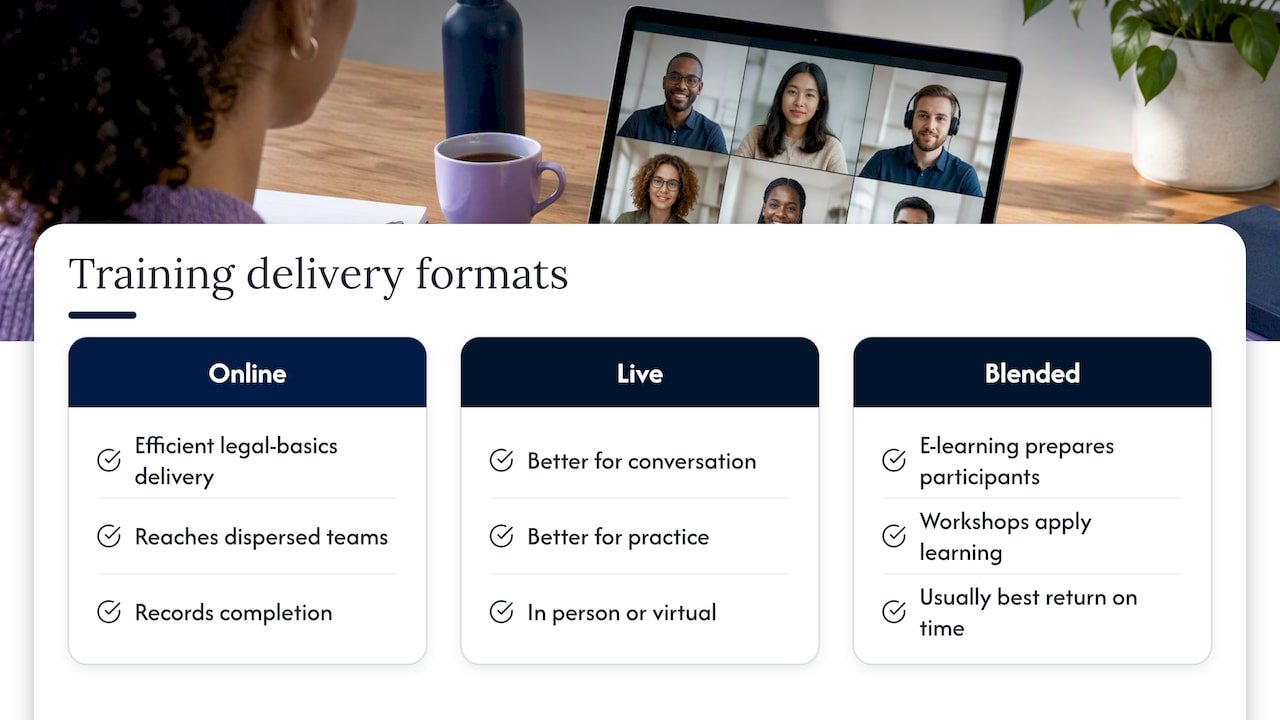
Online modules are efficient for the legal basics and for reaching dispersed teams, and they create a record of completion. Live facilitated sessions, in person or virtual, are better for conversation and practice. Blending the two, with e-learning as preparation and workshops for application, usually gives the best return on time.
Promo: training built around your organisation
We at Oxfordcentre design professional training that can be delivered on-site, online or in a blended format, with content customised to an organisation’s own sector and challenges. If your inclusion programme needs to sit alongside leadership, management, compliance or safety development, we can build it as part of one plan rather than a one-off event.
Teams in the capital can look at our professional training courses in London, and the city listings show where else we run training. Related courses include workplace experience management, which looks at how people experience their working environment day to day, and workplace violence prevention and security, relevant where harassment and safety overlap. For tailored programmes, start from our landing page and tell us about your team.
Perspective: what we see in practice
We have seen the same pattern across sectors, from healthcare to oil and gas to civil engineering. Organisations buy a generic course, tick the box, and wonder why nothing moved. The workplaces that make progress start with a specific problem: a hiring process that narrows the pool, a site culture where people do not speak up, or managers unsure how to handle a complaint.
Our view is that inclusion training belongs in the same family as safety and compliance training. Nobody expects one toolbox talk to make a site safe forever. The same discipline applies here: assess the risk, train by role, practise realistic scenarios, repeat, and check the results. Customisation is the part that matters most. A site supervisor, a hospital ward manager and a project manager face different situations, and the examples they practise on should be theirs.
We would also say plainly that training does not replace fair processes. If promotion criteria are opaque or complaints go nowhere, even excellent training will be undermined.
— Sam
How to tell whether it is working
Here the evidence is humbling. The Wang review found that only 20% of the DEI training studies it examined used randomised conditions and fewer than 7% used a control group. The research base is thinner than the industry’s confidence suggests, which is a good reason to evaluate your own programme properly.
The review recommends rigorous evaluation, longer follow-up and outcomes focused on behaviour and organisational change. It also mentions validated instruments, such as the Reaction-to-Diversity Inventory. Most employers will not run academic studies, but you can apply the same principles:
- Reaction: did people find it relevant? Useful, but the weakest evidence.
- Learning: a short quiz or scenario test before and after, then again after three months to see what stuck.
- Behaviour: observable changes, such as structured interviews in use, more varied shortlists, fewer grievances going unresolved, managers using adjustments processes correctly.
- Organisation: pay gap data, progression and retention by group, staff survey scores on belonging and speaking up.
Compare trained and untrained groups where you can, for example by rolling out in waves. Set the measures before the training starts, not afterwards.
Common mistakes to avoid
- Relying on a single session. The research points to repeated, skills-based learning.
- Using one course for everybody. Induction content for new starters is not what a hiring panel needs.
- Starting at the bottom. If senior leaders skip it, everyone notices.
- Promising too much. Evidence for effects on recruitment and progression is weak when training stands alone, so pair it with process changes.
- Ignoring local context. Cultural values moderate the effects, so adapt examples for each country and team.
- Skipping follow-up. Without a three- or six-month check, you will not know what changed.
How to choose a provider
Whether you build in-house or buy, ask these questions:
- Can the content be tailored to our sector, roles and real scenarios?
- Is there a programme over time, not only a single workshop?
- Does it include practice, not just presentation?
- Is the UK legal content current, and is it clearly separated from other countries’ rules?
- How will we measure behaviour and organisational outcomes afterwards?
- Can it be delivered on-site, online or blended to suit our shift patterns and locations?
If a provider cannot answer the fifth question, treat that as a warning.
FAQ
Is diversity and inclusion training mandatory in the UK?
No law says every employer must run a specific course. However, the Equality Act 2010 makes employers responsible for discrimination and harassment, and employers have a duty to take reasonable steps to prevent sexual harassment. Training is a common and sensible step towards meeting that standard, alongside policies and reporting routes.
How often should staff repeat it?
There is no fixed rule. Research favours longitudinal training that builds over time rather than one-off sessions, so plan a core session, role-specific follow-ups within a few months, and a refresher at least yearly. Shorten or lengthen the cycle according to what your data shows.
What is the difference between EDI and DEI training?
In the UK, “equality, diversity and inclusion” is the more common term and ties closely to the Equality Act. “Diversity, equity and inclusion” is more common in the US and in multinational firms, and adds an explicit focus on fairness of outcomes. The content overlaps heavily, so choose the label that fits your legal context and culture.
Does diversity training actually work?
It reliably improves knowledge and awareness, and longer skill-building programmes tied to wider initiatives do better on attitudes and behaviour. Evidence that it alone improves recruitment, retention or progression is weak, so combine it with fair processes and measure results.
Sources
- Diversity Training, Quality Improvement Center for Workforce Development
- A systematic review of diversity, equity, and inclusion training (Wang et al., 2023)
- A systematic meta-review of organizational diversity and inclusion interventions (Zhao et al., 2025)
- A meta-analytic evaluation of diversity training outcomes (Kawasaki and Zou, 2023)
- Diversity Training Goals, Limitations, and Promise (Devine and Ash, 2021)
- Workplace diversity management toolkit and managers’ guide, Singapore Ministry of Manpower
- Equality Act 2010, section 4, legislation.gov.uk
- Updated EHRC guidance on the duty to prevent sexual harassment, TLT
- What is Workplace Diversity Training (DEI)?, WalkMe